

RuiXin Medical Becomes First Global Company to Secure Dual NMPA Certifications for Coronary CTA Morphological and Functional Products
On September 23, 2021, the Ruixin Coronary Intelligent Post-Processing Platform, independently developed and launched by Shenzhen Ruixin Intelligent Medical Technology Co., Ltd., received certification from the National Medical Products Administration (NMPA) and will officially be launched on the market.
Following the approval of its Class III medical device certification five months ago for the non-invasive coronary functional assessment platform, RevoSIM Fractional Flow Reserve (RevoFFR), the RevoSIM Coronary Intelligent Post-Processing Platform marks the second precision smart medical device product launched by RevoSIM Medical in the cardiovascular field. According to reports, RevoSIM Medical has comprehensively deployed a series of products covering the entire spectrum of cerebrovascular and cardiovascular care, from screening and diagnosis to treatment. In late August, RevoSIM Medical just completed a Series C financing round amounting to hundreds of millions of yuan.
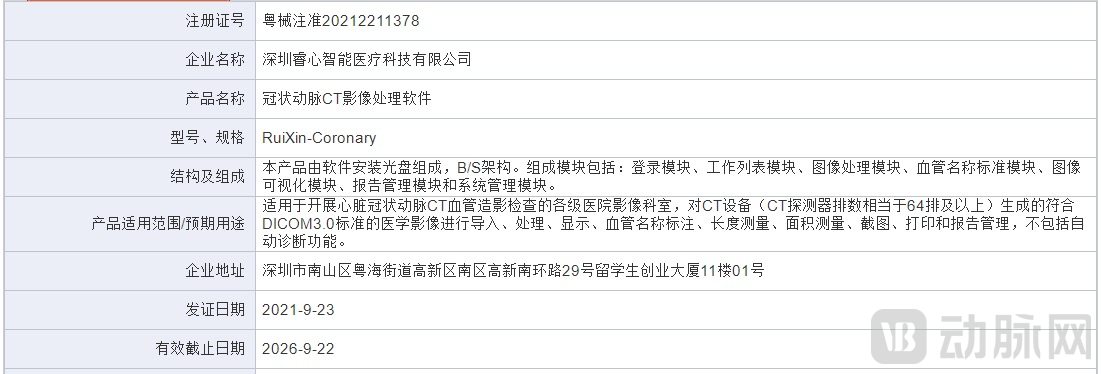
Ruixin Intelligent Coronary Post-Processing Platform is designed for the processing and stenosis analysis of coronary CT angiography images. Coronary CT angiography, also known as coronary CTA, is a routine method for screening and detecting coronary heart disease. According to the "Artificial Intelligence Empowering Cardiovascular Care Report" jointly released by Alibaba Cloud Tianchi and VCBeat, the annual potential market size for medical software platforms related to coronary CTA is RMB 20–30 billion.
It is reported that the Ruixin Intelligent Coronary Post-Processing Platform, built upon five patented technologies, achieves a 97% accuracy rate in three-dimensional vascular reconstruction and a 99% accuracy rate in automatic vessel annotation. Ma Jun, CTO of Ruixin Medical, stated, “This is currently the world’s first precision processing and analysis platform for cardiac coronary CTA imaging that integrates both ‘morphology’ and ‘functionality.’”
The Ruixin Intelligent Coronary Post-Processing Platform enables automated 3D reconstruction of coronary arteries and automated analysis of stenosis severity, i.e., morphological analysis. Currently, cardiac imaging screening primarily relies on two modalities: non-invasive coronary CT angiography (CCTA) and invasive coronary digital subtraction angiography (DSA). It is widely acknowledged in clinical practice that the former generally offers lower accuracy than the latter. The Ruixin Intelligent Coronary Post-Processing Platform leverages AI-driven deep neural networks trained on extensive coronary angiography screening data to achieve diagnostic accuracy comparable to that of invasive coronary DSA, all in a non-invasive manner. This approach mitigates the limitations of CCTA, whose accuracy is often compromised by objective factors such as calcification artifacts and motion artifacts.
Vascular plaque is a significant factor contributing to vascular stenosis. Plaque detachment can trigger blood coagulation, while plaque rupture may induce thrombosis, potentially leading to myocardial infarction. It is reported that by analyzing cross-sectional images of blood vessels using proprietary deep learning methods, the Ruixin Coronary Intelligent Post-Processing Platform can automatically characterize plaque types, such as lipid-rich (dark) plaques, mixed plaques, and calcified plaques. Furthermore, it precisely assesses the risk of detachment and rupture, thereby demonstrating its functional clinical value.
Statistics show that a general radiologist in the imaging department of a Grade A tertiary hospital must identify stenoses and plaques across more than 9,000 coronary CTA images daily. Additionally, they are required to perform complex post-processing, make diagnoses, and write reports, with each case taking 30–60 minutes for image processing. It is understood that by simply importing coronary CTA images, the Ruixin Intelligent Coronary Post-Processing Platform can fully automate the aforementioned workflow within 3–5 minutes, improving efficiency by more than tenfold. Meanwhile, compared to the previous turnaround time of 1–3 days for diagnostic results, the time required for patients to receive their reports has also been significantly optimized.
Currently, the traditional coronary CT image analysis software available on the market is primarily time-consuming due to its low level of automation, which necessitates manual intervention to correct recognition results, such as vessel tracking, removal of misidentified veins, centerline adjustment, and vessel naming.
Traditional manual image interpretation primarily relies on visual assessment by the human eye to determine the degree of stenosis in patients, placing high demands on the seniority and experience of the interpreting physicians. Furthermore, variations in physicians’ experience and differences in the selection of longitudinal sections on the viewer can often lead to discrepancies in the assessed degree of stenosis. The Ruixin Coronary Intelligent Post-Processing Platform employs deep learning methods to ensure that identical input data consistently yields a unique, reproducible result. This high level of automation and consistency eliminates subjective variability in image interpretation.
Fully automated and efficient assessment of coronary artery stenosis reduces the heavy reliance on interpretive experience and lowers the threshold for coronary heart disease screening, enabling patients to receive timely and accurate diagnostic results at primary healthcare institutions. Furthermore, mild cases more suitable for pharmacological management are precisely identified, thereby optimizing medical resources in provincial and municipal hospitals and reducing unnecessary health insurance expenditures. This approach holds significant health economic value and aligns with the national “tiered diagnosis and treatment” policy vigorously promoted since the 17th National Congress of the Communist Party of China.
Zheng Lingxiao, CEO of Rainmed, stated, “Rainmed has always focused on addressing clinical pain points and creating value by leveraging new technologies to meet the practical needs of patients and physicians. Due to factors such as its non-invasive nature and cardiac motion, the accuracy of image assessment in coronary CTA is significantly lower than that of invasive examinations, such as coronary angiography. Based on coronary CTA, Rainmed’s product utilizes AI algorithms to learn from imaging data obtained through invasive examinations, thereby providing clinicians with more precise results. It aims not merely to ‘help doctors see,’ but to achieve ‘seeing what doctors cannot see,’ thus assisting clinicians in improving diagnostic accuracy.”