

Meituan Medicine Unveils 24/7 Smart Pharmacy Solution Amid Intensifying Industry Competition
VCBeat has learned that,Meituan Maiyao has recently launched 24-hour smart pharmacies, adopting a collaborative model with offline brick-and-mortar pharmacies for its operations., meanwhile, professional service personnel are involved in both online and offline channels during the medication sales process, to ensure medication health and safety. For example, in a pilot collaboration with Yueren Pharmacy in Zhengzhou, we transformed and launched the first 24-hour smart pharmacy, increasing labor efficiency by 50% and saving RMB 30,000 per month on rent.
This move has also attracted widespread attention from the industry.It is well known that the operational difficulties faced by traditional pharmacies have been a hotly debated topic in recent years.This reflects both the practical challenge of shrinking profit margins for traditional pharmaceutical retailers driven by the implementation of the new Drug Administration Law, and the urgent need for digital transformation and upgrading of conventional pharmacies in the wake of the COVID-19 pandemic.
According to the “2021 China Pharmacy Innovation Trends Report,” more than 84.3% of pharmacies are actively embracing digitalization. However, due toMost pharmaceutical retail outlets struggle to identify suitable solutions, as their current level of digital and intelligent transformation remains rudimentary, hindering further in-depth development.
Against this broad backdrop, what sets apart the 24-hour smart pharmacies launched by Meituan Medicine for offline drugstores? What challenges remain in the digital transformation of traditional pharmacies? How will the sector evolve in the future? VCBeat will address these questions with a comprehensive analysis below.
Traditional brick-and-mortar pharmacies are engaged in competition within a saturated market, characterized byIntense competitive pressure, difficulty in acquiring new customers, high procurement costs, and low operational efficiency are widespread issues.
Taking customer acquisition as an example, data from a survey by the Smart Face Research Institute shows that 68.52% of pharmacies attract customers through marketing campaigns, with common tactics including spending-threshold discounts and price reductions. However, due to limitations in professionalism and operational precision, independent pharmacies often adopt relatively crude marketing strategies. Coupled with a lack of scientific post-campaign analysis, the effectiveness of these efforts is very limited.
Customer foot traffic and repurchase rates determine a pharmacy’s sales revenue; therefore, traditional pharmacy operations need to shift from extensive management to refined management. Consequently,Online Channels Have Become an Indispensable Component for Traditional Pharmacies: Online operations can expand the customer acquisition radius and operating hours of pharmacies, thereby increasing foot traffic.
However, the issue lies in the numerous pain points traditional pharmacies face in operating 24 hours a day: high offline operational costs at night (due to sparse order volumes and low return on investment compared to daytime), significant costs for pharmacy renovations (such as providing staff accommodation, modifying service windows, and installing facilities like restrooms), difficulties in recruiting staff, high turnover rates, and challenges in ensuring safety.
The 24-hour smart pharmacy launched by Meituan Medicine isBy partnering with brick-and-mortar pharmacies and leveraging its two core capabilities—automated fulfillment and digital management—it further addresses the challenges of nighttime pharmacy operations, thereby achieving the goals of cost reduction and efficiency improvement.
Specifically, in terms of automated fulfillment, 24-hour smart pharmacies can fully automate the processes of sorting, order consolidation, packaging, and handover, while also supporting human-machine collaboration. Data shows that the current average sorting efficiency of 24-hour smart pharmacies is 30 seconds per order, enabling more than 150 orders to be sorted per hour, which represents an increase in labor productivity of nearly 50% compared to traditional methods.
In terms of digital management, compared with traditional offline pharmacies, 24-hour smart pharmacies can achieve full-chain digital management, adding multiple processes such as automatic machine replenishment, automatic picking, AI verification, and remote manual verification, with the store shipment accuracy rate basically reaching 100%.
It is worth noting that the 24-hour smart pharmacy also provides 7*24 remote operation and maintenance services,Throughout the entire medication dispensing process at 24-hour smart pharmacies, professional personnel are involved in both online and offline services to ensure the safety of drug sales.
For example, after being transformed into a 24-hour smart pharmacy, the Zhengzhou Yueren Pharmacy (Central Branch) significantly enhanced its medication storage capacity and saved nearly RMB 30,000 per month in rent costs. Meanwhile, it effectively reduced labor requirements for order picking: previously, two staff members were needed daily to handle an average of 100 orders; after the transformation, these staff members could devote their full time to providing in-person medication consultation services to customers.
Why Do 24-Hour Smart Pharmacies Have Such Significant Advantages in Efficiency and Cost?The core lies in a comprehensive solution that integrates hardware, management software, and Meituan’s 24-hour delivery service.In other words, unlike pure online migration, Meituan Medicine digitizes every element across the value chain, enabling pharmacy merchants to perceive and analyze changes in real time, make optimal decisions, and support 24/7 operations.
The digitalization of traditional pharmacies is key to the comprehensive digital upgrade of the entire pharmaceutical retail industry, with pharmaceutical O2O increasingly favored by traditional pharmacies.
As is well known, the “last mile” has always been a major challenge for pharmaceutical e-commerce. The O2O (Online-to-Offline) model leverages existing resources through offline pharmacies, transforming store functions from mere medication sales into comprehensive services encompassing experience, pickup, and delivery. This approach aligns with local demands and establishes the final connection with consumers.
However,Merely moving stores online is far from sufficient; the key lies in achieving true digitalization in operations.Therefore, this presents both an opportunity and a challenge.
Only by achieving end-to-end digitalization can overall operational and decision-making efficiency be truly enhanced. This is the core issue that Meituan Medicine has consistently aimed to address through initiatives such as the “Takeoff Plan” and the “Little Yellow Light Plan,” as well as its newly launched 24-Hour Smart Pharmacy Solution.
For example, at the recently concluded Xipu Conference, Meituan Medicine launched “Takeoff Plan 2.0,” proposing eight initiatives across four key areas—“increasing average order value,” “reducing costs,” “strengthening operations,” and “driving repeat purchases”—to comprehensively and deeply support the digital transformation of traditional pharmacies. “As pharmacy operators, we not only seek traffic from the platform but also hope to retain this traffic to provide continuous services to users,” said an online operations head of a well-known domestic chain pharmacy.
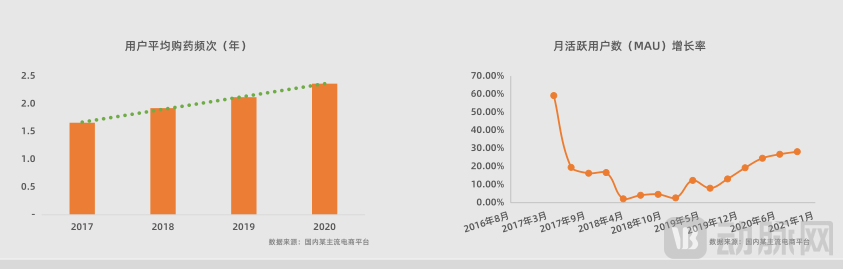
On one hand, the digital transformation of traditional pharmacies is increasing supply; on the other, greater demand is being unleashed online.According to the “2021 Research Report on China’s Pharmaceutical E-commerce Industry” released by VCBeat, the average annual purchase frequency of existing users on pharmaceutical e-commerce platforms has shown a steady upward trend, while new users continue to flock to these platforms.
From this perspective, within the broader trend of accelerating digitalization among traditional pharmacies, the pharmaceutical O2O sector remains in its early stages, with substantial market potential ahead. For instance, while 570 million online consultations were conducted in 2019, this accounted for only 6% of total consultations; meanwhile, online pharmaceutical sales represented merely 1.5% of the overall market, indicating that the overall digital penetration rate is still at an early stage.
From an industry-wide perspective, it is evident that pharmacy operations in the past primarily revolved around competing for supply chain resources and pharmaceutical manufacturers. Within this value chain, most traditional pharmacies were at a disadvantage.
The core reason behind this isTraditional pharmacies lack ecosystem support.: A single channel cannot establish competitive barriers. If pharmacies can integrate with online systems, internet healthcare, and a broader range of medical service resources, they will develop stronger composite competitiveness. This underscores the significance of digital transformation for traditional pharmacies.
Additionally,Amid the trend of digital transformation in traditional pharmacies, the industry still faces numerous challenges to be resolved.
First, the efficiency of matching between drug supply and demand sides needs to be further improved.Similar to the logic of food delivery services, how pharmaceutical suppliers provide the most appropriate medication advice and drug selections to demand-side users is paramount for enhancing user stickiness. For example, when a patient with a chronic condition needs to purchase long-term medication, the platform can leverage user-specific data to rapidly recommend the optimal option, thereby saving time on decision-making.
Second, the operational capabilities of drug sales still require refinement.In traditional pharmaceutical retail scenarios, pharmacy inventory planning is based on local residents’ historical purchasing patterns across different seasons. While this approach generally works well, it is highly vulnerable to unexpected events, which can significantly disrupt medication sales, leading to overstocking of certain drugs and shortages of urgently needed ones. In contrast, online sales generate continuous consumer data that can guide pharmacies in optimizing inventory levels and even scheduling offline staff, thereby enhancing the operational efficiency of pharmaceutical sales.
Third, how to transform low-frequency behaviors into high-frequency consumption scenarios.Pharmaceutical sales are typically low-frequency within the same area at any given time. However, pharmaceutical O2O (Online-to-Offline) models have expanded the coverage area, drug categories, and target consumer base of individual pharmacies, thereby increasing purchase frequency. For offline pharmacies, this means they no longer serve merely as points of sale; they also function as forward warehouses and experience centers, becoming an integral part of the overall service ecosystem.
Fourth, offline supplies of shortage-listed drugs are prone to critical shortages; addressing this gap online requires precise matching capabilities.Online channels hold a distinct advantage in the supply of specific prescription drugs. For instance, the “Notice on the National List of Shortage Drugs” issued by the National Health Commission at the end of 2020 highlighted six critical shortage drugs. When offline pharmacies face urgent shortages of these medications, the ability to forecast demand in advance and precisely allocate supplies to ensure timely delivery to patients becomes a key indicator of operational capability.
Based on the above four aspects, tech companies are each seeking breakthroughs in their own ways. For Meituan Medicine, it provides digital capabilities to physical pharmacy merchants—whether in improving the efficiency of supply-demand matching, enhancing sales operational capabilities, or building scenarios that convert low-frequency into high-frequency consumption—and continues to deepen these efforts.
It is evident that online integration and digitalization will become standard features for traditional pharmacies in the future. Consequently, services such as medical consultations, medication purchases, and delivery will become increasingly homogeneous. Therefore, users’ choices will test the comprehensive service capabilities of each pharmacy. Hence, how to expand user value while consolidating their own competitive advantages is a strategic direction that all stakeholders need to consider.
With the entry of technology companies, traditional pharmacies, and pharmaceutical enterprises, a new pharmaceutical retail ecosystem characterized by mutual prosperity and symbiosis is rapidly emerging., and in the future, it will also be able to bring patients more channels, a wider variety of products, and a better medical service experience.