

DaVita Inc. Files Prospectus Highlighting Buffett's Stake and Global Dialysis Leadership
DaVita
Kidney Care Provider
Warren Buffett, the Oracle of Omaha, has long served as a bellwether in the equity markets and is widely revered globally; inclusion of a company’s stock in his portfolio is considered a significant endorsement.Since 2012, Berkshire Hathaway, under the leadership of the “Oracle of Omaha” Warren Buffett, has repeatedly increased its stake in DaVita on the secondary market and has become its largest single shareholder.
A regulatory filing submitted this August shows that Buffett currently holds 36.1 million shares of DaVita, representing a 34.4% stake. Notably, Buffett has realized nearly $2 billion in gains from his DaVita holdings over the past year, which likely helps keep the stock firmly among Berkshire Hathaway’s top ten largest positions.
So, what kind of company is DaVita? What exactly makes it attractive?
Before introducing DaVita, we should first look at its unrestrained CEO, Kent Thiry.
Some describe him as a cynical, profit-driven businessman, while others hail him as a passionate and creative leader in healthcare services. This is the very same man who danced and jumped on stage barefoot, dressed in medieval attire.Turned a company on the brink of bankruptcy around, achieving annual sales of up to $14.7 billion in 2016, and was included as a teaching case by Harvard Business School.Since then, DaVita has been the subject of leadership and culture case studies at Harvard University and Stanford University, and is taught in many other schools and programs.
Kent Thiry is the former Executive Chairman of DaVita’s Board of Directors. From 1999 to June 2019, he served as Chairman and Chief Executive Officer of DaVita.
In 1983, Kent Thiry earned his Master of Business Administration (MBA) from Harvard Business School with high honors and was inducted into the Century Club. Prior to that, Kent had obtained a Bachelor’s degree in Political Science from Stanford University with distinction and was elected to Phi Beta Kappa in 1978.
Prior to joining DaVita, Kent Thiry held various positions, including Chairman and Chief Executive Officer of Vivra Specialty Partners, a specialized healthcare company; Chief Executive Officer of Vivra, an NYSE-listed healthcare services company; and Partner at Bain & Company. His previous board memberships included serving as Chairman of Oxford Health Plans and the Trust for Public Land.
In 1999, Kent Thiry took over DaVita, which was on the verge of bankruptcy and then known as Total Renal Care. After taking charge, he restructured the company and renamed it DaVita, an Italian phrase meaning “to give life.” This also endowed DaVita with its mission: “Bringing quality to life.”
While most CEOs emphasize teamwork and values, Kent Thiry has taken these concepts to the extreme.Kent Thiry created an unprecedented corporate organizational model at DaVita: the community.DaVita employed another community metaphor, the “village,” and referred to all its employees as citizens. The corporate headquarters was known as the House of Life (Casa DaVita), while Kent Thiry, the Chairman and Chief Executive Officer, was called the Village Mayor.
In addition, Kent Thiry had inspirational slogans written in large letters on the walls of the company’s offices, such as “Begin with the End in Mind” and “Greet Customers with a Smile.” DaVita also strives to create a joyful and enterprising atmosphere: employees who perform exceptionally well are rewarded with fully company-sponsored vacations; and each dialysis clinic features a “Wall of Honor” displaying photographs of every patient and clinic staff member.
Kent Thiry and his wife, Denise O’Leary (a former venture capitalist), also funded the establishment of the KT Family Foundation and the KT Community Foundation. The former provides $100,000 in scholarships annually for employees’ children, while the latter covers the costs of employee community service projects. The company also maintains a fund, supported by contributions from both the company and its employees, to assist staff members facing hardships, such as illness.
Kent Thiry has made full use of DaVita’s large and small gatherings to help employees experience and embrace the “DaVita Way.”Kent often wore Musketeer costumes, delivered speeches at meetings, and then posed for photos with staff members.“To borrow the words of some skeptics, Kent is cultivating a cult of personality like a salesman.”
According to foreign media reports, a former employee of DaVita believes that Kent Thiry’s showmanship is merely an act of self-aggrandizement. Others, however, view Kent Thiry’s motives as pure. Among them is Douglas Ichek, the former Chief Wisdom Officer at DaVita who was responsible for employee training. He left DaVita in 2005 and currently serves as a subdeacon at a Catholic church.
Jeffrey Pfeffer, a professor at Stanford Graduate School of Business, wrote a case study in 2006 on DaVita’s turnaround. He stated that,Although DaVita’s corporate culture is centered around Kent Thiry, it has reduced employee turnover and contributed to the company’s significant success. Furthermore, DaVita is a leader in leveraging data for decision-making.
It can be said that such a legendary figure has built DaVita into a Fortune 500 multinational giant in kidney care.
DaVita, Inc. was founded in 1979 and is headquartered in Denver. Unlike Fresenius and Nipro,DaVita does not manufacture dialysis medications or medical devices; it focuses solely on providing dialysis services.
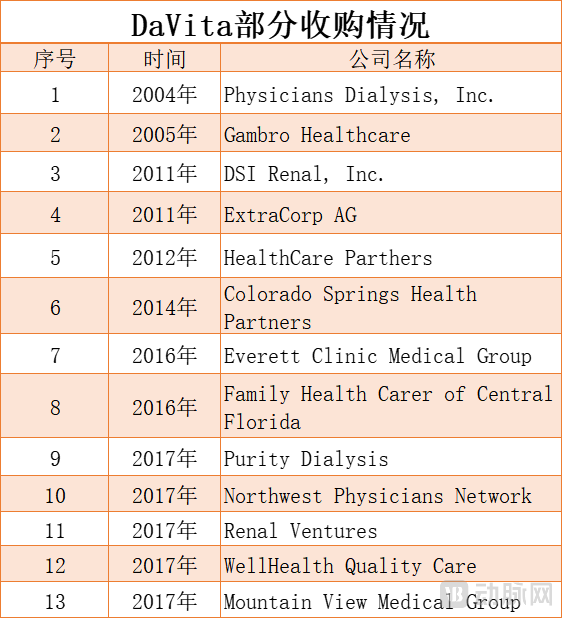
Since Kent took over DaVita in 1999, pulling it back from the brink of bankruptcy, and after several years of development,By 2005, DaVita had entered a period of rapid growth.In 2005, DaVita acquired Gambro, doubling the number of its dialysis centers and establishing “becoming a model for the U.S. healthcare industry” as the company’s strategic direction.
In 2012, DaVita acquired Health Care Partners for $4.42 billion to provide high-quality care, and established the current DaVita Medical Group in the same year.
In 2014, DaVita acquired Colorado Springs Health Partners, which had 600 employees and 110,000 patients. In March 2016, DaVita again acquired the Everett Clinic Medical Group, a Seattle-area organization with 20 care centers and 315,000 patients, for $385 million. That same year, DaVita was recognized for the first time by the Dow Jones Sustainability Index (DJSI), becoming one of only six companies in the healthcare providers and services industry included in the DJSI World Index.
In June 2019, DaVita sold DaVita Medical Group (formerly Medical Partners) to Optum for $4.3 billion.
In 2011, DaVita began its international expansion, and by 2019, it was operating in 10 countries outside the United States.. A review of major international corporations reveals that none have entered the global market without resorting to mergers and acquisitions. After establishing a strong presence in the highly mature U.S. dialysis market through M&A, DaVita has continuously expanded into overseas markets and scaled up its operations via further acquisitions.
In 2011, the company acquired Germany’s ExtraCorp, gaining two dialysis centers, and subsequently expanded through acquisitions in India, Saudi Arabia, Malaysia, and other regions. It currently operates 321 hemodialysis centers in markets outside the United States.
In terms of business operations, DaVita has achieved high profitability through the chain-based and scaled operation of its hemodialysis centers. In 2013, DaVita’s net profit margin and return on equity (ROE) were 5.4% and 15.5%, respectively. During the same period, the median net profit margin and ROE for the Health Care sector under the Global Industry Classification Standard (GICS) were 2.3% and 12.3%, respectively.DaVita’s profitability outperforms that of its industry peers. DaVita’s chain of dialysis centers benefits from economies of scale, delivers high returns, and expands continuously through replication.
On the other hand, continuously expand and strengthen its business through organic growth and external expansion,Over the past few decades, the company built 1,350 dialysis centers on its own and acquired 1,787 through mergers and acquisitions. By the end of 2020, DaVita operated a total of 3,137 dialysis centers, making it the second-largest dialysis services provider in the United States.
Currently, DaVita primarily has three major business segments:
Dialysis services are also DaVita’s core business, accounting for 90% of its revenue.As of December 31, 2020,DaVita provides kidney dialysis services to over 200,000 patients through its network of 2,816 outpatient dialysis centers in the United States, with approximately 900 hospitals offering inpatient dialysis services. Additionally, it delivers dialysis and management services to more than 30,000 patients across 321 outpatient dialysis centers in 10 countries outside the United States.
HCP(Health Care Partners business): On December 1, 2012, a business model was established through the acquisition of Health Care Partners Holdings.Under this business model, the company does not own hospitals; instead, it builds a platform to serve as an intermediary between physicians and patients, and enters into risk-sharing contracts with health insurance providers to deliver medical services.
As of the end of 2013, approximately 764,000 patients in the United States were members of HCP.Among them, approximately 265,000 are patients enrolled in the National Medical Priority Program, while the remaining 499,000 have health insurance provided by their employers or through third-party health insurance plans.
Other Ancillary Services: including pharmacy services, disease management services, vascular access services, ESRD clinical trials, physician services, direct primary care, and international dialysis operations.
Among the three major business segments, the dialysis business is further divided intoIndependent outpatient hemodialysis services, hospital inpatient hemodialysis services, home hemodialysis (HHD) and peritoneal dialysis (PD), and end-stage renal disease (ESRD) laboratory services.
Independent outpatient hemodialysis services are DaVita’s primary source of revenue, accounting for 79% of its turnover.This business model enables patients to receive treatment at any of the numerous outpatient dialysis centers operated by DaVita. In the United States, government policies and healthcare regulations permit and even encourage hemodialysis patients to seek treatment at qualified dialysis centers run by private entities or corporations.
Inpatient Hemodialysis ServicesDaVita provides inpatient hemodialysis services by negotiating and signing agreements with more than 900 U.S. hospitals, accounting for approximately 5% of its revenue.
Home Hemodialysis (HHD) and Peritoneal Dialysis (PD) Services: In the United States, hemodialysis can be performed at home using home hemodialysis machines.ResidenceHome dialysis, including hemodialysis and peritoneal dialysis, is DaVita's second-largest source of revenue.Peritoneal dialysis can also be administered at home in China, but home-based hemodialysis is currently not permitted in the country.
End-Stage Renal Disease (ESRD) Laboratory Services: DaVita operates independent laboratories to monitor residual metabolic waste and serum drug concentrations of concomitant medications in patients with end-stage renal disease (ESRD) after dialysis, thereby assessing the efficacy of dialysis.
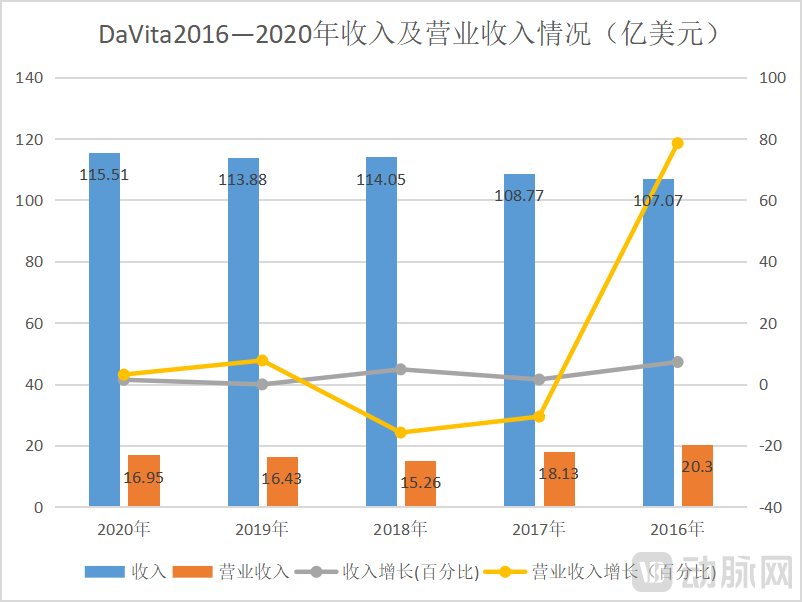
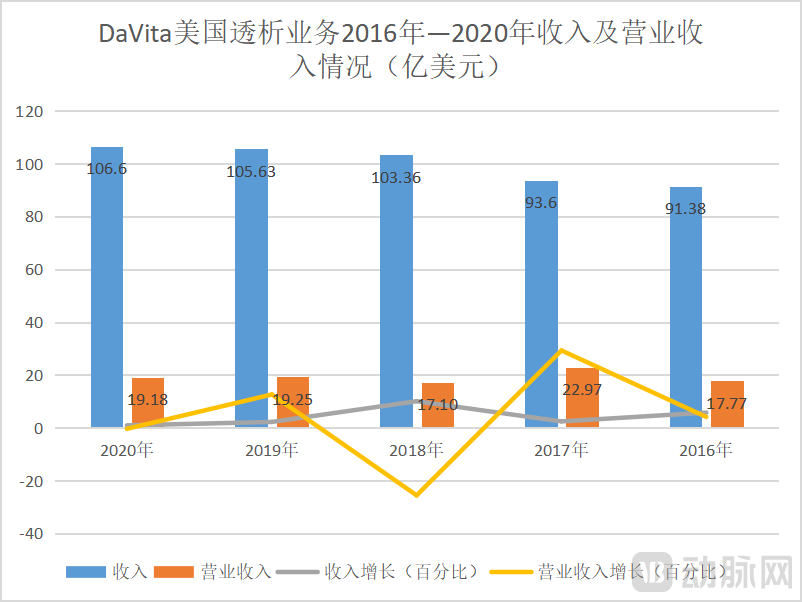
In 2020, DaVita reported total revenue of $11.55 billion, operating income of $1.695 billion, and an operating margin of 13.9%. Of this, U.S. dialysis revenue amounted to $10.66 billion, representing a 0.9% increase; U.S. ancillary services revenue reached $1.053 billion, up 8.3%; and international business revenue totaled $564 million, reflecting an 11.0% growth.
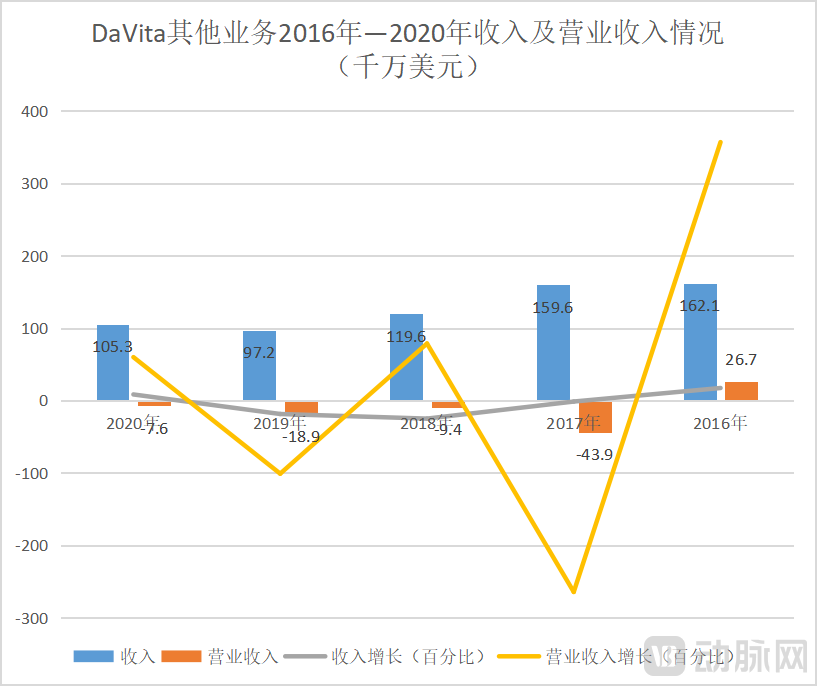
According to the financial reports, DaVita has been significantly impacted by the pandemic over the past two years. While its total revenue has remained relatively stable with slight growth and a high proportion of fixed income, its operating revenue has experienced significant fluctuations and is in a state of negative growth. DaVita provided a detailed analysis of the pandemic's impact in its financial reports.DaVita believes that it has experienced and expects to continue to experience the negative impact of the pandemic on its revenue and non-acquisition growth, and it cannot reasonably estimate the ultimate impact of the COVID-19 pandemic, but the adverse impact may be significant.
Due to the pandemic, DaVita has experienced significant fluctuations in patient insurance reimbursement rates, patient recovery rates, mortality rates, and treatment costs, substantially impacting its business development. According to its financial reports, although DaVita’s revenue and operating income remained positive, this was primarily driven by increased per-patient revenue in its U.S. dialysis operations, acquisitive growth in its international segments, and cash flow gains.
In the United States, government reimbursement rates for dialysis are primarily determined by Medicare and state Medicaid policies. In 2020, 68% of DaVita’s total revenue from U.S. dialysis patient services came from government programs serving approximately 90% of American patients.
These government-sponsored programs, primarily Medicare and Medicare Advantage, Medicaid and managed Medicaid plans, and other government programs, accounted for approximately 57%, 7%, and 4%, respectively, of DaVita’s U.S. dialysis patient services revenue.This has kept DaVita’s business growth in a relatively stable state.
DaVita’s other businesses consist primarily of ancillary services aligned with its core dialysis operations, as well as its international segment, accounting for approximately 9% of its consolidated revenue. Financial reports indicate that revenue from DaVita’s other businesses has been declining year over year, and its operating performance has been less than satisfactory.
In 2020, DaVita’s other businesses experienced growth. DaVita attributed this growth primarily to increased revenue from its integrated care business, driven by a rise in acquired therapies as it continued to expand its international operations.
From a macro perspective, the capital market is quite optimistic about the growth prospects of demand for kidney dialysis services, driven by the significant rise in the incidence of diabetes and hypertension, coupled with population aging.DaVita is expected to sustain growth and profitability amid broader market trends.In addition to Buffett’s endorsement, Deutsche Bank previously raised DaVita’s target price from $150 to $207.
From the perspective of DaVita’s development, its stock price was $1.31 on June 1, 2000, and $67.41 on June 1, 2017.In just the past 17 years, DaVita’s stock price has surged by a staggering 5,045%.Meanwhile, the S&P 500 Index rose by only 167%.On August 4 this year, DaVita’s stock price hit a new closing high of $134.
Some analysts believe that DaVita remains one of the cheapest stocks in the investment universe, trading at less than 12 times its expected earnings for 2022. Given that over 70% of patients have been vaccinated, DaVita’s core dialysis business is expected to normalize in the second half of the year.DaVita Remains One of the Most Attractive Stocks。
DaVita has long harbored ambitious aspirations for the Chinese healthcare market.
To enter the Chinese market, DaVita established a joint venture with 3SBio Inc. in 2012 to provide dialysis services in Northeast China.
At the end of 2013, DaVita even announced a collaborative project in Yangpu District, Shanghai, China. ByWith the strong support of the district government and the approval of the Health Bureau, DaVita plans to establish a nephrology dialysis technology collaboration base at Shanghai Yangpu Antu Hospital, a 400-bed facility., and we hope this collaboration will serve as a model for other communities in China. This arrangement provides DaVita with a research platform aimed at improving patient health outcomes and maximizing cost-effectiveness within China’s healthcare system.
In late August 2015, DaVita announced the formation of a joint venture to establish a specialized chain of kidney care hospitals in Shandong, China.The hospital, named DaVita (Shandong) Kidney Disease Hospital Co., Ltd. (达维塔山东肾脏病医院有限公司), is the first joint venture of its kind in kidney dialysis, established by a multinational healthcare company and China’s private sector.This hospital is the only private hospital in Jinan approved to provide dialysis services.
On June 21, 2017, DaVita partnered with China Resources Healthcare.Leveraging the advantages of China Resources Healthcare Group’s medical resource network in China, it has achieved a leapfrog transition from point-based to area-wide coverage in the country.
As the government gradually loosens regulations on independent hemodialysis medical institutions, China’s dialysis market is steadily expanding. As the sole dialysis service provider that does not supply products, DaVita’s post-pandemic growth prospects are highly anticipated.