

NeuroPace: The Brain-Computer Interface Pioneer Challenging Medtech Giants with Its FDA-Approved RNS System for Drug-Resistant Epilepsy

NeuroPace
Developer of Therapeutic Devices for Neurological Disorders
Over the past four years, Edith has been battling illness. She once suffered from persistent high fever due to seizures and vomited blood, requiring a month of treatment in the intensive care unit. At one point, doctors were unable to control her fever and tremors, and young Edith nearly lost her life.
Since then, her family has sought medical help far and wide. While listening to a podcast, they heard Dr. Robert Bollo, Surgical Director of the Pediatric Epilepsy Program at Primary Children’s Hospital in Salt Lake City, discuss an innovative brain stimulator, which offered them a glimmer of hope.
This June, Edith’s family finally embarked on their transatlantic journey to Salt Lake City, the capital of Utah, USA, to seek treatment for her epilepsy. As a result, 11-year-old Edith became the first child in Europe to undergo implantation of NeuroPace’s innovative invasive Responsive Neurostimulation (RNS) system.
A Family of Three Travels Across the Ocean Just to Try It: What Exactly Is Epilepsy? What Makes NeuroPace’s RNS System Stand Out? What Breakthroughs Can Brain-Computer Interface Technology Bring to Epilepsy Treatment?
Epilepsy is a chronic syndrome characterized by recurrent, transient episodes of brain dysfunction, which can affect patients for years or even decades. It is defined by recurrent seizures caused by abnormal electrical discharges of brain neurons and is one of the most common neurological disorders, with a prevalence second only to that of stroke.
According to data from the World Health Organization, approximately 50 million people worldwide suffer from epilepsy, with about 5 million new cases diagnosed each year. Furthermore, individuals with epilepsy face a risk of premature death three times higher than that of the general population. In addition, countless patients and their families endure the dual burden of the disease itself and societal discrimination.
Epilepsy is classified into two categories: one that can be managed with pharmacotherapy, and another in which patients develop drug-resistant epilepsy (DRE) due to medication resistance or other factors, requiring intervention solely through resective surgery of the epileptogenic focus or neuromodulation.
According to data from Absolute Market Insights’ “Global Epilepsy Neuromodulation Market Report,” the global market size for epilepsy neuromodulation was USD 165.89 million in 2020 and is projected to exceed USD 340.12 million by 2030, representing a compound annual growth rate (CAGR) of 10.71% during the forecast period.
As innovative devices such as vagus nerve stimulation (VNS), deep brain stimulation (DBS), and responsive neurostimulation (RNS) continue to evolve, attention toward neuromodulation technologies is growing. Currently, the competitive landscape for epilepsy neuromodulation is relatively concentrated, with key players including Abbott, Boston Scientific, Medtronic, LivaNova (a major player in extracorporeal membrane oxygenation [ECMO]), and NeuroPace.
But back in 1997, when the Vagus Nerve Stimulation (VNS) device developed and manufactured by Cyberonics (the predecessor of LivaNova) received FDA approval as an adjunctive therapy for patients aged 12 and older with drug-resistant epilepsy (DRE), becoming the first commercially available neurostimulator; and when Medtronic’s Active DBS System gained FDA approval for the treatment of essential tremor and Parkinson’s disease,The story of NeuroPace has only just begun to unfold in Mountain View, California.
NeuroPace founder David Fischell graduated from Cornell University. After earning his Ph.D. in Applied Physics in 1979, he joined Bell Labs, once hailed as “the greatest laboratory in history.” During his 11 years at the lab, he participated in and led numerous scientific research projects.

David Fischell. Image source: Cornell University official website
In 1991, David embarked on a journey of serial entrepreneurship in the medical device industry. Over the next fifteen years, he founded nine biomedical technology companies. During this period, he also served as the lead designer for Cordis Corporation’s BX Velocity™ and Cypher™ coronary stents, subsidiaries of Johnson & Johnson.
In 1997, David founded NeuroPace and initiated the RNS project around 2000, with a primary focus on the treatment of epilepsy. Every day, thousands of epilepsy patients worldwide live in fear of seizures. Yet, words cannot convey even one ten-thousandth of the suffering they endure during an episode. What they need most is a permanent solution.
NeuroPace is dedicated to providing such solutions. The company initiated its feasibility study (n=65) in 2004 and launched its pivotal study (n=191, a multicenter, double-blind, randomized controlled trial) in 2005. It then continuously evaluated the improvement in seizure outcomes among patients implanted with the RNS System over a nine-year prospective study (n=230), ultimately receiving FDA approval for market release in November 2013.
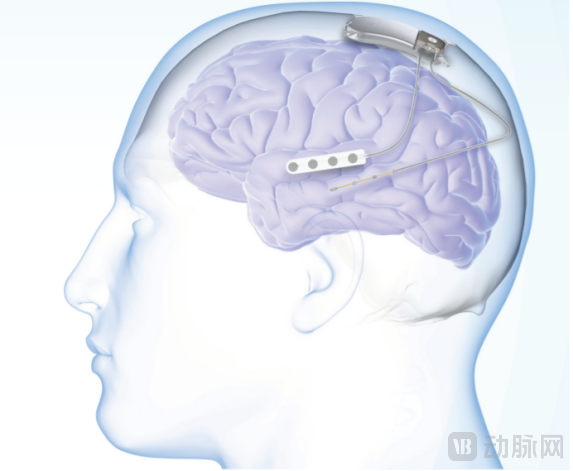 Schematic Diagram of NeuroPace RNS Usage. Image Source: NeuroPace Prospectus
Prior to RNS, two neuromodulation devices on the market—vagus nerve stimulation (VNS) and deep brain stimulation (DBS)—were also approved for treating approximately 80% of patients with drug-resistant epilepsy.
However, the open-loop stimulation employed by VNS and DBS, which determines stimulation intensity and intervals by delivering electrical pulses at a fixed frequency, increases the incidence of side effects such as memory impairment, depression, sleep disorders, and voice disorders. Furthermore, neither device can record intracranial electroencephalogram (iEEG) data, which is critical for physicians’ treatment decisions and may even improve patient outcomes.
The RNS consists of a small neurostimulator implanted beneath the scalp within the skull. Operating on principles similar to those of an automatic implantable cardioverter-defibrillator (AICD), which detects and terminates cardiac arrhythmias, the RNS continuously monitors electroencephalographic (EEG) activity. Upon identifying pre-seizure EEG patterns, it immediately delivers electrical stimulation to abort the seizure. It is the first reactive neurostimulation system device approved by the U.S. Food and Drug Administration (FDA) for the treatment of partial refractory epilepsy.
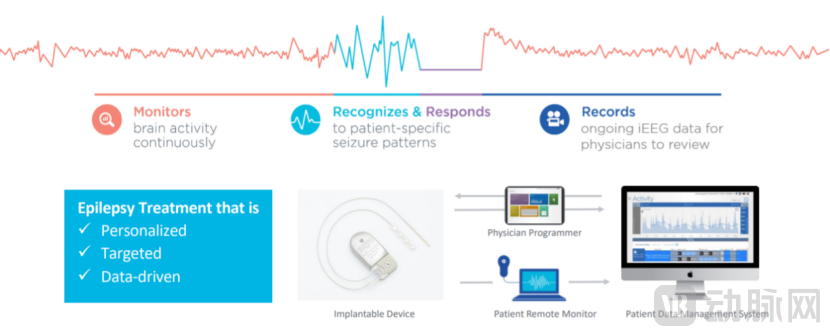
RNS System Using Brain-Computer Interface Technology. Image source: NeuroPace official website
The system can also upload patients' brain data for clinicians' reference, thereby identifying cortical EEG patterns that may lead to seizures. It then programs the device to detect these abnormal patterns and deliver electrical stimulation to terminate the seizures. Finally, through continuous fine-tuning of parameters, it achieves complete cessation of epileptic seizures.
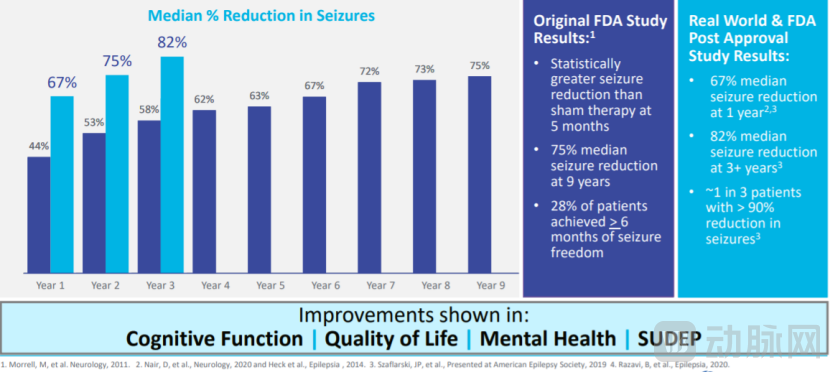 RNS Clinical Data | Image Source: NeuroPace Official Website
Clinical data show that the median reduction in overall seizure frequency among patients increased from 44% at one year to 75% at nine years. In an FDA-mandated real-world prospective study (n=150), results after a mean follow-up of 2.3 years indicated that 35% of patients achieved a ≥90% reduction in seizure frequency.
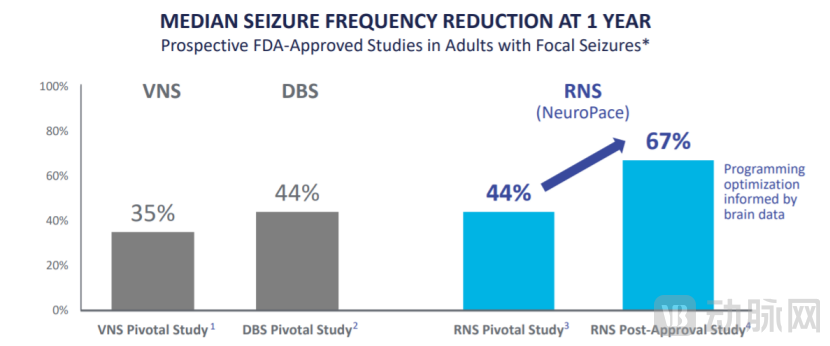 RNS Is More Effective Than VNS and DBS in Reducing Seizure Frequency | Image Source: NeuroPace Official Website
To date, NeuroPace’s RNS system remains the only FDA-approved product worldwide capable of continuously monitoring intracranial electroencephalographic (iEEG) activity and achieving successful commercialization, truly leaving competitors “in the dust.”
Payors for the NeuroPace RNS System are predominantly commercial insurers, often in combination with Medicare and Medicaid. In 2020, 132 Comprehensive Epilepsy Centers (CECs) performed RNS System implantation surgeries. As disclosed in its prospectus, fewer than 1% of potential RNS patients were unable to undergo RNS System implantation due to lack of payor coverage.
NeuroPace’s estimated data indicate that there are approximately 575,000 adults with drug-resistant epilepsy in the United States, representing a total market opportunity of around $26 billion for its RNS System. Furthermore, with the current battery life of the RNS System being approximately eight years, the sale of replacement neurostimulation devices can provide the company with a steady stream of cash flow.
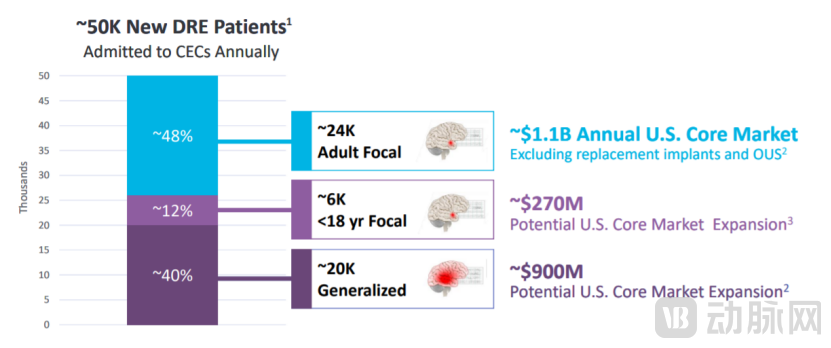 Comprehensive Epilepsy Centers (CECs) Represent an Annual Core U.S. Market Opportunity Exceeding $1 Billion
Image source: NeuroPace official website
Furthermore, since the commercialization of the RNS System, NeuroPace’s annual revenue increased from $28.5 million for the year ended 2018 to $37.0 million in 2019, representing a growth of approximately 30%. However, due to the impact of the pandemic in 2020, the year-over-year growth slowed to 11.3%, with annual revenue rising to $41.1 million.
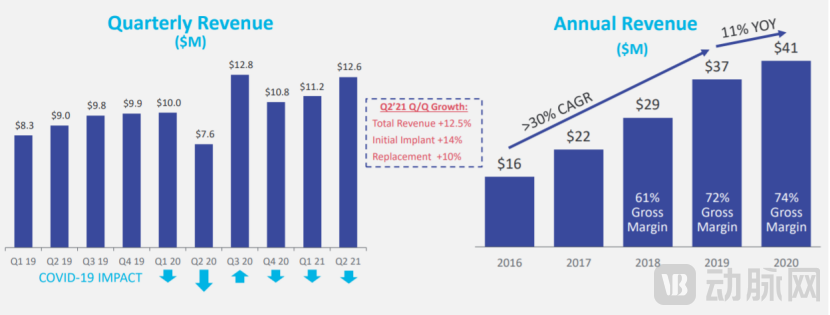 NeuroPace: Quarterly Financial Data for the Past Three Years and Annual Financial Data for the Past Five Years
In February 2021, the NeuroPace RNS System received Breakthrough Device designation from the U.S. FDA for the treatment of Idiopathic Generalized Epilepsy (IGE). IGE comprises a group of generalized epilepsy syndromes associated with genetic predisposition and is one of the main subcategories of idiopathic epilepsy. In the second half of 2021, NeuroPace planned to seek approval for an Investigational Device Exemption (IDE) to initiate clinical studies on generalized epilepsy, thereby expanding the indications for the NeuroPace RNS product.
On April 22, 2021, NeuroPace announced its listing on the NASDAQ in the United States under the ticker symbol “NPCE.” The company offered 6 million shares at an initial public offering price of $17 per share, raising $102 million. Following the IPO, NeuroPace delivered impressive financial performance. Total revenue for the second quarter of 2021 reached $12.6 million, representing a significant 65% increase from $7.6 million in the same period of the previous year.
Among these, revenue from initial RNS implants reached $9.2 million, representing a 100% increase from $4.6 million in the same period last year.
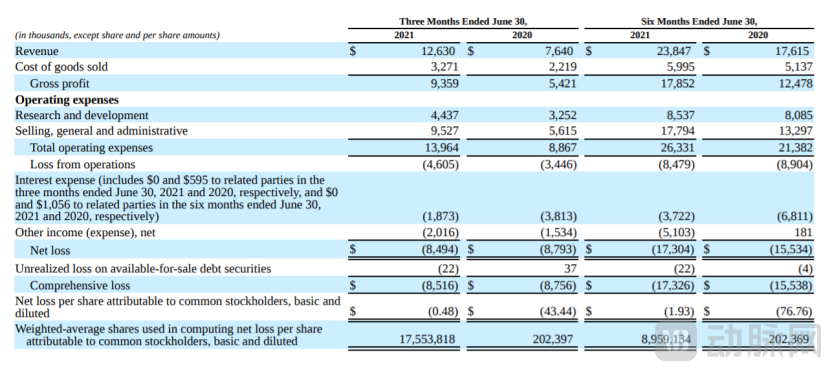 NeuroPace Q2 2021 Revenue Data | Image Source: NeuroPace Official Website
Driven by increased sales volume and reduced fixed costs associated with product development, the Company’s gross margin rose to 74.1% in the second quarter of 2021, compared with 71.0% in the second quarter of 2020. Research and development expenses for the second quarter amounted to $4.4 million, compared with $3.3 million in the same period of the prior year.
Alongside the release of its Q2 earnings report, NeuroPace also provided estimates for its total revenue in 2021. Total revenue for 2021 is projected to be approximately $47 million, representing a 14% year-over-year increase. Revenue from initial RNS system implants amounted to approximately $36 million, marking a 29% increase from the previous year.
However, due to the longer replacement cycle of NeuroPace’s next-generation devices, with an average battery life of eight years (double that of the previous generation), revenue from RNS replacements amounted to approximately $11 million, representing a 16% year-over-year decline.
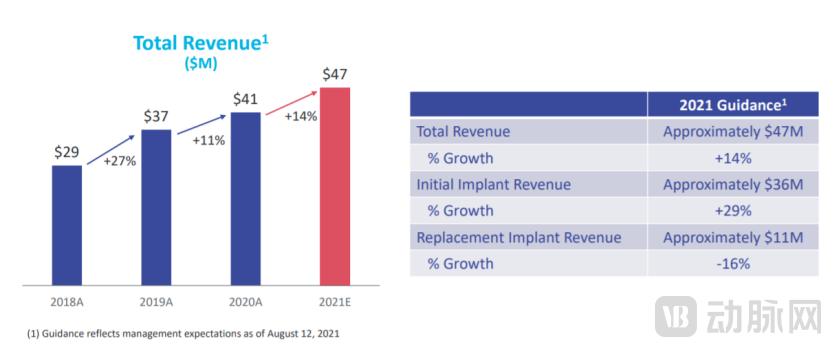 NeuroPace 2021 Revenue Forecast
In June 2021, NeuroPace announced that it had received a research grant from the National Institutes of Health (NIH) Brain Research through Advancing Innovative Neurotechnologies® (BRAIN) Initiative. Under the agreement, the NIH will provide up to $9.3 million in funding to NeuroPace over five years to evaluate the efficacy of the NeuroPace RNS System in treating Lennox-Gastaut syndrome (LGS).
Lennox-Gastaut syndrome (LGS) is a devastating childhood-onset epilepsy characterized by cognitive impairment and frequent generalized seizures. As a form of drug-resistant epilepsy, it remains uncontrolled in 80%–90% of affected children. NeuroPace is seeking approval to conduct an Investigational Device Exemption (IDE) study, which will be the first to evaluate the implantation of the Responsive Neurostimulation (RNS) device in patients with Lennox-Gastaut syndrome. Patient enrollment is expected to begin in the second half of next year.
“Brain-computer interface technology will enable us to gain a deeper understanding of generalized epilepsy networks, facilitating the identification of signals from biomarkers in the brain,” said Martha Morrell, M.D., Chief Medical Officer at NeuroPace and principal investigator of the study. “We hope that treatment with the RNS System will ultimately improve the lives of patients with Lennox-Gastaut syndrome (LGS) and their families. The clinical and electrophysiological data collected during the study may also contribute to future epilepsy research and clinical practice.”
On August 4, 2021, NeuroPace also announced the launch of nSight, a digital online platform that can be used in conjunction with the RNS System to help physicians provide more personalized, data-driven tools for epilepsy management. To fully leverage the capabilities of the nSight platform, NeuroPace has also partnered with Seizure Tracker™, one of the most widely used electronic seizure diary applications.
Through the Seizure Tracker™ mobile application, patients and their caregivers can record videos of seizures when they occur and tag seizure events with detailed information. The app also integrates with Amazon Alexa, allowing patients to verbally log the start and end times of seizures.
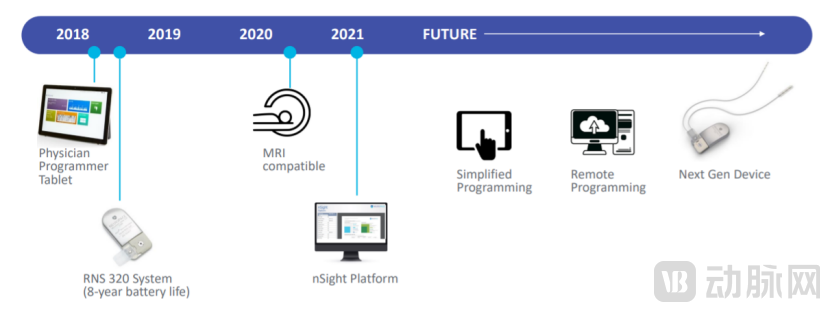 NeuroPace Product Pipeline Plan | Source: NeuroPace Official Website
In addition to its strategic initiatives in digital platforms and expanding the indications for Responsive Neurostimulation (RNS), NeuroPace plans to gradually expand into international markets. Leveraging its RNS System and brain-computer interface (BCI) technology, the company will conduct multi-disease research and development targeting other neurological disorders, including memory impairment, post-traumatic stress disorder (PTSD), and depression.
According to data from Absolute Market Insights’ “Global Epilepsy Neuromodulation Market Report,” the Asia-Pacific region is projected to register the highest compound annual growth rate (CAGR) of 11.97% in the epilepsy neuromodulation market over the next nine years. The Chinese market will dominate this segment and represents a key area for NeuroPace’s future expansion. Notably, domestically developed neuromodulation technology products are also making significant strides.
Beijing PINS Medical DBS (Deep Brain Stimulation) Neurostimulation System (Brain Pacemaker) initiated its research and development in 2000, relying on Tsinghua University. The first clinical trial was successfully conducted in 2009. In 2014, it obtained registration certificates for its full series of brain pacemaker products, and in October 2016, it achieved CE certification.
This deep brain stimulator, developed over more than a decade, has broken the monopoly of foreign products. It is used in more than 150 collaborative clinical centers, with an average of over 4,000 implantations annually, and can be used to treat diseases such as Parkinson's disease, essential tremor, dystonia, and obsessive-compulsive disorder.
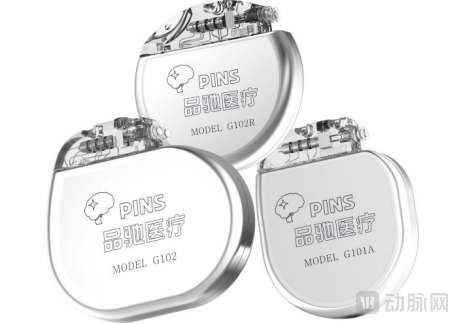
PINS Medical Neuromodulation System | Source: PINS Medical Official Website
Furthermore, Epilcure, developed through in-depth collaboration between Hangzhou Nuowei Medical Technology Co., Ltd., a subsidiary of the Chinese brain-computer interface high-tech company Jialiang Medical, and the team at Zhejiang UniversityTMClosed-loop neurostimulators (RNS) have also filled the gap in domestically produced devices.
EpilcureTMCompact and lightweight, it innovatively introduces a wireless charging solution that can significantly extend product lifespan. The device incorporates a medical-grade brain-computer interface (BCI) application chip and intelligent BCI modulation technology, and is equipped with an intelligent EEG-based seizure detection algorithm to enable automatic optimization of treatment protocols.
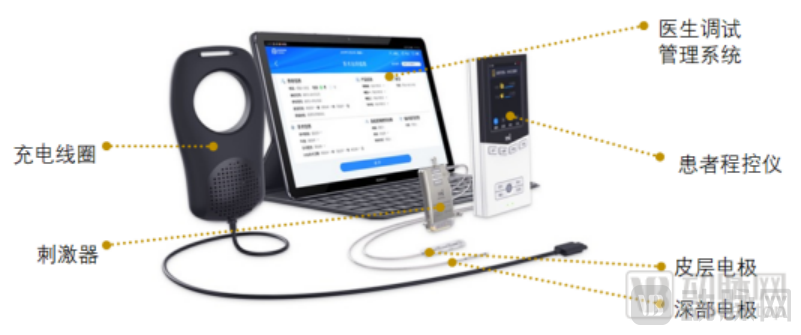
Jialiang Medical Closed-Loop Neurostimulator EpilcureTM
In March this year, Jialiang Medical, in collaboration with the Second Affiliated Hospital of Zhejiang University School of Medicine, successfully performed Asia’s first closed-loop neurostimulator implantation. During the one-month in-hospital observation period following the procedure, the patient experienced no epileptic seizures, yielding positive clinical feedback.
On August 29, 2021, Epilcure, after more than a decade of research and development,TM, the prospective, multicenter, controlled Chinese registration clinical trial for drug-resistant epilepsy has been officially launched, with promising prospects.
On January 19 this year, China’s major “Brain Science and Brain-Inspired Intelligence” project officially opened for public comment, gradually entering a phase of substantive policy support, as the curtain finally rose on the China Brain Project.
Eight months later, on September 16, the Ministry of Science and Technology officially released the notice on the 2021 Project Application Guidelines for the Major Project “Brain Science and Brain-Like Research” under the Science and Technology Innovation 2030 Initiative. The guidelines cover 59 research fields and directions, with national funding expected to exceed RMB 3.148 billion. The overall scale is projected to reach tens or even hundreds of billions of yuan, comparable to the U.S. BRAIN Initiative.
Brain-Computer Interface (BCI) technology is an indispensable pathway in brain science research. Pioneers in innovative medical applications within this field include NeuroPace abroad, as well as domestic companies such as Pins Medical and Jialiang Medical.
The future is here. Standing at the starting point of both the inaugural year of China’s 14th Five-Year Plan and the relaunch year of the China Brain Project, VCBeat will continue to monitor and document market dynamics in global innovative healthcare for brain science. We look forward to seeing more and more brain science technologies take root, flourish, and benefit humanity!