

How ColinBrid Harnesses Medical Big Data to Empower Hospitals in the AI Era
In recent years, the Chinese government has vigorously supported the application of next-generation information technologies, such as big data and artificial intelligence (AI), in the healthcare industry. It has promoted the deep integration of emerging technologies with medical and health services, and has successively established a series of technical specifications and data standards. These measures aim to ensure the safety, compatibility, and reliability of AI in application scenarios including medical imaging, smart hospitals, and new drug development, thereby regulating the development of medical AI.
How to leverage big data and intelligent applications to support the construction of smart hospitals and drive the development of a smart healthcare ecosystem has become a hot topic. On September 17, the Fourth Academic Conference of 2021 held by the Medical Artificial Intelligence Management Professional Committee of the Shanghai Hospital Association proposed the formulation (or revision) and promotion of hospital AI technical specifications and data standards. Healthcare big data companies, including ClinBrain, shared their insights on the challenges and practical experiences in health and medical big data governance.
It is widely recognized in the industry that, from a data perspective, hospital data domains and their flows can be basically categorized into the following five data domains: the production data domain centered on patient services, the data utilization domain centered on diagnostic and therapeutic improvement, the data utilization domain centered on operational management improvement, the data utilization domain centered on medical research, and the data flow domain centered on exchange and sharing (interconnectivity).
The application of big data analytics and mining technologies in healthcare plays a pivotal role in hospital operational management, clinical research, medical service collaboration, intelligent patient services, and foundational medical support. These technologies enhance the precision of diagnostic and therapeutic processes, promote scientific hospital management, continuously improve operational efficiency, and elevate hospital-based research to new heights.
Currently, China’s performance in data application and mining is less than ideal. The focus remains on mere “large volumes of data” rather than true “big data,” with an emphasis on data collection. There are notable deficiencies in data governance, data mining and analysis, and the development of analytical platforms—areas that constitute the core value of big data. In particular, capabilities for platform-based data analysis are weak; efforts tend to concentrate on single domains, with limited integration of diverse data analysis objectives.
Due to the lack of emphasis on standardization and interoperability in previous hospital informatization initiatives, coupled with the fact that open data interfaces were previously a key revenue stream for healthcare IT vendors, the phenomenon of “data silos” in hospitals has become increasingly severe. This has made data integration and aggregation extremely challenging.
In addition, the issue of hospital data quality is even more severe. As a co-founder of ClinBrain, a medical big data company, Qin Xiaohong has many years of experience in hospital data governance. In an interview with VCBeat, he summarized the main problems currently existing in China's hospital data quality into three aspects.
First, due to the previous scarcity of domestic medical digitalization standards, various business vendors developed software systems entirely based on their own enterprise-defined standards when building their business systems.
Secondly, each business system within the hospital only ensures that its own operational workflows function properly, without regard for data quality. This neglect leads to various data quality issues, such as mismatches between master and detail tables, incorrect logical relationships among data, and data inconsistencies.
Finally, physicians failed to adhere to standards when documenting medical records and various examination reports. The widespread practice of writing unstructured medical documents based on habitual patterns has hindered the high-quality conduct of scientific research and quality control.
Experts from the health commission system also shared with VCBeat their views on the shortcomings in the development of China’s healthcare big data.
First, the resource planning for health and medical big data in China needs to be refined, requiring a detailed grasp of fundamental information such as “what data are available,” “what data are missing,” “where the data are located,” “who needs the data,” “who provides the data,” and “who serves as the authoritative source.”
Secondly, inter-departmental data collaboration needs to be strengthened. Current big data applications are mainly confined to individual healthcare service domains, with limited cross-departmental integration. It is essential to establish mechanisms for close cross-departmental cooperation to fully leverage the intensive scale benefits of big data.
Finally, the integration of data applications requires further deepening. In the healthcare sector, there are currently few truly integrated applications that span the “national–provincial–municipal–county–institution” hierarchy within specific business domains. The recent COVID-19 pandemic has, to some extent, exposed deficiencies in this area. Even vaccination records across different provinces remain difficult to share.
To address these pain points, relevant national authorities are strengthening policy and standard development. Since 2008, the state has been progressively promoting hospital informatization centered on electronic medical records (EMRs), and has initiated the establishment of EMR-related standards as well as the basic framework for the EMR information standard system.
In recent years, the application of electronic health records (EHRs) has garnered significant attention. The national government aims to achieve information sharing among healthcare institutions regarding residents’ basic health information, laboratory and diagnostic test results, and medication records through the development of regional health information platforms. This initiative seeks to enable real-time, dynamic updates of residents’ electronic health records (EHRs) and electronic medical records (EMRs) within each region.
Meanwhile, the state has incorporated EMR grading, interoperability assessments, accreditation standards for tertiary hospitals, and smart hospital development into performance evaluations. Furthermore, by implementing DRG and DIP payment reforms, it leverages health insurance reimbursement mechanisms to further compel hospitals to enhance their EMR-centric information systems, along with the underlying capabilities for data collection, governance, and application.
Qin Xiaohong believes that, from graded hospital accreditation and electronic medical record (EMR) grading to interoperability assessments, smart management ratings, and hospital performance evaluations, the state’s accreditation and rating systems for hospitals are becoming increasingly refined, with a greater emphasis on the critical supporting role of big data in the development of healthcare informatization.
Moreover, the state has further strengthened legislation and policies to prepare for the deeper exploitation and application of medical data. The “Opinions of the Central Committee of the Communist Party of China and the State Council on Building a More Complete System and Mechanism for Market-Based Allocation of Production Factors” explicitly recognized data as a new type of production factor for the first time, placing it on par with traditional factors such as land, labor, capital, and technology. Meanwhile, both the Personal Information Protection Law and the Data Security Law were approved within the year, providing a legal foundation for data security and privacy in the circulation of data as a production factor.
Evidently, after establishing data as a factor of production, the state is continuously refining the corresponding top-level design. Although many challenges remain to be addressed, as conditions mature in the future, compliantly processed health and medical data may emerge as a significant resource supply market, enabling its trading and circulation akin to traditional factors of production such as land, labor, capital, and technology.
It is precisely for this reason that “medical big data” has remained a hot topic in recent years. Whether in the primary market, the secondary market, or at various conferences within the healthcare industry, medical big data is frequently discussed, and concepts such as medical data governance and intelligent healthcare are evolving rapidly. According to IDC’s Worldwide Big Data and Analytics Spending Guide, the market size of China’s clinical information-based medical big data solutions (software and services) reached RMB 1.01 billion in 2019. This sector is expected to accelerate its growth in the coming years, with a compound annual growth rate (CAGR) of 22.0% from 2019 to 2024, reaching RMB 2.73 billion by 2024. If medical insurance big data and life sciences big data are also taken into account, the market size would be even larger.
In the era of big data, whoever controls medical data holds the future of healthcare; the notion that “he who commands data commands the world” will gradually become a consensus.
Currently, China’s healthcare informatization is in a transitional phase, shifting from the era of “business process digitization” to the “Healthcare Big Data + AI” era, with big data as its core foundation. In the big data era, hospitals’ clinical, research, and management needs are becoming increasingly refined, while enhancing hospital management efficiency and disciplinary capabilities has become a top priority for high-quality hospital development.
Currently, the value of medical big data in clinical practice and scientific research is gradually being realized: on one hand, medical big data can empower clinical research, enhancing both the quantity and quality of research outputs by clinicians; on the other hand, AI-driven, scenario-based intelligent applications leveraging big data technology have improved the standard of clinical diagnosis and treatment as well as work efficiency.
In addition, big data technology is being increasingly integrated into hospitals’ core systems, electronic medical record (EMR) systems, and health insurance payment systems. This not only facilitates system performance upgrades but also plays a significant role in helping hospitals achieve higher ratings in EMR application maturity assessments and pass health information interoperability evaluations, as well as meet new requirements for health insurance payment compliance and high-quality operational management.
As one of the pioneers in “Medical Big Data + AI,” ClinBrain has, through continuous R&D breakthroughs and accumulated experience, achieved the integration of data from hundreds of systems provided by dozens of vendors within a hospital into a unified data platform—without requiring interfaces from third-party business system providers such as HIS or EMR vendors—thereby connecting the “data silos” within hospitals.
Throughout the long-term governance of medical big data, ClinBrain has standardized non-standard data through mapping, performed post-structuring on unstructured data, and cleaned dirty data, thereby establishing a comprehensive industry standard library and medical terminology database.
Currently, top-tier Grade A tertiary hospitals—including West China Hospital, Ruijin Hospital, the First Affiliated Hospital of Naval Medical University, Southwest Hospital of Army Medical University, Fudan University Shanghai Cancer Center, and Shanghai Mental Health Center—have partnered with ClinBrain to build medical big data governance and application platforms.
So, what advantages does ClinBrain have that can impress these top-tier hospitals? Qin Xiaohong believes there are three main reasons.
First, to avoid dependence on others, ClinBrain has adhered since its inception to a technological strategy of independent innovation and self-driven R&D. It has independently developed core technologies, including ETL tools, Natural Language Processing (NLP) systems, metadata systems, and big data visualization systems. The company has applied for 17 invention patents related to medical big data and obtained 88 software copyrights. After years of deep engagement in the medical big data sector, ClinBrain has established a competitive “moat” across various dimensions, including data integration, data governance, and intelligent data applications.
Leveraging its foundational big data technology infrastructure for healthcare, ClinBrain has proposed an integrated “3+N+1” solution for building smart hospitals. The “3” refers to three major data centers: the Clinical Data Repository (CDR), the Operational Data Repository (ODR), and the Research Data Repository (RDR). Centered on these three data hubs, ClinBrain has developed the ClinData series of data middle-platforms and data governance products.
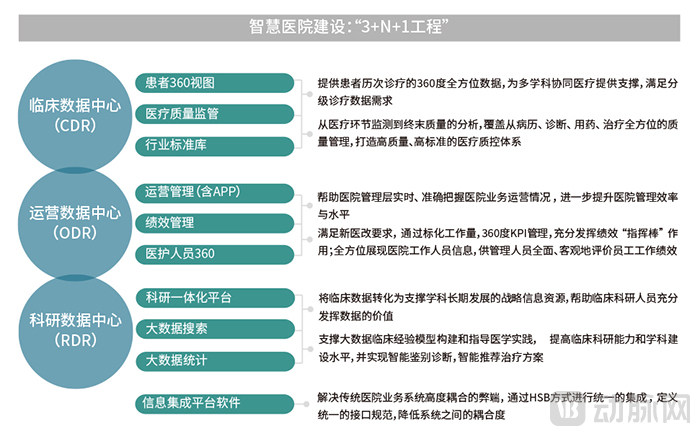
ClinBrain’s Three Major Data Center Product Layouts (Image source: ClinBrain)
The so-called “N” refers to multi-scenario adaptable applications. It denotes the data-driven applications of the ClinAPP series and the artificial intelligence applications of the ClinAI series, which are built upon three major data centers and designed to meet hospitals’ needs across various domains, including medical care, teaching, research, and management.
ClinBrain’s data middle platform and data applications enable most hospitals to achieve data synchronization, collection, and integration for their big data platforms without the need to modify interfaces in their business systems. This provides comprehensive, accurate, and high-quality data support for hospital operational management, performance evaluation, and clinical research, making it highly attractive to hospitals plagued by numerous “data silos.”
The so-called “1” refers to the information integration platform. This platform enables unified integration via HSB and defines standardized interface specifications.
Secondly, leveraging a high-quality medical big data platform, ClinBrain’s advantages in developing AI-driven healthcare products have become increasingly prominent. This has led to the formation of its “ClinAI” suite of intelligent medical solutions, which includes natural language processing (NLP), intelligent structuring of electronic health record data, intelligent interpretation of medical literature and clinical guidelines, single-disease quality control reporting systems, an intelligent VTE prevention and management platform, an intelligent decision-support platform for rare diseases, and an intelligent early-warning platform for COVID-19 infection.
In particular, the single-disease quality control reporting system enables intelligent data collection and submission, significantly saving human resources and improving work efficiency; it helps hospitals plan data sources to enhance the quality of data entry; it implements full-process key node management with equal emphasis on process and outcomes, thereby strengthening single-disease management capabilities; and it provides hospitals with flexible operational tools for single-disease indicator management, allowing for customized adjustment of indicators.
The newly launched Intelligent VTE Prevention and Management Platform is designed for VTE prevention and management scenarios in secondary and tertiary hospitals. Leveraging real-world data from diverse patient populations within the hospital, and grounded in authoritative domestic and international VTE diagnosis and treatment guidelines as well as artificial intelligence technologies, the platform enables real-time monitoring of high-risk patients across the entire institution and proactively identifies suspected cases. Furthermore, it precisely recommends personalized intervention measures and provides a stratified, tiered, end-to-end management system, serving as an efficient service platform that meets the collaborative workflow needs of multiple roles.
In addition to ClinData and ClinAI, ClinBrain has developed the ClinAPP series of medical data application products, represented by the Clinical Big Data Search Engine, Clinical Research Platform for Single-Disease and Cohort Studies, Medical Big Data Statistical Mining Platform, Medical Big Data Visualization, Hospital Operations Management, Medical Quality Management, Patient 360, Healthcare Professional Competency Model 360, and Public Hospital Performance Evaluation.
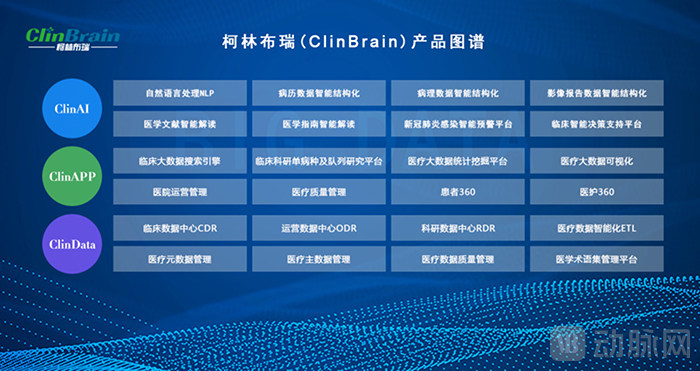
ClinBrain’s Product Portfolio (Image source: ClinBrain)
These applications have generated substantial benefits during their implementation in hospitals. At West China Hospital, physician-researchers have adopted the clinical big data search engine as a routine tool for their research activities, with over 8,000 user sessions recorded per month. Following the deployment of the single-disease research module in the Department of Gastrointestinal Surgery at Ruijin Hospital, more than 45 papers were published within one year, including 23 indexed by SCI, with a cumulative impact factor exceeding 70.
In terms of supporting performance assessments for public hospitals, ClinBrain has not only provided robust support to mega-hospitals such as West China Hospital and Ruijin Hospital, but also helped some medium-sized hospitals achieve remarkable results by adopting its high-quality data platform. Notably, Shanghai Integrated Traditional Chinese and Western Medicine Hospital affiliated to Shanghai University of Traditional Chinese Medicine ranked second nationwide among integrated TCM and western medicine hospitals in performance assessment, while Chengdu Fifth People’s Hospital ranked first among municipal hospitals.
Finally, ClinBrain has placed significant emphasis on the development of industry standards since its inception and has participated in the formulation of numerous standards and guidelines. To date, ClinBrain has contributed to the drafting of guidelines such as the Guidelines for the Construction and Practical Application of Hospital Information Integration Platforms in Shanghai, the Guidelines for the Construction of Clinical Data Retrieval Systems in Traditional Chinese Medicine Hospitals, and the Guidelines for the Construction of Shared Databases of Typical Medical Cases from Renowned Senior TCM Practitioners. Additionally, it has participated in the development of multiple group standards for medical data in Guangdong Province, including Specification for the Construction of Medical Data Centers Part 1: Clinical Data Center and Basic Data Set for Novel Coronavirus Pneumonia Part 4: Clinical Research.
Meanwhile, ClinBrain has officially achieved Level 5 certification under the CMMI DEV V2.0 (Capability Maturity Model Integration for Development) assessment, demonstrating that its capabilities in product research and development, project management, and solution delivery have reached an internationally advanced level, with its R&D maturity recognized by authoritative international bodies. According to data from the official CMMI website, as of the end of 2020, only 12.5% of companies worldwide holding valid CMMI certifications had attained Level 5.
Currently, companies across the medical big data industry are showcasing their unique strengths: some focus on single-disease applications for scientific research, others on AI applications in specific scenarios, and still others on management-oriented data applications.
In the future, will the “top-down” approach, starting with upper-layer applications, prove more dynamic, or will the “bottom-up” approach, beginning with data governance, demonstrate greater potential? ClinBrain, which has consistently adhered to the “bottom-up” strategy and continuously built high competitive barriers, remains poised for future breakthroughs—only time will tell.
References:
IDC: "Worldwide Big Data and Analytics Spending Guide"