

Blue Ocean Worth Billions: Leading Institutions Enter the Single-Use Endoscopy Market
In 2021, the single-use endoscopy sector experienced explosive growth.
In September alone, the single-use endoscopy sector saw three financing rounds exceeding RMB 100 million each. A review of business registration information by VCBeat revealed that Ruipai Medical, a platform company specializing in single-use endoscopes, recently completed a new round of financing, with investment from Tencent and Sequoia Capital.
Over the years, leveraging its social platforms such as WeChat and QQ, and supported by technologies including AI, big data, and cloud computing, Tencent has built a vast healthcare ecosystem encompassing medical services, hospital management, health insurance, and pharmaceutical R&D and distribution.
Today, Tencent continues to expand its healthcare footprint by investing in traditional medical device R&D and manufacturing companies.Its first investment target was Guangzhou Ruipai Medical, a leader in the disposable endoscope market.
In fact, in addition to Tencent and Sequoia Capital, numerous well-known investment firms—including Yuanhe Origin, Sida Capital, Mifang Capital, Tonghe Yucheng, and CITIC Medical Fund—have long entered the disposable endoscopy sector.
The surge in the disposable endoscope sector is driven by two factors: first, endoscopic equipment is trending toward “disposable-ization,” with disposable endoscopes poised to profoundly reshape the competitive landscape of the endoscopy industry; second, Chinese companies have leveraged disposable endoscopes to achieve rapid advancement, giving rise to firms with global competitiveness in this field.
It is well known that investment institutions favor market segments characterized by large addressable markets, rapid growth rates, low commercialization barriers, and significant technological moats. Disposable endoscopes precisely meet all these criteria: the domestic market size exceeds RMB 10 billion; they address the critical clinical pain point of cross-infection, driving rapid growth in clinical utilization; their low procurement costs facilitate commercialization; and they possess distinct technological barriers.
Consequently, disposable endoscopes have surged in popularity within the capital market over the past two years, with both the number of financing events and the total amount raised repeatedly hitting record highs, while attracting prominent investors such as Tencent and Sequoia Capital to enter the sector.
1. The market size for single-use endoscopes exceeds RMB 10 billion
According to projections by the renowned consulting firm Evaluate MedTech, the global endoscopy market reached $20.9 billion in sales in 2019 and is expected to grow at a compound annual growth rate (CAGR) of 6.3% to reach $28.3 billion by 2024.
Although endoscopes are widely used in clinical practice, the issue of cross-infection has plagued physicians, patients, and endoscope developers since their large-scale adoption. An article published in 2018 by the American Journal of Infection Control revealed that endoscopes ranked first among medical devices for the risk of cross-infection, with over 70% suffering from inadequate cleaning and nearly three-quarters of commonly used endoscopes being contaminated with bacteria.
Previously, due to their high cost, endoscopes had to be reused, meaning a single device was used on multiple patients. Meanwhile, the complex structure of endoscopes, featuring multiple narrow and long channels, makes thorough cleaning and disinfection difficult. Given this reusability and the challenges in cleaning and disinfection, traditional endoscopes are highly prone to causing cross-infections, which compromises the safety and efficacy of surgical procedures and can even endanger patients' lives.
In response to this challenge, the significant reduction in the cost of core endoscopic components has led to the emergence of single-use endoscopes, which eliminate reuse and address the problem of cross-infection. Relevant companies develop and manufacture various types of single-use endoscopes based on factors such as the usage volume of traditional endoscopes, the cost per use, and commercialization difficulties.
In fact, traditional endoscopes with large market sizes, high clinical usage volumes, and elevated operational costs all have the potential to be converted into disposable consumables.
According to public data, the annual volumes of gastrointestinal endoscopy and nasopharyngolaryngoscopy procedures in China are 40 million and 11 million cases, respectively, indicating a substantial market potential. The domestic procedure volumes for cystoscopy and hysteroscopy stand at 6 million and 10 million cases, respectively; these segments represent sizable markets with higher per-procedure costs.
The per-use cost of an endoscope includes not only the product itself but also expenses such as maintenance, facility usage, and sterilization. Taking into account factors including service life, maintenance costs, sterilization costs, and facility usage costs, the per-procedure cost for a ureteroscope exceeds RMB 12,000, whereas the use of a disposable ureteroscope costs no more than RMB 10,000.
Regarding commercialization challenges, cystoscopes and ureteroscopes are priced relatively high, which facilitates reasonable pricing for single-use endoscopes. This enables the transformation of cost centers into profit centers while meeting clinical needs. Currently, most companies in the single-use endoscope sector enter this market by launching single-use cystoscopes and single-use ureteroscopes.
Overall, various endoscopes—including cystoscopes, ureteroscopes, hysteroscopes, gastroscopes, colonoscopes, choledochoscopes, bronchoscopes, nephroscopes, and laryngoscopes—have the potential to be converted into disposable consumables. The corresponding market size accounts for approximately 75% of the total endoscope market. Therefore, disposable endoscopes hold significant growth potential, with the global market size reaching approximately USD 15 billion in 2019. In the Chinese market, endoscopes with consumable potential correspond to 70 million diagnostic and therapeutic procedures. It is foreseeable that the domestic market size for disposable endoscopes will far exceed RMB 10 billion.
2. Disposable Endoscopes Offer Greater Social and Economic Value
In 2018, at the American Urological Association Annual Meeting, Dr. Mantu stated, “Reusable endoscopes will become a thing of the past; the future healthcare market will be dominated by single-use endoscopes.”
In addition to preventing cross-infection, single-use endoscopes offer greater economic and social value compared to traditional endoscopes.
According to VCBeat, Ruipai Medical has long been conducting surgical mentoring programs for primary care physicians in provinces and cities such as Hunan, Jiangxi, Gansu, and Hubei. By engaging with primary care doctors across China, the initiative has garnered widespread attention from grassroots hospitals.
An industry veteran stated, “For a long time, there has been a misconception regarding the application scenarios of single-use electronic endoscopes, with the belief that only high-end clients with strong demands for preventing cross-infection would use such products. In reality, primary care hospitals represent the blue-ocean market where single-use endoscopes should focus their efforts. Physicians in these settings have a pronounced desire for more opportunities to gain surgical experience. Taking ureteroscopy as an example, single-use endoscopes have significantly promoted the decentralization of this procedure to lower-tier institutions due to their cost advantages. This greatly alleviates the surgical pressure on primary care physicians, especially young doctors, allowing them to concentrate more on the surgery itself without worrying about the high repair costs associated with damaging reusable scopes. Consequently, patients also have the opportunity to receive higher-quality diagnostic and therapeutic services.”
Building a high-caliber workforce of young physicians at the primary care level is the cornerstone of implementing the tiered diagnosis and treatment policy. As a pioneer in the rollout of this policy, single-use endoscopes not only significantly reduce the learning curve for surgeons but also demonstrate their value by strengthening hardware infrastructure at primary care institutions through cost advantages.
In addition to the high costs of the endoscope and its main unit, traditional endoscopes also incur substantial operational expenses for maintenance, cleaning, and disinfection. Studies have indicated that the cost per procedure using a traditional flexible ureteroscope in China exceeds RMB 12,000, with daily disinfection, sterilization, and operation and maintenance accounting for 43% of the total cost.
The business model of single-use endoscope manufacturers differs significantly from that of traditional endoscopy, enabling these companies to expand their product reach to primary-care hospitals.
Traditional endoscopy companies primarily generate revenue through the sale of medical devices, with product portfolios comprising endoscopy system processors and multiple reusable endoscopes. However, this model results in high hospital procurement prices, making them unaffordable for primary care hospitals. Taking flexible ureteroscopes as an example, the initial procurement cost for a hospital includes one processor priced at RMB 1 million and two flexible ureteroscopes priced at RMB 500,000 each, totaling RMB 2 million.
However, if single-use ureteroscopes are selected, the initial procurement cost for hospitals is less than 100,000 yuan.
The exceptionally low hospital procurement price for single-use endoscopes stems from the “razor-and-blades” consumables sales model adopted by relevant companies, whereby profitability is driven primarily by disposable endoscope products rather than the mainframe systems.
Therefore, single-use endoscopes play a significant role in empowering primary care hospitals and facilitating the decentralization of minimally invasive endoscopic surgeries. As primary care hospitals leverage single-use endoscopes to extensively perform minimally invasive endoscopic procedures and diagnostic examinations, the market for single-use endoscopes will expand rapidly.
For primary care hospitals, the procurement cost of disposable endoscopes is extremely low, enabling them to easily offer endoscopic diagnostic and therapeutic services to meet patient needs. For large hospitals, the limited number of endoscopes and the time-consuming disinfection procedures previously prevented consecutive surgeries, significantly reducing the utilization efficiency of medical resources.
For physicians, disposable flexible electronic ureteroscopes offer high image quality, excellent maneuverability, and low usage costs; they impose no psychological burden on beginners and achieve a high success rate in the treatment of complex stones.
For patients, the use of disposable endoscopes can avoid the risk of cross-infection, ensure surgical safety, reduce intraoperative pain, and lower the total cost of care throughout the entire disease course. In fact, patients undergoing procedures with traditional endoscopes face a certain risk of cross-infection; the treatment and hospitalization costs associated with such infections will continuously increase the total cost of care, and cross-infections may even lead to patient mortality.
We believe that in the existing market for traditional endoscopes, single-use endoscopes are poised to capture market share by leveraging their advantage in reducing infection risks; in the incremental market of primary care hospitals, single-use endoscopes are expected to penetrate this previously underserved segment by capitalizing on their cost advantages.
3. Single-Use Endoscopes Enhance Surgical Safety
It is important to emphasize that single-use endoscopes do not compromise the operator’s experience or product performance. In fact, according to research by VCBeat, there is a consensus among many domestic single-use endoscope manufacturers in China: to minimize product costs while meeting clinical needs, thereby making these devices accessible to a broader patient population.
Among these, a key priority is meeting clinical needs. In certain aspects, single-use endoscopes even offer distinct advantages. For instance, as they do not require reprocessing, they eliminate the risk of cross-infection, thereby enhancing procedural safety.
Furthermore, due to their reusable nature, the performance of traditional endoscopes progressively deteriorates with repeated repairs, cleaning, and disinfection cycles, thereby compromising their safety during surgical procedures. In contrast, single-use endoscopes are ready for immediate use out of the box, ensuring optimal quality and condition with every application, which guarantees both intraoperative safety and efficacy.
In terms of meeting clinical needs, single-use endoscope products can achieve the same level as existing traditional endoscopes. For example, single-use endoscopes can realize many functions of traditional endoscopes, such as fluorescence imaging, 4K ultra-high-definition imaging, and NBI (Narrow Band Imaging).
Meanwhile, the processors provided by disposable endoscope manufacturers are equally powerful. Taking Ruipai Medical as an example, its in-house developed and manufactured processors can achieve the same functionality as those from traditional endoscope companies.
Overall, single-use endoscopes can meet current clinical needs, and with continued innovation, they will address more pain points, benefit more patients, and even gradually replace some traditional endoscopes.
During the era when traditional endoscopy reigned supreme, China’s endoscope market was predominantly monopolized by companies such as Olympus, Fujifilm, Karl Storz, Stryker, and Richard Wolf.
However, it is encouraging to note that with the gradual rise of single-use endoscopes, the foreign-dominated monopoly in the endoscopy market is destined to be broken. Single-use endoscopes have become a rare opportunity for domestic companies to overtake their competitors on a bend.
VCBeat’s research has found that disposable endoscopes differ significantly from traditional endoscopes in terms of design philosophy, large-scale mass production, and cost control. These differences have made it difficult for established endoscope manufacturers such as Olympus to leverage their existing resources in the disposable endoscope sector, thereby eroding their first-mover advantage.
For example, Olympus entered the single-use endoscope market around 2019. However, to date, Olympus has only launched a single-use bronchoscope, which was developed and manufactured by a Chinese company and introduced into the U.S. market with Olympus serving as the exclusive distributor in the United States.
At present, Ambu, Boston Scientific, and Ruipai Medical are representative companies in the global disposable endoscope market. As the world’s largest supplier of disposable endoscopes, Ambu received FDA approval for its disposable colonoscope, disposable cystoscope, and disposable duodenoscope between 2018 and 2020, with its disposable colonoscope and disposable cystoscope also obtaining CE certification during the same period.
Boston Scientific entered the single-use endoscope market through the urology and gastroenterology fields, launching the first single-use ureteroscope. Currently, Boston Scientific’s single-use duodenoscope, single-use cholangiopancreatoscope, and single-use ureterorenoscope received FDA approval between 2019 and 2020.
Ruipai Medical is a leading representative in China’s disposable endoscopy sector. Its disposable cystoscope and disposable ureteroscope received approval from the National Medical Products Administration (NMPA) in July and August 2020, respectively. Currently, Ruipai Medical is the Chinese manufacturer holding the largest number of Class III registration certificates for disposable endoscopic products in China.
From the perspective of product approval timelines, Ruipai Medical’s products received regulatory clearance concurrently with those of overseas companies such as Ambu and Boston Scientific. This also signifies that Chinese enterprises like Ruipai Medical are at the forefront of the global disposable endoscopy field.
From the perspective of product portfolio, domestic enterprises boast diverse product lines and strong competitiveness. Currently, no company in the disposable endoscopy sector offers a full range of products; for instance, Ambu, a representative player, focuses solely on flexible endoscopes. In China, however, Ruipai Medical, as a platform-based enterprise in disposable endoscopy, addresses the needs of various departments and clinical requirements by offering both flexible and rigid endoscopes, covering numerous specialties including urology, gynecology, otolaryngology, pulmonology, and general surgery.
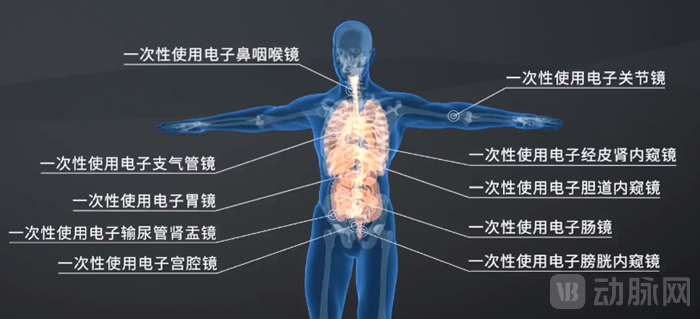
(Public Information: Ruipai Medical's Product Portfolio)
In summary, Chinese manufacturers are at the forefront of the global disposable endoscope market and are poised to achieve a leapfrog advancement in the endoscopy sector, driven by factors such as product pipeline strategy, pace of development, and product advantages.