

ViaCyte Files for IPO: Advancing Stem Cell-Derived Therapies for Insulin-Dependent Diabetes

ViaCyte
Stem Cell-Derived Cell Replacement Therapy Developer
Type 2 diabetes is the most common form of diabetes, accounting for more than 90% of all cases. Patients with this condition can produce insulin, but their cells are unable to utilize it effectively, and insulin resistance is commonly observed. Type 1 diabetes, on the other hand, is a chronic autoimmune disease that accounts for approximately 5% of all diabetes cases and predominantly affects children and adolescents.
Currently, there is significant variation in the incidence of type 1 diabetes across countries. The incidence is higher in Western countries, particularly those in Northern Europe, while it is lower in Asian countries, including China. However, globally, the incidence of type 1 diabetes in children continues to rise year by year.
According to data released by the International Diabetes Federation (IDF), the global number of people with diabetes is projected to reach 629 million by 2045. As the diabetic population continues to rise year by year, the diabetes drug market has firmly become the second-largest pharmaceutical market, surpassed only by the oncology drug market.
As a chronic disease requiring long-term, uninterrupted management, diabetes is currently treated primarily with oral medications and insulin injections. While these approaches can control blood glucose levels to some extent, they cannot yet provide a complete cure for diabetes.Moreover, as the disease progresses, patients with diabetes often develop various complications, imposing a significant physical and psychological burden.
With the advancement of biomedicine, the emergence of stem cell therapy holds promise for curing diabetes. In 2019, U.S. Time magazine included stem cell therapy for diabetes in its list of 12 major innovative inventions poised to transform healthcare over the next decade.
Type 1 diabetes is an autoimmune disease specifically targeting pancreatic beta cells. In healthy individuals, the pancreas contains a certain number of beta cells, which maintain a dynamic equilibrium through continuous apoptosis and proliferation. In type 1 diabetes and insulin-requiring type 2 diabetes, this dynamic balance is disrupted.
By leveraging the capacity of stem cells to undergo multidirectional differentiation and proliferation under specific conditions, they can be induced to differentiate into insulin-secreting beta-like cells, thereby regenerating and enhancing islet cell function to achieve a curative effect. Meanwhile, stem cells also participate in immunomodulation and the induction of immune tolerance, helping to restore immune balance within the pancreatic islets.
The ability of stem cells to cure diabetes has also prompted many pharmaceutical companies to enter this field.Currently, some large multinational pharmaceutical companies such as Eli Lilly, Novo Nordisk, and Sanofi, as well as innovative drug companies like Vertex Pharmaceuticals, ViaCyte, Sernova, AltuCell, Semma Therapeutics, and Beta-O2, have all made moves in this field.
Among them, ViaCyte is the main focus of today’s detailed introduction.
Supported by the California Institute for Regenerative Medicine,
Partnered with Nestlé and Thermo Fisher Scientific; invested by Bain Capital and Johnson & Johnson
The company was founded in 1999 and is headquartered in San Diego, California. Over the past twenty-two years since its establishment, the company’s name has undergone several changes. ViaCyte was formerly known as Novocell. In 2004, Novocell merged with CyThera and BresaGen, retaining the Novocell name. In 2010, Novocell was renamed ViaCyte, a name it has retained to this day.
The suffix “-cyte” in ViaCyte’s name is derived from the Greek word “kytos,” meaning cell. Indeed, ViaCyte is a cell therapy company focused on regenerative medicine, dedicated to discovering, developing, and commercializing novel stem cell-derived cell replacement therapies for the treatment of human diseases.
ViaCyte’s current R&D focus is on using stem cell-derived islet cells to treat insulin-dependent diabetes (including all cases of type 1 diabetes and some cases of type 2 diabetes).In its early stages, the company received partial funding from the California Institute for Regenerative Medicine (CIRM). Public records indicate that since its inception, ViaCyte has not only secured financial support from CIRM but also attracted investments from major institutions such as TPG and RA Capital.
Based on Crunchbase data,ViaCyte, over its 22-year history, has completed a total of 15 financing rounds, raising approximately $257 million in total.The financing parties include RA Capital, Bain Capital Life Sciences, CIRM, and the National Institute of Diabetes and Digestive and Kidney Diseases (NIDDK) at the National Institutes of Health (NIH), among other institutions and companies.
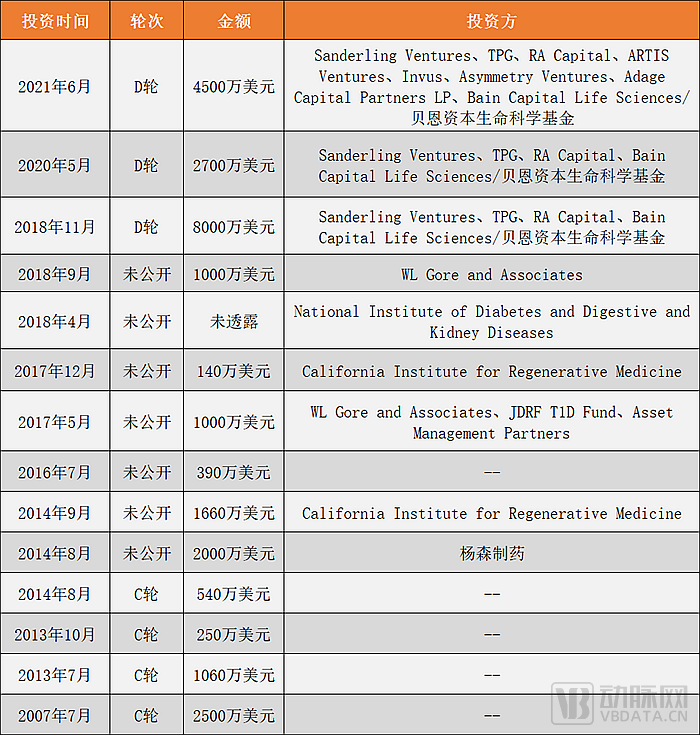
ViaCyte’s Funding History, Compiled from Crunchbase
In addition to the continued optimism and ongoing investment from capital markets, ViaCyte has also seen a steady stream of partners.
To date, ViaCyte’s partners include a pioneer in gene editing.CRISPR Therapeutics(NASDAQ: CRSP), a company founded in 2013 by Nobel laureate Emmanuelle and her partner; global materials science companyW. L. Gore & Associates (Gore);Nestlé Institute of Health Sciences (NIHS), Nestlé Health Science is the youngest subsidiary under the global food giant Nestlé; a leader in the scientific services sectorThermo Fisher(NYSE: TMO) and seven other pioneering companies and institutions.
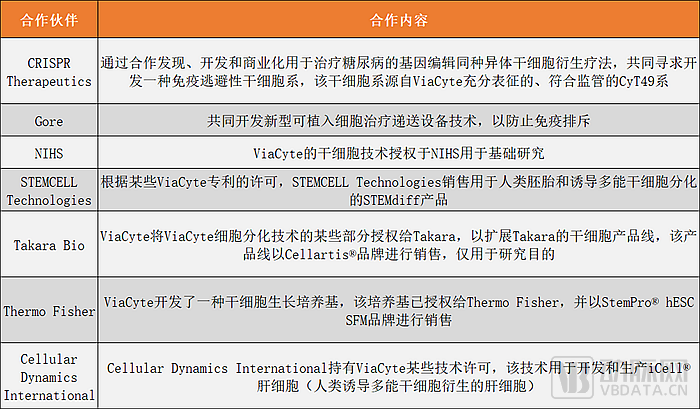
Partners and Collaboration Details, Compiled from ViaCyte’s Official Website
It is evident that, with financial support from research institutions such as CIRM and financing firms like Bain Capital and TPG, ViaCyte has achieved rapid development in its R&D of stem cell-derived therapeutic technologies.
Another point worth noting is that although ViaCyte has not yet had any direct stem cell-derived cell therapy products approved for market launch, by collaborating with large companies such as Gore and Thermo Fisher Scientific, it can license patents or certain technologies to partner companies. This allows other research outcomes to be quickly translated into the market, providing ViaCyte, whose current projects are still in the R&D stage, with a certain degree of financial recovery capability.
Why has ViaCyte garnered support and collaboration from various stakeholders? It all begins with a scientist named Kevin D’Amour.
Dr. Kevin holds a Bachelor of Science in Animal Sciences from the University of New Hampshire and a Ph.D. in Biology from the University of California, San Diego. He holds more than 100 U.S. and international patents and has published extensively in peer-reviewed journals recognized both domestically and internationally.
After earning his Ph.D. in 2002, Dr. Kevin joined CyThera as a Scientist (CyThera merged with Novocell and BresaGen in 2004 to form Novocell, which was later renamed ViaCyte). Over the course of nearly 20 years from 2002 to the present, Dr. Kevin has advanced at ViaCyte from his initial role as a Scientist to positions including Senior Scientist, Director of Stem Cell Biology, Vice President of Research and Development, and Chief Scientific Officer. His career has been closely intertwined with ViaCyte’s growth, reflecting a shared journey of development.
Although Dr. Kevin left ViaCyte this June to join the immunotherapy company Brooklyn ImmunoTherapeutics (NYSE ticker: BTX) as Chief Scientist, he currently continues to serve as a Special Advisor to ViaCyte on a part-time basis.
An individual served as a senior executive at a company for nearly two decades, during which time significant events were highly likely to occur. Among these, one particular event propelled Dr. Kevin to prominence and solidified ViaCyte’s position at the forefront of the regenerative medicine field.
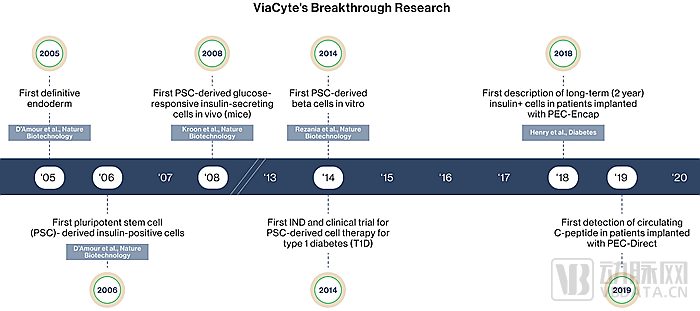
Milestones in the Company’s Development, Image Source: ViaCyte Official Website
In 2006, Kevin et al. published an important paper titled “Production of pancreatic hormone-expressing endocrine cells from human embryonic stem cells” in Nature Biotechnology.
This paper describes a modified five-step in vitro directed differentiation protocol employed by Kevin et al. (i.e., human embryonic stem cells → definitive endoderm → gut tube endoderm → pancreatic endoderm and endocrine progenitors → hormone-expressing endocrine cells) to induce the differentiation of human embryonic stem (hES) cells into endocrine cells capable of producing insulin, glucagon, somatostatin, pancreatic polypeptide, and ghrelin (a growth hormone secretagogue).
After transplantation of pancreatic endoderm-stage cells from the protocol into diabetic mice, the grafts further differentiated and matured in vivo, exhibiting characteristics of functional pancreatic β-cells: they not only secreted insulin and C-peptide but also demonstrated a significant glucose-lowering effect, further confirming that embryonic stem cells can differentiate into insulin-secreting cells both in vitro and in vivo.
This landmark study reports for the first time the generation of hormone-expressing endocrine pancreatic cells from human embryonic stem cells differentiated in vitro. These findings also provide a definitive treatment for patients with diabetes requiring insulin therapy, offering the potential to even cure the disease.
The publication of this paper also cements ViaCyte’s leadership in stem cell-derived cell therapies for type 1 diabetes and insulin-requiring type 2 diabetes.
Building on its technical expertise, ViaCyte’s current R&D portfolio encompasses three core areas: pluripotent stem cell expansion and differentiation engineering, stem cell engineering, and device engineering. ViaCyte develops these technologies either independently or through collaborative partnerships to address diseases that can be treated by replacing lost or dysfunctional cells or proteins.
In terms of stem cell proliferation, ViaCyte has mastered the signals that direct pluripotent stem cells to self-renew without differentiating into more specialized cell types.Furthermore, through years of research and development, ViaCyte has developed a stem cell growth medium for the expansion and cryopreservation of undifferentiated pluripotent stem cells, thereby providing the necessary foundation for the clinical and commercial scale-up and manufacturing of stem cell-derived cellular products.
In the field of stem cell differentiation, based on published scientific research, ViaCyte has invented a reproducible, patented, multi-step process (a five-step in vitro directed differentiation protocol)., used to differentiate pluripotent stem cells into pancreatic endoderm cells (also known as pancreatic progenitor cells or PEC-01 cells).
This process mimics the natural development of the human pancreas. At each step, specified types and quantities of growth factors, culture media, and supplements guide pluripotent stem cells along the differentiation pathway until they differentiate into PEC-01 cells. Upon subcutaneous implantation in patients, the PEC-01 cells within the implant device further differentiate into functional beta cells and other islet cells that regulate blood glucose levels.
Specifically, PEC-01 cells are derived from the pluripotent stem cell line (CyT49). ViaCyte has established and validated a large-scale cGMP cell bank of the CyT49 line, which provides the company with a fully characterized, single-cell source.
ViaCyte’s advancements in the proliferation and differentiation of pluripotent stem cells have laid the essential foundation for subsequent large-scale manufacturing and commercialization of its products.
Type 1 diabetes is an autoimmune disease in which the patient’s immune system attacks and destroys insulin-producing cells in the pancreas; therefore, any implanted cell replacement therapy must evade the immune system to prevent attack. Furthermore, similar to donor organs, any implantable human cell product expresses unique immunological characteristics, leading to immune rejection in patients who are not matched to these characteristics.
Allogeneic immune rejection can be addressed through physical means (PEC-Encap) or pharmacological approaches (immunosuppressive therapy using PEC-Direct), or by genetically engineering stem cells to enable the derived cells (e.g., PEC-01 cells) to evade the immune system (PEC-QT).
Ex vivo editing of immunomodulatory genes in the CyT49 stem cell line, which is used for producing pancreatic lineage cells, via CRISPR-Cas9 gene editing technology on pluripotent stem cell starting materials, can protect implanted cells from the patient’s immune system.
ViaCyte, in collaboration with CRISPR Therapeutics, a pioneer in the field of gene editing, is discovering, developing, and commercializing an immune-evasive islet replacement therapy for diabetes (the PEC-QT program).Combining ViaCyte’s stem cell capabilities with CRISPR’s gene-editing technology holds promise for developing islet replacement products that do not trigger immune rejection.
ViaCyte has two types of proprietary medical devices, PEC-Direct and PEC-QT, to house, protect, and implant its developed cell replacement therapies. Each type of device is available in multiple sizes for preclinical and/or clinical use.
During the device development process at ViaCyte, a key component is composed of a medical-grade plastic known as expanded polytetrafluoroethylene (ePTFE), which is manufactured by Gore. Furthermore, ViaCyte’s devices are fabricated from implant-grade materials selected for their long-term biocompatibility. All devices are designed for subcutaneous implantation, allowing oxygen, nutrients, proteins, and other molecules essential for cell survival and function to reach the cells, while enabling insulin and other proteins secreted by the cells to exit the device and enter the bloodstream to exert therapeutic activity.
Therefore, in terms of device development, ViaCyte has partnered with W. L. Gore & Associates, a global materials giant, combining Gore’s expertise in materials science and implantable medical devices with ViaCyte’s preclinical and clinical experience in human cell replacement therapy.ViaCyte is initially applying this combined technology to its PEC-Encap candidate product currently under development, as a potential functional cure for patients with type 1 diabetes.
ViaCyte is simultaneously advancing in the aforementioned three areas,To date, over 100 patents have been granted worldwide., patents have been granted in the United States and many other countries worldwide, including Australia, Belgium, Canada, China, Denmark, France, Germany, Iceland, India, Ireland, Israel, Italy, Japan, Mexico, the Netherlands, Poland, South Korea, Russia, Singapore, South Africa, Spain, Sweden, Switzerland, and the United Kingdom.
ViaCyte’s patent portfolio covers patented technologies for cell suspension and scale-up culture methods, defined media for pluripotent stem cells, cryopreservation of pancreatic-lineage cells, immune-evasive gene-edited pluripotent stem cells and their derivative cells, encapsulation of pancreatic cells, large-capacity cell-encapsulation delivery devices, direct vascularization delivery devices, various tools and equipment for combination products, as well as the culture and expansion of human pluripotent stem cells and their differentiation into pancreatic progenitor cells, late-stage endocrine precursors, and endocrine cells, thereby enabling the generation of pancreatic progenitor cells and pancreatic endocrine cells at different stages of differentiation.
Based on these technologies, ViaCyte currently has three pipelines under development.
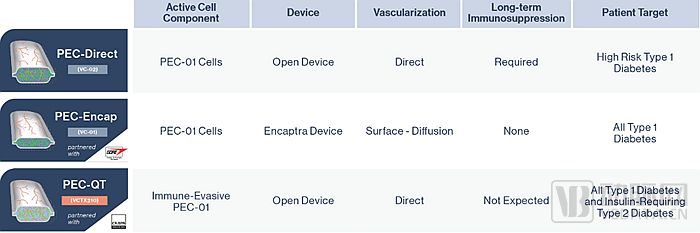
Pipeline Details, Source: ViaCyte Official Website
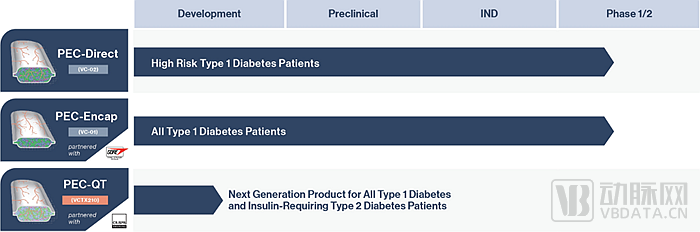
Pipeline Progress, Image Source: ViaCyte Official Website
ViaCyte’s PEC-Direct (VC-02) candidate product is in clinical development for the treatment of patients with type 1 diabetes at the highest risk of life-threatening acute complications.In addition to providing an unlimited supply of cells for implantation, PEC-Direct offers advantages such as more consistent product formulations under cGMP quality control conditions, as well as a more direct and safer method of administration.
PEC-Encap (VC-01) is another candidate product from ViaCyte in clinical development, indicated for the treatment of all types of type 1 diabetes.This device is designed to prevent immune cells from coming into direct contact with the implanted cells, thereby allowing them to function without triggering an immune response or being destroyed.
PEC-QT (VCTX210) is a pipeline product jointly developed by ViaCyte and CRISPR Therapeutics following their establishment of a strategic partnership in 2018., is a next-generation functional therapy for all patients with type 1 diabetes and type 2 diabetes mellitus (T2DM) who require insulin. The two companies are jointly developing an immune-evasive stem cell line—derived from ViaCyte’s well-characterized, regulatory-compliant CyT49 line—to avoid destruction by the patient’s immune system, thereby eliminating the need for immunosuppressants.
The latest updates on ViaCyte date back to June this year. On June 25, ViaCyte presented the latest clinical results for PEC-Direct (VC-02) at the 81st Scientific Sessions of the American Diabetes Association (ADA):
Preliminary data from a patient during the 9-month study period following PEC-Direct implantation showed that stimulated C-peptide levels increased from 0.1 ng/mL to 0.8 ng/mL (at Week 39), and glycated hemoglobin (HbA1c) levels also decreased.This demonstrates that, following treatment, the patient’s cells are producing and secreting insulin, leading to improved and controlled blood glucose levels.Moreover, no serious adverse events were reported in this patient during the same period, suggesting that this therapy holds promise for achieving a functional cure for type 1 diabetes.
ViaCyte expects to announce additional patient data from the PEC-Direct study in the first half of 2022.
Although stem cell-derived cell therapies still require optimization and development in terms of manufacturing standardization, product efficacy, controllability, and clinical accessibility, clinical data released by ViaCyte have indeed demonstrated their positive role in the treatment of diabetes.
Perhaps in the near future, this chronic disease, which affects hundreds of millions of patients worldwide, will truly become curable thanks to the efforts of regenerative medicine. Let us leave it to time and await good news from all companies developing stem cell-derived cell therapies.