

Fresenius Medical Care: Can the $17.8 Billion Dialysis Leader Continue to Lead Amid Healthcare Model Transformation?
Fresenius Medical Care
Dialysis treatment services and dialysis product suppliers
In 1912, a car navigated the streets of Frankfurt. As a novelty at the time, the vehicle drew pedestrians who stopped to watch; it had been purchased by Eduard Fresenius to deliver pharmaceuticals and sterile solutions for injection to the Hirsch Pharmacy.
Edward Fresenius inherited the Hirsch Pharmacy, which has a history of over 400 years, from his father last year. He is full of confidence and has ambitious plans for the pharmacy’s development, as evidenced by the use of automobiles for cargo delivery.
At that time, pharmacies competed by expanding their product ranges, while the number of industrialized pharmaceutical manufacturers continued to grow. Recognizing with great foresight that market demands on pharmacies would become increasingly stringent, Edward Fresenius adopted a dual strategy to respond to these changes.
On the one hand, he expanded into pharmaceutical wholesale based on his pharmacy business and provided delivery services; on the other hand, he developed the laboratory of Hirsch Pharmacy into a pharmaceutical company, Dr. Eduard Fresenius chemisch-pharmazeutische Industrie.
The pharmaceutical company officially registered for business in 1912, the year that marked the 450th anniversary of Hirsch Pharmacy. The establishment of this company not only ushered Hirsch Pharmacy into a new era of development but also laid the foundation for what is now the Fresenius Group.
This article provides a brief overview of the development history of the Fresenius Group, with a focus on exploring the growth of its nephrology and dialysis division, Fresenius Medical Care.
Spun off from the Fresenius Group, with the highest revenue share
Since 1912, the Fresenius Group has evolved from a local pharmacy into a global healthcare corporation with over a century of history. In 1966, Fresenius took a significant step by beginning to sell imported dialysis machines and dialyzers, thereby establishing its presence in the field of dialysis.
Fresenius’ leadership thus recognized that continuous expansion into new business areas was essential to sustain the company’s growth. In its subsequent development, Fresenius first broadened its product portfolio in infusion therapy, an area where it had long specialized, and later began independently manufacturing dialysis machines and other dialysis-related products in the dialysis sector.
Since the 1990s, strategic acquisitions have been a testament to Fresenius's rapid growth.In 1996, marking the 30th anniversary of Fresenius’ entry into the dialysis sector, the company merged its dialysis division with the U.S. dialysis provider National Medical Care to establish Fresenius Medical Care, headquartered in Bad Homburg. Fresenius Medical Care has become one of the world’s largest providers of dialysis services.
In the same year, Fresenius also acquired a majority stake in VAMED AG, a hospital service provider, which later evolved into the Fresenius Vamed business division. In 1999, Fresenius acquired Pharmacia & Upjohn’s international infusion therapy business, establishing Fresenius Kabi.
In the 21st century, Fresenius acquired Wittgensteiner Kliniken in 2001 and HELIOS Kliniken GmbH in 2005, merging them to establish Fresenius Helios.At this point, the four major business divisions of the Fresenius Group are all present.
Fresenius Medical Care primarily provides comprehensive dialysis products and services to patients with chronic renal failure worldwide.
Fresenius Kabi provides intravenous drugs, infusion therapies, clinical nutrition, medical devices, and services to critically ill and chronically ill patients.
Fresenius Helios is Europe’s largest private hospital operator, providing specialized technical services across all areas of clinical care.
Fresenius Vamed provides services related to the design, construction, and operational management of healthcare projects.
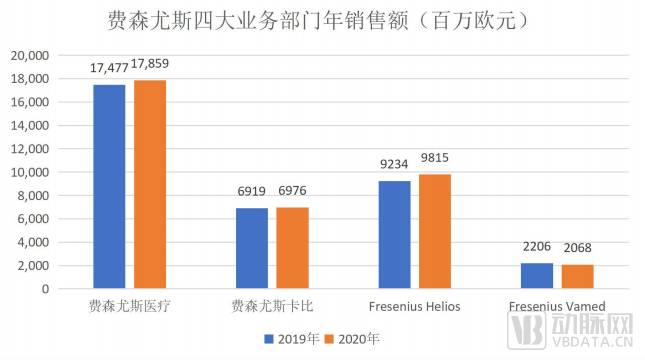
Source: Fresenius Group Official Website
From the perspective of the Fresenius Group’s overall business, consolidated sales exceeded €35 billion in 2019; in 2020, despite the impact of the pandemic, consolidated sales still achieved organic growth of 5% year-on-year, surpassing €36.6 billion.Among them, Fresenius Medical Care is the largest segment of the Fresenius Group, accounting for approximately 49%, with sales reaching €17.859 billion in 2020.
The King of Hemodialysis: The Evolution of Fresenius Medical Care
In the field of dialysis, Fresenius Medical Care is the undisputed global leader. According to its annual report, in 2020, its dialysis products accounted for 35% of the global market share, with hemodialysis products holding a 40% share globally. Meanwhile, worldwide, Fresenius Medical Care provides dialysis treatment services to approximately 9% of dialysis patients, treating more than 346,500 individuals.
Focus on kidney disease dialysis, with rapid expansion of products and services
Fresenius Medical Care primarily provides medical products and services centered on dialysis.Its dialysis business is vertically integrated; Fresenius Medical Care develops and manufactures dialysis products that are sold globally while also being supplied to its own dialysis services division, thereby optimizing its resource structure.
On the product, which can be categorized into hemodialysis products, peritoneal dialysis products, acute dialysis products, and non-dialysis products. In the field of hemodialysis, the comprehensive product portfolio includes dialysis machines, dialyzers, hemodialysis tubing sets, dialysate, water treatment systems, and data processing and analysis systems. For peritoneal dialysis, system solutions for Continuous Ambulatory Peritoneal Dialysis (CAPD) and Automated Peritoneal Dialysis (APD) are provided to dialysis centers.
In acute dialysis, it provides continuous renal replacement therapy (CRRT) products for use in intensive care units. Additionally, it offers non-dialysis products, primarily focused on acute cardiopulmonary care.
In terms of service, focusing on dialysis services while coordinating other nursing care services. Fresenius Medical Care primarily provides dialysis services by establishing dialysis centers worldwide, and also offers products and medical support for patients undergoing home dialysis.
In addition to dialysis services, Fresenius Medical Care is currently strengthening its non-dialysis service operations in North America and the Asia-Pacific region, gradually transitioning toward integrated coordinated care and expanding its scope of services.
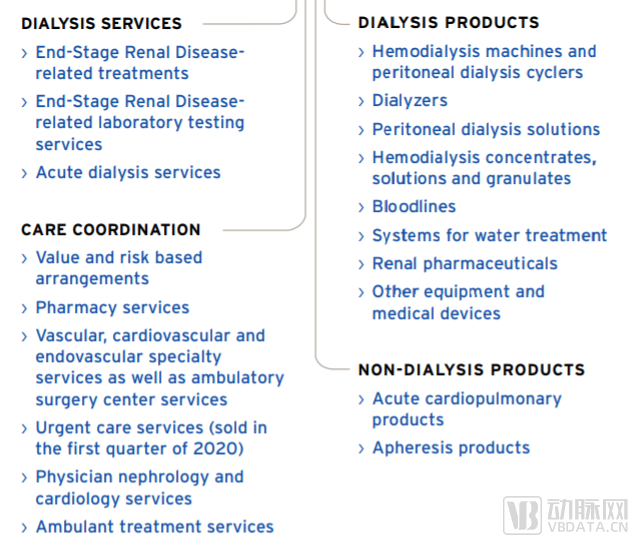
Fresenius Medical Care Products and Services Source: Fresenius Medical Care 2020 Annual Report
Since its inception, Fresenius Medical Care has been committed to providing advanced products and services for patients with kidney disease, achieving continuous progress and breakthroughs in the process.
In terms of volume, dialysis products and services have grown rapidly.Taking dialyzers as an example of dialysis products, Fresenius Medical Care’s production of dialyzers exceeded 50 million units in 2003. Four years later, this figure increased tenfold, with total dialyzer production surpassing 500 million units in 2007. In 2013, total dialyzer production reached 1 billion units, and the 2-billionth dialyzer rolled off the production line in 2020, just seven years after the previous “1 billion” milestone.
According to its annual report data, global dialyzer sales reached approximately 370 million units in 2020, with 158 million units supplied by Fresenius Medical Care, accounting for about 43% of the market. Among the estimated 90,000 dialysis machines installed globally in 2020, approximately 42,000 were from Fresenius Medical Care, representing a market share of about 48%.
Source: Fresenius Medical Care Official Website
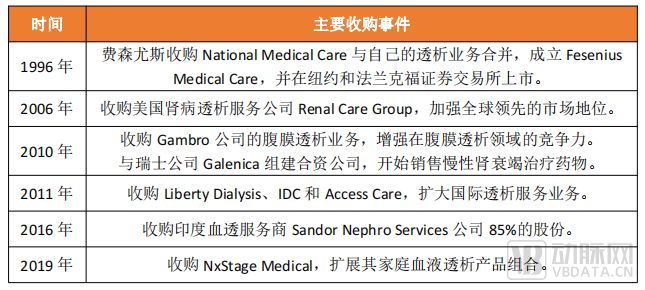
Fresenius Medical Care’s dialysis services have also kept pace, primarily achieving rapid expansion through acquisitions.For example, in 2006, the acquisition of the U.S. kidney disease dialysis service company Renal Care Group added 2,000 dialysis clinics and a patient base of over 150,000 to the company. In 2011, the acquisitions of IDC, Liberty Dialysis Holdings, and American Access Care further expanded its service operations.
Since 1996, it has established a network of over 4,000 dialysis clinics in approximately 50 countries and regions worldwide, serving more than six times the number of patients.
Revenue of €17.8 billion, with hemodialysis services accounting for the largest share
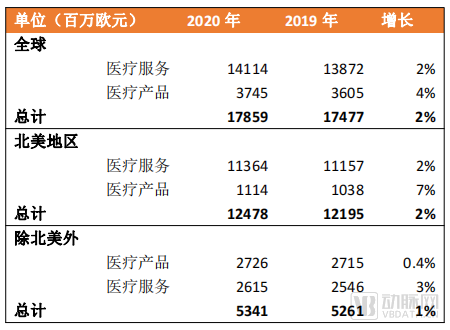
In Fresenius Medical Care’s annual report, total revenue for 2020 amounted to €17.859 billion, representing an increase of approximately 5% compared with 2019. Excluding medical products, revenue from healthcare services reached €14.114 billion, accounting for approximately 79% of the total and reflecting a year-on-year growth of around 2%.
Fresenius Medical Care operates across four geographic regions: North America, Europe, the Middle East and Africa (EMEA), Asia-Pacific, and Latin America. The North American market is the primary revenue driver, accounting for approximately 70% of total business. This is followed by the EMEA market at 15%, the Asia-Pacific market at 11%, and the Latin American market at 4%.
Source: Fresenius Medical Care 2020 Annual Report
In terms of Fresenius Medical Care’s global total revenue, revenue from medical services far exceeds that from product sales, accounting for 79%.North America, as the primary market, has reached saturation in dialysis centers; consequently, sales of dialysis products such as dialysis machines are significantly lower than those of dialysis services, amounting to only a fraction of service revenue. In markets outside North America, however, revenue from dialysis products is roughly comparable to that from dialysis services.
As of the end of 2020, approximately 3.7 million patients worldwide were regularly receiving dialysis treatment, with the market size reaching about €82 billion, of which dialysis services accounted for more than 80%. The dialysis services sector holds substantial growth potential, particularly in emerging markets. Taking China as an example, the proportion of patients receiving dialysis treatment is very low; the treatment rate was approximately 25% in 2020, leaving a significant gap compared to the roughly 80% treatment rate observed in European and American countries.
It is also worth noting that, due to the impact of the pandemic, more than 14% of dialysis treatments provided by Fresenius Medical Care in the United States in 2020 were administered in home settings, representing a significant increase from 2019. In its outlook for 2021, Fresenius Medical Care also stated that it would continue to increase its investment in the field of home dialysis.
Enhancing Treatment Outcomes Through Innovation to Drive Business Growth
From the perspective of product innovation, Fresenius Medical Care continuously improves dialysis technology and introduces new, innovative treatment concepts.Since 1979, Fresenius Medical Care has independently developed dialysis machines and launched its first model, the A2008, which won the Gold Award for Technological Innovation at the Leipzig Trade Fair.
Subsequently, the company launched the new 5008 and 6008CAREsystem dialysis treatment systems. In 2019, it also introduced the 4008A dialysis machine, specifically developed to meet the needs of developing countries. This product maintains high treatment standards while demonstrating excellent cost control.
In the development of dialyzers, the company developed synthetic polysulfone fiber membranes for blood purification in 1983, establishing today’s industry standards. Since then, it has continuously innovated in areas such as product design and material selection.
For example, in 2020, Fresenius Medical Care pioneered the launch of its next-generation dialyzer, FX CorAL, in Europe, the Middle East, and Africa. This product features an innovative Helixone hydro fiber design, which may reduce the risk of immune reactions. Meanwhile, another new dialyzer, Optiflux Enexa F500, received FDA 510(k) clearance.
In the field of home dialysis, Fresenius Medical Care will launch the SILENCIA automated peritoneal dialysis (APD) treatment system in 2021, which enables silent therapy while patients sleep at night.
In the non-dialysis sector, Fresenius Medical Care’s Novalung system for respiratory or cardiopulmonary support received FDA approval in February 2020. This system maintains patients’ blood circulation, oxygenates blood extracorporeally, and reduces the burden on the heart and lungs. It is the first ECMO system approved in the United States for use as a life-support therapy for more than six hours.
Developing innovative products and continuously improving renal therapies are integral components of Fresenius Medical Care’s business growth strategy. In 2020, Fresenius Medical Care’s total R&D expenditure amounted to €194 million, representing an increase of €26 million compared with 2019.
Its R&D innovation is driven by two forces, internal and external:Internally, Fresenius Medical Care’s R&D activities are centrally managed by the Global Research and Development (GRD) department., enabling the effective development of products and renal therapies, and systematically promoting technical exchanges.Externally, Fresenius Medical Care collaborates with numerous academic institutions and startups., to foster an open innovation culture and acquire the latest technologies.
2025 Strategy: Imagining the Future of Healthcare
In the future, the global number of dialysis patients is projected to increase from approximately 3.7 million in 2020 to over 6 million by 2030. Going forward, the focus of dialysis treatment will shift from merely providing standalone dialysis products or services to integrating all dialysis-related application areas, thereby offering comprehensive solutions that encompass chronic kidney disease management, dialysis services, hospitalization, and kidney transplantation.
Fresenius Medical Care believes that the future of healthcare will face challenges such as an aging population, a rise in lifestyle-related chronic diseases, and increasing demand for holistic care. Meanwhile, artificial intelligence and digitalization have begun to disrupt traditional healthcare delivery models.
For instance, amid the impact of the current pandemic, demand for home dialysis has surged, prompting Fresenius Medical Care to rapidly expand its home dialysis product portfolio. As an increasing number of patients receive treatment at home, connectivity between healthcare providers and patients has become one of the key factors driving the development of home dialysis, with digital health services demonstrating distinct advantages.
Fresenius Medical Care is developing related methods and solutions to make the treatment process more efficient. In 2020, Fresenius Medical Care launched the Kinexus therapy management service in Chile and the United States, a cloud-based home patient management solution. Its features include remote dialysis monitoring, treatment workflow management, personalized prescriptions, and daily treatment reports for clinicians.
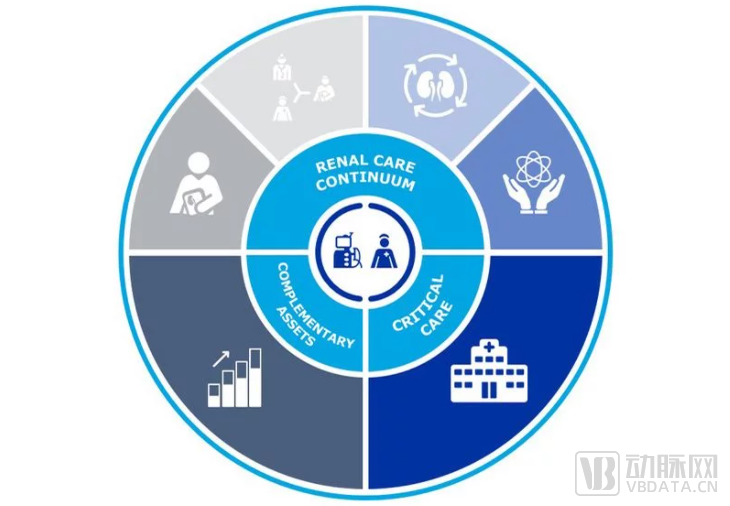
In its outlook for the future, digital and intelligent healthcare services are undoubtedly one of the key focus areas for Fresenius Medical Care. More specifically,Fresenius Medical Care launched its 2025 Strategy in 2020, stating that it would focus on three key areas: continuity of renal care, critical care solutions, and complementary assets.
Source: Fresenius Medical Care Official Website
Fresenius Medical Care will focus on four key areas in kidney care.One, by leveraging digital tools such as artificial intelligence to develop new models of kidney care, thereby advancing personalized dialysis and innovative therapies.II, leveraging its experience in disease management and the collaborative partnerships established worldwide to drive the transition of service payment models toward pay-for-performance.
ThirdFresenius Medical Care aims to expand its range of services and products, incorporating the treatment of chronic kidney disease and kidney transplantation into its business portfolio, thereby providing holistic care and treatment for patients along the entire continuum of kidney disease management.IV, by making strategic investments in startups to help itself acquire new technologies and therapies in the field of kidney care.
On Critical Care SolutionsIn the long term, demand for intensive care will rise, and Fresenius Medical Care will expand its existing portfolio of products in the intensive care sector. For instance, Fresenius Medical Care projects that by 2030, the number of patients requiring continuous renal replacement therapy (CRRT) for acute renal failure will increase to 1.6 million.
In terms of asset complementarity, Fresenius Medical Care will continue to complement its current products and services through partnerships, investments, and acquisitions, building a more solid and resilient foundation for growth beyond 2025.
For example, in 2020, Fresenius Medical Care invested in Alucent Biomedical and Magenta Medical in the field of regenerative medicine. The former is developing products to help keep human arteries patent, while the latter is researching next-generation percutaneous left ventricular assist devices and transcatheter renal vein volume reduction devices.
Fresenius Medical Care in China
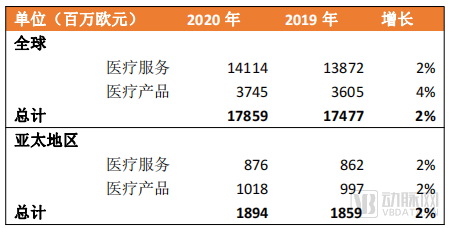
Fresenius Medical Care’s revenue in the Asia-Pacific market has maintained a relatively stable growth trend in recent years. The most significant difference compared to the global market lies in the disparity in the ratio between services and products.
Source: Fresenius Medical Care 2020 Annual Report
The global market is heavily influenced by North America, where revenue from medical services significantly exceeds that from product sales. In contrast, in the Asia-Pacific market, product sales revenue surpasses that of medical services. This is primarily due to the insufficient development of dialysis service facilities in the Asia-Pacific region, where the dialysis treatment rate has not yet reached the levels seen in North America.
Conversely, the Asia-Pacific market offers substantial room for growth. Taking China as an example, VCBeat projects that by 2025, the market size for dialysis equipment, pharmaceuticals, and consumables will approach RMB 30 billion, while the market for dialysis services will near RMB 70 billion.
In China, Fresenius Medical Care’s dialysis products were the first to enter the market. Its dialyzers and dialysis machines hold a significant market share in China. However, with the recent implementation of volume-based procurement for high-value medical consumables, Fresenius Medical Care will face a series of impacts.
In June this year, the Anhui Provincial Healthcare Security Administration released the “Work Plan for the 2021 Centralized Volume-Based Procurement of High-Value Medical Consumables in Anhui Province,” formally including four categories of high-value medical consumables, such as hemodialyzers, in the centralized procurement program. Previously, many other regions had also implemented volume-based procurement for hemodialysis-related medical consumables. For instance, according to information released by the Nanjing Municipal Healthcare Security Administration in April this year, prices for hemodialyzer products dropped by a maximum of 66.86% and an average of 41.54% following negotiations on medical consumables.
Products first, services later. Fresenius Medical Care’s deployment of dialysis services in China did not commence until after the policy liberalization in 2016.
With the opening of policies in the hemodialysis industry, Fresenius Medical Care began establishing self-operated dialysis centers nationwide in 2017, introducing internationally leading dialysis services (FKC) and peritoneal dialysis business. Since the end of 2017, Fresenius Medical Care has actively collaborated with hospitals and enterprises across China to rapidly expand its dialysis service operations.
As one of Fresenius Medical Care’s key global markets, the company has been present in China for nearly two decades.During this period, Fresenius Medical Care established its first manufacturing plant in Changshu in 2007. To better serve the Chinese market, it founded a research and development (R&D) center in Shanghai at the end of 2015, marking its first R&D center outside Europe and America. In early 2016, Fresenius Medical Care established the Fresenius Nursing Academy to train professional medical staff, standardize operational procedures, and enhance nursing standards...
Fresenius Medical Care will accompany China’s dialysis industry through many more 20-year chapters.
References:
[1] Fresenius Medical Care. 2020 Annual Report.
[2] Wang Shiyu, Lu Mengyi. Surge in Demand and the Rise of Domestic Brands: 2021 Hemodialysis Industry Report. VCBeat. May 15, 2021
[3] Liu Zongyu. In-Depth Analysis of Independent Hemodialysis Centers: This Niche Sector Already Boasts a Market Size of RMB 150 Billion. 2017.04.10