

Roivant Sciences Files Prospectus to Break Pharma's 'Eroom's Law' with Innovative Hub-and-Spoke Model
Roivant Sciences
Biopharmaceutical Company
With continuous breakthroughs and advancements in science and technology, societal development has progressed by leaps and bounds. The rapid iteration of most technologies seems to validate the existence of “Moore’s Law.” However, the pharmaceutical industry, which impacts the health and well-being of people worldwide, plays the role of an “anti-Moore’s Law”—Since 1950, the number of new drugs approved for market launch per $1 billion invested has halved every nine years, while the cost of new drug development has surged dramatically.
On July 17, 2019, the journal Trends in Pharmacological Sciences published a review article titled “Artificial Intelligence in Clinical Trial Design” by the IBM Watson Health AI team. The article pointed out that AI can accelerate the success of drug clinical trials, thereby helping to address the challenge posed by “Eroom’s Law.” Consequently, the integration of AI into new drug development has spurred vigorous growth in the AI-driven pharmaceutical sector.
According to incomplete statistics from VCBeat, the global AI-driven drug discovery sector saw 33 transactions in the first half of 2021 (H1 2021), with cumulative financing reaching $2.57 billion—already approaching the full-year 2020 total of $2.78 billion. Based on this trend, financing in the AI-driven drug discovery sector is highly likely to hit a new record high in 2021. The fervor in the financing market also reflects the strong desire to leverage AI to enhance the efficiency of new drug development.
However, as a technological tool, AI is merely one of the approaches to enhancing the efficiency of new drug development from a technical perspective. Apart from AI, are there other avenues that can accelerate the efficiency of new drug development?
Swiss CompanyRoivant SciencesBy building a highly distinctive business landscape, it strives to enhance the efficiency of new drug development from multiple dimensions—including operating a specialized business model, advancing foundational technologies, and mining and integrating underlying data—so as to break the pharmaceutical industry’s “Eroom’s Law.”
Roivant Sciences (hereinafter referred to as “Roivant”) was founded by Vivek Ramaswamy in 2014. The company is headquartered in Basel, a city in northwestern Switzerland, situated along the scenic Rhine River.Roivant aims to become a large holding company serving dozens of biopharmaceutical companies, building a “Vant Empire” (all companies founded by Ramaswamy have names ending in “vant”)—enabling each subsidiary to focus on drug development in different disease areas while simultaneously advancing technologies to accelerate the drug development process and improve the efficiency of new drug research and development.
Roivant adopts a “hub-and-spoke” model to build its business portfolio, aiming to create what the company describes as “a new form of industrial organization in R&D.”Each biopharmaceutical subsidiary under Roivant operates as an independent entity to preserve the agility, flexibility, and innovative entrepreneurial spirit of a startup; meanwhile, each subsidiary can leverage and share resources from the parent company and other data-driven subsidiaries to support the development and commercialization of its respective drug candidates.
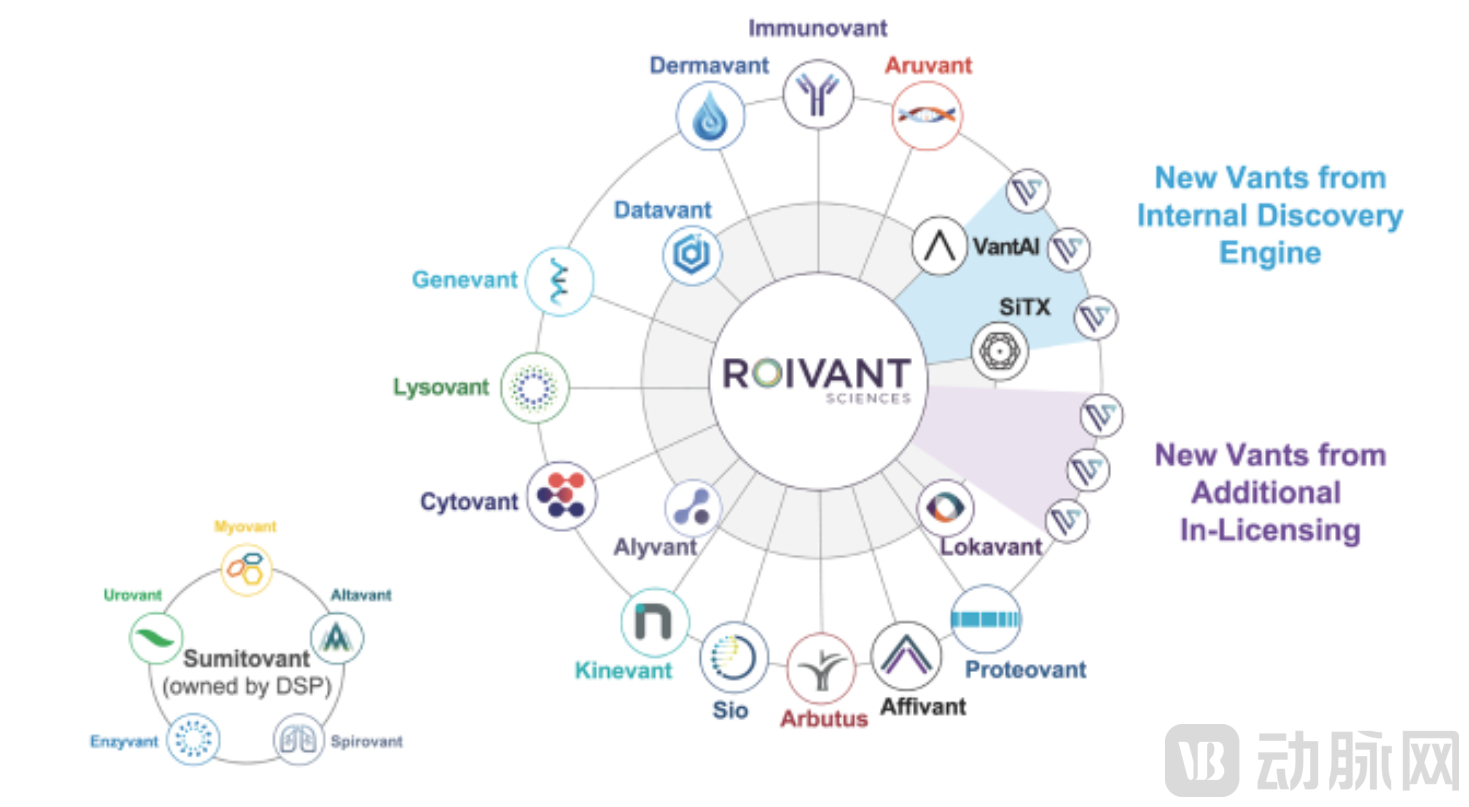
Roivant Sciences’ “Vant Empire”
Caption in the lower-left corner: Altavant, Enzyvant, Myovant, Spirovant, and Urovant were transferred to a subsidiary of Sumitomo Pharma in December 2019.Sumitovant
(Image source: Sec.gov)
Since its inception in 2014, Roivant has established or acquired and merged 21 subsidiaries, four of which have successfully gone public and five of which were acquired by Sumitomo Pharma. The company has invested in the development of a drug pipeline comprising more than 40 candidates across a broad range of therapeutic areas, initiated eight active Phase III clinical trials, and secured FDA approval for three drugs.Its prominent development partners include Takeda, Merck, GlaxoSmithKline, AstraZeneca, Eisai, Vertex Pharmaceuticals, and Daiichi Sankyo.
Next, we will examine Roivant Sciences through the lens of its core mission to “enhance the efficiency of new drug development,” exploring the company via three distinct business pillars: its operationally driven commercial model, the advancement of foundational technologies, and the mining and integration of underlying data.
Roivant Sciences was founded with the original intention of“Rescuing the Forgotten Drugs of the Pharmaceutical Industry”This idea emerged because Vivek Ramaswamy, during his tenure as a hedge fund manager on Wall Street, observed that many large pharmaceutical companies were abandoning drug candidates with significant potential for various reasons. His own success in the investment sector further solidified his resolve to make “rescuing forgotten drugs in the pharmaceutical industry” the cornerstone of his future career.
During his tenure as a hedge fund manager at QVT Financial, Ramaswamy successfully invested in multiple hepatitis C drug companies. His most notable achievements include two key investments: beginning in 2008, he accumulated a large position in Pharmasset at extremely low prices (Pharmasset was later acquired by Gilead for $11 billion), and in 2009, he purchased substantial shares of Inhibitex at approximately $1 per share (Inhibitex was acquired by Bristol Myers Squibb [BMS] for $2.5 billion in 2012). These investments generated an approximate 25-fold return for QVT. At just 28 years old, Ramaswamy became a partner at QVT.
It was precisely this unique investment experience that allowed Ramaswamy to see“Many pharmaceutical companies abandon the development of numerous drugs with market potential due to reasons unrelated to drug efficacy, resulting in the discarding of many medications that could have been beneficial to society.”。
Ramaswamy is determined to establish Roivant Sciences to help complete clinical trials for drug pipelines that have been “abandoned by pharmaceutical companies but still hold development potential,” enabling their smooth market entry and thereby enhancing the efficient utilization of new drug resources.
To maximize the R&D success rate of these “orphan” new drugs, Roivant Sciences typically recruits the original technical teams behind the relevant drug development programs or top-tier scientists in the field to participate in their development. This approach ensures optimally designed clinical trials, strives to mitigate R&D risks, and shortens drug development timelines. Roivant Sciences is “quite adept” at attracting high-quality talent.By establishing highly attractive R&D incentive mechanisms and a secure employment framework, Roivant Sciences has attracted numerous top-tier talents who previously held key positions at major pharmaceutical companies to join its subsidiary teams.
For example, Rachelle Jacques, former Global Vice President of Alexion Pharmaceuticals, now serves as the CEO of Enzyvant, a Roivant Sciences company; Pete Salzmann, who held various key positions during his 20-year tenure at Eli Lilly, now serves as the CEO of Immunovant, another Roivant Sciences company.
Roivant’s talent incentive mechanism not only employs the equity incentives commonly used by small startups, but also stipulates that scientists responsible for drug development will receive substantial financial rewards if the relevant drugs successfully reach the market. Even if the drugs ultimately fail to gain market approval, Roivant will secure suitable positions for these scientists within its other subsidiaries, allowing them to continue engaging in the clinical development of other drug candidates.
In contrast, traditional pharmaceutical companies typically treat scientists as follows: when a drug developed by the team becomes a blockbuster, the scientists usually receive no reward; if drug development fails, it often results in layoffs.
Of course,For drugs with R&D costs easily reaching hundreds of millions, Roivant does not accept all new drug “orphans” indiscriminately.How to Identify Drugs for Continued Development from a Vast Pipeline? Roivant Sciences Employs a Proprietary Algorithm: It First Searches and Screens Drug Information from Public Databases and Stakeholder Data Networks. After Identifying Several Candidate Drugs, the Company’s Analysts Compare Them with Existing Drugs in Terms of Therapeutic Class, Mechanism of Action, Efficacy, and Safety, While Also Considering Market Size, to Select the Target Drug.
Daniel Rothman, former Chief Information Officer of Roivant Sciences, stated: “Roivant begins by reviewing research patents and then identifies companies with clinical trials steadily progressing. Through this approach, the company narrows its focus to five candidates and three drugs. Meanwhile, in consideration of eventual drug commercialization, Roivant carefully evaluates unmet clinical needs to determine the actual patient population requiring these medications.”
In its early development stages, Roivant’s unique business model was certainly eye-catching. The compelling vision of enhancing new drug R&D efficiency by redeveloping drugs “abandoned by pharmaceutical companies yet still possessing development potential” was indeed promising. However, for the traditional pharmaceutical industry, this business model still carries significant risks.
Even with access to top-tier R&D resources, talent, and ample capital, pharmaceutical giants cannot guarantee the successful development of new drugs. How likely is it that Roivant’s opportunistic investment strategy will achieve net profitability, while also withstanding the risks of clinical failure or patent cliffs?
As a savvy investor, Vivek Ramaswamy certainly does not “put all his eggs in one basket”; he understands better than most how to “balance” an investment portfolio to achieve overall profitability. As noted at the beginning of this article, there is more than one way to improve the efficiency of new drug development, and AI-driven drug discovery represents a promising approach. This pathway has not only generated significant enthusiasm in the capital markets, but real-world research has also confirmed that AI-driven drug discovery can indeed yield substantial returns.
In June 2020, the journal Drug Discovery Today published a short review article titled “The upside of being a digital pharma player,” which analyzed the current state of AI applications in the R&D departments of 21 global pharmaceutical giants from 2014 to 2018. The results indicated that although the AI-driven drug discovery field is still in its early stages, it is trending toward maturity. The article examined the revenues and R&D investments of these major pharmaceutical companies, finding that only Sanofi and Gilead had investments exceeding their returns, whereas AstraZeneca and Novartis were representative cases where returns far surpassed R&D investments.
In 2019, Roivant established VantAI, a company providing an artificial intelligence-powered computational drug design platform. By assisting biopharmaceutical companies in de novo drug design, drug target prediction, computational ADMET profiling, and interactive mapping, as well as in the computational design and optimization of protein degraders, VantAI aims to enhance the efficiency of new drug development. In January 2021, Roivant announced the acquisition of Oncopia Therapeutics, a protein degradation-focused company, to fully leverage the advantages of its computational drug discovery platform, VantAI, and create synergistic alignment among its subsidiaries.
In February 2021, Roivant announced the acquisition of Silicon Therapeutics for $450 million (approximately RMB 3 billion), with an additional $1.6 billion to be paid in installments contingent upon pipeline development, bringing the total transaction value to $2.05 billion (approximately RMB 13.3 billion).
Silicon Therapeutics is a drug design and development company focused on small-molecule therapeutics. Its proprietary physics-driven drug design platform integrates quantum physics, statistical thermodynamics, molecular simulation, dedicated high-performance computing clusters and related software, as well as in-house laboratory and clinical development capabilities. The platform aims to tackle traditionally “undruggable” targets through physics-based simulations and experimental validation, thereby opening new avenues for drug design. Silicon Therapeutics is currently the only company with a fully integrated pipeline spanning from physics-driven drug discovery to clinical trials. Its lead program is a highly differentiated small-molecule stimulator of interferon genes (STING) agonist for cancer treatment, which entered clinical development in November 2020.
Previously, Roivant’s capabilities in computation-driven drug development were more prominently reflected in the clinical and commercial stages, whereas Silicon Therapeutics’ physics-based computing platform was specifically tailored for early-stage preclinical research. Following this acquisition, the integration of the two companies not only strengthens Roivant’s capabilities in computer-aided drug discovery but also completes the final link in closing the loop of its pharmaceutical value chain. Roivant will now be able to leverage both physics-based computational and machine learning approaches for drug design.
In its efforts to enhance the efficiency of new drug development, Roivant not only employs a “niche-picking” investment strategy to fully leverage R&D resources and deploys AI-driven drug discovery using advanced technologies to accelerate the process, but also actively engages in clinical data mining and the integration of healthcare big data to further improve new drug development efficiency.
Vivek Ramaswamy found that, unlike other industries, information sharing in the pharmaceutical sector is extremely limited:Data silos are prevalent among pharmaceutical companies, gene sequencing firms, contract research organizations (CROs), universities, research institutes, and hospitals, with minimal data intersection. This fragmentation has severely limited the development and application of healthcare big data.Ramaswamy believes that the proper integration and utilization of big medical data is one of the effective ways to improve the efficiency of new drug development.
In September 2017, Roivant established Datavant to integrate healthcare data, leveraging artificial intelligence for efficient data analysis and processing to enhance the efficiency of new drug development. Datavant stated that the integration and analysis of these data would be used to guide the design and conduct of clinical trials, thereby increasing the success rate of clinical trials, reducing trial costs, and shortening the time to market for new drugs.
In 2019, Roivant established Alyvant, a company dedicated to linking de-identified patient data with physician data to match patient populations with appropriate therapies in the most cost-effective manner, thereby helping pharmaceutical sales address drug marketing challenges. Benjamin Zimmer, President of Roivant Health, stated in a press release: “Alyvant’s technology platform enables us to enter new market segments underserved by traditional pharmaceutical business models, while also reducing reliance on expensive and wasteful mass-market direct-to-consumer (DTC) campaigns that drive up the cost of delivering new medicines to patients.”
The above outlines Roivant’s business landscape to date.
In this light, Roivant’s parallel pursuit of three strategic pillars—innovating new drug R&D models, leveraging advanced technologies to accelerate the drug development process, and strengthening the mining and integration of healthcare big data to enhance R&D efficiency—represents a forward-looking and relatively comprehensive corporate development strategy. We applaud Roivant’s business landscape and are impressed by Vivek Ramaswamy’s visionary leadership.
However, Ramaswamy did not initially implement such a visionary strategic layout. Instead, he gradually built the aforementioned business landscape through the company’s continuous development over the years and his deepening insights into the market. In its early days, Roivant was relatively small in scale and lacked substantial capital strength. It primarily attracted investment by adopting an aggressive new drug development strategy of “turning waste into treasure,” coupled with Ramaswamy’s impressive prior professional track record and charismatic personality, which persuaded certain investors to place their bets on Roivant. During this initial growth phase, many investors were effectively investing in Vivek Ramaswamy as an individual.
As Roivant continues to grow and strengthen its capital foundation, the company has gradually expanded its business portfolio, balanced its “investment portfolio,” and strategically positioned itself in high-growth sectors, thereby reducing its overall development risk.
To date, Roivant has established 21 subsidiaries through organic creation and mergers and acquisitions, of which four have successfully gone public and five have been acquired by Sumitomo Pharma. Over the seven years since its founding, Roivant has invested in the development of more than 40 drug candidates covering a broad range of disease areas, initiated eight active Phase III clinical trials, and secured FDA approval for three drugs.
Among the four biopharmaceutical companies established by Roivant, two respectively achieved the largest IPO in the history of the biotechnology sector at that time and the largest IPO in the biotechnology sector for that year—Sio Gene Therapies (formerly known as Axovant Sciences, renamed in 2020) was founded in 2014 and completed its IPO in 2015, raising $315 million, which made it the largest biotechnology IPO in U.S. history at that time. Myovant Sciences (acquired by Japan’s Sumitomo Pharma), established in 2016 through a collaboration between Roivant Sciences and Takeda Pharmaceutical Company, successfully listed on the New York Stock Exchange just four months later, raising $218 million, marking it as the largest IPO in the biotechnology sector that year.
Roivant has three FDA-approved drugs: Orgovyx (relugolix) and Myfembree, both from Myovant Sciences (acquired by Sumitomo Pharma of Japan), are indicated for the treatment of advanced prostate cancer in adults and for the management of heavy menstrual bleeding associated with uterine fibroids in premenopausal women, respectively; the third approved drug is GEMTESA® (vibegron) from Urovant Sciences (also acquired by Sumitomo Pharma of Japan), a medication for the treatment of overactive bladder (OAB) in symptomatic adults.
Currently, among the product pipelines of Roivant’s 16 subsidiaries, 14 products have entered clinical development.
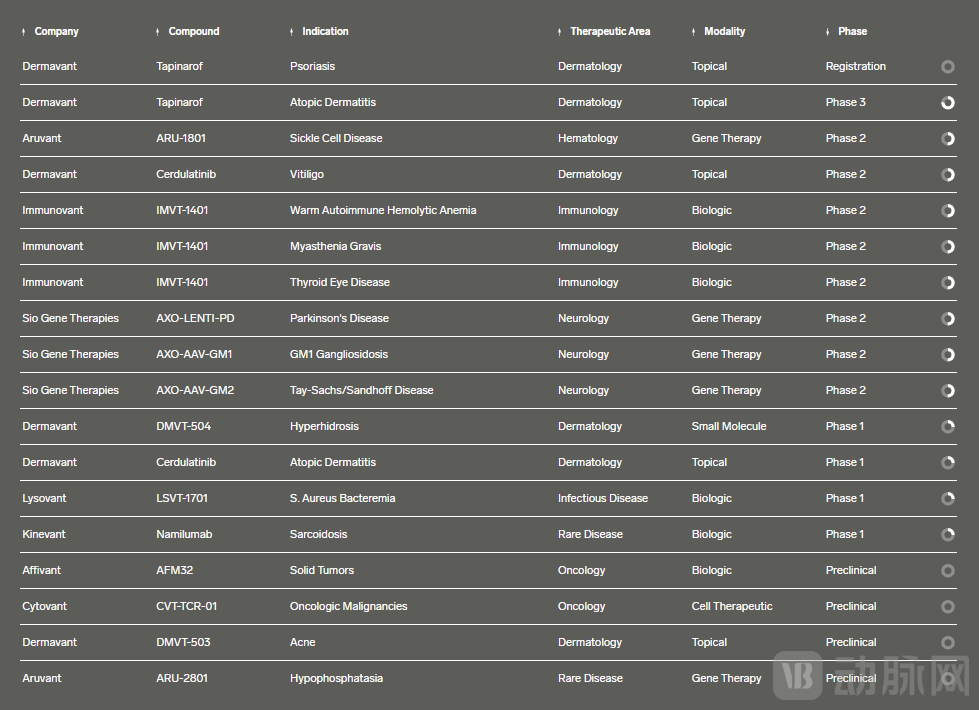
Image source: Roivant Sciences official website
Currently, the product pipeline with the most rapid progress is that of Dermavant, a subsidiary of Roivant Sciences focused on the development of drugs for immune-mediated dermatological conditions. The company recently completed two pivotal Phase III clinical trials, PSOARING 1 and PSOARING 2, evaluating tapinarof for the treatment of mild, moderate, and severe plaque psoriasis in adults.
Dermavant has currently submitted a New Drug Application (NDA) to the FDA for tapinarof in the treatment of plaque psoriasis in adults, with approval results expected by mid-2022. If approved, tapinarof will become the first novel topical therapy approved by the FDA for plaque psoriasis in more than 20 years. Additionally, Dermavant expects to initiate pivotal Phase 3 clinical trials of tapinarof for the treatment of atopic dermatitis in the second half of 2021. On May 14, 2021, Dermavant entered into a $160 million Royalty Interest Purchase Sale Agreement (“RIPSA”) with three institutional investors regarding tapinarof.
Roivant Sciences’ rocket-like growth, driven by its distinctive business development model, has attracted a wave of prominent investors and publicly listed companies eager to extend olive branches. These entities have either made substantial investments or acquired assets at significant cost, including global pharmaceutical giant Pfizer, Japan’s Sumitomo Pharma, and notable investment firms such as SoftBank and South Korea’s SK Holdings.
In October 2016, at the time of Myovant’s launch, Pfizer became a major investor in Myovant with a $30 million investment (approximately RMB 200 million), securing priority negotiation rights and a board observer seat.
In August 2017, SoftBank led a $1.1 billion (approximately RMB 7 billion) investment in the company, setting the record for the largest venture capital deal in Europe that year;
In September 2019, Sumitomo Dainippon Pharma announced a plan to pay $3 billion (approximately RMB 19.4 billion) in upfront consideration to acquire equity interests in five Roivant subsidiaries—Altavant, Enzyvant, Myovant, Spirovant, and Urovant—as well as to obtain a 10% equity stake in Roivant and priority rights to acquire six additional subsidiaries.
In December 2020, following the acquisition of a PROTAC company, Roivant’s targeted protein degradation drug development platform received a $200 million (approximately RMB 1.3 billion) equity investment from SK Holdings of South Korea.
Roivant was the talk of the town.
On May 3, 2021, Roivant Sciences announced that it was preparing to embark on a “new chapter” by going public through a merger with a special purpose acquisition company (SPAC), a process expected to raise $611 million.
News reports reveal that Roivant will receive up to $411 million from the SPAC Montes Archimedes Acquisition Corp., along with a $200 million investment from investors including Fidelity Management & Research Company, Eventide Asset Management, Suvretta Capital, Palantir Technologies, RTW Investments, LP, Viking Global Investors, SoftBank, and Sumitomo Pharma. The combined company will operate under the name Roivant.
The new Roivant will continue to operate under its original management team, led by CEO Matthew Gline. Company founder and former CEO Vivek Ramaswamy will continue to serve as Executive Chairman. Upon completion of the transaction, the new Roivant’s shares will be traded on the Nasdaq under the ticker symbol “ROIV.” The deal is expected to close in the third quarter of this year.
Over the past half-century, science and technology have advanced at an unprecedented pace, with most industries achieving either breakthrough innovations or disruptive progress. However, new drug development, the primary driving force behind the pharmaceutical industry, has remained largely stagnant, even witnessing a declining trend in R&D efficiency. This is ultimately attributable to the extreme complexity of life processes and our insufficient understanding of biological systems. Therefore, prioritizing basic scientific research and enhancing our comprehension of biological systems are essential to fundamentally addressing the issue of low efficiency in new drug development. This is a long-term developmental process.
At the same time, we must not overlook innovation in the business models of the pharmaceutical industry, nor cease our exploration of more effective ways to enhance the efficiency of new drug development. Progress in any industry is driven by innovation, which encompasses not only technological breakthroughs but also model innovations. Similar to Flagship Pioneering, the emergence and development of Roivant Sciences have provided another new window for us to contemplate the future of the pharmaceutical industry.
In the 21st century, it seems that only imagination is the true ceiling.