

MaiLing Robotics Files IPO Prospectus: Delivering High-Cost-Performance Surgical Robots Driven by Clinical Needs
According to the latest census data, China’s population aged 60 and above has reached 264.02 million, accounting for 18.70% of the total population. The deepening aging trend has led to a year-on-year increase in the incidence of joint disorders and sports medicine–related injuries.
Meanwhile, with the growing clinical demand for precision medicine in recent years, traditional orthopedic surgeries have largely relied on the surgeon’s experience and clear visualization of the lesion. Large incisions and high radiation exposure can increase surgical risks. In contrast, robot-assisted orthopedic surgery offers advantages such as precise targeting of the lesion, minimally invasive incisions, high stability, and favorable postoperative outcomes. Consequently, surgical robots are gradually gaining clinical acceptance.
At the policy level, China has intensified support for domestically produced products. With abundant clinical research resources and rapid development in AI applications, the proportion of domestic robots has been increasing year by year. Under the impetus of policy support and technological advancements, the trend toward import substitution with domestic alternatives is clear. From a market perspective, driven by an aging population amid China’s vast demographic base and rising healthcare demands due to improved living standards, China boasts a large and rapidly growing surgical robot market. Given the currently low penetration rate, there is significant room for future market expansion.
Amid this trend, a growing number of innovators are entering the surgical robotics field, with MaiLing Robotics being one of them.
Focusing on the Surgical Robotics Sector, Winning with Speed
Based on Zhang Shen’s prior work experience, it seems difficult to associate her with the development of surgical robots; however, she has never been far removed from the healthcare industry.
Before founding Mileading Robotics, Zhang Shen worked as a medical journalist for a television station and later managed brand marketing for pharmaceutical and medical device clients at Ogilvy & Mather, a globally renowned public relations firm. It was these experiences that allowed Zhang Shen to witness the profound changes brought about by technological innovations in healthcare for both clinicians and patients.
Through professional connections, Zhang Shen met numerous medical AI experts from Shanghai Jiao Tong University and Tsinghua University, conducted multiple in-depth studies and on-site visits in the field of surgical robotics, and ultimately decided to provide comprehensive solutions for surgical robots driven by actual clinical needs.
By definition, surgical robots represent a novel interdisciplinary research field that integrates medicine, mechanics, biomechanics, and computer science. They are also system-integrated products encompassing materials, optoelectronic technology, visual imaging, algorithms, motion control, and consumable design. Leveraging advances in minimally invasive surgery and related underlying technologies, they provide surgeons with multimodal support through visual, auditory, and haptic feedback during surgical procedures.
This means that the research, development, and manufacturing of surgical robots face extremely high technical barriers, and product costs are high, which has indirectly led to low market penetration of surgical robots.
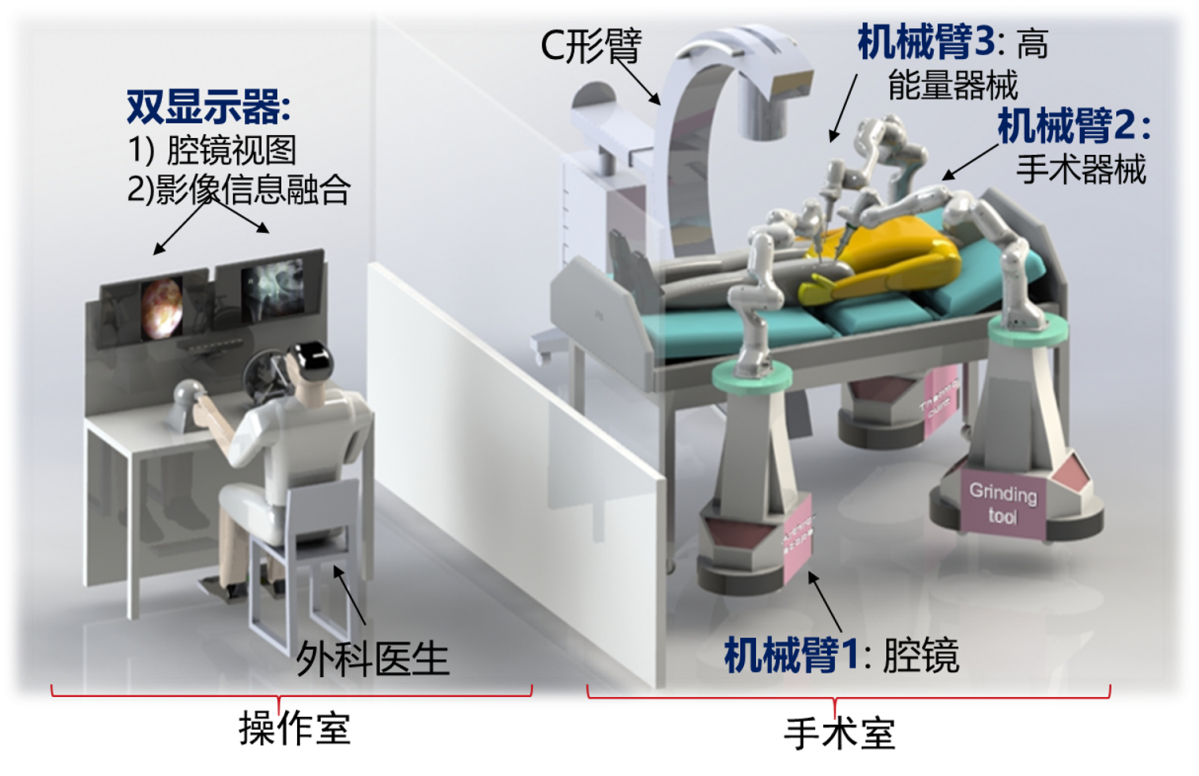
Mailling Robotics’ ability to establish a strong presence in this field is clearly underpinned by the technical expertise of its core team. It is reported that most members of Mailling Robotics’ R&D team hold master’s degrees from prestigious universities such as Shanghai Jiao Tong University, Tsinghua University, and Harbin Institute of Technology. Currently, the Mailling Robotics team has collaborated with the medical AI teams at Shanghai Jiao Tong University and Tsinghua University to develop an orthopedic endoscopic robot. The functional prototype has been successfully developed, and two patent certificates have been granted. Meanwhile,Clinical studies have been conducted in collaboration with Shanghai Jiao Tong University-affiliated Sixth People's Hospital and Ninth People's Hospital. It is expected that full-scale production of the complete device will be completed, and the final deliverables will be formally handed over, within the next 18 to 24 months.。
During this period, MaiLing Robotics will simultaneously advance clinical trials for its products and pursue relevant patent approvals, continuously building a technological moat to ensure the smooth subsequent commercialization and market promotion of its products.
As the saying goes, “In the world of martial arts, speed is the ultimate weapon that cannot be defeated.” In many cases, speed is the key determinant of success or failure.
From the perspective of market entry timing, MaiLing Robotics does not hold a first-mover advantage; however, the team’s ability to rapidly complete prototype development and its plan to achieve successful production within the next two years constitute the company’s key competitive strengths.
Deploying at the Grassroots Level: Developing a Multi-Functional Orthopedic Robot for County-Level Hospitals
In Zhang Shen's view,Strategic Penetration into Lower-Tier Markets: Early Deployment of Surgical Robots in Primary Hospitals Across China Is Mailling’s Most Critical Strategic Pivot, with far-reaching significance.
In terms of market size and application prospects, primary hospitals reach over 90% of the potential patient population across China. With the national planning and development of medical consortia and medical alliances, primary healthcare institutions will accommodate an increasing number of local patients. As a pioneer in deploying surgical robots in primary hospitals, Mailling focuses strategically on establishing a presence in these facilities and supporting them by providing the products and ancillary services most needed by primary care physicians.
After surveying numerous primary-care hospitals across China, Zhang Shen uncovered a key insight: compared with large tertiary Grade-A hospitals in core cities, primary-care hospitals have a greater need for cost-effective, multi-functional surgical robots capable of performing multiple procedures with a single system.
Currently, in the field of surgical robotics, the prevailing industry consensus is that the U.S. healthcare system, characterized by generalist practice, is well-suited for integrated products represented by the da Vinci Surgical System. In contrast, most hospitals in China operate under a specialist-driven model, making functionally specialized products better aligned with domestic hospital needs. However, after interviewing numerous grassroots surgeons, Zhang Shen found that multi-functional integrated products are actually better suited to the surgical needs of primary-care hospitals in China.
Taking orthopedics as an example, primary care hospitals typically have only one or two orthopedic surgery departments, far fewer than large tertiary Grade A hospitals in first-tier cities. Therefore, products with highly specialized functions do not align with the actual needs of primary care hospitals. Furthermore, the current volume of orthopedic surgeries performed at primary care hospitals is significantly lower than that at core tertiary Grade A hospitals. Multifunctional products can enhance utilization rates and improve cost-effectiveness.
Therefore,Leveraging the resources and capabilities of its R&D team, Milebot has chosen to first develop an orthopedic arthroscopic robot that can be widely used in primary care hospitals., as arthroscopic surgery accounts for the largest proportion of orthopedic surgical procedures in primary care hospitals, products in this field are among the most urgently needed in clinical practice.
After developing its first product and accumulating knowledge and experience, MaiLing will devote all efforts to developmentSecond Key Product: Multi-Functional Orthopedic Robot, Meeting the Clinical Surgical Needs of Primary Hospitals with High Cost-Effectiveness.This product meets the requirements of three categories of routine orthopedic surgeries: arthroscopic surgery of the shoulder and hip joints, spinal and trauma surgery, and joint replacement surgery.
Furthermore, as more surgical procedures generate an accumulating data repository, the MaiLing AI platform will deliver faster and more efficient machine learning models and product iteration optimization solutions. From a long-term commercial perspective, the continuously expanding market size will also drive the development of high-value consumables and value-added services, thereby creating greater market potential.
Building an Ecosystem for Surgical Robots and Establishing a Closed-Loop Business Model
Since its inception, MaiLing has established a closed-loop business model encompassing “software + hardware + consumables + services” and built its proprietary AI technology platform. The robots deployed across hospital networks in China will continue to accumulate clinical case data through surgical procedures. MaiLing’s proprietary AI system leverages data mining to provide clinical data and insights that drive product optimization and upgrades, as well as the evolution of its business model, while continuously delivering value-added services to hospitals beyond equipment and consumables sales.
According to Zhang Shen, founder of MaiLing, the evolution of business models in the surgical robotics industry will unfold in three stages: short-term focus on equipment, mid-term focus on high-value consumables, and long-term focus on value-added services. She further explained that as technology matures and digitalization and intelligence advance, the service component within MaiLing’s commercial closed loop will extend beyond routine maintenance to encompass a wide range of software-based value-added services, including preoperative planning, intraoperative guidance, and postoperative analysis. This segment is poised to become MaiLing’s most important second growth curve in the next decade.
In the field of surgical robotics, the da Vinci series is undoubtedly a pioneer. Introduced in 2000, the da Vinci surgical robot held a monopoly on relevant patents for two decades, dominating the market almost exclusively. Its emergence addressed common shortcomings of traditional open surgery, such as limited precision, prolonged operative times, and the lack of a three-dimensional visual field. However, the prohibitively high acquisition cost has prevented many healthcare systems in developing countries and underdeveloped regions from widely adopting the da Vinci system. In China, the purchase price of this system reaches as high as RMB 20 million. This exorbitant cost remains the primary barrier to the widespread clinical application of the da Vinci surgical robot series.
At present, surgical robots are predominantly purchased by large Grade 3A hospitals. However, MaiLing has adopted a distinct development strategy by focusing on primary healthcare institutions. To align with this strategic direction, MaiLing is continuously refining its planning and initiatives.
1. Establish a Demonstration Base for Clinical Research. It is used to accumulate a large number of surgical cases, providing more references for the clinical application of the product, while also serving as a training tool for primary-care physicians, thereby facilitating the promotion of the product to grassroots medical institutions.
Second, by controlling manufacturing costs and innovating sales models, we provide primary-care hospitals with highly cost-effective products that are urgently needed in clinical practice.With the continuous rise of primary healthcare in China and policy support for its development, the demand for surgical robots in primary care settings is expected to grow steadily. Accordingly, MaiLing’s products are initially positioned at the million-yuan price level, making them well-suited to meet the needs of primary healthcare institutions.
To deliver “high-quality, affordable” products, Mailing will pursue a dual-pronged strategy by controlling manufacturing costs and innovating sales models. In terms of cost control, while striving for top-tier product quality, Mailing adheres to the model of independently developed equipment paired with high-value consumables, and effectively reduces production costs through strategic planning and oversight of its global supply chain.
In terms of product sales, MaiLing will adopt a variety of flexible sales models, including installment payments, rent-to-own, and financial leasing. Meanwhile, it will offer a “one-week free trial” campaign for new customers and plans to launch a care program for patients facing financial hardships, providing various forms of assistance such as installment plans, fee reductions, and subsidies for surgical costs.
Third, deploy telemedicine to overcome geographical barriers, enable the sharing of medical resources, and boost the development of primary healthcare services.。
The domestic surgical robot market is currently experiencing rapid growth, with high-quality products being continuously launched by both domestic and international companies. In response to this competitive landscape, Mailing will continue to strengthen its R&D capabilities to ensure the development and iterative innovation of future products, while maintaining close collaboration with clinical practitioners to advance clinical trials.
Furthermore, MaiLing will continue to pursue patent filings and obtain relevant regulatory approvals, thereby establishing a professional moat in the research and development of surgical robots.
To accommodate the rapid advancement of R&D projects and their subsequent market commercialization, capital injection is a critical need for the company at this stage.Regarding capital, Mailing maintains an open attitude and also hopes to engage with moreCapital Collaboration Based on Shared Vision and Values to Jointly Promote the Development of China’s Surgical Robotics Industry.