

Baiyang Intelligence Pioneers Therapeutic-Grade AI Innovation in Oncology Surgery
After a decade of perseverance, the medical AI sector finally achieved its phased milestone in 2021 by entering the secondary market. However, in terms of development, this technology, which people hope will disrupt healthcare, remains limited to auxiliary diagnosis. Within the vast healthcare workflow, medical AI has only just begun.
Divergence begins to emerge here. In facing the next phase of medical AI, practical medical AI companies tend to focus on high-volume application scenarios such as pulmonary nodules and fundus imaging. After their products mature, they pursue horizontal expansion, extending their auxiliary diagnostic capabilities to more detectable and large-scale scenarios, thereby further amplifying the efficiency gains brought by medical AI.
But for the “idealists,” the ultimate goal of “recreating a human-like computer system” is by no means limited to assisting in diagnosis—artificial intelligence should strive to offer insights and recommendations to physicians in deeper clinical scenarios, becoming a key component in treatment processes such as surgical and radiotherapy interventions.
Baiyang Intelligent Technology falls into the latter category and is one of the pioneers exploring AI-assisted surgical treatment for tumors. Although the volume of AI demand in therapeutic applications cannot compare to that in diagnostic testing, there remains a strong need for digitalization. Furthermore, the non-standardized nature of therapeutic scenarios suggests greater potential for disruptive innovation.
In the field of oncology, surgeons typically need to obtain sufficient evidence before performing open surgery. To this end, they must engage in detailed preoperative communication with radiologists to assess the patient’s lesions and surrounding tissues, thereby finalizing the surgical plan.
However, in actual clinical practice, there is a cross-dimensional discrepancy between two-dimensional imaging and three-dimensional reality. This means that even with detailed preoperative planning, surgeons must rely on their experience during the procedure—when they perceive tissue as requiring resection, they proceed with the excision.
Since it is impossible to precisely locate all blood vessels adjacent to the lesioned tissue or to clearly delineate the boundary between cancerous and normal tissues, physicians can only determine the success or failure of the surgery by observing the patient’s postoperative clinical course.
A surgeon at West China Hospital once told VCBeat, “In the past, when orthopedic surgeons performed bone tumor resections, they had to rely on tactile feedback during surgery to determine the resection margins. This is because the distinct boundaries visible on imaging studies are delineated by contrast agents, whereas these margins cannot be visually distinguished with the naked eye during actual surgical procedures. From an observational standpoint, obviously protruding areas are certainly tumorous; however, much of the surrounding bone that appears healthy on the surface has already been infiltrated by the tumor internally. Superficially, we cannot discern any difference.”
“The orthopedic surgeon could only attempt to resect a segment and then send the margin tissue for intraoperative frozen section pathology. This process takes half an hour. After waiting for half an hour, if residual tumor cells are found at the margin, the orthopedic surgeon would resect a bit further outward—proceeding step by step in this manner.”
As a result, a traditional orthopedic oncology surgery typically takes 10 hours to complete, with blood loss ranging from several thousand to over ten thousand milliliters. Such major surgeries are usually only performed in large hospitals, as ordinary hospitals simply do not have the capacity to undertake them.
In the face of the challenges confronting hospitals and physicians, can we leverage artificial intelligence to intelligently optimize surgical procedures, thereby enhancing the speed and accuracy of surgical execution and enabling more hospitals to meet the basic requirements for providing surgical care?
The answer to the question is affirmative. In fact, Baiyang Intelligent Technology is already capable of providing comprehensive artificial intelligence solutions from a technical standpoint.
Cancer treatment is a protracted battle. Preoperative planning and intraoperative procedures are both critical to cancer therapy. Therefore, leveraging artificial intelligence to address challenges in oncology requires not only intelligent optimization at each stage but also precise integration of planning and navigation tailored to the specific data formats required by each phase.
Li Qin, President of Baiyang Intelligent Technology, told VCBeat: “To develop a comprehensive solution spanning the entire process of oncologic surgical treatment, Baiyang Intelligent Technology has established the Intelligent Imaging Research Institute and the Intelligent Decision-Making Research Institute, creating two major systems: the BïSO AI-powered Imaging Surgical Planning System and the CDSS (Clinical Decision Support System) for Intelligent Oncology Treatment Decision-Making. The CDSS assists physicians in formulating treatment plans, such as determining whether a patient should undergo radiotherapy or chemotherapy. If surgery is required, BïSO can be used to assist physicians in completing surgical planning.”
The BïSO system is powered by advanced artificial intelligence and image processing algorithms derived from Harvard Medical School. Equipped with the robust processing capabilities of an independent workstation, it enables one-click completion of registration, fusion, segmentation, and reconstruction, supporting applications in neurosurgery, hepatobiliary and pancreatic surgery, orthopedics, and other related departments.
Take BïSO-Neuro, a neurosurgical solution co-developed with top-tier Chinese medical and research institutions such as Peking Union Medical College Hospital, as an example. This system integrates guidelines for neurosurgical tumor imaging into a knowledge graph, fusing patients’ MRI and CT scans to enable preoperative cross-modal 3D precision surgical planning for neurosurgical tumors and intraoperative neurosurgical navigation.
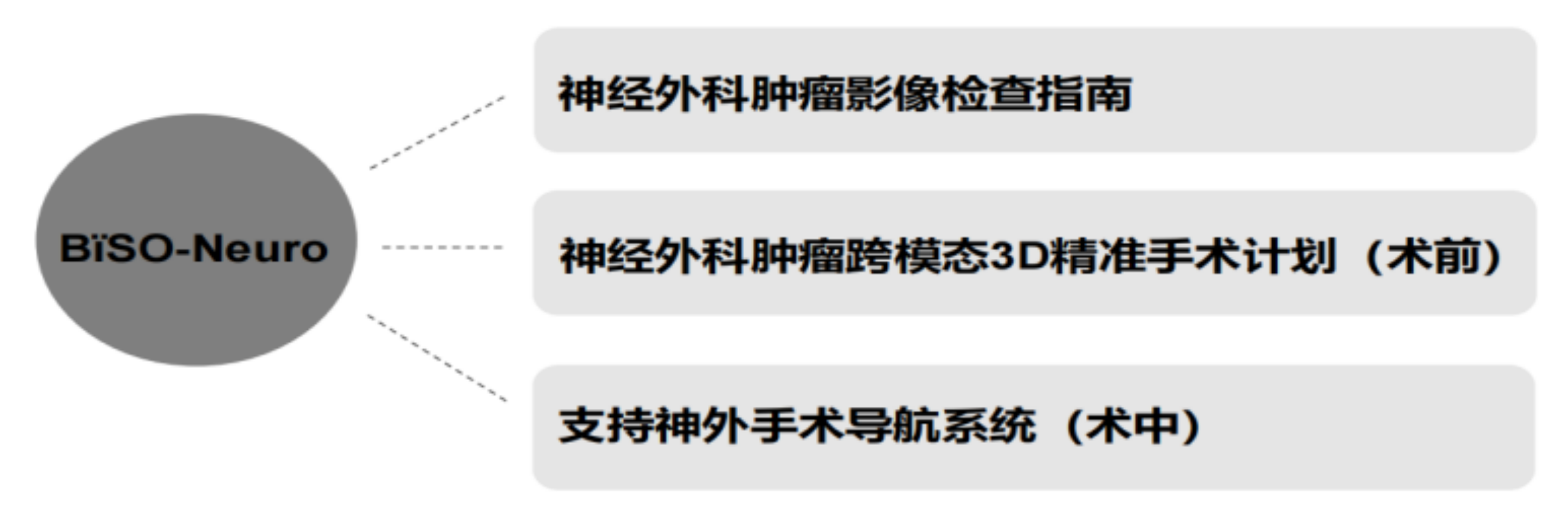
BïSO-Neuro Capabilities
In terms of clinical decision support, the oncology-specific intelligent platform developed by Baiyang Intelligent Technology integrates multi-guideline consensuses, expert experiences, and clinical cases to construct an ontological knowledge graph. Taking the Clinical Decision Support System (CDSS) for glioma as an example, this knowledge graph encompasses the latest guidelines, such as the Chinese Guidelines for the Diagnosis and Treatment of Central Nervous System Gliomas, as well as extensive domestic and international literature on gliomas and clinical trial data, including diagnostic and therapeutic experiences from Peking Union Medical College Hospital (PUMCH). Such a comprehensive knowledge graph enables highly accurate and strongly correlated functionalities, including alerts for key patient indicators and adverse reactions, as well as the formulation of prevention and treatment plans.
Li Qin stated, “There are two barriers to such an intelligent oncology-specific platform. The first is the integration of multiple oncology guidelines and advanced expert experience, which constitutes our knowledge system advantage. The second is the incorporation of case data and experts’ best clinical practices for system optimization, which will significantly enhance the coverage of treatment regimens and the accuracy of recommendations. These two factors are the key differentiators between Baiyang Intelligent Technology’s oncology-specific intelligent CDSS system and other CDSS solutions on the market.”
With the support of a dual-system framework, physicians’ formulation of personalized and standardized treatment plans for oncology patients, as well as their intraoperative assessment of the relationship between lesions and surrounding critical tissues and vasculature, along with considerations of surgical approach and risks, no longer rely solely on clinical experience.
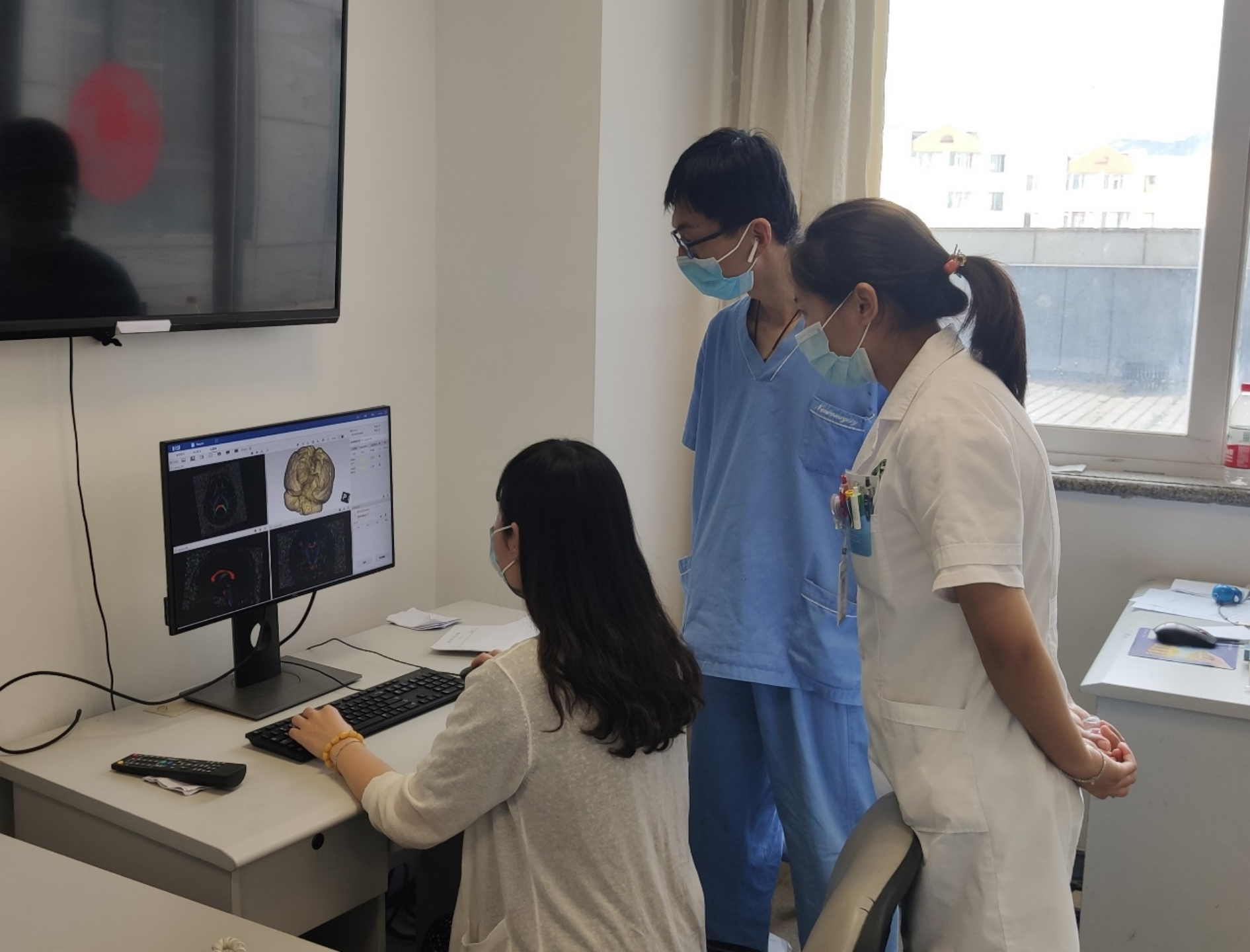
Clinicians Learn to Use BïSO-Neuro for Preoperative Planning and Propose New Requirements for Product Features
According to practical operational statistics, the fusion accuracy error margin of the AI algorithm in BiSO’s surgical planning system is approximately 0.6 mm. This enables surgeons to accurately assess the full extent of the tumor and clarify its relationship with surrounding tissues, thereby significantly reducing intraoperative risks for patients and correspondingly lowering medical costs.
Certainly, the beneficiaries are not limited to doctors and hospitals. If physicians can present a patient’s tumor status through precise imaging prior to surgery, they can more vividly describe the procedural details and expected outcomes of each surgical option. In this way, the entire surgical process becomes more transparent, turning shared decision-making between doctors and patients from an aspiration into a reality.
More importantly, there is the empowerment of medical resources. Complex tumor surgeries that were previously only performed at large hospitals can now be conducted at more hospitals through the BïSO system. As medical services become more accessible at the grassroots level, more ordinary patients may regain their lives as a result.
As of now, Baiyang Intelligent Technology and its controlled subsidiaries hold hundreds of independent intellectual property rights and have filed dozens of invention patent applications. Among these, the invention patents titled “A Clinical Intelligent Auxiliary Decision-Making Method and System for Femoral Neck Fractures” and “Medical Image Three-Dimensional Reconstruction System” have been granted. Additionally, a self-developed medical imaging software suitable for clinical diagnosis and treatment has obtained Class II medical device registration and received market approval on September 26.
This is only the beginning. Li Qin stated that although Baiyang Intelligent Technology already possesses a complete set of patented technologies and has obtained Class II medical device registration certificates from the Center for Medical Device Evaluation (CMDE) for tools such as medical imaging software, the company still needs to further refine its technologies and applicable scenarios.
Looking ahead, Baiyang Intelligent Technology will continue to refine and enhance its AI products while exploring the extension of medical intelligence into frontier technologies such as robotics. Meanwhile, by providing more vivid teaching imagery through its visualized reports and operational processes, the company aims to strengthen tumor treatment capabilities from both equipment and personnel perspectives, thereby improving the surgical proficiency of hospital surgeons.
In this process, Baiyang Intelligent Technology will continue to focus on developing therapeutic-grade AI innovative products, striving to lead medical artificial intelligence into a new phase. This journey is long and arduous.