

World Mental Health Day: Tapping into a Billion-Dollar Market Amid Rising Mental Health Needs Affecting Nearly 20% of the Population
Today is World Mental Health Day.
According to authoritative statistical data, 16%-17% of the population in China suffers from various mental and psychological problems. The disease burden caused by mental and psychological issues accounts for 13% of the burden of non-communicable diseases, making it a major public health, social, and livelihood issue.
However, experiencing mental and psychological distress is not equivalent to having a “disorder.” Statistics show that the prevalence of major depressive disorder in the mental health field is 2.1%, and the prevalence of anxiety disorders is 4.98%. Although these rates are not low, they remain substantially lower than the nearly 20% figure mentioned above. This also indicates that mental and psychological problems vary in severity, and corresponding interventions are therefore diverse.
The reality is that public awareness of common mental disorders and psychological-behavioral issues remains insufficient. There is a widespread lack of knowledge regarding prevention and treatment, as well as limited initiative in seeking help or medical care, while stigma persists among some patients and their families. Mental health service providers also face challenges such as low connectivity efficiency and inadequate coordination. It is therefore imperative to urgently establish a multi-tiered mental health service system.
It is reported that, in observance of World Mental Health Day, JD Health launched a mental health channel, introducing mental wellness courses and integrated online-offline psychological counseling services. These initiatives complement its previously established psychiatric and psychological clinical services, creating a more comprehensive mental health service ecosystem. VCBeat conducted an exclusive interview with Jin Fangyi, General Manager of the Specialty Internet Hospital Division at JD Health, to discuss how to establish and improve the mental health service system.
From the perspectives of patient needs, clinical practice guidelines, and policy advocacy, it is essential to establish a multi-tiered service system for mental health.
“Generally, when facing psychological issues, the public tends to acquire relevant knowledge and attempt to resolve them through self-regulation, including confiding in family and friends. When self-regulation proves ineffective, they seek help from external professionals, such as psychological counselors.” Jin Fangyi explained that in cases where symptoms are more severe or persistent, individuals should consult the Department of Psychiatry and Clinical Psychology at a hospital for medical interventions, including pharmacotherapy, psychotherapy, and physical therapy.
In the "Diagnostic and Treatment Guidelines for Mental Disorders (2020 Edition)," the guidelines for various mental disorders emphasize the importance of professional guidance from psychiatrists, assistance from psychotherapists/counselors, and support from medical staff in general hospitals, community health workers, and social workers in the treatment and rehabilitation of these conditions.
During the COVID-19 pandemic in 2020, mental health issues received significant societal attention. The National Health Commission of China frequently issued work plans related to psychological counseling, supporting psychiatric medical institutions, social work service agencies, and psychosocial service organizations in participating in mental health services. In addition, in recent years, the state has repeatedly introduced relevant policies to advocate for the establishment of a comprehensive mental health service system.
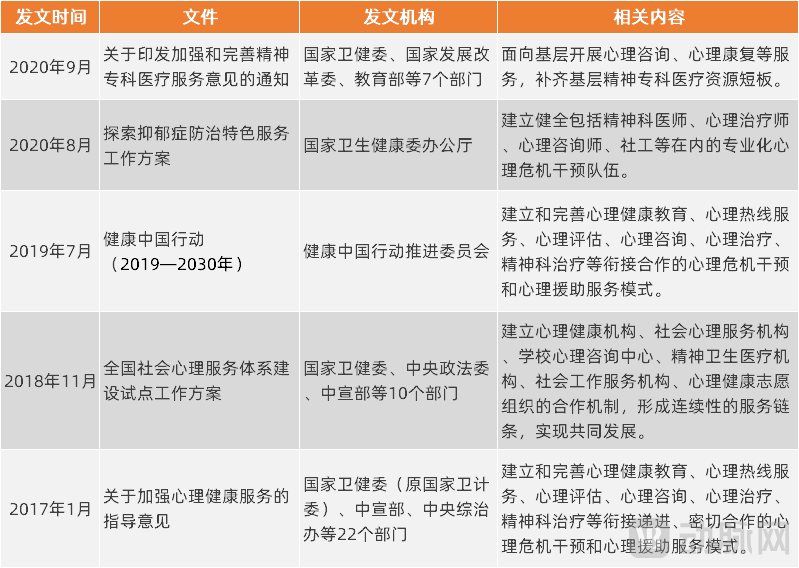
Policy Documents Related to Mental Health Services, Source: Official Website of the National Health Commission, Chart by VCBeat
In 2017, the National Health Commission (formerly the National Health and Family Planning Commission), the Publicity Department of the Communist Party of China Central Committee, the Office of the Central Leading Group for Comprehensive Social Security Governance, and a total of 22 departments jointly issued the "Guiding Opinions on Strengthening Mental Health Services." The document pointed out that mental health services apply psychological and medical theories and methods to prevent or reduce various psychological and behavioral problems, promote mental well-being, and improve quality of life. These services primarily include mental health education and promotion, psychological counseling, treatment of mental disorders, and psychological crisis intervention.
Since then, multiple policy documents, including the Healthy China Action Plan (2019–2030), have emphasized the need to establish and improve integrated models for psychological crisis intervention and psychological assistance that facilitate coordination and collaboration among mental health education, psychological hotline services, psychological assessment, psychological counseling, psychotherapy, and psychiatric treatment.
“Users have varying levels of need, and thus the types of mental health services required also differ. After taking stock of offline institutions and online platforms offering mental health services in the market, and reviewing various products and services, we found that resources should be integrated to build a product framework categorized by mild, moderate, and severe levels. This approach would provide users with professional guidance, enabling them to select appropriate services based on their individual needs under such guidance,” said Jin Fangyi.
Thus, we can outline a multi-tiered mental health service system (as shown in the figure below).
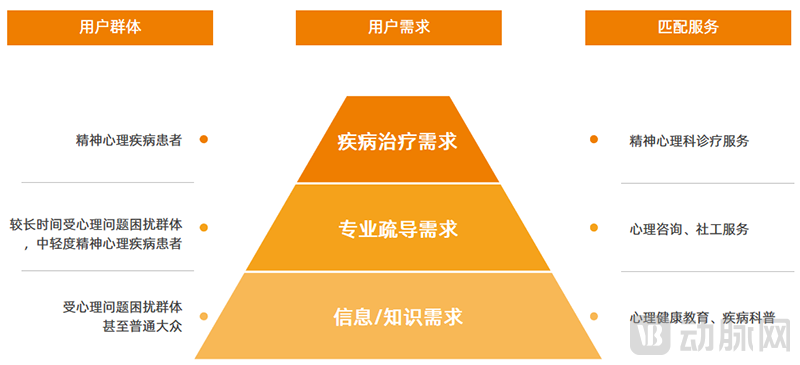
Mental Health Service System, Chart by VCBeat
Within this framework, user groups are categorized based on the duration and severity of their mental health challenges, as well as their diagnostic status. These factors give rise to distinct needs for information or knowledge, professional counseling, and medical treatment, each requiring corresponding services. For instance, mental health education and disease awareness campaigns should be provided to all individuals experiencing mental health issues, including the general public. For those who have been affected for an extended period or who suffer from mild to moderate mental health conditions, various channels of psychological counseling and social work services can be offered. For patients with confirmed diagnoses of mental disorders, treatment and management through medical interventions are necessary.
There is a continuum and overlap among various population groups and their needs; therefore, the corresponding services must be progressive and seamlessly integrated.
As of the end of 2019, there were 5,529 mental health medical institutions across China, including 2,096 specialized psychiatric hospitals and 3,433 departments of psychiatry and psychology in general hospitals. Nationwide, there were 46,300 licensed (assistant) psychiatrists, with the number of psychotherapists, mental health and psychosocial social workers, and psychological counselors also increasing year by year.
Currently, mental health professionals are developing in a diversified manner, and the quality of mental health services is gradually improving. However, there remains a gap between the current state and the establishment of an ideal service system, which is mainly manifested in several aspects.
First, from the user’s perspective, while public awareness of mental and psychological issues has increased due to diversified information channels brought by mobile social media and new media, the level of understanding remains low. There is a notable lack of knowledge regarding prevention and treatment, as well as limited initiative in seeking medical care; stigma persists among some patients and their families. In fact, the emergence of psychological or behavioral problems does not necessarily equate to having a disease. Even when a disorder is present, it is controllable and treatable.
This necessitates more comprehensive and authoritative dissemination of information and knowledge to the general public, thereby enhancing public awareness of mental and psychological issues, as well as fostering greater initiative in seeking professional help and medical care.
Secondly, from the perspective of service providers, non-psychiatric medical personnel have limited ability to identify mental and psychological disorders, particularly in critical service areas such as psychological counseling. According to the Mental Health Law of the People's Republic of China, psychological counselors are prohibited from engaging in psychotherapy or in the diagnosis and treatment of mental disorders. This requires psychological counselors to possess the capability to conduct preliminary assessments of clients to determine whether they are more suited for psychological counseling or should be referred to a hospital for prompt medical attention. However, as Jin Fangyi noted, among the more than one million psychological counselors nationwide, very few possess the ability to identify mental and psychological disorders.
In accordance with the requirements of the “Work Plan for Pilot Programs on the Construction of a National Social Psychological Service System,” social psychological counseling institutions shall strengthen training in service skills and ethical standards to enhance their service capabilities and ability to identify common psychological disorders. Psychiatrists and psychotherapists shall provide technical guidance to psychological counselors, social workers, and other relevant personnel, and deliver treatment and psychological interventions for common mental disorders and psychobehavioral issues.
Furthermore, the seamless integration of various service components has not yet become the norm. Multiple providers of mental health services are administered separately by entities such as the National Health Commission, the Ministry of Human Resources and Social Security, and the Ministry of Civil Affairs; the Ministry of Education is also involved in matters pertaining to students’ mental health. As evident from the policy section discussed earlier, systematic policy documents are typically issued jointly by multiple departments.
During the 2020 pandemic, multi-sectoral coordination was strengthened across various regions to provide psychological intervention services to residents. In Wuhan, Hubei Province, local authorities established specialized teams, including an expert panel for psychological rescue, a medical team for psychological rescue, and a hotline counseling group for psychological assistance. Mechanisms for collaboration were developed and improved among mental health institutions, social psychological service agencies, school counseling centers, and volunteer organizations providing psychological services, thereby forming a continuous and comprehensive chain of psychological care.
Post-pandemic, inter-departmental and inter-organizational coordination and collaboration must be institutionalized.
More critically, disease diagnosis and treatment are conducted within medical institutions, while psychological counseling and other non-medical interventions are provided by social service organizations. There is no mature referral mechanism between medical and non-medical institutions.
Finally, there is no scaled payer.
In the National Specifications for Pricing of Medical Service Items, there are 26 items related to psychiatric and psychological services, including psychotherapy, hypnotherapy, and Morita therapy. However, only regions such as Shanghai, Shenzhen (Guangdong Province), and Haidian District (Beijing) have included psychological counseling and psychotherapy in the scope of medical insurance reimbursement; meanwhile, most commercial insurance products exclude mental and psychological disorders from coverage.
However, Jin Fangyi stated that from the perspective of out-of-pocket payments, as public awareness of mental health improves and purchasing power strengthens, willingness to pay is gradually increasing, indicating significant market potential.
Simply put, the current mental health service system suffers from low connectivity efficiency and has weak links.
In recent years, some government departments, public institutions, large enterprises, and schools have established psychological counseling rooms, mental health education centers, and mental health service platforms through methods such as purchasing services, providing comprehensive mental health services to employees or students. This has, to a certain extent, improved the construction of the mental health service system, enhanced the coordination among various service components, and refined the payer structure.
What else can be done? Since a major bottleneck lies in inefficient connectivity, the internet—with its inherent connective properties—can deliver substantial value in this regard.
Currently, internet-based mental health service platforms such as Jiandan Xinli (Simple Psychology) and Yidianling have enabled more efficient connections for psychological science popularization and counseling. Meanwhile, internet hospitals with psychiatric qualifications, such as JD Health Internet Hospital, are also capable of facilitating connections to medical services.
As a comprehensive internet healthcare service provider, JD Health launched its mental health services on World Mental Health Day, building upon its previously established Mental and Psychological Center. The new offering includes psychological counseling and mental health courses, covering nearly 400 counseling institutions and featuring course content developed by numerous mental health experts. Through this initiative, JD Health has formed a more complete mental health service ecosystem that integrates online and offline channels, as well as medical and non-medical services.
Within JD Health’s mental health service ecosystem, users experiencing psychological distress can first gain greater awareness of mental disorders or behavioral issues by purchasing books or paying for knowledge-based content, or they can use expressive platforms to vent emotions and regulate their mood.
Meanwhile, users can use the results from JD Health’s online psychological assessment tools as a reference for subsequent decision-making. Subsequently, users may seek professional help, either online or offline, through psychological counseling institutions located in nearly 60 cities across China; alternatively, they can obtain advice from psychiatrists or psychotherapists via internet hospitals. Currently, JD Health has assembled a network of nearly 10,000 psychiatric and psychological specialists from prestigious institutions such as Peking University Sixth Hospital and Tianjin Anding Hospital.
For users diagnosed with mental or psychological disorders, online follow-up consultations can be conducted on JD Health in accordance with their physician’s treatment plan, and psychological counseling may also be provided as needed.
When patients with mental and psychological disorders also suffer from other comorbidities—a scenario that is not uncommon, such as when major diseases like cancer are accompanied by psychological issues—JD Health can coordinate multiple specialty centers to provide multidisciplinary team (MDT) consultations for patients.
“After the pandemic, we received widespread demand for psychological services during our user engagement efforts. This included not only members of the general public experiencing psychological distress but also patients with mental and psychological disorders, as well as those suffering from both somatic and mental/psychological conditions. These users have diverse needs in terms of scope and content. To meet these needs, we have extended the medical services of our Mental Health Center to encompass a broader range of mental health services,” Jin Fangyi introduced to VCBeat, adding that they are also planning insurance products to cultivate a larger-scale buyer base.
Jin Fangyi believes that there is still a mismatch between supply and demand in the current mental health service sector, meaning that existing mental health service products fail to meet user needs. To address this, JD Health will not only deliver more standardized, higher-quality products to users but also continue to empower its partners, helping them enhance their professional capabilities.
For example, JD Health can leverage its science popularization and product review offerings to channel precise users or patients to psychological counseling agencies and medical institutions; establish referral pathways between psychological counseling agencies and mental health centers; and provide training courses for psychological counselors, delivered by psychiatrists, on the differential diagnosis of common mental disorders, thereby enhancing the service capabilities of counseling agencies.
As evidenced by the aforementioned cases, internet platforms can play a significant role in building mental health service systems and invigorating the vast market encompassing psychological counseling and psychiatric treatment. According to industry reports from LeadLeo Research Institute, the market size of China’s mental healthcare industry was projected to exceed RMB 100 billion in 2022, with the overall scale of the psychological counseling industry reaching RMB 95.34 billion in 2023.
In the future, with social development and changes in the spectrum of mental and psychological disorders, the population affected by mild mental illnesses and suboptimal psychological health will continue to expand, leading to increasingly strong demand for corresponding services.
Building and improving the mental health service system is not only a key initiative for government departments to promote social governance from the top down, but also an industry opportunity for various social stakeholders to leverage their strengths and obtain corresponding returns.
For healthcare companies, particularly internet platform enterprises that serve as efficient connectors, there is significant potential to further expand platform coverage and enhance the breadth and depth of services. By leveraging foundational technologies such as AI and big data to continuously improve supply-demand matching and optimize service experiences, the prospects for growth are promising.
We also look forward to a future, driven by the collective efforts of all stakeholders, where mental and psychological issues no longer evoke fear or stigma. Both societal awareness of these conditions and public access to mental health services will become as commonplace as treating a minor cold.