

Unlocking the $10B Brain Science Market: 59 Research Directions and 90+ Chinese Institutions Pioneering the Frontier
October 10 marks the annual World Mental Health Day. With global socio-economic development, an increasing number of people are suffering from mental and psychological disorders. Statistics show that patients with brain disorders account for approximately 11% of all disease cases worldwide, while the associated social burden approaches 30% of the total burden of human diseases. In China, the number of individuals affected by various brain disorders is nearly 130 million, including 9.83 million with Alzheimer’s disease, over 2 million children under the age of 12 with autism spectrum disorder (with 200,000 new cases annually), and more than 50 million with depression. These conditions have become significant public health, social, and livelihood issues.
Most major brain disorders originate from pathological changes in brain functional networks, yet effective treatments remain largely unavailable. The key reason lies in the significant difficulty of detecting human brain functional networks and disease-related neural circuits, which severely hinders our understanding of the mechanisms underlying brain diseases. To date, neuroscience has garnered the most Nobel Prizes among studies on living humans; however, the brain—an organ composed of hundreds of billions of neurons—has not yet been fully understood in terms of its relationship with the human body.
Taking Alzheimer’s disease as an example, since 1998, 100 drugs have been put into testing worldwide, but only a handful have been approved for use. Moreover, their indicated populations and symptoms are highly restricted, and their actual efficacy has been far from satisfactory.
To conquer brain diseases, the United States, the European Union, and Japan have successively launched brain science initiatives since 2013: the EU took the lead in launching the €1 billion Human Brain Project; subsequently, the United States also introduced the $4.5 billion BRAIN Initiative. Brain science is also regarded as one of the two most important frontiers for humanity in the next century.
So, what is the current state of brain science development in China? Which institutions are exploring this frontier? VCBeat (WeChat ID: VCbeat) hopes that this article will provide some insights.
In a broad sense, brain science explores the physical structure, biological mechanisms, and functional operations of the brain from a biological perspective, representing a process of understanding the brain. These interdisciplinary fundamental studies delve into the most foundational levels, including individual neurons and synapses. It is essential to gain a deeper understanding of how the brain collects, organizes, and stores information to form perceptions, and subsequently transforms these perceptions into thoughts, emotions, decisions, actions, and memories. Currently, human knowledge of these processes remains very limited, which has become the primary bottleneck constraining new discoveries in the treatment of brain-related disorders and the development of brain functions.
The history of brain science dates back to ancient times. As early as in Ancient Greece, Hippocrates, the founder of Western medicine and a renowned physician, posited that human emotions and sensations originate from the brain, which serves as the seat of the human mind. Overall, its developmental trajectory can be divided into four phases: the Enlightenment Phase (before the 16th century), the Nascent Phase (early 16th century to early 19th century), the Pioneering Phase (early 19th century to the 1960s), and the Rapid Development Phase (from the 1960s to the present).
Particularly since the dawn of the 21st century, brain science has witnessed significant advancements. Scientists have not only elucidated the working principles of vision, olfaction, gustation, audition, and somatosensation, as well as the mechanisms underlying neural information transmission and optimized processing; they have also preliminarily revealed the pathogenic mechanisms of mental disorders; successfully mapped the dynamic developmental blueprint of the human brain; and deciphered the two organizational axes of the human brain, along with the dynamic mechanisms by which neuronal network structures adapt to environmental changes.
However, we still know little about complex functions such as learning, memory, attention, and decision-making in the brain, let alone empathy, self-awareness, reasoning, and language. This is because the human brain is the most complex object on Earth, comprising at least 100 billion neurons of various types and a complex neural network formed by 10^15 connections.
Overall, current brain science research primarily aims at “brain exploration, brain protection, and brain creation.”
One is “Brain Exploration,” which refers to exploring the functions, structures, and principles of the brain, including its physical composition, biological mechanisms, and operational capabilities.
The second is “neuroprotection,” which refers to the treatment of brain-related diseases.
Due to insufficient knowledge of disease etiology and pathogenesis, many brain disorders remain incurable. By gaining a deeper understanding of brain-related mechanisms and functional processes, scientists are striving to translate these findings into breakthroughs in treatments for human physical and psychological ailments, primarily focusing on psychiatric disorders and neurodegenerative diseases.
Mental disorders, including depression, mood disorders, chronic pain, and schizophrenia, impair cognitive and emotional functioning and significantly affect patients’ ability to cope with daily life. Neurodegenerative diseases encompass conditions such as Alzheimer’s disease, Parkinson’s disease, paralysis agitans, and motor neuron diseases, which cause substantial impairment of patients’ physical mobility.
The third is “brain creation,” which refers to the development of brain functions or the adoption of technologies for developing brain functions.
Beyond the treatment of brain diseases, a precise understanding of brain function and its underlying mechanisms will enable us to harness and enhance cognitive capabilities in multiple domains in the future, and even create artificial brains. This requires three steps.
First, in-depth research into brain-computer interface (BCI) technology will enable the development of seamless, real-time, and side-effect-free BCIs. By promptly recording and interpreting neuronal interaction patterns, perfect bidirectional information communication between the brain and machine can be achieved.
Secondly, enabling direct communication between the brain and machines has emerged as a novel pathway for augmenting human capabilities. Leveraging technologies such as AR and VR, brain-computer interfaces (BCIs) can facilitate neurological rehabilitation, generate virtual sensory experiences, and enhance cognitive performance in areas including learning, memory, and attention.
Finally, research into neural mechanisms, cognitive structures, and brain-computer interfaces facilitates groundbreaking advances in the field of artificial intelligence. This enables the design of novel learning paradigms that mimic human neuronal activity, thereby fostering the development of more intelligent machines and robots.
It is precisely due to the promising prospects of brain science that it has attracted significant capital interest. According to data from CB Insights, the global market size for brain science was $6.2 billion in 2020 and is projected to surpass $10 billion by 2024, with a compound annual growth rate (CAGR) of 17% expected between 2020 and 2024. This trajectory positions it as the next industry poised to deliver transformative impacts on human society.
Over the past five years, the number of global brain science financing events has increased rapidly, rising significantly from 238 in 2016 to 323 in 2020, an increase of more than 35%. Meanwhile, the total amount of global brain science financing in 2020 also reached a record high of $5 billion.
Nevertheless, startups in this sector remain predominantly in the early to mid-stages, at Series B or earlier. As of 2020, 58% of financing rounds were at Series B or prior. However, since 2021, the proportion of companies reaching Series B has begun to rise, increasing significantly from 15% in 2020 to 24%. We may well see tangible results in the near future.
The United States is currently the leader in brain science research, far ahead in both the number of financing events and the total amount raised. Specifically, U.S. brain science companies accounted for 883 financing events, representing 60% of global financing activities during the same period; the total funding reached $11 billion, accounting for nearly 70% of the global total ($16.145 billion).
Among these, Neuralink, the brain-computer interface (BCI) company founded by Elon Musk, recently completed its Series C financing round, raising $205 million—the largest funding round in the BCI sector to date.
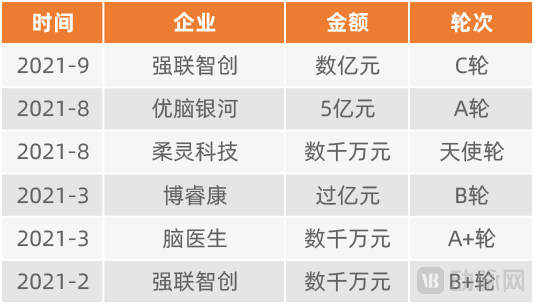
Partial Financing of China’s Brain Science Enterprises in 2021
China ranks in the second tier globally. However, the gap with the United States remains substantial. Over the past five years, brain science enterprises in China have raised approximately $1.1285 billion in financing. Among them, UniBrain Galaxy, which recently completed its Series A funding round, has accumulated a total financing amount of around $100 million through multiple rounds, making it one of the best-funded brain science companies in China.
It is not difficult to see that although China’s brain science industry still lags significantly behind that of the United States, it has secured a place on the global stage. This achievement is closely tied to the heightened emphasis China has placed on this sector in recent years.
As early as the 1980s and 1990s, China included brain science in the “863 Program (National High-Tech Research and Development Program),” the “973 Program (National Key Basic Research Development Program),” and the “National Science and Technology Support Program,” with a cumulative total investment of approximately RMB 1.4 billion in brain science research. The National Natural Science Foundation of China has also provided nearly RMB 2 billion in funding for brain research over the years.
However, compared with developed countries and regions, China’s investment at that time was insufficient. The primary objective in the 1980s was to establish a high-quality teaching system for biological sciences. It was not until the late 1990s, when China began to make substantial investments in basic research, that Chinese brain science started to make notable high-level contributions on the international stage.
The successful hosting of the 2008 Beijing Olympic Games led to gradual improvements in China’s economic, social, and research environments, attracting an increasing number of young Chinese scientists abroad to return home for career development. This surge of returning overseas-educated young talents has propelled China’s brain science into a new stage, marked by a rapid increase in publications in international journals.
In 2012, the Chinese Academy of Sciences launched the Class B Strategic Priority Research Program titled “Brain Functional Connectome Project,” with an annual funding investment of approximately RMB 60 million. Research on the brain functional connectome is regarded as a strategic high ground in brain science, representing an essential pathway for exploring the working principles of the brain, elucidating the mechanisms underlying brain disorders, and advancing brain-inspired computing. It is widely believed within the industry that significant breakthroughs in brain science are highly likely to emerge in this direction.
This initiative brings together multiple research institutes and teams under the Chinese Academy of Sciences (CAS), including the Institute of Neuroscience at the Shanghai Institutes for Biological Sciences, CAS; the Institute of Biophysics, CAS; the Institute of Psychology, CAS; the Institute of Genetics and Developmental Biology, CAS; the Institute of Automation, CAS; the University of Science and Technology of China; the Kunming Institute of Zoology, CAS; the Wuhan Institute of Physics and Mathematics, CAS; and the Shenzhen Institutes of Advanced Technology, CAS.
The proposal of this pilot special project was quite forward-looking. Merely one year later, in 2013, the European Union and the United States successively launched major brain science initiatives, propelling research enthusiasm in this field to new heights.
The European Union’s “Human Brain Project (HBP)” focuses on simulating brain functions using supercomputing technologies, establishing a new research platform for the development of artificial intelligence and further driving advances in bionics. In contrast, the United States’ “Brain Research through Advancing Innovative Neurotechnologies (BRAIN) Initiative” places greater emphasis on developing new tools and technologies for brain science research, thereby fostering the emergence of new disciplines and industries grounded in fundamental research.
In addition, Japan, France, and Germany have also launched their own brain science research initiatives. Although these national brain projects differ in specifics, they share the ultimate goal of understanding the brain and applying research findings to the treatment of brain disorders and the development of artificial intelligence. The focus of international brain science research is gradually shifting from studying diseases based on brain structure and function toward greater interdisciplinary integration and convergence.
In 2015, the field of brain-inspired intelligence research was also incorporated into the “Brain Functional Connectome Project” special initiative. The expanded initiative was renamed the “Research on Brain Functional Connectome and Brain-Inspired Intelligence,” achieving the world’s first substantive integration of neuroscience and intelligent technology. This laid a solid foundation for the development of brain-intelligence science and the launch of the China Brain Project.
Ultimately, the special project implemented various research tasks with high quality, achieving pioneering results particularly in non-human primate model studies. Breakthrough progress was made in elucidating the neural mechanisms underlying sensory processing, emotional regulation, and social hierarchy behaviors; significant advances were achieved in mapping brain functional connectivity; and several groundbreaking accomplishments were realized in brain-inspired intelligent computing models and algorithms. In addition to publishing papers in prestigious journals such as Nature, Science, and Cell, representative achievements were selected for inclusion in the “Top Ten Scientific Advances in China,” the “Top Ten Scientific and Technological Progress News in China,” the “Top Ten Medical Advances in China,” and the “Landmark Major Achievements of the Chinese Academy of Sciences during the 12th Five-Year Plan Period.”
The successful implementation of this pilot special project has enabled China to make significant strides in overall brain science research, placing it among the international forefront. Several research achievements have led the development direction of international brain science and brain-inspired intelligence technologies, laying the foundation and playing a pioneering role for subsequent major scientific research projects on “Brain Science and Brain-Inspired Research” and the initiation and implementation of the international megascience program “Mesoscopic Whole-Brain Neural Connectivity Atlas.”
In 2016, “Brain Science and Brain-Inspired Intelligence Research” was designated as one of the major scientific and technological innovation projects and initiatives in China’s 13th Five-Year Plan Outline, and was included in the “Major Science and Technology Innovation Projects 2030.” This project established a strategic framework described as “one body with two wings”: the “body” refers to the central focus on elucidating the neural basis of human cognition (understanding the brain); the “two wings” refer to research on major brain disorders and the advancement of artificial intelligence through computational and systems modeling.
In 2018, the Beijing Academy of Brain Science and Brain-Inspired Intelligence and the Shanghai Academy of Brain Science and Brain-Inspired Intelligence were established in Beijing and Shanghai, respectively. These institutions launched regional initiatives on “Brain Science and Brain-Inspired Intelligence” and began funding related research projects. Meanwhile, numerous universities also set up research centers dedicated to brain-inspired intelligence. As a result, Beijing and Shanghai have gradually become the most concentrated hubs for brain science research in China today.
In 2021, China released its 14th Five-Year Plan, further elevating the priority given to brain science. The plan specifies targeting frontier fields such as brain science and implementing a batch of forward-looking and strategic national major science and technology projects. It also calls for organizing and implementing future industry incubation and acceleration programs in emerging areas of technological and industrial transformation, including brain-inspired intelligence, while strategically planning and laying out a cohort of future industries.
In 2021, the long-awaited “China Brain” Project entered its implementation phase. The Ministry of Science and Technology officially released the “Guidelines for Project Applications in 2021 under the Major Project ‘Brain Science and Brain-Inspired Research’ of Sci-Tech Innovation 2030,” with project applications opening on October 9.
The Guideline establishes a five-year cycle for the Major Project on Brain Science and Brain-Inspired Research. In 2021, it will focus on 59 research directions across five key areas: elucidation of principles underlying brain cognition; pathogenesis and intervention technologies for major brain disorders associated with cognitive impairment; brain-inspired computing and brain-machine intelligence technologies and applications; brain and intellectual development in children and adolescents; and technical platform construction. The estimated national funding allocation amounts to RMB 3.148 billion.
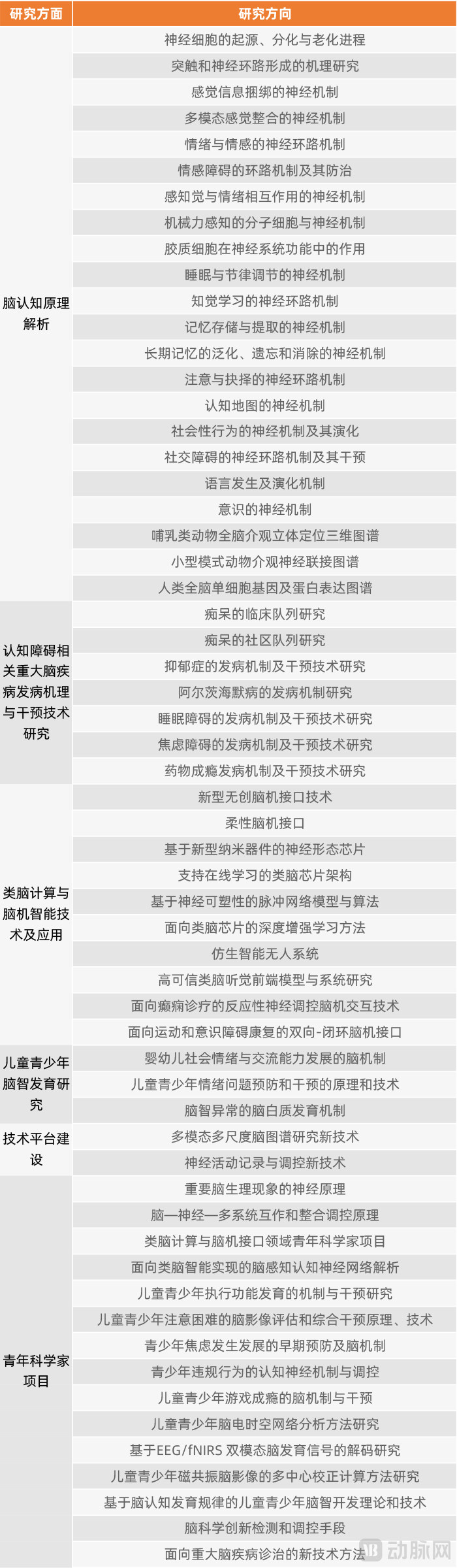
Science and Technology Innovation 2030—Research Directions for 2021 of the Major Project on “Brain Science and Brain-Like Research”
Among the 59 research directions, the analysis of brain cognition principles, equivalent to “brain exploration,” comprises a total of 22 research directions, accounting for 37%, which is the largest proportion in the entire research guideline.
The two areas—research on the pathogenesis and intervention technologies for major brain diseases associated with cognitive impairment, and research on brain and intellectual development in children and adolescents—can be categorized under “Brain Protection,” encompassing a total of 10 research directions. Similarly, brain-inspired computing and brain-machine intelligence technologies and applications, equivalent to “Brain Creation,” also comprise 10 research directions.
It is evident that, at present, China’s brain science research continues to prioritize “brain exploration” as its primary focus. This aligns with the strategic framework of “One Body, Two Wings.”
Currently, brain science research institutions in China are primarily divided into public and private entities. Among the public institutions, the Beijing Academy of Brain Science and Brain-Inspired Intelligence and the Shanghai Academy of Brain Science and Brain-Inspired Intelligence, located in the north and south respectively, are undertaking research for the major “Brain Science and Brain-Inspired Intelligence Research” project, serving as the preliminary phase of China’s “Brain Project.” In the future, as research progresses, these two centers may potentially merge to officially launch China’s “Brain Project.”
According to public reports, the research institutions involved in the Beijing Brain Science and Brain-Inspired Intelligence Research Center include the Chinese Academy of Sciences, the Academy of Military Medical Sciences, Peking University, Tsinghua University, Beijing Normal University, the Chinese Academy of Medical Sciences, and the China Academy of Chinese Medical Sciences. The Shanghai Brain Science and Brain-Inspired Intelligence Research Center involves institutions such as the Chinese Academy of Sciences, Fudan University, Shanghai Jiao Tong University, Tongji University, East China Normal University, and ShanghaiTech University.
In addition, as a core force in domestic brain science research, various institutions under the Chinese Academy of Sciences (CAS) have also demonstrated outstanding performance in this field. Currently, CAS’s brain science research institutions mainly include the Center for Excellence in Brain Science and Intelligence Technology, the State Key Laboratory of Neuroscience, the State Key Laboratory of Pattern Recognition, the State Key Laboratory of Brain and Cognitive Science, the Key Laboratory of Animal Models and Human Disease Mechanisms, and the Key Laboratory of Brain Function and Brain Diseases.
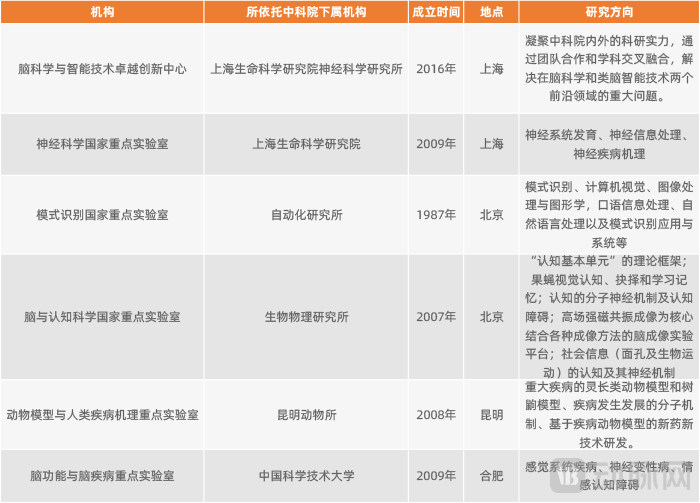
Major Brain Science Research Institutions of the Chinese Academy of Sciences
Since the 13th Five-Year Plan period, local governments across China have established corresponding coordinating bodies for brain science research. For instance, in Guangdong Province, the Department of Science and Technology of Guangdong Province took the lead, leveraging Southern Medical University as a key partner, and joined forces with 16 institutions—including The Hong Kong University of Science and Technology, The University of Hong Kong, The Chinese University of Hong Kong, City University of Hong Kong, the University of Macau, as well as universities and research institutes in Guangzhou and Shenzhen—to jointly establish the Greater Bay Area Center for Brain Science and Brain-Inspired Intelligence.
Chongqing, Tianjin, Henan Province, Heilongjiang Province, and Sichuan Province have also established their own brain science research centers to coordinate research by leveraging local scientific resources.
In addition, universities across China have actively launched brain science research initiatives. In 2018, the Ministry of Education initiated the Mount Everest Plan for Basic Research in Higher Education Institutions (hereinafter referred to as the “Mount Everest Plan”), which began deploying and establishing Frontier Science Centers at universities. The plan aims to assemble world-class innovative research teams, build globally leading scientific research platforms, cultivate major technological projects that secure strategic high grounds, and consistently produce pioneering original achievements with global leadership.
As a frontier science, brain science has naturally been included in the “Everest Plan.” In 2018, the Ministry of Education successively approved the establishment of the Frontier Science Center for Brain Science at Fudan University and the Frontier Science Center for Brain and Brain-Computer Integration at Zhejiang University. Currently, most provinces across China have established brain science research centers relying on local universities.
In addition to government-led brain science research institutions, private research institutes have also emerged in recent years. Among them, the most prominent is the IDG McGovern Institute for Brain Research. Between 2011 and 2014, the IDG McGovern Institute for Brain Research established joint institutes with four domestic entities: the Peking University IDG/McGovern Institute for Brain Research (2011), the Beijing Normal University IDG/McGovern Institute for Brain Research (2011), the Tsinghua University IDG/McGovern Institute for Brain Research (2013), and the Institute for Brain Cognition and Brain Disorders, co-established by the Shenzhen Institutes of Advanced Technology of the Chinese Academy of Sciences and the MIT McGovern Institute for Brain Research (2014).
In 2016, Chen Tianqiao, formerly known for Shanda Games, announced a $1 billion funding commitment and co-founded the Tianqiao and Chrissy Chen Institute (TCCI) with his wife to advance brain science research. Subsequently, TCCI partnered with the California Institute of Technology to establish the Caltech-Tianqiao and Chrissy Chen Institute.
From 2017 to 2018, TCCI invested RMB 500 million to jointly establish frontier laboratories for brain science with Huashan Hospital of Fudan University and the Shanghai Mental Health Center, supporting brain science research in China. The first frontier laboratory opened in October 2020 at the Hongqiao Campus of Huashan Hospital. The second frontier laboratory was announced as completed in 2021 and is located at the Shanghai Mental Health Center.
Currently, TCCI has made progress in facial recognition, brain-computer interfaces, brain imaging, and cognitive science.
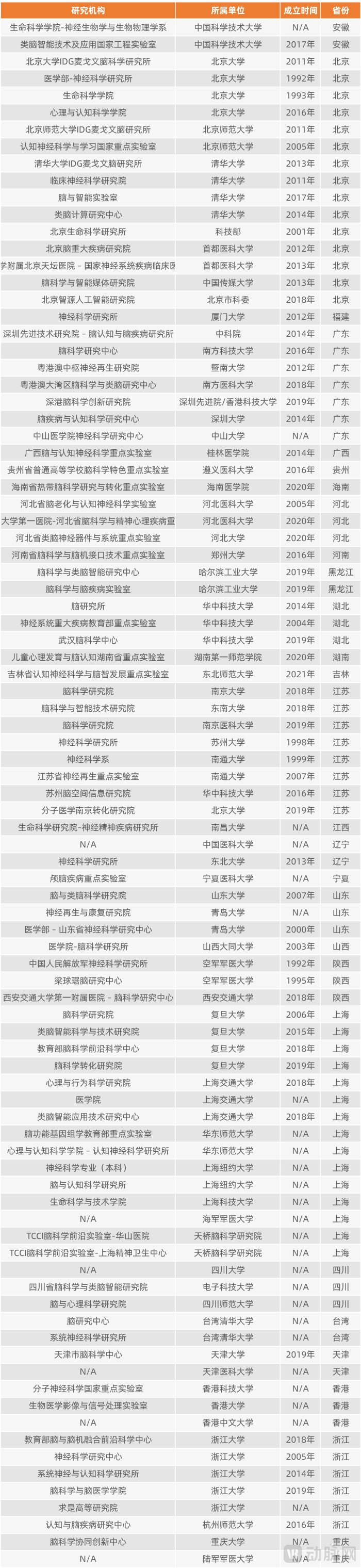
An Incomplete List of Major Brain Science Research Institutions in China (Excluding Institutions under the Chinese Academy of Sciences and the Beijing/Shanghai Center for Brain Science and Brain-Inspired Intelligence)
As a widely recognized hotspot for the future, the prospects of brain science are undeniable; however, it is also a fundamental scientific discipline that requires sustained, long-term investment and patience, the courage to explore the unknown, and a measure of luck. As China has gradually prioritized the development of basic science and increased investment over the past decade, it has made progress in brain science research, achieving internationally advanced levels in certain areas.
Academician Mu-Ming Poo, Director of the Institute of Neuroscience at the Chinese Academy of Sciences and Director of the Center for Excellence in Brain Science and Intelligence Technology, plays a pivotal strategic role in China’s Brain Project. In an interview with National Science Review (NSR), he noted that future Chinese science will not be content merely with “matching Western countries.” With its long-standing intellectual tradition, Chinese science is poised to exert a unique and distinctive influence on the global stage.
Of course, we must remain acutely aware that, compared with global advanced standards, we still have a considerable way to go in terms of both investment intensity and research capabilities. VCBeat will continue to closely monitor the latest developments in brain science and track breakthroughs in this field.
References:
Andrew P.Wickens:A History of the Brain, From Stone Age surgery to modern neuroscience
Guo Aike: Wen Hui Bao: "Exploring Brain Science: 'Bridging' the Macro and Micro"
Cebsit.cas.cn: Final Acceptance Meeting Held for the Chinese Academy of Sciences’ Strategic Priority Research Program (Category B) “Research on Brain Functional Connectome and Brain-Inspired Intelligence”
Bulletin of the Chinese Academy of Sciences: “China’s Areas of Advantage in Brain Science and Brain-Inspired Intelligence Technologies”
National Science Review:Mu-ming Poo: China Brain Project and the future of Chinese neuroscience
Deeptech: “Decoding the Brain Science Market Worth Billions: 1,500+ Companies—Therapeutic Benefits Are Real, Immortality Is Not; From Paralysis Improvement to Neural Induction | In-Depth”
Cyzone: “Why Brain Science, Known as the ‘Final Frontier,’ Is Becoming Increasingly Important”
Yicai: [Exclusive] China’s “Brain Project” Expected to Be Unveiled by Year-End, with Investment Scale Rivaling That of the United States
Focus: Distribution of Neuroscience Research Institutions in China