

Baidu's LinearDesign Algorithm Validated in Biological Experiments: Key Vaccine Efficacy Metrics Surpass Standard Methods by Up to 20x
Baidu’s Biological Computing Takes Another Step Forward! Recently, Baidu and SWM Biotech, a leading mRNA drug company, jointly announced that Baidu’s LinearDesign algorithm for mRNA vaccine sequence design has completed biological validation in the molecular design of COVID-19 mRNA vaccines. Experimental results showed that vaccines designed by LinearDesign significantly outperformed those designed using traditional methods (benchmark sequences) in key indicators such as stability, protein expression levels, and immunogenicity, fully demonstrating the practicality and effectiveness of the LinearDesign algorithm, as well as its substantial commercial value in the biopharmaceutical field.
Baidu Research recognized the importance of computational biology and bioinformatics several years ago and proactively initiated research in the field of RNA secondary structure in 2018. In early 2020, amid the global outbreak of the COVID-19 pandemic, Baidu Research keenly identified that mRNA vaccines, owing to their rapid production cycles and absence of biosafety risks, would become a critical tool in epidemic control. However, the instability of mRNA molecules and their susceptibility to hydrolysis posed significant obstacles to mRNA vaccine development. This instability presented challenges for the storage, transportation, and immunogenicity of mRNA vaccines. Addressing these issues is closely tied to the design of mRNA vaccine sequences.
Leveraging its long-term, forward-looking research accumulation in the field of biological computing, Baidu Research successfully developed the LinearDesign mRNA sequence optimization algorithm over several months starting in early 2020, and officially released it to the public in April 2020. Computer simulation results demonstrated that LinearDesign can effectively enhance the stability of mRNA vaccine sequences and improve protein translation efficiency. Notably, for mRNA vaccines targeting the SARS-CoV-2 spike protein, LinearDesign can complete sequence design in as little as 10 minutes.
To further validate the practical efficacy of the LinearDesign algorithm, Baidu collaborated with StemRNA to conduct a series of experimental studies. As an innovative enterprise leading internationally and the first in China to focus on mRNA vaccine and drug development, StemRNA is also the company that introduced mRNA therapeutics, innovative high-end nanocarrier platforms, and industrialization technologies into China. This study investigated seven mRNA vaccine sequences encoding the SARS-CoV-2 spike protein, designed using the LinearDesign algorithm, conducting in-depth analyses of their stability, encoded protein expression levels, and immunogenicity in animal models. These were compared head-to-head with benchmark mRNA sequences designed using traditional methods.
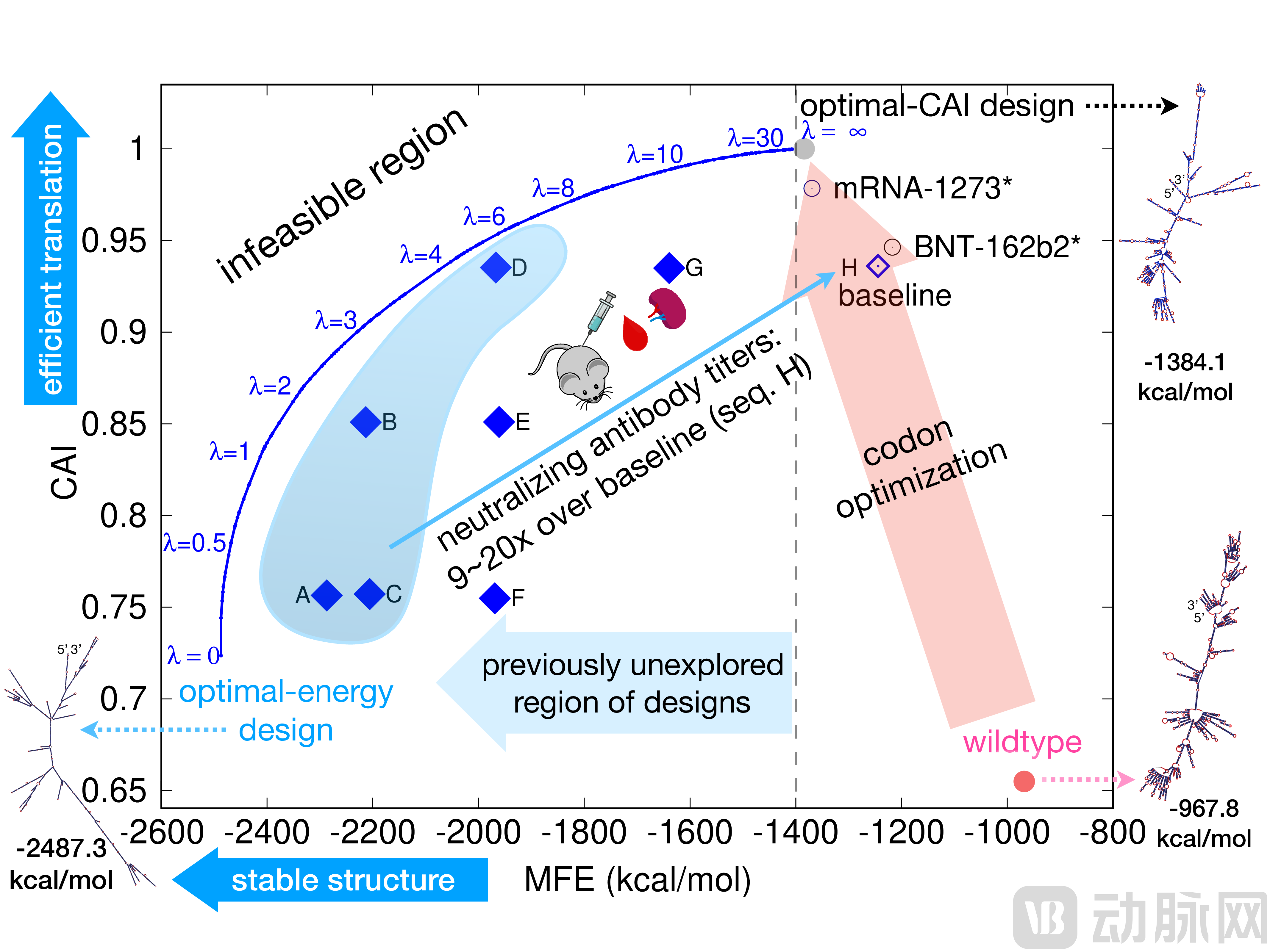 Information on the Seven Vaccine Sequences (A–G) Designed by Baidu’s LinearDesign Algorithm and the Reference Sequence (H)
Experimental results demonstrate that mRNA molecules designed by LinearDesign exhibit superior structural compactness, stability in solution, protein expression levels, and immunogenicity in animals compared to those designed using conventional methods. Notably, regarding the titer of antigen-neutralizing antibodies—a key indicator of vaccine efficacy where higher titers signify more effective immune protection—molecules designed by LinearDesign achieved levels up to 20 times higher than the benchmark molecules. Furthermore, in terms of binding antibody titers, LinearDesign-designed molecules showed levels up to 23 times higher than the benchmark, while T-cell responses were enhanced by nearly sixfold. These experimental data fully validate the practical effectiveness of the LinearDesign algorithm and its potential in drug development.
In addition to its application in the development of mRNA vaccines for SARS-CoV-2, the LinearDesign algorithm can also be utilized in the research and development of various vaccines and therapeutics, including those for infectious diseases, cancer vaccines, and monoclonal antibody drugs. As a critical technology urgently needed by the biopharmaceutical industry, it holds substantial scientific and commercial value.
The success of Baidu’s LinearDesign algorithm further validates the value of AI in pharmaceutical development. The deep integration of AI algorithms with biopharmaceuticals transforms drug discovery from a “needle-in-a-haystack” challenge into a targeted, systematic process, thereby safeguarding the health and well-being of humanity.