

Battle for Gen Z: ByteDance and Baidu Enter the Booming Oral Care Market
In the consumer healthcare sector, oral care is currently the hottest growth track.
Don't believe it?Just look at the frequency of financing rounds.Recently, the oral care brand “Canban” added a new shareholder, “Happy Wisdom Limited.” It is understood that the entity behind this investment is the family fund of Professor Zeng Ming, former Executive Vice President and Chief of Staff of Alibaba Group. This marks the brand’s fourth financing round this year.
Moreover, as of October this year, seven companies in the oral care sector have secured financing, with the total amount reaching approximately RMB 1 billion. The investors include not only prominent capital firms such as China Renaissance, Shuangbai Investment, Sinovation Ventures, and DCM China, but also internet giants like ByteDance and Baidu.
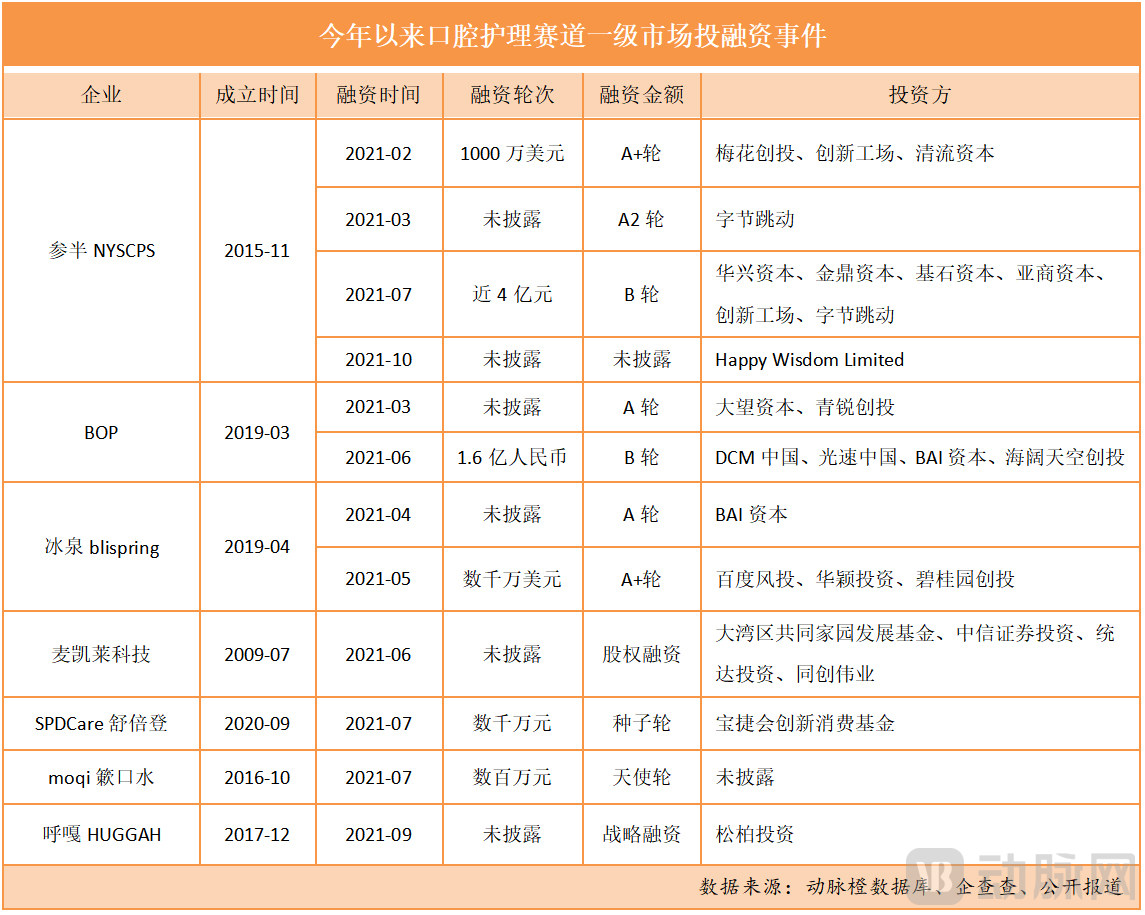
It is worth noting that,These companies have been established for a relatively short period, mostly around two to three years. They are in the early to mid-stages of financing and have demonstrated strong fundraising capabilities.For instance, Canban, founded in 2015, has completed eight rounds of financing to date, while BOP, established in 2019, has undergone four rounds of financing.
“Gen Z (those born between 1995 and 2009) is becoming the key decision-maker in purchasing oral care products. Their upgraded demands for aesthetics and health, their discerning taste preferences, and their distinct choices of media and channels differ significantly from those of the previous generation. This is a major reason behind the current boom in oral care brands,” China Renaissance told VCBeat.
In other words,Unlike traditional oral care companies, emerging oral care brands are actively vying for young consumers.So, how do the underlying strategies differ from those of traditional brands? How should the business model be structured? Will industry competition intensify following capital entry? What are the future evolutionary trends? To address these questions, VCBeat conducted interviews with numerous industry practitioners and investment institutions to gain insights into the answers.
In the consumer healthcare sector, represented by oral care, winning over young people means winning the market.
“We found that,An increasing number of young people are prioritizing oral care, particularly with regard to aesthetic concerns.“, for example, the sales growth of services such as teeth cleaning and whitening has been rapid.” Zhang Wei (a pseudonym), a partner at an investment firm that has long focused on consumer healthcare, told VCBeat that in addition to using traditional toothpaste and toothbrushes for oral hygiene, the new generation of consumers is also pursuing more portable and diverse care options, such as mouthwash, electric toothbrushes, teeth whitening strips, dental floss, and water flossers.
Data can corroborate this trend. The “Latest Trends Report on the Oral Care Industry in 2020” released by Alibaba Research Institute shows that,Last year, nearly all major categories in oral care experienced growth., for example, the GMV growth index of water flossers reached 206, making them the category with the highest growth rate among oral care products.
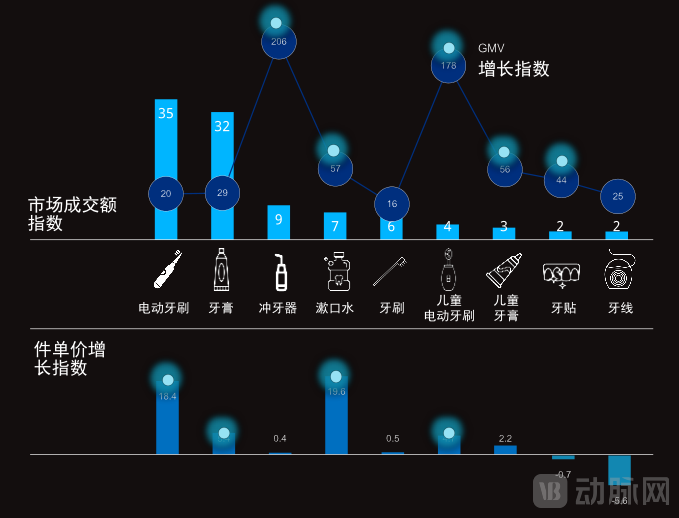 (Image source: Alibaba Research Institute)
The reason behind this lies in the fact that,With the vigorous promotion of science popularization and the development of media, oral health issues have garnered increasing public attention.According to the results of the Fourth National Oral Health Epidemiological Survey released by the National Health and Family Planning Commission, the detection rate of dental calculus among residents aged 35–44 was 96.7%, with higher rates observed in males than females and in rural areas than urban areas. The detection rate of gingival bleeding was 87.4%, also higher in males than females and in rural areas than urban areas, representing a 10.1% increase compared with ten years earlier.
“In the past, people’s understanding of oral care was largely limited to toothpaste, which is why competition in this sector used to center on toothpaste brands,” said Zhang Wei. “After decades of development and maturation, toothpaste brands have found it increasingly difficult to innovate beyond functional differentiation, while the diverse needs of younger consumers remain to be met.”
It is against this backdrop thatA migration path for category structure is becoming increasingly clear (i.e., from the current situation in China’s oral care market, where toothpaste and toothbrushes account for over 90%, to the U.S. market, where they account for 64%).
“Unlike the beauty sector, the daily chemical industry typically exhibits high market concentration. Developed markets such as the United States and Japan have already validated a consolidated landscape in the oral care segment, with the CR2 (market share of the top two companies) reaching 50%. We believe that”China's leading brands are also able to enjoy greater market share and more enduring brand advantages.“China Renaissance stated.”
Taking Listerine, the leading mouthwash brand under Johnson & Johnson, as an example, it has launched a wide range of mouthwash products and boasts a broad user base in the United States. Since entering the Chinese market in 2005, Listerine has rapidly captured a significant market share by delivering high-quality user experiences. According to the “2020 Mouthwash Market Overview and Trend Insights Report,” Listerine ranked first among the top 10 mouthwash brands on Alibaba’s platform in 2020, with a market share of 19.3%, representing a year-on-year increase of 58.2%.
On the other hand, domestic oral care brands are also rapidly catching up. For instance, “Canban,” which secured three rounds of financing this year, ranks just behind Listerine in sales on Alibaba’s platforms, with a market share of 11.3%. This indicates that emerging Chinese oral care brands possess strong competitiveness. “As new consumption becomes a hot track in today’s primary markets, consumer healthcare, as an important vertical segment, undoubtedly offers significant growth potential. After all, whether it is investment institutions or tech giants like ByteDance and Baidu, who would want to miss out on the next ‘Pop Mart’ or ‘Heytea’?” said Zhang Wei.
In summary, amid the prevailing "appearance economy," young consumers’ demand for oral care is experiencing steady growth and increasing diversification. Coupled with ongoing shifts in the category structure of China’s oral care product market, leading companies are presented with substantial opportunities. This constitutes the primary reason why capital is betting on new domestic oral care brands.

Since 2019, domestically produced oral care brands in China have entered a phase of accelerated development.
According to data from Qichacha Professional Edition, the number of newly registered oral care-related enterprises in China was below 1,000 per year prior to 2019. In 2019 and 2020, the number of new registrations reached 1,392 and 1,449, respectively, with 1,140 recorded in the first nine months of 2021. This demonstrates that market enthusiasm has continued to grow unabated.
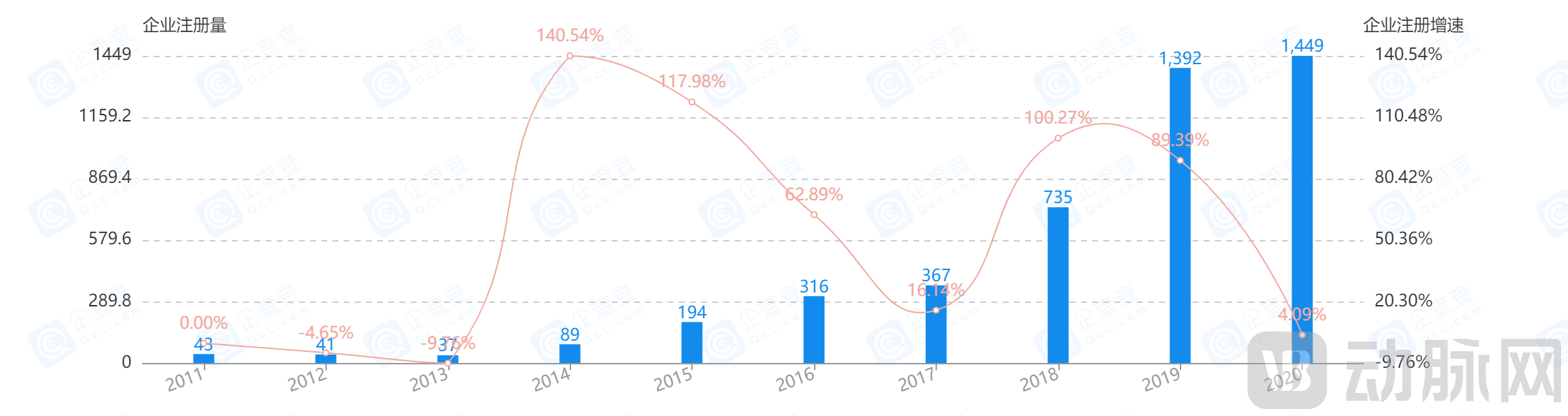 (Trend in the Registration of Oral Care-Related Enterprises. Image source: Qichacha Professional Edition)
The market's fervent sentiment is also being transmitted to downstream partners.“Orders for oral care brands have been increasing over the past two years, with consumer demand becoming more diversified and increasingly refined,” a manager from a third-party market brand operation firm, who requested anonymity, told VCBeat.
Behind this lies the rapid influx of new entrants, intensifying competition in the oral care sector. “For these emerging brands,To succeed, the key lies in one word: “speed.”“In Zhang Wei’s view, the oral care sector is fundamentally a business driven by model innovation. ‘Whoever can rapidly capture market share in the short to medium term is more likely to emerge as the ultimate winner.’”
Thus, it can be seen that new domestic oral care brands in China are beginning to engage celebrities, expand distribution channels, and broaden product categories in order to achieve rapid market expansion.
On Hiring Celebrities, “Bingquan Blispring,” backed by investors such as Baidu Venture Capital and Country Garden Ventures, appointed Zhang Yuqi as its brand ambassador early this year. In April, “Canban,” invested in by ByteDance, officially announced Zhao Lusi as its brand ambassador. Both ambassadors are prominent young Chinese actresses from the new generation, with the core target audience being those born after 1995 and 2000.
According to statistics from Xingshu, under the Yicai Business Data Center, in the three months before and after the official announcement of Zhao Lusi as the brand ambassador, “Canban” allocated 80% of its Xiaohongshu influencer marketing budget to “ordinary users + junior influencers.” Only one post was published by a celebrity, yet it garnered more likes than those from ordinary users and mid-tier influencers. Following the ambassador announcement, the overall number of likes on brand-related posts showed a significant upward trend, indicating that “Canban” has undoubtedly reaped the benefits of celebrity endorsement.
In a previous interview, Zhang Yi, founder of Canban, summarized this online marketing methodology as follows: it leverages the multiplicative effect of in-house high-quality content creation based on data analytics, combined with off-platform content placement and collaborations with celebrities and key opinion leaders (KOLs), all underpinned by strong product competitiveness and differentiated positioning. In other words,Celebrities serve as amplifiers, enabling brands to reach their target audiences more precisely.Of course, hiring celebrities also carries certain risks. For instance, Saky once engaged Wu Yifan as its brand ambassador and sponsored the TV series "Mr. Right."
In terms of channel expansion, domestic oral care brands are also sparing no effort. Taking “Blispring” as an example, it has adopted a comprehensive online and offline strategy.
Online, “Blispring” leverages e-commerce platforms such as Tmall, Douyin, and Kuaishou as its primary promotional channels, particularly focusing on interest-based e-commerce platforms like Douyin and Kuaishou to drive content marketing conversions through strategies such as “product seeding reviews” and “influencer live-streaming sales.” Moreover, Blispring has established its own in-house live-streaming system. Offline, “Blispring” continues to expand its presence and has now entered more than 30,000 retail outlets, including Watsons, RT-Mart, Sanfu, WOWCOLOUR, and Xiran.
“HUGGAH” follows a similar path in channel selection; in addition to establishing a presence on online platforms such as Tmall, Xiaohongshu (Little Red Book), and Douyin (TikTok China), it is also actively expanding into offline channels including KKV and Hema Fresh.
“Most core executives of these emerging brands have prior experience in new-consumption brands or major internet companies, giving them a distinct advantage over traditional oral care enterprises in developing online channels. Coupled with the fact that younger consumers are predominantly active online, this has led to a pronounced fission effect for leading brands.” In Zhang Wei’s view, although the online space is an “area of strength” for new brands, offline channels still warrant significant attention.
This lies in the fact that,Although entering offline channels is more challenging—requiring the marketing team to conduct on-the-ground promotion and operational maintenance across various locations—it is essential for firmly capturing consumer mindshare by ensuring that users can see your brand at any time.“If users frequently cannot see or purchase your products, they will soon forget about you.”
In terms of product categories, brands are continuously expanding their offerings.For instance, Blispring’s product portfolio spans adult toothpaste, children’s toothpaste, manual toothbrushes, electric toothbrushes, mouthwash, and oral sprays, with more than 80 SKUs. Among these, its social-breath-friendly flavored toothpaste is the flagship product.
The BOP brand, launched in late 2019, is also accelerating its SKU expansion. Currently available product categories include oral sprays, teeth whitening strips, and mouthwash. According to founder Liu Bin, BOP plans to expand its product line in the future to include toothpaste, water flossers, and electric toothbrushes.
“The core of category expansion is to cover more scenarios, but judging from current trends, the industry as a whole remains somewhat homogeneous. I believe”"Creating blockbuster products is the key driving force for brands to achieve rapid breakthroughs in the current market."“said Zhang Wei.
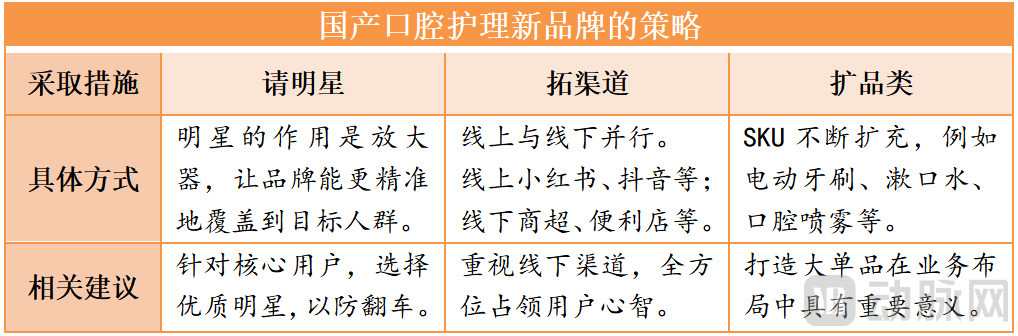
It is evident that, amid intensifying competition in the oral care sector, brands are increasingly striving to solidify their market position by engaging celebrities, expanding distribution channels, and diversifying product categories.So, what is the most critical factor in competition?
“It must be the founder and his team.“Zhang Wei stated, ‘Unlike other sectors in healthcare, once the competitive landscape of the oral care market becomes clear, it is highly likely that industry giants will enter the fray directly. How to validate the business model in the early stage, withstand pressure amid intense competition in the mid-term, and choose the right strategic direction—these all’”It tests whether the founding team possesses the ability to rapidly adapt to the market and continuously iterate on themselves.”
The oral care sector has gained rapid momentum amid the wave of the beauty economy.
According to CBNData’s “Report on Consumption Trends in Healthy Living,” 72% of consumers believe that oral health issues affect their social confidence, and 67% believe that such issues impact their physical appearance.
Thus, it can be seen that, in addition to using a wider variety of product categories to meet users’ oral care needs in different scenarios,Domestic oral care brands also place great emphasis on product aesthetics.For instance, Qingzhi Keyan’s mouthwash products resemble perfumes in appearance and incorporate fragrance elements; similarly, SPDCare (Shubeideng) employs a monochromatic color scheme in its packaging design to highlight product flavor as a key selling point.
Additionally,In terms of product efficacy, companies are also seeking points of differentiation.Taking HUGGAH’s flagship mouthwash as an example, it incorporates two distinct antibacterial agents—cetylpyridinium chloride and domiphen bromide—to address diverse oral health concerns. For preservation, plant-derived extracts are used to replace traditional preservatives. According to test reports from the Beijing Research Institute of Daily Chemical Industry, HUGGAH mouthwash demonstrates an antibacterial efficacy rate exceeding 99.9% against pathogens associated with periodontal disease and dental caries, specifically Streptococcus mutans and Porphyromonas gingivalis.
“From the current perspective, the rise of new domestic oral care brands has mainly capitalized on traffic dividends and received a boost from capital,” Zhang Wei told VCBeat. In the foreseeable future,Enterprises must also strengthen brand equity accumulation.
This is because, for companies in the consumer healthcare sector, the key to long-term sustainability lies in whether their brand has taken deep root in consumers’ minds. “Traditional brand building relies on channel communication centered on end-point product distribution and brand communication driven by advertising, with these two approaches operating in silos. Therefore, future brand-building strategies should emphasize the integration of both. For instance, companies should reduce the proportion of hard-sell advertisements while increasing investment in content marketing, making the brand more tangible and perceptible to users.”
Furthermore, the accumulation of brand equity ultimately hinges on product experience and efficacy. “As homogenization intensifies, pinpointing a specific core pain point for product positioning often holds greater advantage over a broad, all-encompassing product portfolio, enabling brands to better capture consumer mindshare and establish brand recognition.”
It is foreseeable, as more capital and industry giants enter the market in the future, an era belonging to new domestic oral care brands is dawning.At the same time, amid increasingly fierce market competition, many companies will ultimately fade away as the tide recedes.
So, who will emerge as the leader in the vast oral care market? Only time will tell.