Shanzhen Releases Report on Silver-Haired Population's Health Screening Trends: Seniors in Beijing, Shanghai, Guangzhou, and Shenzhen Spend the Most

Shanzhen
Operator of Internet Physical Examination Service Platform
As the Double Ninth Festival arrives once again, China’s rapidly aging population has made improving the health of older adults a renewed focal point of public discourse.
The “Healthy China 2030” Planning Outline, issued by the Central Committee of the Communist Party of China and the State Council, highlights the concept of healthy aging and explicitly sets the target of reaching an average life expectancy of 79.0 years by 2030, with a significant increase in average healthy life expectancy.
Shifting from passive treatment to proactive prevention through health checkups is particularly crucial for the elderly population, who face higher health risks. On the occasion of the Double Ninth Festival, Shanzhen, a leading brand in senior healthcare, released the “2021 Data Report on the Current Status of Health Checkups Among China’s Silver-Haired Population,” providing an authoritative analysis of the current state of health screenings among this demographic.
According to a report released by Shanzhen, among the population undergoing health checkups, those aged 60 to 69 accounted for 8.15%, and those aged 70 and above accounted for 4.59%, with the combined proportion of individuals aged 60 and above totaling less than 13%.
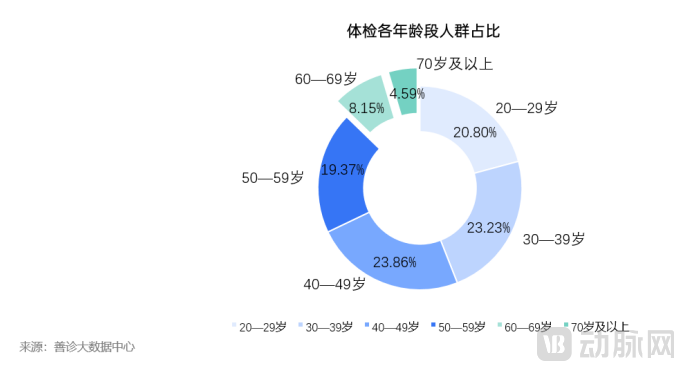
(60Proportion of health checkups among individuals aged and above is less than13%)
From 2017 to 2020, the number of health check-ups among the elderly population increased year by year, with a significant growth rate reaching up to 64%. Meanwhile, the elderly are also more willing to spend on health check-ups. In 2021, the average spending per customer for health check-ups among the elderly increased by approximately 20% compared to the previous year. Thus, although the proportion of health check-ups among people aged 60 and above is not high, the market for elderly health check-ups shows strong upward momentum.
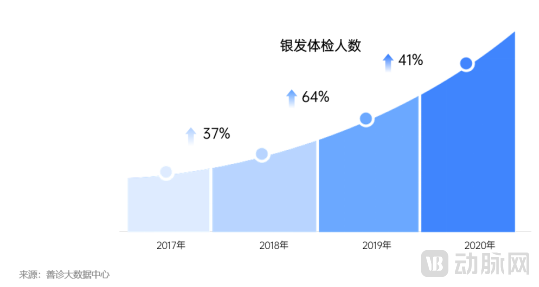
(The number of health checkups for individuals aged 60 and above has been increasing year by year, with an annual growth rate exceeding 35%)
According to a report released by Shanzhen, from September 2020 to August 2021, the top 10 cities in terms of health checkup volume among the elderly population were Shanghai, Beijing, Guangzhou, Tianjin, Suzhou, Xi’an, Chengdu, Wuhan, Qingdao, and Shenzhen, while the top 5 cities by average transaction value were Shenzhen, Beijing, Guangzhou, Shanghai, and Nanjing. This indicates that first-tier cities such as Beijing, Shanghai, Guangzhou, and Shenzhen remain the most enthusiastic and willing to spend on health checkups.
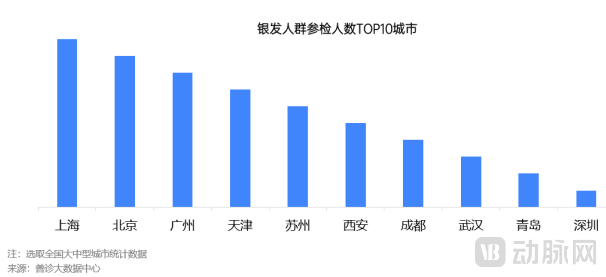
(Top 10 Cities by Volume of Health Checkups for the Silver-Haired Population)
Experts analyze that, currently, with rising life expectancy and advancements in medical care, more elderly individuals are willing to invest in their health, driving significant growth in the premium senior health checkup market. On the other hand, as basic medical knowledge becomes more widespread and public awareness of disease prevention generally improves, older adults are increasingly accepting of health screenings. Consequently, more children are beginning to gift comprehensive, high-end health checkup packages to their parents as a gesture of filial piety.
From a gender perspective, among individuals under the age of 60, the participation rates for males and females were 45% and 55%, respectively; among those aged 60 and above, the participation rates for males and females were 47% and 53%, respectively. Compared with men, women demonstrated greater enthusiasm for health checkups, which to some extent reflects their higher level of attention to their own health status.
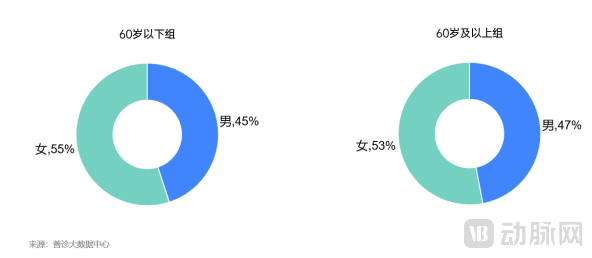
(Women’s participation in health checkups is higher than that of men across all age groups)
According to the report released by Shanzhen, health issues among the silver-haired population continue to increase with age. Among more than 60 common health problems, the average number of health issues for individuals under 60 is 6.17, while for those aged 60 and above, it is 9.22—approximately 50% higher than the former. Meanwhile, health problems in the population over 60 increase at an average rate of 0.45 per five years.
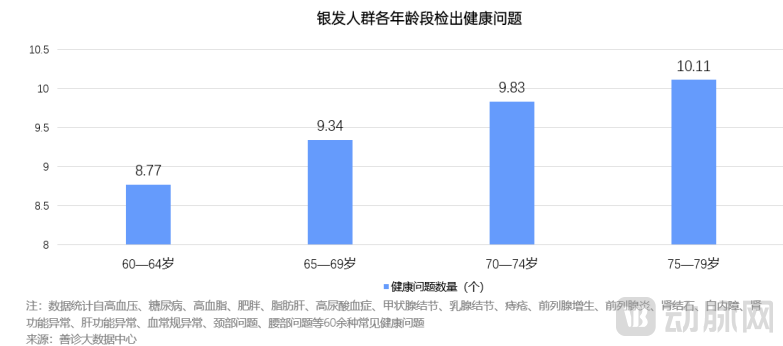
(The number of health issues among the silver-haired population surges with age)
Among the elderly population, the top ten diseases detected during health examinations are, in order: thyroid nodules, overweight or obesity, dyslipidemia, elevated blood pressure, hyperglycemia, abnormal electrocardiogram (ECG) findings, fatty liver, Helicobacter pylori positivity, hemorrhoids, and straightening of the cervical curvature. The primary health issues identified in women are thyroid nodules, overweight or obesity, and dyslipidemia, whereas in men, they are overweight or obesity, benign prostatic hyperplasia, and thyroid nodules.
As the disease with the highest detection rate among individuals aged 60 and above, thyroid nodules are more likely to affect women. In this age group, the detection rate of thyroid nodules in women is approximately 15% higher than that in men. The top five cities with the highest detection rates of thyroid nodules among the elderly population are Shanghai, Suzhou, Beijing, Guangzhou, and Wuhan, in descending order.
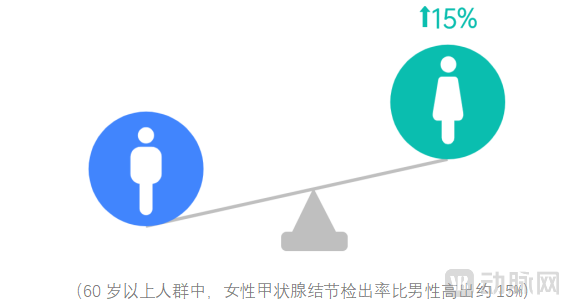
(Among individuals aged 60 and above, the detection rate of thyroid nodules in women is approximately 15% higher than in men)
Benign prostatic hyperplasia (BPH), a condition affecting the majority of elderly men, is positively correlated with advancing age, with a detection rate exceeding four-fifths among men over 80 years old. Among men aged 60 and above, the top five cities with the highest BPH detection rates are Beijing, Chengdu, Shanghai, Xi’an, and Tianjin, in that order.
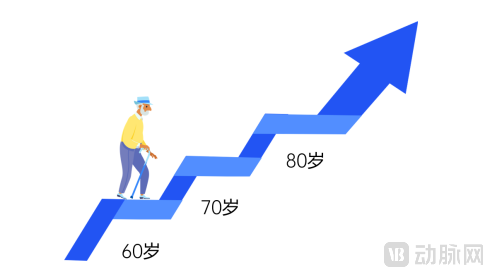
(The detection rate of benign prostatic hyperplasia shows a "stepwise" increase every 10 years)
“Age 60” is the watershed for gender-specific detection rates of hypertension. Among individuals under 60, the detection rate is significantly higher in men than in women; however, after age 60, the detection rate in women begins to surpass that in men. This is because estrogen levels in middle-aged and older women drop precipitously, leading to dysregulation of vascular contraction and relaxation, which results in a significant increase in hypertension.
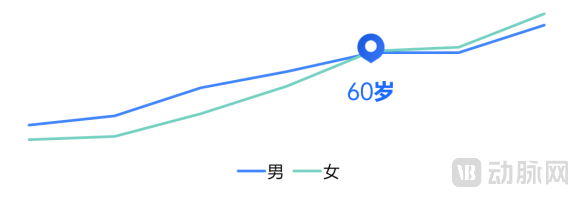
(After age 60, the detection rate of hypertension in women begins to surpass that in men)
Shanzhen’s report highlights that for middle-aged and elderly individuals, undergoing at least one comprehensive health examination annually, tailored to their individual conditions, is particularly crucial. The risk of cardiovascular and cerebrovascular diseases as well as cancer increases significantly in this age group. Coupled with aging and reduced physical activity, which lead to a lower metabolic rate, they are more prone to metabolic disorders such as hypertension, diabetes, and hyperlipidemia.
Experts recommend that additional health screening items suitable for the elderly include chest CT, a panel of 12 tumor markers, carotid artery ultrasound, echocardiography, Helicobacter pylori testing, and cervical spine imaging. Among gender-specific screenings, breast ultrasound, liquid-based thin-layer cytology (TCT) for cervical cancer, and prostate ultrasound are highly necessary. Notably, thyroid nodules have become the most frequently detected condition in the elderly population, underscoring the increasing importance of thyroid ultrasound examinations.
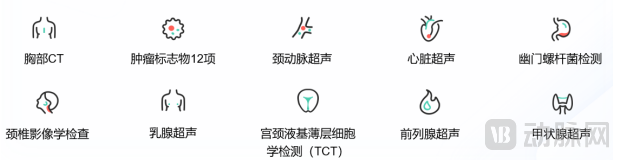
(Additional Health Checkup Items Suitable for the Silver-Haired Population)
Shanzhen’s report highlights that, based on daily health check-up capacity utilization, Mondays and Tuesdays see the lowest saturation levels, while weekends experience the highest, with Saturdays being the most crowded. If scheduling a health check-up on a weekday, it is advisable to choose the first half of the week; if a weekend appointment is unavoidable, consider avoiding Saturday to steer clear of peak crowds.
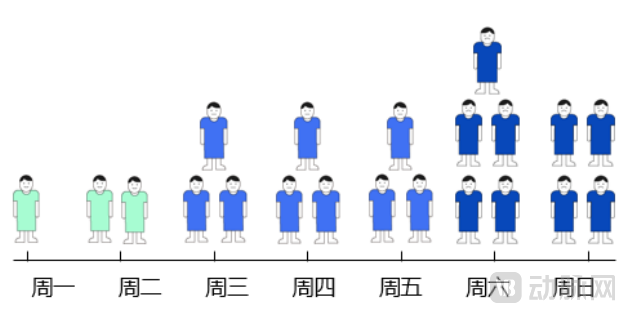
(Low examination volume in the first half of the week)
It is reported that Shanzhen has been deeply engaged in the health sector for the elderly for many years. It has been selected as one of Shanghai’s Top 50 Online New Economy Enterprises for two consecutive years. Possessing China’s largest medical checkup service platform, its service network covers more than 3,000 public hospitals and branded checkup institutions across over 300 cities nationwide. Additionally, it is China’s largest provider of medical checkup software.
Scan the QR code below to access the full report: