

Dreem Files for IPO: FDA-Approved Smart Headband Uses Audio Stimulation to Enhance Deep Sleep and Monitor Brain Activity in Real Time

Dreem
Sleep Monitoring Wearable Device Developer
According to the World Health Organization, 27% of the global population experiences sleep problems. The "2021 White Paper on Exercise and Sleep," released by the Chinese Sleep Research Society, reveals that over 300 million people in China suffer from sleep disorders, with the average sleep duration for Chinese individuals reaching only 6.69 hours in 2020. Among internet users, 56% report having sleep issues, with work pressure identified as the primary factor affecting sleep quality. Furthermore, the "2020 China Sleep Index Report" highlights that sleep problems are more pronounced among young people; notably, 69.3% of those born in the 1990s go to bed after 11:00 p.m., many of whom experience difficulty falling asleep.
Good sleep is crucial for both physical and mental health, impacting cognitive function, immune activity, weight maintenance, emotional stability, and psychological well-being. Sleep provides our bodies and brains with essential “rest” or “recharge” time. Quality sleep helps protect the body from disease, enables clearer thinking and more efficient information processing, and also contributes to preventing anxiety and depression.
Dreem, a neurotechnology company based in California, USA, is dedicated to redefining sleep management by developing innovative and clinically validated solutions to measure and improve sleep quality.The company’s product, Dreem, is a head-mounted wearable device that analyzes users’ sleep quality by detecting brainwaves, heart rate, and sleeping posture, and employs auditory stimulation to promote deep sleep and improve sleep quality.
In 2014, at France’s most prestigious École Polytechnique, two students, Hugo Mercier and Quentin Soulet de Brugière, embarked on an exciting adventure.
Hugo Mercier has long been deeply interested in brain function, dedicating significant time and employing diverse approaches to study this field. Quentin Soulet de Brugière is passionate about translational medicine and firmly believes that integrating technology with pharmaceuticals can improve the lives of millions.
After encountering a recent discovery involving audio stimulation and deep sleep, the two co-founded the neurotechnology company Rhythm (later renamed Dreem) to conduct in-depth research in the field of sleep, aiming to develop wearable sleep devices that use auditory stimuli to enhance deep sleep during the night.
Starting as a duo, the team rapidly expanded to include 12 sleep physicians, neuroscientists, engineers, machine learning experts, designers, and specialists in advanced computing and electronics. By integrating cutting-edge hardware and software technologies with foundational neuroscience and clinical research, the team is dedicated to addressing diverse sleep challenges and introducing a novel sleep solution for patients with various sleep disorders.
By the end of 2015, the company had filed 10 patents and developed its first product prototype: the Dreem headband was born.
On March 29, 2016, Dreem completed its Series A financing round, raising $11 million from investors Laurent Alexandre and Xavier Niel. On June 16, 2017, Dreem secured a new $11 million in funding, led by Xavier Niel, with participation from Laurent Alexandre and new investor MAIF Avenir.
On June 26, 2018, Dreem completed its latest funding round of $35 million, led by Johnson & Johnson and Bpifrance, with participation from Laurent Alexandre, Xavier Niel, and MAIF Avenir. The proceeds from this round will be used to bring next-generation sleep technology to the global market and to continue investing in research and development to drive future scientific discoveries and technological innovations related to sleep.To date, Dreem has completed three rounds of financing, raising a total of $57 million.
Since its establishment in 2014, Dreem has filed more than 40 patents, developed four full versions of the Dreem headband, and helped thousands of people around the world address their sleep problems.Dreem has also compiled an electroencephalogram (EEG) database, with over 7,000 participants enrolled in testing and more than 2.1 million nights of data recorded.
The company’s product is a smart headband called “Dreem” that connects to mobile devices and can track users’ brain activity in real time.
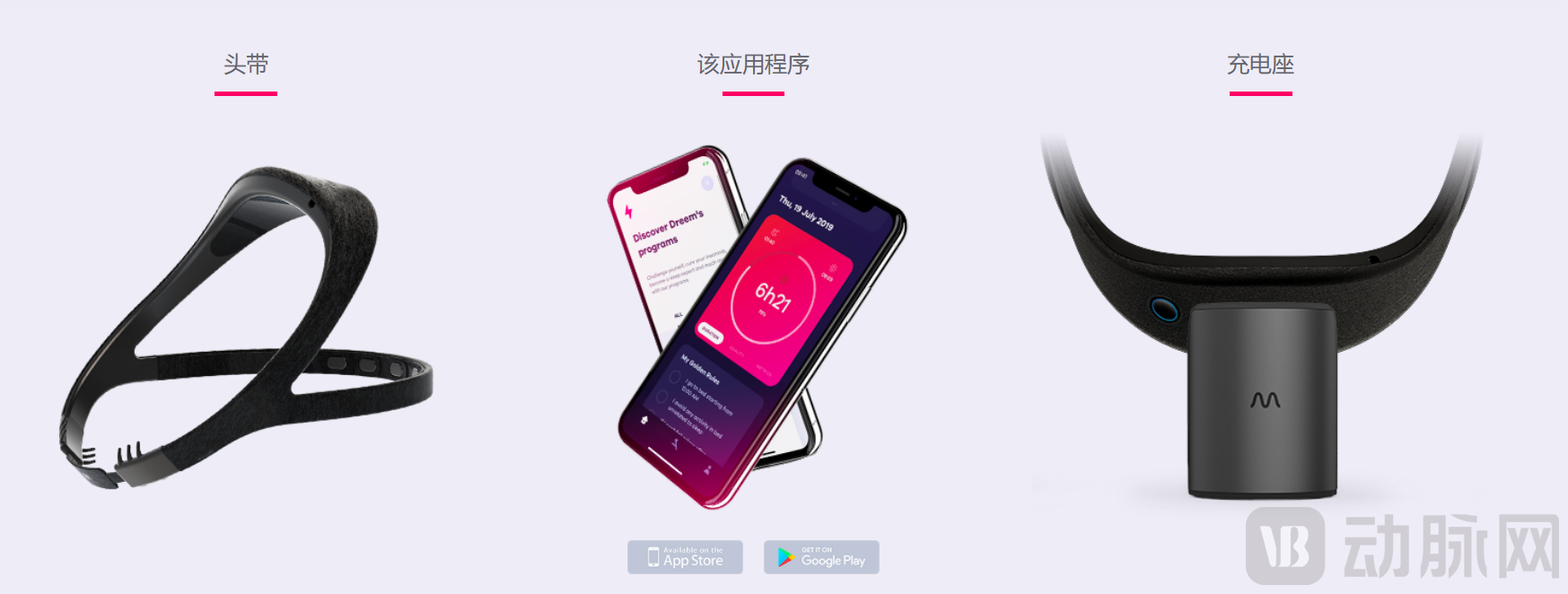
“Dreem” is a sleep solution that integrates findings from neuroscience research with advanced technology. It consists of a headband equipped with sensors and an acoustic wave generator, a charging dock, and a companion mobile app.
Dreem is made of silicone, lightweight and comfortable to wear. The company collaborated with the industrial design firm Fuseproject to ensure that the fabric in contact with the head is sufficiently comfortable and natural. Using polysomnography (PSG) technology, it employs electroencephalogram (EEG) sensors to monitor brainwaves in real time during sleep, while simultaneously tracking and collecting data such as sleeping position, respiratory rate, and heart rate, which are then transmitted via Bluetooth to the app for completion.Data Display, Patient Education, Sleep Interventionand other features. In addition, users can view their sleep onset time, sleep duration, sleep stages, and sleep history on the app.
According to the company,The headband also features a biofeedback function that utilizes an acoustic wave generator to deliver audio stimulation for sleep assistance, making it easier to fall asleep and wake up.“After using Dreem, 80% of patients with chronic insomnia experienced reduced or resolved symptoms within six weeks,” said Hugo Mercier, the company’s former CEO. “Thanks to its biofeedback feature, patients who previously took an hour and a half to fall asleep now do so within 15 minutes.”
Furthermore, when the device detects that the user has entered deep sleep mode, it emits a special acoustic wave that propagates through the skull bones, effectively prolonging the user’s deep sleep state. During this process, users do not require any additional auxiliary devices or earplugs. Paris-based scientists who developed this product believe that auditory stimuli directly transmitted to the inner ear, such as “pink noise,” can improve slow-wave sleep or deep sleep.
In 2019, the newly launched Dreem 2 received approval from the U.S. Food and Drug Administration (FDA) to be marketed as a Class II medical device.
According to the company, more than 50 engineers participated in the second beta version, which was released in collaboration with renowned neuroscientists such as Emmanuel Mignot, Christoph Koch, and David Eagleman.
“Currently available sleep solutions on the market fall into two categories. One is medical solutions, such as sleeping pills, which can be addictive, invasive, and have adverse side effects on health. The other is consumer-oriented solutions, such as sleep trackers and wearable devices, which rely on overly simplistic technologies, lack accuracy, and are inefficient in improving sleep,” said Hugo. “Dreem is safe, non-invasive, and highly effective. It ensures accuracy in sleep monitoring and can actively improve sleep through auditory stimulation.”
Compared with accelerometer-based sleep trackers, ballistocardiography (BCG) or measurements of heart rate variability are superior physiological indicators of sleep, as it is well established that human heart rate increases or decreases during specific sleep stages. For instance, heart rate slows during the transition from wakefulness to light sleep, increases slightly during rapid eye movement (REM) sleep, and reaches its lowest level during deep sleep.
“However, none of these processes are as effective as electroencephalogram (EEG) sleep monitoring. EEG can accurately measure the frequency, amplitude, and type of brainwaves in each sleep cycle, and sleep can be deepened by manipulating these frequencies, which is not possible with ballistocardiography,” said Hugo.
In 2019, Dreem conducted a validation study aimed at comparing the Dreem headband with traditional polysomnography (PSG). Thirty-one participants completed overnight sleep studies using both PSG and the Dreem headband, allowing for an evaluation of the device’s signal acquisition and performance.
Signal acquisition results in the alpha, beta, theta, and delta frequency bands demonstrated substantial agreement between conventional polysomnography (PSG) and Dreem, with heart rate and respiratory measurements yielding adequate data. Furthermore, sleep staging from PSG was scored by five certified sleep technologists, while Dreem’s sleep staging was generated by its automated algorithm. Comparative analysis of the technologist scores and the Dreem algorithm outputs indicated that Dreem’s staging performance is comparable to that of PSG-based sleep scoring.
Dreem stated that the study results demonstrate the accuracy of its signal acquisition and algorithms, positioning them as a viable alternative to polysomnography (PSG) and analysis by sleep specialists.. The success of this validation, coupled with the explosive growth of digital health amid the pandemic, has driven the company’s B2B transformation.
The outbreak of the COVID-19 pandemic has brought about profound changes in the healthcare industry and also propelled the development of digital health. In this context,Dreem has also embarked on the second phase of its commercial journey, shifting its focus toward pharmaceutical companies, research laboratories, healthcare providers, and device manufacturers.
In March this year, Dreem announced that Quentin Soulet de Brugière had succeeded Hugo Mercier as the company’s CEO. Previously, as a co-founder, Quentin Soulet de Brugière had served as the company’s Chief Scientific Officer (CSO). Meanwhile, Anne Reiser, a veteran of the healthcare industry, has joined Dreem’s board of directors. Prior to this, Anne served as President for EMEA, APAC, and Japan at ResMed Inc., and held leadership positions at Medtronic, bringing decades of experience in the healthcare and sleep industries.
The success of the Dreem headband has provided the company with a substantial volume of highly precise sleep data, paving the way for further enhancements in the accuracy of future products. Currently, the company is collaborating with key stakeholders in the healthcare industry, including 250 research laboratories, leading pharmaceutical companies, and medical device manufacturers, to develop digital sleep solutions. To date, Dreem has been utilized in five clinical trials and incorporated into numerous academic research protocols.