

Fosoto Medical Files for IPO: Pioneering Radiation-Free 3D Spinal Imaging for Pediatric Scoliosis Screening
Before AlphaGo defeated the then-world champion Lee Sedol, perceptions of artificial intelligence were largely confined to mimicking human intelligence or serving as an extension of the human body, without excessive expectations. Five years later, however, this technology has expanded across healthcare, education, manufacturing, smart homes, transportation, and other sectors, opening up new possibilities for human life.
Technological iterations are accelerating, repeatedly disrupting human society. Mobile communication technologies such as 5G and 6G, along with virtual reality technologies like VR and AR, have made telemedicine a reality. The “Metaverse,” coined by science fiction master Neal Stephenson, has become the next industry trend favored by numerous investors. Amid this trend, it is hard not to ponder: what can a breakthrough in new technology truly bring to this era?
Fusote Medical Technology Co., Ltd. (hereinafter referred to as “Fusote”), which specializes in the research, development, and production of original, miniaturized, portable, and non-invasive cutting-edge medical products, has joined this wave of enthusiasm.
Fusote leverages its corporate expertise in sensors, optics, image recognition, and artificial intelligence to develop proprietary, compact, portable, and non-invasive advanced medical technologies. These innovations address critical industry pain points, including the inability to rapidly screen for pediatric spinal issues, excessive testing costs, the potential harm posed by traditional detection methods to children and adolescents, and the lack of effective treatment monitoring.
This year, Fusote has begun filing for medical device registration certificates both domestically and internationally, as well as applying for international patents. The company expects to launch its 3D spinal visualization devices, “Jixiang” and “Xiaoshu Tongxue,” in late October and late November, respectively.。
As of September 2021, Fusote has organized scoliosis screening programs for tens of thousands of individuals across various primary schools and other institutions, obtaining test efficacy data and result feedback. Meanwhile, commissioned by the government, Fusote plans to undertake the adolescent scoliosis screening project at Shanghai Jing’an Foreign Language Primary School.
Fusote’s decision to enter the “spinal screening” sector stems from its market observations.
Company founder He Dan told VCBeat: “During our initial project engagement, we recognized that scoliosis among children and adolescents has become relatively prevalent. However, the market lacks both specialized physicians and technological solutions capable of measuring and screening for scoliosis. Therefore, leveraging our team’s expertise in sensor technology, optical technology, cloud computing, and artificial intelligence, we aim to develop a non-invasive, innovative product for the measurement and screening of scoliosis in children and adolescents.”
In fact, scoliosis has become the third major “killer” of children’s and adolescents’ health, following obesity and myopia.According to existing epidemiological studies and reports on the prevalence of scoliosis in Chinese cities, approximately 3 million children across China currently suffer from varying degrees of scoliosis, with an annual increase of 300,000 cases. Meanwhile, if scoliosis is not screened for and intervened in a timely manner, it can easily lead to worsening spinal deformity, reduced labor capacity, and even paraplegia.
Despite the continuous rise in the number of individuals with scoliosis, the market lacks relevant measurement and screening technologies, as well as an adequate number of specialized physicians.
From a technical perspective,Although traditional X-ray examination offers rapid detection and a lower workload, it involves a larger radiation field, which can cause irreversible damage to adolescents' hematopoietic and reproductive systems. Furthermore, due to equipment limitations, this method is unsuitable for follow-up monitoring of adolescent idiopathic scoliosis, thereby delaying timely corrective treatment.
From the perspective of physician measurement,Traditional single scoliosis screening programs may lead to high false-positive rates, inconsistencies between suspected positive rates and prevalence, subjective bias from examiners affecting results, and poor reproducibility due to non-uniform measurement methods and varying technical proficiency.
A myriad of issues form a web that hinders the prevention and early intervention treatment of scoliosis.
The Chinese government has also recognized the severity of this issue. On February 1, 2021, the official website of the Ministry of Education of China published two proposals submitted by members of the National Committee of the Chinese People's Political Consultative Conference: “Proposal on Promptly Launching Prevention and Control Efforts for Scoliosis in Children and Adolescents” and “Proposal on Paying Attention to Spinal Health Among Adolescents to Improve the Overall Health Status of Chinese Youth,” so as to accelerate interventions aimed at improving spinal health among children and adolescents.
It is evident that families with children and adolescents, various hospitals and rehabilitation health institutions, communities, schools, and other educational institutions all require relevant measurement technologies to address the current challenges in scoliosis screening.
In response to this market demand, Fusote has developed the “SpinalView – Spine Visualization Detection System” and the “Xiao Shu Tongxue Spine Detector” to address the challenges in detecting and screening for scoliosis.
Its spinal visualization detection system, “SpineSight,” is specifically designed for hospital use and consists of three components: a 3D spinal scanner, a spinal visualization management computer, and a spinal examination pan-tilt unit.Early screening and intervention for scoliosis in children and adolescents, leveraging technologies such as pose-detection-based 3D spinal reconstruction, Qt+VTK computational visualization graphics, nine-axis sensor attitude angle measurement, optical sensing with roller sensors, and laser tracking with fiducial marker localization.
This system not only employs optical sensing technology to avoid radiation-induced harm to the bodies of children and adolescents, but also overcomes the limitations of two-dimensional imaging, enabling the calculation of spinal health metrics that are difficult to quantify using conventional methods. It offers high measurement accuracy, with an angular resolution of less than 0.5°.
In terms of result presentation, the system utilizes data visualization to intuitively display the 360-degree, comprehensive posture and morphology of the human spine. Upon completion of the measurement, it immediately provides relevant data, including projections of the subject’s spine in the coronal, sagittal, and horizontal planes. This enables physicians to perform a 360-degree rotational observation of changes in spinal morphology, thereby enhancing the accuracy of scoliosis screening.
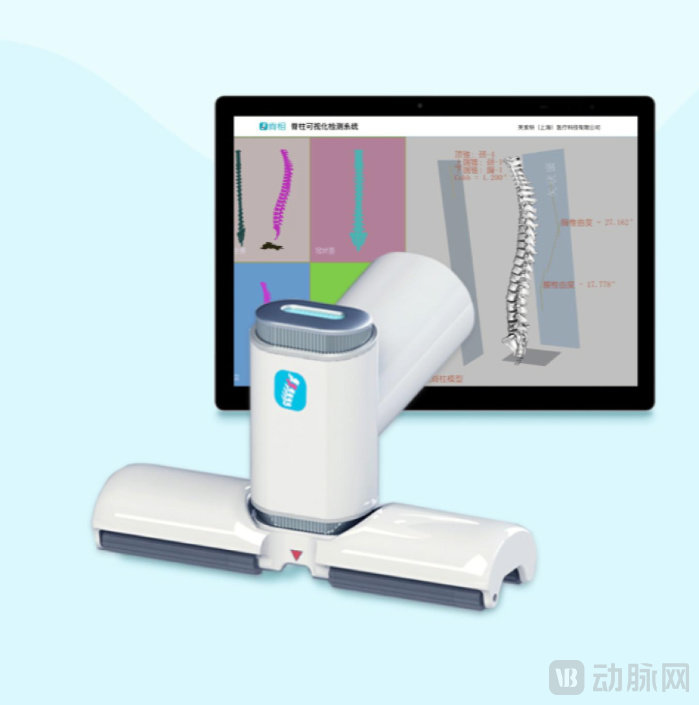
Spinal Imaging
Meanwhile, the system requires only 5–10 seconds per individual for a single measurement, which not only accommodates large-scale screening but also enables physicians to assess patients’ spinal conditions more precisely and rapidly, thereby facilitating diagnostic decision-making.
Distinct from traditional screening methods, the product features multidimensional data analysis, intuitive result presentation, and ease of use, enabling broad application scenarios and an expanding user base. It can be applied in hospital testing, student health examinations, home monitoring, and rehabilitation correction.
The Xiaoshu Student Spine Detector is an advanced technological product designed to monitor and support the healthy spinal development of children.
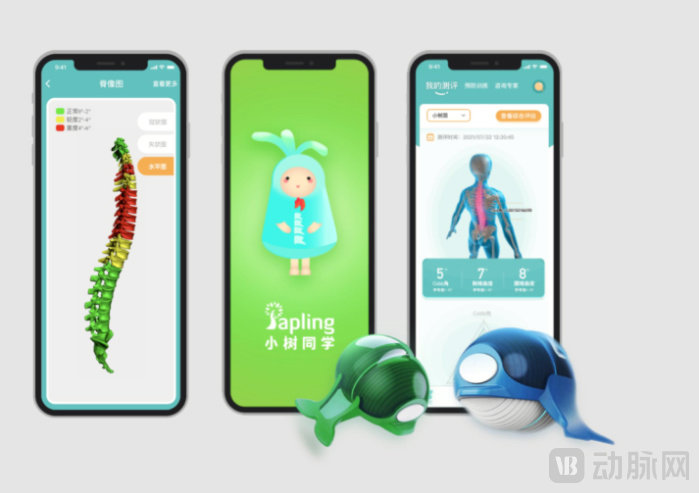
SaplingStudent Xiaoshu
Users need only connect the Sapling (Xiao Shu) home-use detection device via Bluetooth and complete a one-minute test to obtain spinal health metrics. This testing method reduces the complexity of measurement, making self-testing easier for users. It empowers early screening and intervention for scoliosis in children and adolescents.
Moreover, the platform will assess children’s developmental status by measuring multiple developmental indicators and provide families with “improvement trend curves” generated from each test record, helping them better understand their child’s scoliosis condition. Regarding specific diagnostic results and solution recommendations, the platform will leverage patients’ test data to enable online experts to deliver customized, professional exercise plans, facilitating rapid recovery and establishing an internet-based diagnosis and treatment system for spinal rehabilitation.
To address user demands for rehabilitation and preventive consumables, as well as access to spinal rehabilitation centers and clinics specializing in myopia and height management, Fusote has integrated an e-commerce platform covering the spinal rehabilitation industry chain into its app. This enables users to purchase related consumables online and access information on professional diagnosis, treatment, and rehabilitation institutions, thereby creating a closed-loop system that fulfills users’ end-to-end needs.
To address the current mismatch between the demand for scoliosis screening and market supply, Fusote has leveraged its technological expertise to develop targeted products for both healthcare providers and end users, thereby addressing industry pain points from multiple dimensions.
In this regard, He Dan stated:“Fusote has integrated emerging technologies from other fields with the current needs of the healthcare sector, creating a medical technology product that breaks through conventional thinking. We aim to continuously develop cutting-edge ‘black tech’ products for healthcare, with three objectives: first, to enable Chinese-made medical technology products to go global; second, to further drive innovation in the domestic market through the R&D of such frontier technologies; and third, to reduce patient testing costs through ‘black tech’ solutions, thereby allowing more people to access better treatment.”
Currently, Fusote has obtained three invention patents, two integrated circuit layout designs, ten software copyrights, and two design and utility model patents, and has passed the novelty search report issued by the Chinese Academy of Sciences. Among these, the patent application for “A Method for Scoliosis Detection” has been approved through the green channel, while the other two are under review. The novelty search report has confirmed that this technology has reached an internationally advanced level.