

Chinese TYK2 Inhibitors Challenge Global First-in-Class Drugs Amid IPO Filing

Johnson & Johnson
Medical Device R&D and Manufacturer

Alumis
Autoimmune Disease Therapy Developer
Biogen
New Drug Developer

By the end of March each year, the AAD Annual Meeting (American Academy of Dermatology Annual Meeting) is the most intensive clinical data festival in the global autoimmune and inflammation fields.
Within a few days, clinical data was densely released across multiple fields such as psoriasis, cutaneous lupus erythematosus, and atopic dermatitis. Johnson & Johnson's oral IL-23 receptor antagonist peptide JNJ-2113 (icotrokinra) has been officially approved by the FDA. Alumis' (authorized by Haisco) next-generation TYK2 inhibitor Envudeucitinib caused a sensation at a late-breaking session, while Biogen’s BDCA2 antibody brought new excitement to investors in the long-dormant cutaneous lupus erythematosus (CLE) field.
However, when the global pharmaceutical industry is immersed in this data feast, one cannot overlook what's coming from China.The Mysterious Power of TYK2, the apparent strongest efficacy data for oral psoriasis treatment currently still remains in China.
BMS's Sotyktu, as the First in class, has fallen into an awkward situation, facing the dilemma of being surrounded by a group of potential Me better and Best in class.
01
The Battle of Two Targets in Psoriasis
Overview of Recent Clinical Data from Major Psoriasis Pipelines:
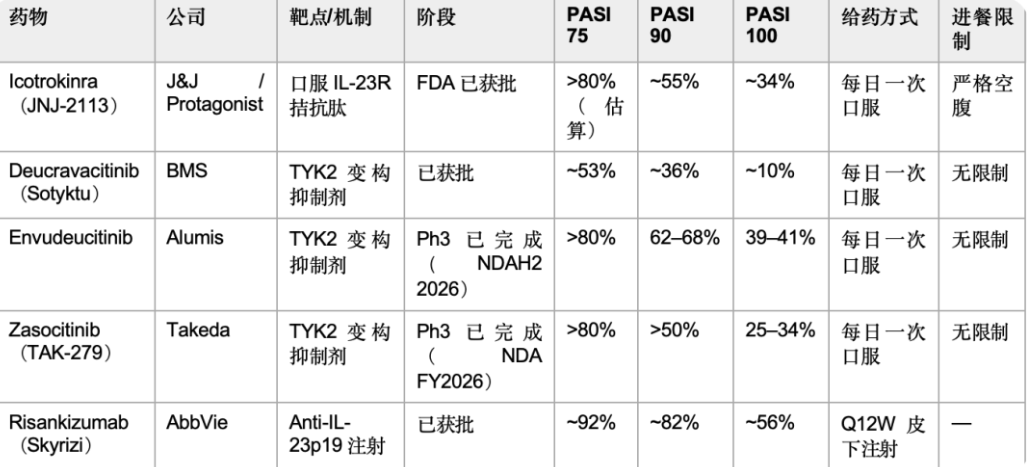
(Note: Caution is required when comparing numbers across trials due to differences in patient enrollment criteria.)
On March 18, 2026, Johnson & Johnson announced that the FDA officially approved icotrokinra (brand name ICOTYDE™) for moderate to severe plaque psoriasis — this isWorld's First Oral IL-23 Receptor Antagonist, alsoThe First Targeted Oral Peptide DrugApproved for this indication.
The significance of this approval goes beyond the launch of a new drug itself.
Previously, BMS's deucravacitinib (Sotyktu), with its novel mechanism as a "TYK2 allosteric inhibitor" and efficacy superior to apremilast, quickly established a new benchmark for oral psoriasis treatment after its launch, with annual sales rapidly climbing to approximately $20 billion. However, the arrival of JNJ-2113 directly suppressed it in head-to-head trials.
ICONIC-ADVANCE 1/2 Two Phase III Studies – The World’s First Head-to-Head Trial of Oral Psoriasis Drugs, Results Clear:
1) Week 16 IGA 0/1 (skin clearance rate): icotrokinra approximately 70% vs deucravacitinib approximately 40%, a significant gap;
2) Week 16 PASI 90: icotrokinra approximately 55% vs deucravacitinib approximately 35%, leading by 20 percentage points;
Safety: The incidence of adverse events with icotrokinra (57%) was even lower than that of deucravacitinib (65%), and was almost indistinguishable from placebo.
It is not difficult to understand this gap in terms of mechanism: Sotyktu acts on the TYK2 kinase domain (JH2 allosteric), exerting its effects by indirectly inhibiting the IL-23/IL-12 signaling pathway; whereas JNJ-2113 directly blocks the IL-23 receptor, with a mechanism that is more upstream and precise, essentially "packing the efficacy of injectable IL-23 monoclonal antibodies into a pill." BMS has evidently already felt the threat —Sotyktu's indication barrier is not thick, and moderate to severe plaque psoriasis is its core area.
However, JNJ-2113 is not without its weaknesses.
This medication has an unavoidable restriction on its use:No food should be consumed at least 2 hours before taking the medication, and no food should be consumed for at least 30 minutes after taking the medication. The medication should be taken on an empty stomach in the morning with approximately 240ml of water.
This requirement presents considerable compliance pressure for patients who need to send their children to school every morning and then rush to catch the subway for work. In contrast, neither Sotyktu nor Envudeucitinib has dietary restrictions and can be taken at any time. The bioavailability of oral peptides relies on the fasting environment of the intestine, which is determined by the chemical properties of the molecule itself (cyclic peptides) and cannot be completely resolved through formulation improvements.
Moreover, icotrokinra is currently only approved for psoriasis (plaque type), while Sotyktu has already been approved for psoriatic arthritis (PsA). The broader coverage of multiple indications remains one of the latter's competitive advantages.
However, TYK2 is a typical late-stage target. While JNJ-2113 was at the height of its popularity, two TYK2 inhibitors under development also delivered impressive data at AAD 2026.
Alumis' Envudeucitinib——The LBA data from the two Phase III studies, ONWARD1 and ONWARD2, were orally presented at the AAD:
At Week 24, PASI 90 reached 68.0% and 62.1%, respectively, and PASI 100 reached 41.0% and 39.5%, respectively, surpassing Apremilast comprehensively and significantly exceeding Sotyktu in absolute values. The improvement in skin clearance quality positions Envudeucitinib to potentially become the most potent TYK2 inhibitor to date. Alumis plans to submit the NDA in the second half of 2026.
Takeda's ZasocitinibEqually impressive: Approximately 70% achieving sPGA 0/1, up to 34% achieving PASI 100, and over 90% of patients maintaining skin clearance beyond Week 40, with persistence data still stunning. According to Takeda's disclosed plans, it expects to initiate FDA submission this fiscal year, almost in sync with Alumis for the final push.
In fact, Envudeucitinib, the pipeline that has gained immense popularity at AAD, is a representative of the early license-out pipelines in China. In March 2021, Haisco Pharmaceuticals licensed it to Alumis for an upfront payment of $60 million and a potential milestone deal worth $120 million. Its structure replaced the methyl group in the BMS molecule with a deuterated compound, inhibiting methyl metabolism and achieving a longer half-life, offering an advantage in pharmacokinetics. Looking back now, this deal was truly a steal for Alumis, as Takeda later spent $4 billion just two years later to acquire a similar me-too pipeline.
It can be foreseen that in the next 2-3 years, the psoriasis oral treatment market will see a tripartite dominance: JNJ-2113 will occupy the high-end market with head-to-head superiority, Envudeucitinib and Zasocitinib will split the mid-range market due to better medication convenience (no dietary restrictions), while Sotyktu will face the risk of being squeezed from both sides. Of course, Sotyktu’s price war is extremely aggressive, showing a strategy of trading volume for price.
02
CLE——A Market Forgotten for 70 Years, Biogen Arrives
Cutaneous Lupus Erythematosus (CLE) is an autoimmune disease primarily characterized by skin lesions, with a global prevalence of approximately 73 per 100,000 people, and about 200,000 patients in the United States. Symptoms include facial discoid erythema, photosensitivity, and pigmentation. Of course, compared to SLE, its symptoms are milder, only affecting the skin without involving other organs, and it is not life-threatening. Nevertheless, CLE should still be taken seriously—just as atopic dermatitis or psoriasis deserves attention—as it still carries the risk of developing into SLE.
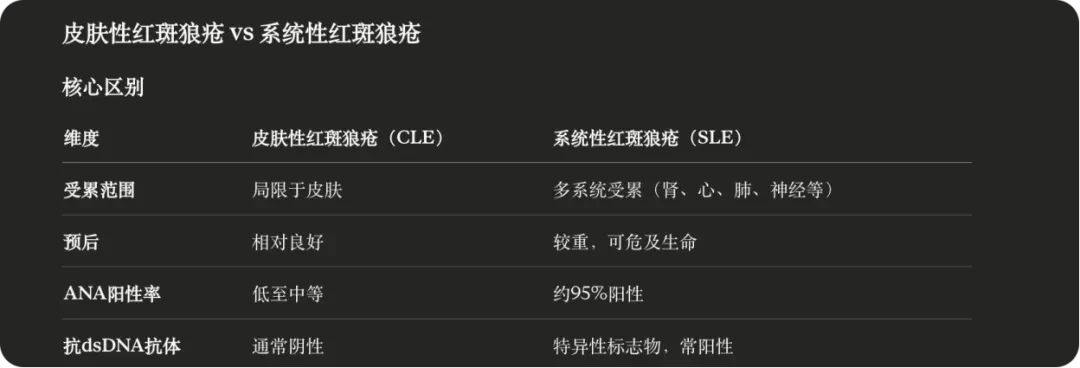
However, this indication has its pain points:For the past full 70 years, CLE has not had a single approved targeted innovative therapy.What clinicians can offer patients are still mainly hydroxychloroquine (HCQ) — an old anti-malarial drug developed during World War II — and topical glucocorticoids. For refractory patients, off-label use of belimumab (the monoclonal antibody approved for SLE) has become common practice, but it does not have a formal indication.
This "gap" in the market is the sharpest manifestation of the contradiction between clinical needs and the limitations of drug development. Today, however, this contradiction finally has the potential to be resolved — thanks to Biogen's BIIB059.
BIIB059 is a monoclonal antibody targeting BDCA2 (Blood Dendritic Cell Antigen 2). This target may be familiar to some, mainly from the ADC for autoimmune diseases developed by Ying’s Bio, but in fact, BDCA2 is highly expressed on the surface of plasmacytoid dendritic cells (pDCs) — the latter being the core cells responsible for producing Type I interferons in the pathogenesis of CLE. By blocking BDCA2, litifilimab can suppress the inflammatory cascade in skin lesion areas at its root.
In 2025, litifilimab had already read out the first positive Ph2 data in the LILAC study and received FDA Breakthrough Therapy Designation. The AMETHYST Ph2/3 Part A results presented at AAD 2026 (March 28) mark the second formal validation of an independent Ph2:
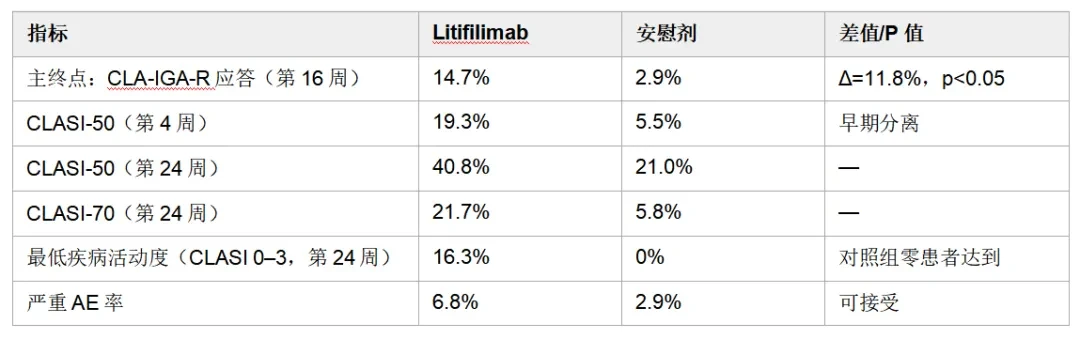
Both Independent Ph2 Trials Positive, Combined with FDA Breakthrough Designation, Litifilimab’s Ph3 Success Probability Widely Upgraded to Over 65% in the Industry. Next, the Ph3 Portion of AMETHYST Will Validate Registration Endpoints, with Readout Expected in 2027.
Meanwhile, Biogen is also advancing two independent Phase 3 studies of litifilimab for systemic lupus erythematosus (SLE), with data expected to be read out in Q4 2026. If the SLE data is also positive, litifilimab will become a "dual-indication" platform antibody spanning both CLE and SLE, significantly increasing its market valuation.
The current static estimation of the CLE market by third-party institutions (approximately USD 370 million by 2034) significantly underestimates the potential of litifilimab, as these forecasts are based on conservative assumptions regarding market penetration. Once litifilimab becomes the first approved targeted biologic for CLE, it will enjoy a competition-free blue ocean window period. A reference point is the feast enjoyed by belimumab within its first decade of approval—by 2024, its market penetration in the U.S. reached 11.5%.
Two Recent Independent Ph2 Positives + FDA Breakthrough Designation Significantly Reduce Ph3 Risk; No Targeted New Drug for 70 Years, First-to-Market Approval Allows Unique Pricing; If SLE Ph3 is Positive Simultaneously, Litifilimab Will Become a True Autoimmune Platform Asset.
Conservative Estimate: With only CLE indication approved, peak-year sales are approximately $500 million to $800 million; if combined with SLE, the peak could reach $1.5 billion to $2 billion.Biogen's current market value has significantly contracted, and litifilimab is one of the most certain catalysts in its autoimmune pipeline.
03
China's TYK2 Ace —— Upending the MNC Table
As the global market buzzes about the iteration of oral molecules for psoriasis drugs from the previous generation of JAK inhibitors, most people fail to realize that the competition for best-in-class TYK2 small molecules in this era is essentially an internal battle among Chinese molecules.
Comparison of Core Data on TYK2 and IL-23R in China and Overseas
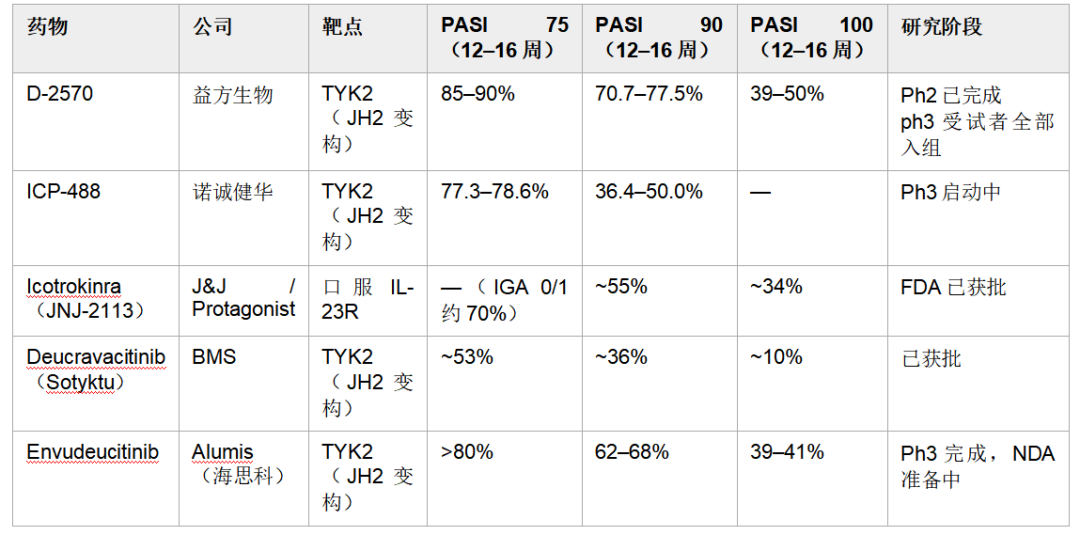
(Note: There are differences in patient baseline between different trials, so direct comparison is not advisable; China Ph2 data is at 12 weeks, while international data is typically at 16 weeks, with the 12-week data showing more significant advantages.))
This table presents information in a very straightforward manner: the Phase 2 data of D-2570 from InnoCare Pharma is almost the strongest PASI 75/90/100 combination globally in the TYK2 field. Among allosteric inhibitors targeting the same site, its 12-week PASI 90 (70.7–77.5%) not only far surpasses Sotyktu (approximately 36%), but even approaches the 24-week PASI 90 (62–68%) of Envudeucitinib, currently the most potent TYK2 inhibitor worldwide — and D-2570 achieved this in just 12 weeks.
InnoCare's ICP-488 also showed strong results, with a PASI 75 response rate of 77.3–78.6% at 12 weeks already surpassing Sotyktu's 16-week data, significantly outperforming the First in class.
Of course, Phase 2 data may have an overestimation effect (small sample size, positively biased enrollment), and direct comparison with international Phase 3 data should be approached with caution. However, these figures at least suggest that the ceiling of efficacy for China’s TYK2 pipeline could be much higher than the market expects.
The key variables constraining the overseas progress are two-fold: First, whether Ph3 can reproduce the robust data from Ph2 in an international multicenter design, given that cross-ethnic clinical differences genuinely exist in the psoriasis field; Second, the timing of BD — with JNJ-2113 advancing rapidly, whether large pharmaceutical companies still have the motivation to introduce TYK2 varieties will depend on how the commercial progress of Envudeucitinib and Zasocitinib segments the market.
But one thing is certain: the most significant pipeline for autoimmune diseases still lies in China.
Conclusion:AAD 2026 has given the market an opportunity to reassess the autoimmune track. Johnson & Johnson demonstrated with JNJ-2113 that oral peptides can achieve injection-level efficacy; Biogen cracked open a fissure in a 70-year shadow with Litifilimab, allowing light to shine through; China’s TYK2 contenders have used data to declare the extent of our potential.
The era of oral treatments for psoriasis has arrived, and this revolution is far from over.

Click "PharmSnap" below”, follow more exciting content
Disclaimer
The push rules of WeChat Official Accounts have changed again. If you don't tap"Views"Or not set to"Star Mark", we might just dissipate in the vast sea of literature~ Click here, don't miss out on PharmaDJ's latest news!???