

Jiayibao Files IPO Prospectus: Building an Integrated 'Medical + Pharma + Wellness + Insurance' Ecosystem through Innovative Products and Sales Models
“The mounting pressure on the basic medical insurance fund, the upgrading of national health consumption, and the significantly heightened insurance awareness among those born in the 1980s and 1990s have all created substantial growth opportunities for commercial health insurance,” said Yang Yufeng, CEO of Jiayibao.
What is the current situation?
According to the research report “In-Depth Analysis of the Health Industry (Part I): Health Insurance Is in Its Ascendancy, with Urgent Need for Product Innovation” released by Haitong Securities,In recent years, the health insurance market has experienced rapid growth, with the compound annual growth rate of gross written premiums reaching 28% from 2015 to 2020. However, in 2021, the growth rate of health insurance premiums declined significantly. The sector now faces challenges such as severe product homogenization, intensified competition in coverage and pricing, and substantial pressures on traditional sales models.
Meanwhile,The report points out that, based on the “product + service” model, focusing on enhancing health management service capabilities may be the key to breaking through the current impasse for medical insurance in the future.
“Insurance serves as an excellent lever for integrating the broader health industry. How insurance leverage can integrate the industrial chain, and how its financial attributes can be utilized to achieve mutual aid and risk pooling, is an endeavor that holds both social significance and economic value,” stated Yang Yufeng, butCurrently, the health insurance industry indeed faces challenges such as imbalances between product design and supply/demand, a lack of scenario-aligned traffic entry points, and insufficient risk management capabilities among insurers.
Against this backdrop, drawing on years of in-depth research and understanding of the healthcare and medical insurance systems, Jiayibao has developed innovative commercial insurance products to integrate upstream and downstream sectors through insurance as a strategic lever. By leveraging technology empowerment and sophisticated model design, the company is advancing the construction of a health insurance medical risk management system tailored to China’s national conditions. It has built an integrated “healthcare + pharmaceuticals + wellness + insurance” full-industry-chain platform aligned with the basic medical insurance fund, aiming to address development challenges in commercial health insurance through its proprietary algorithmic and technological capabilities, thereby achieving win-win cooperation across the entire industry chain.
How Jia Yibao Leverages Insurance to Integrate the Upstream and Downstream Industry Chain, and What Tangible Value This Model Delivers to B-End and C-End Stakeholders? In light of this, VCBeat interviewed Yang Yufeng, CEO of Jia Yibao, to address these questions.
“Compared with foreign countries, the domestic health insurance industry has developed rapidly in recent years, but it is still in its early stages,” said Yang Yufeng. “However, we also see opportunities within it.”
According to the aforementioned report by Haitong Securities, China’s health industry faces challenges such as supply-demand imbalances and excessive payment pressure on medical insurance funds, giving rise to significant potential market growth for health insurance.
Specifically, with the continuous improvement of the national economy and the advent of an aging society, domestic residents are paying increasing attention to health issues, and the demand for medical and healthcare services is becoming increasingly prominent and diversified.National total health expenditure has increased from RMB 866 billion to RMB 7,230.6 billion, with a compound annual growth rate (CAGR) of 15.2%, which is 6.7 percentage points higher than the average annual GDP growth rate.
However, in contrast to the growing demand, China’s capacity to provide multi-tiered medical and health services remains somewhat inadequate.
For example, from January to March 2021, the 22,783 primary and secondary hospitals in China provided 376.56 million outpatient visits, while the 3,044 tertiary hospitals recorded 522.47 million outpatient visits,Data indicate that tertiary hospitals are bearing an excessively heavy burden of diagnosis and treatment. Typically, these institutions primarily provide disease treatment and partial rehabilitation services, but are unable to offer more comprehensive, multi-tiered health services. Consequently, there is currently a significant supply-demand gap in China’s healthcare industry.
From the payment perspective, China’s health industry currently relies primarily on basic medical insurance, with out-of-pocket payments and commercial health insurance serving as supplementary sources.
As of 2020, although the number of participants in China’s national basic medical insurance scheme had reached 1.36 billion, with a total of 2,800 pharmaceuticals and 892 types of traditional Chinese medicine decoction pieces included in the National Reimbursement Drug List, and despite the continuous expansion of covered drug categories from essential medicines to medications for chronic diseases, pediatric conditions, cancer, rare diseases, and other major illnesses, the level and scope of coverage remained relatively limited.
Furthermore, with the continuous increase in the number of insured individuals and the ongoing expansion of coverage scope, the payment pressure on medical insurance funds has been rising year by year.Although the surplus rate of China’s basic medical insurance for urban and rural residents increased by 5.9% in 2020 compared with 2019, the overall trend from 2009 to 2020 shows a general decline in the surplus rate of China’s medical insurance funds, placing considerable pressure on the balance between revenue and expenditure.
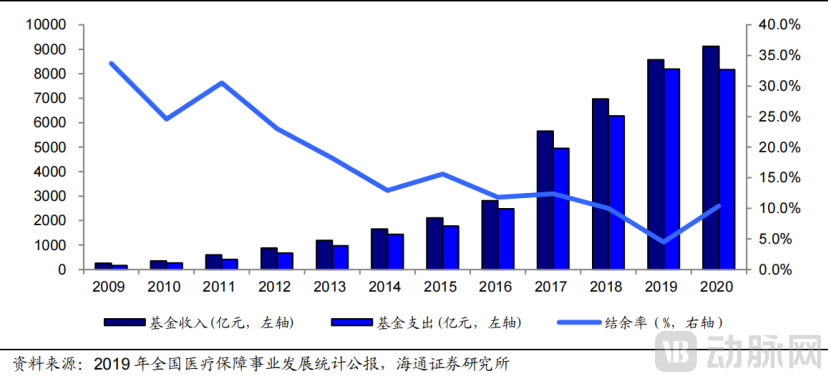
Medical Insurance Fund Revenue and Expenditure from 2009 to 2020
(Image source: Haitong Securities’ research report “In-Depth Analysis of the Health Industry (Part I): Health Insurance Is in Its Ascendancy, with Urgent Need for Product Innovation”)
In contrast, from 2012 to 2020, commercial health insurance claim payouts grew rapidly. Original premium income increased from RMB 86.3 billion to RMB 817.3 billion, representing a compound annual growth rate (CAGR) of 32%, while claim payouts rose from RMB 29.8 billion to RMB 292.1 billion, with a CAGR of 33%. Driven by continued favorable national policies, the commercial health insurance sector is exhibiting strong vitality and boasts substantial market potential.
“After years of rapid development, the product design philosophy and sales operation model of health insurance have reached an endogenous turning point that necessitates upgrading. This internal drive stems from shifts in the positioning of health insurance, as well as changes in how the new generation of users access information and their purchasing behaviors. Health insurance product design should transition from being finance-driven to service-driven, while the sales model should evolve toward a more professional, precise, and scenario-based approach,” said Yang Yufeng. “In this process, we see many opportunities.”
“The design philosophy of future health insurance will inevitably shift from being finance-driven to being driven by medical and healthcare services.” This was a point Yang Yufeng repeatedly emphasized during the interview.
Regarding the product design of Jiayibao, Yang Yufeng introduced that its design philosophy aligns with the core principles of medical insurance. It predicts the funding gaps for personal and family healthcare services from the user’s perspective, and integrates other factors to provide comprehensive “insurance + service” solutions covering the entire lifecycle for individuals and families.
“Based on this product design philosophy and the corresponding operational mechanisms, Jiayibao has not only integrated the industry value chain but also contributed to the sales transformation and enhanced risk management capabilities within the health insurance sector,” Yang Yufeng told VCBeat.
Moreover, during the interview,Yang Yufeng has repeatedly emphasized the need to fully leverage commercial health insurance’s role in integrating the broader healthcare industry chain. This is directly reflected in Jiayibao’s business layout.
It is reported that Jiayibao's main business activities primarily include:
Collaborate with insurance and reinsurance companies to design and precisely market supplemental health insurance products that meet market demands, while insurers can also leverage Jiayibao’s technological capabilities for risk control;
Under the guidance and support of relevant government departments, and leveraging years of accumulated experience in healthcare data analysis, actuarial capabilities, and a self-developed capitation payment system, we provide partner hospitals with services including agreed-upon product design and pricing, operational promotion, and decision support.
Based on the specific requirements of the designed products, integrate pharmaceutical companies, nursing services, and other supporting service providers as needed; organize primary healthcare institutions and medical consortia to deliver differentiated services, and leverage product design and technical capabilities to aggregate both consumer-side (C-end) and business-side (B-end) stakeholders, thereby building a platform that connects the upstream and downstream segments of the industry chain.
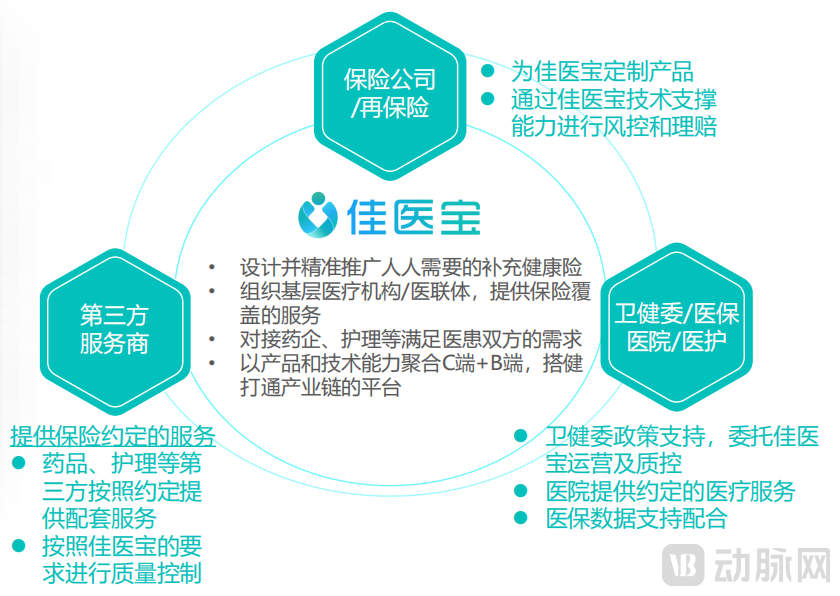
Schematic Diagram of Jiayibao's Business Layout
Why Choose This Layout?
Yang Yufeng stated,“Laying out the entire industrial chain is an inevitable path for the development of health insurance. JiaYiBao’s primary responsibility in this process is to oversee product and model design, as well as resource integration. By leveraging the financial instrument attributes of insurance, it helps partners optimize their business models.”
For example, with traditional health insurance products, claims processing typically occurs after treatment. However, Jiayibao adopts a user-centric approach by transforming post-treatment claims into precise, embedded health services. This not only eliminates cumbersome claims procedures but also enables users to access higher-quality, more targeted health management services.
Furthermore,Jiayibao can also help alleviate the problem of mismatched medical resources to some extent.
For instance, expert-level physicians may prefer to treat patients with complex and challenging conditions, while junior doctors may be more inclined to gain experience by managing cases of relatively lower complexity. However, the majority of patients tend to seek care at top-tier hospitals from the most renowned specialists. This mismatch leads to misallocation and waste of medical resources.
“Leveraging years of technological and resource accumulation in the industry, Jiayibao can assist in the rational allocation of medical resources through a portfolio of products, ensuring that users have genuine access while enabling insurance companies and healthcare service providers to achieve profitability,” said Yang Yufeng. “However, such products must be dynamic and continuous, fostering mutual growth among all stakeholders by integrating resources across the industry.”
After determining the overall business layout, the primary issue facing Jiayibao was from which angle to enter the market. Jiayibao's answer was community hospitals.
What are the underlying reasons? Yang Yufeng disclosed to VCBeat that there were mainly two considerations:
First, against the backdrop of the national promotion of tiered diagnosis and treatment, rising demand for multi-level health services, and growing societal attention to elderly care, community hospitals possess inherent advantages in scenario-based patient acquisition and service differentiation.
In September 2015, the State Council issued the "Guiding Opinions on Promoting the Construction of a Tiered Diagnosis and Treatment System," which established assessment criteria for pilot programs on tiered diagnosis and treatment.
In November 2015, the National Health and Family Planning Commission and the State Administration of Traditional Chinese Medicine jointly issued the “Notice on Conducting Pilot Programs for Tiered Diagnosis and Treatment of Hypertension and Diabetes,” which outlined key tasks for the tiered diagnosis and treatment of hypertension and diabetes, as well as service flowcharts, technical service protocols, and traditional Chinese medicine (TCM) technical service protocols.
In 2016, the "Outline of the 'Healthy China 2030' Plan" proposed to comprehensively establish and improve a mature tiered diagnosis and treatment system, forming a rational medical order characterized by initial consultation at primary care facilities, two-way referrals, coordination between upper- and lower-level institutions, and separate management of acute and chronic conditions, while strengthening the service chain for treatment, rehabilitation, and long-term care;
Second, community hospitals can reach a larger population with needs for health management, preventive care, and elderly care, thereby facilitating the upgrading of health insurance and fostering the development of managed care in China.
“Beyond the elderly and those with chronic diseases, there is no doubt that individuals born in the 1980s and 1990s have both the need for and awareness of health management,” said Yang Yufeng. “Data shows that although this demographic has a relatively lower incidence of major diseases, it does not mean they lack needs for medical and health management. Their participation can not only help spread the risk in commercial health insurance but also drive innovation in health management services.”
Obviously, integrating the industrial chain is no easy feat. What gives Jiayibao the confidence to make such a strategic move?
Robust core algorithm capabilities are likely the primary reason.
VCBeat has learned that,After years of accumulating experience in government service projects, Jiayibao has gained analytical expertise across hundreds of data tags spanning four dimensions: Hospital Information Systems (HIS), physical examinations, personal health information, and hospital operational data. Having analyzed over 7 billion data records, the company has developed its proprietary algorithms. Its core models, which encompass both healthy and diseased populations, offer extensive coverage and focus on three key areas: health risk prediction, key points for health interventions, and medical cost forecasting and analysis.
Furthermore, Jiayibao’s core algorithms attribute over 10,000 clinical diagnosis codes for common diseases to dozens of groups. By incorporating factors such as genetics and lifestyle, the system enables precise assessment of the impact on costs and outcomes. Leveraging these data and aligned with the disease characteristics of Chinese residents, Jiayibao has developed a population segmentation framework tailored to the domestic demographic. This framework pioneers the quantitative linkage between health risks and financial risks, facilitating accurate risk prediction and pricing.
Leveraging its robust algorithmic capabilities, Jiayibao has successfully established numerous industry benchmark cases.
For example, Jiayibao has undertaken projects such as the design of medical insurance systems in key regions of China, and decision-support initiatives for healthcare policy including analyses of the implementation effects of the comprehensive reform separating pharmaceutical prescribing from dispensing and the coordinated reform linking medical services with consumable costs. Through these engagements, it has accumulated in-depth understanding of the design and operational logic of China’s medical insurance system.
“The healthcare industry cannot be fully commercialized, as the most core resources are concentrated in government-run medical service institutions,” said Yang Yufeng. “Once we have accumulated case studies, we gain the advantage to continuously establish new partnerships, which is essentially the industry barrier built by Jiayibao.”
Additionally,Years of experience in end-to-end commercial health insurance development and service chain integration is also one of Jiayibao’s strengths.
According to Yang Yufeng, Jiayibao has extensive experience in the end-to-end development of commercial health insurance products, with a client base largely composed of industry benchmark enterprises. For instance, in collaboration with Sunshine Property & Casualty Insurance, Aixin Life Insurance, China Life Property & Casualty Insurance, and PICC Property & Casualty Insurance, Jiayibao provides comprehensive services including product structure design, actuarial pricing, and risk control modeling. The company has also provided technical support and designed promotional and operational systems for various local Hui Min Bao (inclusive supplementary medical insurance) and long-term care insurance initiatives. Furthermore, Jiayibao serves as the exclusive provider of intelligent underwriting services for major insurers such as China Life Insurance, Taikang Life Insurance, and Sunshine Insurance Group.
Regarding future plans, Yang Yufeng disclosed to VCBeat that Jiayibao’s short-term goal is to solidly advance the replication of the aforementioned model, while its long-term objective is to collaborate with more industry partners to build a “health financial services” platform serving the entire industry. Leveraging Jiayibao’s precise pricing model and other accumulated capabilities, the platform aims to facilitate the matching of resources and products between supply and demand sides, achieving mutual benefits for all stakeholders.
Wang Haining, Founding Partner of Longmen Capital, the angel investor in Jiayibao, stated that Longmen Capital has accompanied Jiayibao through years of strategic deliberation and business adjustments. Although Jiayibao had already reached a user base of millions when it initially launched its diabetes health management services, it faced the same challenge as other internet healthcare projects: how to translate user data into profitability. Throughout this process, the entire team gained a profound understanding of the pain points and opportunities within China’s healthcare payment system.。In recent years, Jiayibao has pivoted toward insurtech, undertaking extensive pioneering work in product and model innovation for medical insurance. Through these efforts, it has accumulated vast experience in medical data analysis and developed a proprietary algorithmic framework.
“Longmen Capital led and participated in Jiayibao’s Series A financing last year, based on its recognition of the Jiayibao team’s business model and industry insights. We hope that Jiayibao will develop more innovative products and solutions in the future, benefiting more patients,” added Wang Haining.