

AI Virtual Metabolism: A Pioneering Framework for Reconstructing Cellular Metabolic Pathways through AI and Multi-Omics Integration

BioMap
Developer of Innovative Drug R&D Platform
This article formally proposes and defines for the first time"AI Virtual Metabolism (AIVM)"This groundbreaking concept establishes a new AGI for Science research paradigm driven by "AI + multi-omics" to reconstruct metabolic networks. As part of achieving the "AI virtual cell" (AI Virtual Cell, AIVC) An indispensable and most challenging core component in the grand blueprint, the proposal of AIVM fills the gap in the current field and points out a new direction for international virtual metabolism research.
Paper link:https://www.cell.com/trends/biochemical-sciences/pdf/S0968-0004(26)00003-4.pdf
01
Core Challenge:
Bridging the Gap Between "Dead" Chemistry and "Living" Life
The cellular metabolic network is the underlying operating system of life activities. However, traditional biochemical reconstruction methods are limited by the scarcity of experimental data, making it difficult to address highly branchedMetabolismPathways and complex regulatory mechanisms. Meanwhile, existing AI methods mostly remain at static, template-based chemical reaction predictions.Level, unable to simulate the multipleSteps, an adaptive dynamic process.
How can AI not only deduce the breaking and forming of chemical bonds, but also "understand" enzyme specificity, thermodynamic boundaries, and complex system regulation within cells? This is the necessary path toward digital cell twins, and also a highly challenging, unexplored area of scientific research.
02
Core Paradigm of AIVM:
Deep Fusion of Retro-synthesis Thinking and Biological Constraints
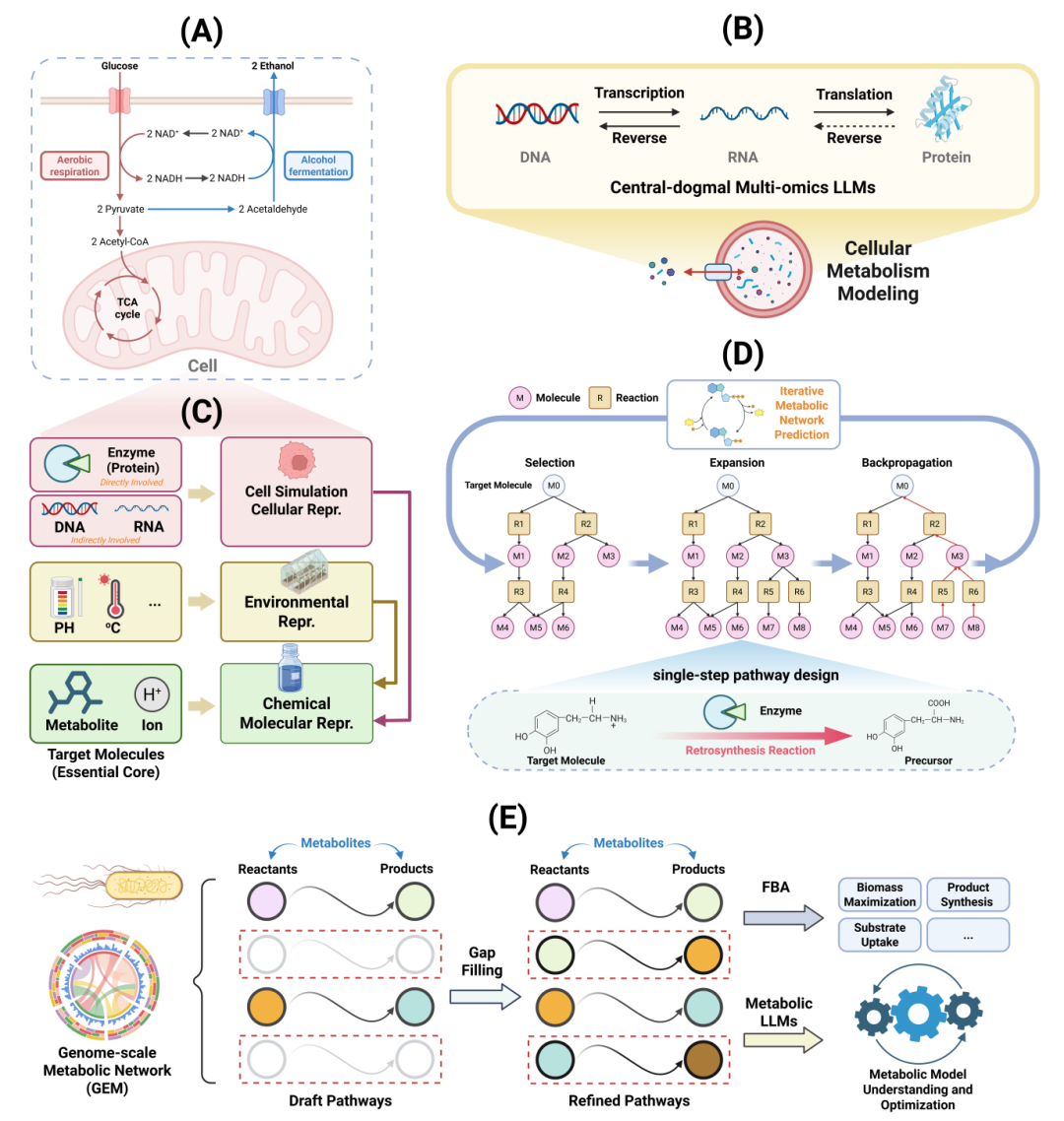
In response to the aforementioned pain points, the research team proposed a completely new conceptual framework —AIVM(AI Virtual Metabolism). This framework does not stop at simple path prediction but builds a systematic project containing three major dimensions:
1. The Deep Integration of AI and Multi-omics:Utilizing large language models in life sciences trained on multi-omics data such as genomics, transcriptomics, proteomics, and metabolomics to achieve hierarchical representation capture of cellular functions.
2. Strict Biological Constraint Filters:Unlike in vitro chemical synthesis, AIVM incorporates enzyme specificity, thermodynamic feasibility (e.g., Gibbs free energy calculations), and cellular environmental constraints.Ensure the generated metabolic pathways are biologically realistic and feasible。
3. From Single-Path to Whole-Genome Models:By combining graph search algorithms with genome-scale metabolic models (GEMs), AIVM can expand from designing single biosynthetic pathways (such as the biosynthesis of artemisinic acid) to dynamically simulating and optimizing entire cellular metabolic networks.
03
Future Vision:
AI Scientists and Digital Cell Twins
The proposal of AIVM marks the shift of metabolic engineering research from "rule-driven" to "discovery-driven".InUnder this paradigm, the role of AI is no longer just an auxiliary tool, but has evolved into a true"AI Metabolism Scientist"。
By coupling multi-omics features with the topological structure of GEMs, LLM-based agents can capture nonlinear biological dependencies, autonomously propose new metabolic pathway hypotheses, recommend enzyme engineering solutions, and complete dry-wet experimental closed-loop validation.
The establishment of this groundbreaking paradigm is a pathway toCompleteA crucial step for AI Virtual Cells (AIVC). If AIVC is the "Holy Grail" of synthetic biology, then AIVM is the core spark that lights up this grail. It not only provides a new perspective for understanding the principles of life but also offers powerful theoretical and tool support for microbial chassis optimization, green manufacturing of high-value compounds, and precision medicine.
04
Conclusion: Exploring the Uncharted Territory
From data gaps to paradigm establishment, this work demonstrates the great potential of AI for Science in the field of life sciences. Although it cannot completely replace wet-lab trial and error.It will take time, but AIVM has already painted a future for us featuring a programmable, modular, and biologically principled "virtual cell."Vision。
Chief AI Scientist Review — From VCC Champion to AIVM Paradigm, Completing the Final Piece of the "Virtual Cell" Plan
Corresponding Author: Chief of BioMapAIScientist, Chair Professor at Westlake UniversityProfessor Liziqing,FromAIThe development trend of deep integration with life sciences, provided an in-depth interpretation of the positioning of this work: "The grand blueprint of AI Virtual Cell (AIVC) is just beginning to unfold, and this will be a focal point for global research institutions and tech giants over the next five years.A strategic high ground for fierce competition. Prior to this, the BioMap team I led has already taken the lead in taking action.Won the championship by defeating over a thousand teams globally in the first Virtual Cell Challenge (VCC).(Related Reading:BioMap Wins Inaugural World "Virtual Cell Challenge" Championship by Defeating Over a Thousand Teams Globally). This milestone victory strongly proves that our AI technology team has reached an internationally leading level in single-cell gene expression prediction and perturbation simulation.CompetitionForce."
Going further, Professor Li Ziqing also proposed: "The existing VCC Challenge focuses on gene regulatory networks, which is crucial for building aComprehensive AI Virtual CellIt is necessary, but by no means sufficient. The endpoint of the life-centered principle is metabolism, and the core of material and energy exchange in cells also lies in metabolism. A virtual cell lacking the metabolic dimension is incomplete. Therefore,Westlake University Team, in Collaboration with BioMap, Shanghai AI Laboratory, and Shanghai Creative Academy, Officially Proposes the AIVM (AI Virtual Metabolism) Concept, This is a crucial step we have taken to fill the gap in the AIVC landscape — it signifies our formal transition from gene-level regulation simulation to the more complex and dynamic reconstruction of metabolic networks. Only by combining the gene regulation capabilities validated by VCC with the metabolic reconstruction abilities defined by AIVM can we truly approach a'Living' Digital Cell Twin。”
Looking Ahead,Professor Li ZiqingRepresentation"The proposal of the AIVM concept is just the first step. We are uniting various forces to conduct intensive scientific research based on this new paradigm. Let us look forward to the future research achievements of AIVM and witness the next exciting collision between AI and synthetic biology!"
Acknowledgments
This work was supported by the National Science and Technology Major Project, the National Natural Science Foundation of China, the Center for Synthetic Biology and Bioengineering at Westlake University, and the Key Laboratory of Low-Carbon Intelligent Synthetic Biology of Zhejiang Province.