

TinyChip Electronics Unveils High-Precision, Highly Integrated, and Cost-Effective Blood Oxygen Monitoring SoC Amid Strong Market Demand
In 2020, “blood oxygen saturation monitoring,” frequently mentioned during the COVID-19 pandemic control efforts, brought pulse oximeters into the spotlight, leading to a significant surge in market demand.
Relevant reports indicate that in 2020, the average annual sales of finger-clip pulse oximeters from leading domestic brands such as Choicemmed and Contec each exceeded 10 million units. Although sales data for pulse oximeters declined in 2021, this downturn was primarily observed in the hospital market. This trend is attributable to the product’s consumption cycle. As a home-use medical device, the finger-clip pulse oximeter has a relatively long consumption cycle and was therefore not significantly affected. The market for finger-clip pulse oximeters still holds substantial potential for growth.
Meanwhile,Currently, the domestic pulse oximeter market in China is grappling with severe product homogenization, a scarcity of devices offering medical-grade monitoring accuracy, and suboptimal cost-performance ratios, creating an urgent need to identify pathways for breakthrough. Applicability, monitoring accuracy, motion performance, and cost control have become critical metrics for evaluating companies engaged in the research, development, and manufacturing of fingertip pulse oximeters.
“The pandemic has driven rapid market growth and signifies increasing public acceptance of pulse oximeters; indeed, the pandemic has spurred a surge in global demand for these devices. However, the pulse oximeter industry is also experiencing intense competition.”Xiong Haifeng, founder of Taixi Microelectronics, stated that continuously improving the cost-performance ratio of products is an enduring theme for enterprises. “Only by ensuring high quality and performance while keeping costs under control can a company stand out in fierce competition, and selecting competitive chip solutions is of paramount importance.”
The annual reports of leading pulse oximeter manufacturers provide a clear glimpse into the impact of the COVID-19 pandemic on the pulse oximeter market.
Taking Lepu Medical as an example, its 2020 annual report shows that the company achieved a revenue of RMB 8,038.6675 million in 2020, a year-on-year increase of 3.12%, and a net profit of RMB 1,801.9325 million, a year-on-year increase of 4.44%.
However, in reality, affected by the centralized procurement of coronary stents, the revenue of Lepu Medical’s largest business segment—medical devices—declined. In contrast, its medical services and health management segment (which includes pulse oximeters) achieved a revenue of RMB 1,226,595,200, representing an increase of approximately 140.36% compared with 2019.
andIn Hongri Pharmaceutical’s 2020 annual report, the impact of the COVID-19 pandemic on its pulse oximeter business was even more pronounced.
In 2020, Chase Sun Pharmaceutical achieved operating revenue of RMB 6.488 billion, a year-on-year increase of 29.69%, with its medical device business experiencing robust growth. Its subsidiary, SuperSens Electronics, generated nearly RMB 1 billion in revenue and recorded net profits exceeding RMB 200 million.
Notably, in 2020, overseas orders for Choicemmed’s medical device products, represented by finger-clip pulse oximeters, were more than four times those in 2019, while domestic orders exceeded three times the 2019 volume, indicating a significant growth in order momentum.
The COVID-19 pandemic sparked a sales surge for pulse oximeters. Now that epidemic prevention and control have become normalized, will the pulse oximeter market remain hot?
The answer is yes.
The 2021 Report on China’s Foreign Trade Situation points out that the global pandemic trajectory faces significant uncertainty, with the fight against the disease expected to be a protracted endeavor. Consequently, sales of related medical device products are projected to sustain an upward trend over the next decade.
Specifically, unlike the early stage of the COVID-19 outbreak in 2020, we are now in a phase where prevention is more important than treatment. As a home health device with “preventive” attributes, the home finger-clip pulse oximeter will continue to see sustained high market demand.
Furthermore,The COVID-19 pandemic was not the sole driver behind the surge in sales of fingertip pulse oximeters. Other significant factors contributing to the increased demand include population aging and the growing, more diverse needs for health management.
For example, patients with cardiovascular and cerebrovascular diseases may experience difficulty in oxygen supply due to blood viscosity, coronary atherosclerosis, and narrowing of the vascular lumen. In cases of severe hypoxia, patients may suffer from myocardial infarction or cerebral infarction; failure to provide timely oxygen therapy and emergency intervention can be life-threatening. Therefore, patients with cardiovascular and cerebrovascular conditions should undergo long-term monitoring of blood oxygen levels to prevent adverse events.
As health management awareness rises, an increasing number of people are using home pulse oximeters to monitor their physical condition after exercise. In some remote and impoverished areas, where the high cost of professional medical devices such as patient monitors may be prohibitive, there is also demand for purchasing medical-grade fingertip pulse oximeters.
However,Currently, there are some manufacturers operating without proper licenses in the market, whose shipment volumes have even reached millions of units. Moreover, even for legitimate companies with certifications such as CE and FDA, due to issues like cost control and technical challenges in R&D, the monitoring accuracy of their finger-clip pulse oximeters rarely reaches medical-grade standards.
In this context,Taixiwei, in collaboration with third-party design firm Lanruige, has jointly launched a high-precision fingertip pulse oximeter product and solution. By integrating Taixiwei’s high-performance dedicated chips with Lanruige’s proprietary patented algorithms, the device accommodates measurements across diverse skin tones and finger sizes, achieves a perfusion index (PI) superior to 0.1%, and provides robust motion artifact resistance.
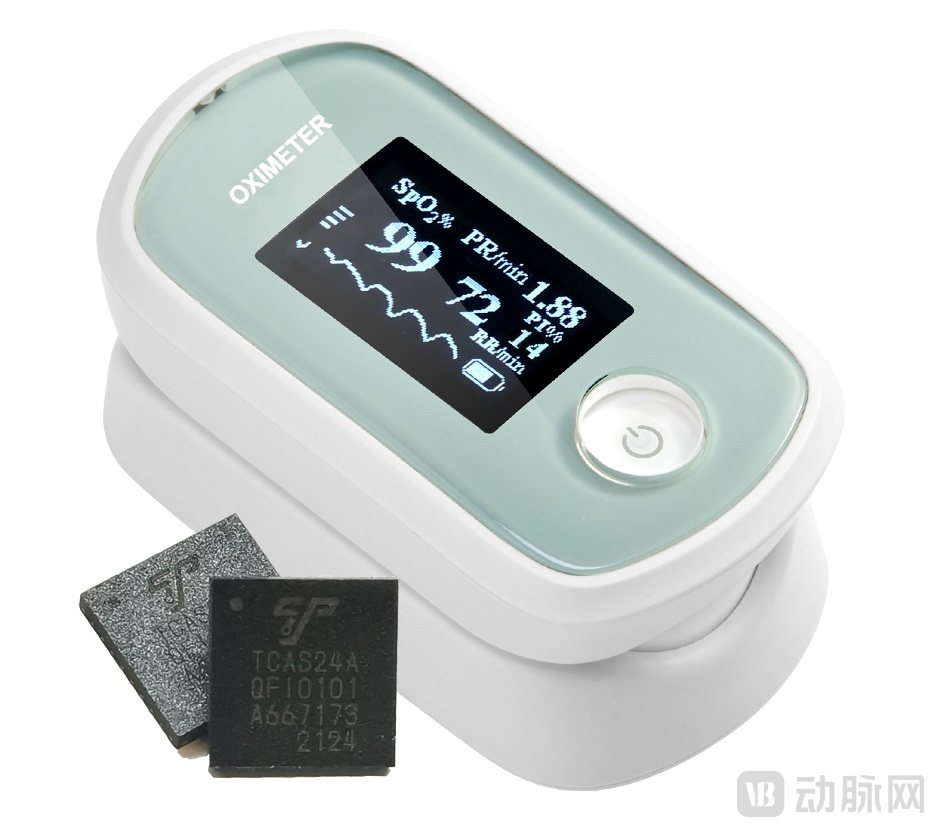
Taixiwei-Lanruige Fingertip Pulse Oximeter Product Image
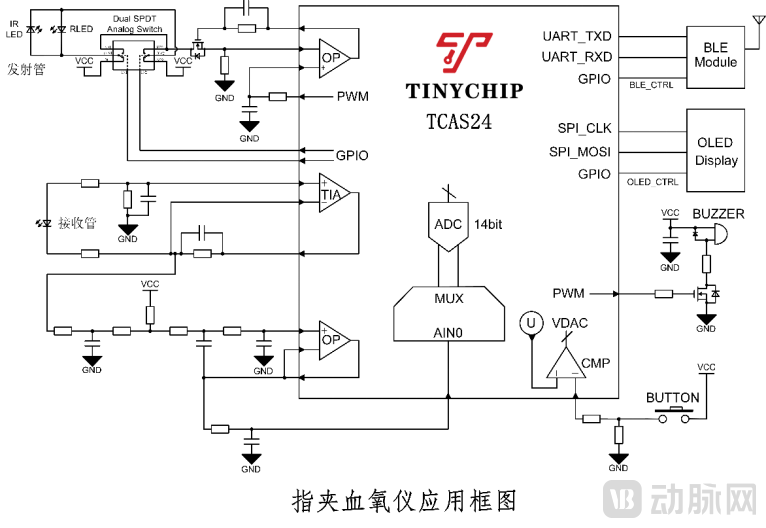
Furthermore,TCAS24, a dedicated chip for pulse oximeters launched by Taixi Microelectronics, integrates a high-precision AFE and MCU on a single chip, offering complete hardware and software reference designs along with detailed application documentation.
In clinical applications, blood oxygen measurement primarily faces two major pain points: first, poor applicability. Fingers with different skin tones or varying thicknesses often lead to measurement failures or abnormal readings; second, weak anti-interference capability. Movement at the measurement site is highly likely to cause significant deviations in the results.
Therefore, applicability across different skin tones and resistance to motion artifacts have become key R&D challenges that pulse oximeter manufacturers need to overcome.
How Did Taixiwei and Lanruige Achieve Their Collaborative Finger-Clip Pulse Oximeter Solution?
First, let’s examine the breakthrough in skin tone applicability.
“Different skin tones mean different levels of light absorption. From the perspective of the signal chain, this can be understood as variations in signal strength. Therefore, to overcome limitations in skin tone applicability, it is necessary to have the ability to identify weak signals,” Xiong Haifeng explained to VCBeat. To achieve breakthroughs in weak signal identification, on one hand, the precision performance of the chip itself needs to be improved to enhance physical accuracy; on the other hand, special design methods need to be employed on the software side to increase logical precision. Only by combining both aspects can the issue of skin tone compatibility be resolved.
In other words, chip performance is critical.
VCBeat has learned that Taixiwei completed the research and development of four chips within two years, with two of them already in mass production and shipment. This achievement is attributed to the strength of its team. Ninety percent of its core team members hold master’s or doctoral degrees, hailing from top-tier semiconductor companies both in China and abroad and originating from established teams. The team comprehensively covers key roles including chip product definition, design, solutions, operations, marketing and sales, and support.
Furthermore, Taixiwei’s full product portfolio extends outward from MCU cores to develop application-specific chips targeted at vertical markets. By integrating high-performance analog peripherals, algorithms, and communication interfaces, these single-chip solutions replace multi-chip architectures. This approach effectively addresses challenges associated with discrete multi-chip designs, such as functional redundancy, multiple package types, and higher production costs, thereby enhancing overall cost-effectiveness while simplifying supply chain management.
Specifically,The TCAS24 chip from Taixiwei, adopted in this solution, offers the following key advantages:
First,Highly integrated.The TCAS24 integrates three operational amplifiers internally: one is used to implement the LED driver circuit in conjunction with PWM, and two are used to construct the PD sampling circuit, thereby integrating the essential peripheral hardware required for a pulse oximeter.
Second,High precision.The TCAS24 integrates a 14-bit ADC internally, offering higher precision than AFEs built with general-purpose ADCs. Combined with other low-noise analog front-end peripherals integrated within the MCU,Achieves a perfusion index (PI) accuracy of up to 0.1%, surpassing the 0.3%-0.5% range typical of current consumer-grade pulse oximeters on the market;
Third,Cost-effective.Conventional solutions typically employ a dedicated AFE paired with a general-purpose MCU to build the circuit, resulting in higher costs. Moreover, amid the current chip shortage, the supply of general-purpose MCUs remains unreliable. By adopting the TCAS24 solution, which integrates AFE and MCU functionalities into a single chip, cost-effectiveness can be significantly improved.
Fourth, low power consumption.The TCAS24A consumes only 700 nA in deep sleep mode, and when combined with Tinywork® technology, it further reduces dynamic power consumption, delivering excellent battery life.
Furthermore, according to Xiong Haifeng, Taixiwei also provides the SDK software package and hardware reference design schematics for pulse oximeters, accompanied by detailed documentation and mass-production tools, enabling a turnaround time of just two weeks from solution evaluation to development.
In addition, Taixiwei maintains strong partnerships with experienced third-party expert design firms, enabling it to provide multi-tiered services to end customers in the oximeter market, including customized solutions, pre-programmed chips, and PCBA supply.
“Building on the current TCAS24, Taixiwei will continue to iterate and develop more competitive dedicated chips for pulse oximeters, while implementing a more long-term and comprehensive product planning and layout for medical-grade chips,” said Xiong Haifeng.
Next, let’s examine how the algorithmic design of this solution overcomes the challenge of motion artifact resistance.
“Motion artifacts are the most intractable challenge in blood oxygen saturation (SpO2) measurement applications. Traditional time-domain design methods cannot resolve motion interference issues because the noise and signal are coupled, making them indistinguishable,” Xiong Haifeng explained to VCBeat. Taixiwei’s finger-clip SpO2 solution is no longer confined to time-domain methods; instead, it employs a combination of signal processing techniques—including time-domain analysis, frequency-domain analysis, and adaptive noise identification—to leverage the strengths of each approach. Through comprehensive analysis and judgment, the solution achieves accurate SpO2 calculations even during physical activity.
In the field of health monitoring, wearable devices have experienced rapid growth in recent years.
According to IDC’s “China Wearable Device Market Quarterly Tracker, Q2 2021,” global wearable device shipments reached 114.2 million units in the second quarter of 2021, a year-on-year increase of 32.3%. Among these, shipments in the Chinese wearable device market totaled 36.14 million units, representing a year-on-year growth of 33.7%.
Moreover, in the second half of 2021, wearable devices also witnessed significant functional advancements, steadily progressing toward serious medical applications.
Under this industry trend,Xiong Haifeng revealed to VCBeat that Taixiwei is also considering entering the wearable device market in the future. “The gradual popularization of home pulse oximeters is a prerequisite for integrating blood oxygen monitoring into wearable devices. The pandemic drove sales growth of pulse oximeters, increased their recognition among users, and cultivated user habits. Further adoption and promotion of home health products are still needed to facilitate the integration of blood oxygen monitoring into wearable devices.”
Furthermore, in recent years, how to enhance the synergy between out-of-hospital and in-hospital data, and how to maximize the application value of out-of-hospital data, have also become topics of concern within the industry.
Regarding this, Xiong Haifeng stated that the fundamental reason why out-of-hospital data struggles to be integrated into in-hospital diagnosis and treatment is that the communication link between out-of-hospital and in-hospital systems has not been established.
“Due to the unique nature of the healthcare industry, there can be significant differences between in-hospital and out-of-hospital settings in terms of equipment used and usage scenarios. How to harmonize these differences and achieve standards recognized both within and outside hospitals is a lengthy process of integration,” said Xiong Haifeng.To unlock the application value of out-of-hospital data, it is necessary to continuously improve the accuracy of home medical devices so that they can align with in-hospital standards. Meanwhile, proactive planning is required to maximize the accumulation and management of population-based health data. “When the bridge between in-hospital and out-of-hospital settings is established, data becomes the greatest asset.”
Therefore,Although Taixiwei’s pulse oximetry solution is targeted at the home health market, its quality and performance are developed and designed in accordance with hospital-grade equipment standards. “Taixiwei aims to first capture a certain share of the home health market, and then gradually expand its business into the hospital market by offering products that rival the quality of medical devices used in clinical settings,” Xiong Haifeng revealed to VCBeat. Therefore, in addition to promoting its home health products, Taixiwei is also committed to providing high-performance medical parameter templates for hospital clients.
Regarding future strategic initiatives in the healthcare sector, Xiong Haifeng stated:First, Taixiwei will refine and deepen its presence in the pulse oximeter market, striving to cover a full range of pulse oximeter chips and solutions from the low-end to the mid-to-high-end segments, thereby exploring the integration of pulse oximetry into wearable devices. Second, as medical devices increasingly shift toward home use, Taixiwei will also expand its portfolio of chips and solutions for other home healthcare products, such as those in the home wearable device sector. “Taixiwei’s goal is to empower manufacturers adopting its solutions with stronger competitive advantages, and thus it will continue to innovate based on the needs of downstream enterprises.”
“In the future, driven by population aging and the widespread adoption of 5G technology, the home-use health medical device market will continue to offer substantial growth opportunities, with miniaturization and portability of health devices becoming a key trend. As a medical device manufacturer, only by keeping pace with these evolving trends can we survive and thrive,” summarized Xiong Haifeng.
About Taixi Microelectronics
Shanghai Taixi Microelectronics Co., Ltd., established in 2019, is a high-tech chip R&D enterprise under key collaboration and support from the Yangtze Delta Region Institute of Tsinghua University. It specializes in the development and customization of a series of high-end application-specific MCUs, excelling at integrating highly reliable, low-power microprocessors with high-performance analog circuits, dedicated hardware acceleration circuits, and algorithms to meet the needs of various vertical industries. Its applications span multiple fields, including medical devices, industrial sensing, consumer electronics, and automotive electronics.