

From Corindus Co-Founder to Venture Partner at JENS MEDTECH: Tal Wenderow Embarks on a New Chapter

Genesis Medtech
Medical Device Research, Development, Production, and Sales
In 2002, Rafael Beyar, a renowned Israeli expert in interventional cardiology, and his student at the Technion – Israel Institute of Technology, Tal Wenderow, co-founded the surgical robotics company Corindus Vascular Robotics. The company’s CorPath platform is the first robot approved by the U.S. Food and Drug Administration (FDA) that enables vascular interventional procedures using remote control and robotic technology.
In August 2019, Siemens acquired Corindus for $1.1 billion; in 2021, its latest-generation product, the CorPath GRX interventional surgical robot, performed China’s first robot-assisted percutaneous coronary intervention (PCI) at Hainan Boao Super Hospital. The procedure was carried out by the team led by Professor Ge Junbo from Zhongshan Hospital Affiliated to Fudan University, an academician of the Chinese Academy of Sciences.
After leaving Corindus, Tal continued to dive into the turbulent waters of entrepreneurship. Not long ago, we learnedTal joined the emerging medical technology company, Genesis Medtech, as a Venture Partner.
After years of deep involvement in the surgical robotics industry, why did Tal choose to join Genesis Medtech? How does he plan to help Genesis Medtech grow in his new role? To find answers to these two questions, VCBeat conducted an exclusive interview with Tal.
In 2000, the da Vinci Surgical System received FDA clearance, marking the first commercialization of surgical robots and ushering in the era of robotic surgery. Vascular interventional physicians have similar clinical needs; they not only seek greater precision and stability in procedures but also aim to effectively minimize radiation exposure during surgeries.
In 2001, Tal, who had just graduated with a degree in Mechanical Engineering from the Technion – Israel Institute of Technology, recognized the significant potential in addressing clinicians’ needs through surgical robotics solutions and was determined to translate Professor Rafael Beyar’s research into practical applications. In 2002, Tal co-founded Corindus, a company specializing in robotic systems for vascular interventions, together with his mentor, and dedicated himself to the venture for seventeen years.
Clinically, the complex anatomy of coronary arteries and surrounding vessels poses significant challenges for interventional procedures. Corindus’ latest-generation CorPath GRX robotic-assisted intervention system effectively addresses these challenges by enabling more precise positioning and navigation, while substantially reducing radiation exposure to physicians. Furthermore, the CorPath system pioneered guidewire manipulation technology, allowing sub-millimeter precision in measuring lesion areas to facilitate optimal stent selection and reduce complications.
Tal stated that, just as intelligent assistance systems enable airline pilots to fly more effectively, surgical robot technology will not replace doctors but rather enhance their surgical capabilities. Robot-assisted surgery (RAS) has brought revolutionary advances to the treatment of certain diseases, and surgical robotics startups are currently emerging in large numbers on the market.
The latest statistics show that more than 200 companies are developing robotic systems ranging from second-generation general-purpose surgical platforms to those dedicated to single procedures. In Tal’s view, robotic surgery will continue to make an impact in areas such as single-port and vascular surgery, while expanding into ophthalmology and oncology.
When asked how medical enterprises should cultivate innovation capabilities, Tal stated, “Innovation in medical devices first and foremost requires a deep integration of physicians’ clinical needs with engineers’ development capabilities, which is crucial.”
Tal introduced that, taking the development of surgical robots as an example, on one hand, we must listen to physicians’ feedback and deeply explore their true clinical needs; on the other hand, our engineers must be proficient in developing, applying, or integrating the latest technologies. It can be said that the integration of medicine and engineering is a critical factor for the success of product innovation.
Furthermore, not everyone embraces change, nor can all physicians readily adopt innovations. Therefore, it is essential to collaborate with physicians who possess genuine wisdom and a pioneering spirit. Engineers must also ensure that innovative products are practical and feature a short learning curve, which requires effective collaboration among mechanical, electronic, software, and other engineering disciplines.
“This is fundamentally about building an innovation-oriented ecosystem and culture. On a broader scale, we must cultivate and promote a spirit of innovation throughout society. At the corporate level, it is equally critical to foster a team culture driven by innovation.“I am Israeli myself, and there is a pervasive culture in Israel that highly values innovation,” Tal added.
In Israel, everyone views “a small step for the individual” as “a giant leap for innovation,” with all stakeholders actively engaged. The country boasts hospitals and universities with a strong spirit of innovation, alongside a vibrant technology community. All sectors, including the government, place great emphasis on innovation and provide robust support, creating a multi-layered framework for driving and safeguarding innovative efforts.
“Additionally, it is crucial to fully leverage external resources. By walking through the entire process of product research, development, and production, a company can clearly identify its capability boundaries and thus seek or accept external assistance when appropriate.“If corresponding technologies are available on the market, innovation processes can be accelerated and innovation capabilities enhanced entirely through collaboration or acquisition,” said Tal.
Back to the present, Tal has joined Genesis Medtech as an investment partner. During the interview, he shared his reasons with VCBeat. “I chose to join primarily because of Wang Xin (Warren Wang), Chairman and CEO of Genesis Medtech. We have been close friends for many years, having first met when Corindus entered the Chinese market. When he embarked on his entrepreneurial journey, he shared with me the vision and future plans for Genesis Medtech, which left a deep impression on me.”
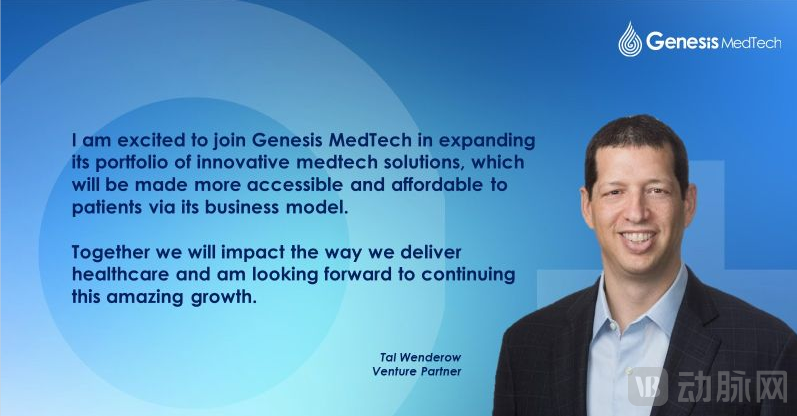 Tal Wenderow Announces Joining Genesis Medtech
Tal revealed that at Genesis Medtech, he will leverage his industry experience and strategic vision to focus on areas such as vascular intervention, digital health, and artificial intelligence. He aims to identify startups in the United States, Europe, and Israel, introduce innovative technologies and products to the Genesis Medtech platform, and integrate systematic solutions. Meanwhile, he will collaborate with various business departments to formulate and optimize mid-to-long-term strategies, driving the company’s differentiated competitiveness.
In fact, over the past two years, Genesis Medtech has made unremitting efforts to enhance the innovation capabilities of domestic enterprises, whether by supporting local R&D or introducing foreign technologies.“Building an Open MedTech Platform to Incubate and Accelerate Innovation in Medical Technology”, is not an empty promise: the company has established R&D centers in China, the United States, and Singapore, and collaborates with top-tier R&D teams worldwide.
In 2020, Genesis Medtech announced the establishment of an R&D and manufacturing base for high-end medical devices in Wuxi, with plans to commence operations in 2022. The facility is dedicated to the R&D and production of interventional products, including neurovascular, cardiac, and peripheral interventions. Upon completion, it will serve as a core hub for Genesis Medtech’s independent R&D, global technology introduction, and large-scale manufacturing.

Genesis Medtech Wuxi R&D and Production Base Rendering
Tal also stated that since its establishment, Genesis Medtech has developed rapidly, achieving swift commercial growth in the Asia-Pacific region. The company has signed multiple joint ventures, acquisitions, and distribution agreements with partners including Shockwave Medical, Riche Surgical, Nico Medical, and LivsMed, while also introducing corresponding R&D and management teams. To date, the integration of its internal R&D team has proceeded smoothly, further enhancing the platform’s innovation capabilities.
“Genesis Medtech focuses more on the continuous R&D and improvement of its products. At Genesis Medtech, this innovative mindset starts with the CEO and permeates the entire organization from top to bottom,” Tal added. “In fact, while many large international pharmaceutical and medical device companies operate in China, they rarely center their R&D efforts here. Genesis Medtech holds a significant advantage by leveraging its Wuxi-based R&D and manufacturing hub to introduce new technologies and support local R&D, enabling Chinese patients and healthcare providers to access globally leading innovative medical devices more rapidly.”
For example, driven by the advantages of the Genesis Medtech platform, Rich Surgical’s new-generation intelligent electric endoscopic stapler “Anzhi” was officially approved for market launch in May this year; Shockwave’s intravascular lithotripsy system has already commenced clinical trials in China; Chocolate® The Touch drug-coated chocolate balloon entered the National Medical Products Administration’s Special Review Procedure (the “Green Channel” for Innovative Medical Devices) this September.
When asked about the company’s future plans, Tal responded with an understanding smile, “By combining customized in-house R&D with complementary external resources, Genesis Medtech aims to platformize innovation, thereby accelerating the rapid development of domestic medical device enterprises. Therefore, moving forward, Genesis Medtech will continue to deepen collaborations with small and medium-sized medical technology companies and entrepreneurs on one hand, while strengthening the integration of medicine and engineering to independently develop innovative products on the other. As I have relevant experience in both areas, I hope to contribute meaningfully.”