Exosomes, Red Blood Cell Therapies, and Live Biotherapeutic Products: Emerging Frontiers in Next-Generation Drug Delivery
It must be acknowledged that the pace of biotechnological development has truly surpassed our expectations. The gap between scientific research and clinical application is rapidly narrowing. Just last year, we were marveling at the novel mRNA-based vaccine technology enabled by nanoliposomes; this year, a surge of mRNA companies has emerged, becoming one of the core forces driving pharmaceutical innovation.
The same trend is evident with other technological platforms, such as AAV viral vectors, ADCs, and PDCs. These innovative delivery technologies are propelling industries like gene therapy and conjugated drugs into a phase of rapid growth, making them focal points in the primary market and even causing significant ripples in the secondary market.
Following the tremendous success of these delivery technologies, which other drug delivery platforms are poised to become the next focal point in drug development? VCBeat New Medicine has identified four emerging directions that may spark the next revolution in drug delivery and provides a brief analysis of each technology.
Exosomes are a class of extracellular vesicles (EVs), typically ranging from 30 to 150 nm in diameter. Extracellular vesicles are a collective term for various membrane-bound vesicular structures released by cells. Based on differences in size, biogenesis, and biological properties, EVs are classified into multiple subtypes, with exosomes being one of them.
The category most frequently compared with exosomes is another major class of extracellular vesicles, namely microparticles/microvesicles (hereinafter referred to as microvesicles). The key difference between them lies in their biogenesis. Microvesicles are generated through outward budding from the plasma membrane, resulting in relatively less stable membrane structures. In contrast, exosomes are formed via inward invagination of the cell membrane, undergo packaging within the cell, and are subsequently released into the extracellular space. Consequently, exosomes exhibit greater structural stability and can encapsulate a more diverse array of cargo.
All cells secrete exosomes. However, pathological cells, particularly tumor cells, secrete significantly larger quantities of exosomes compared to normal cells. These exosomes enter the peripheral bloodstream, where they can be collected and serve as targets for early cancer screening. Consequently, exosomes have become one of the hottest topics in the liquid biopsy industry in recent years. Furthermore, due to their exceptional stability and ease of cellular uptake, exosomes can serve as high-quality carriers for targeted drug delivery.
Codiak Biosciences stands as the benchmark company in the field of exosome-based therapeutics. Founded in 2015, the company successfully listed on the NASDAQ in October 2020.Prior to its initial public offering, the company secured a total of $234.9 million in funding across four rounds, with Flagship Pioneering and ARCH Venture Partners among its shareholders.
Codiak’s core competency lies in its exosome manufacturing processes. For a long time, the production and purification of exosomes have been the biggest obstacles to translating exosome technology into clinical applications.
Codiak’s engEx platform provides it with proprietary manufacturing and analytical technologies. In the manufacturing component, Codiak identified two highly abundant natural exosomal proteins, PTGFRN and BASP1, which can anchor target proteins to the outer or inner surface of exosomes.。
In the purification stage, the ENG platform employs chromatography and filtration technologies to replace traditional ultracentrifugation, thereby enhancing both efficiency and purity in GMP manufacturing.
Leveraging the engEx platform, Codiak has built a pipeline of drug candidates targeting oncology and neurological diseases, with its most advanced products having entered clinical development.
In December 2020, Codiak announced that its Phase I clinical study of exoIL-12 (exosomes carrying IL-12) had met its primary endpoint, demonstrating favorable safety and tolerability in the dose-escalation trial involving healthy subjects. This also marked the first disclosed clinical study results for an exosome-based therapeutic.
In this field, several Chinese companies, including Enze Kangtai and Yumeibo Biotech, are actively establishing their presence. At present, domestic enterprises are still in the early exploratory stage of drug development, with their current core businesses focused on exosome-related research services. As foreign companies such as Codia, Evox, and Avalon achieve greater clinical progress, it is believed that China’s exosome sector will gradually enter a period of growth.
Red blood cells are the most abundant type of blood cell in human blood. The primary functions of red blood cells are transport and immune support. They are responsible for delivering oxygen to various tissues throughout the body and removing carbon dioxide, a metabolic byproduct, from these sites. Red blood cells serve as an indispensable “transport fleet” within the human body.
When red blood cells undergo immune adhesion with microorganisms such as bacteria and viruses, they exert a direct cytotoxic effect on these pathogens via peroxidase. Furthermore, they can promote the phagocytosis of microorganisms by phagocytes. Based on the immune adhesion function of red blood cells, they are also capable of recognizing and carrying antigens, clearing circulating immune complexes, and enhancing T cell-dependent responses.
Mature mammalian red blood cells are anucleate. This means they lack DNA and are incapable of self-replication. Isotope labeling studies have confirmed that the lifespan of red blood cells is typically 100–120 days. Compared with synthetic drug carriers, red blood cells offer advantages such as a prolonged circulation half-life, ease of acquisition, larger specific surface area and volume, high biocompatibility, and a safe clearance mechanism.
Currently, the most well-known company in the field of red blood cell therapy is Rubius Therapeutics.Through the RED platform, Rubius collects CD34+ hematopoietic progenitor cells from healthy O-negative blood donors. After purification, the cells are genetically modified using lentiviral vectors or gene cassette technology. The cells are then cultured to proliferate and differentiate into mature enucleated red blood cells, ultimately forming a cell therapy product for the treatment of diseases.
In Rubius’s projections, a single donation from an O-negative donor could yield hundreds to thousands of doses. By modifying the gene cassettes encoding biotherapeutic proteins, a pipeline capable of generating RCT candidate products is established.
Rubius’s red blood cell therapy requires first identifying the disease, then genetically engineering stem cells to express the corresponding therapeutic protein. Subsequently, the stem cells are cultured and induced to differentiate into red blood cells that synthesize the protein-based drug. Finally, the nucleus is extruded from the cell, while the drug remains either intracellularly or on the cell membrane. The drug is expressed within the cells, thereby effectively evading attack by the human immune system.
Red blood cell therapy cleverly leverages the characteristic that red blood cells discard their nuclei during maturation. Due to the absence of a nucleus, drug-loaded red blood cells do not trigger allogeneic rejection, thereby broadening patient eligibility and expanding applicable therapeutic areas. Furthermore, there is no concern regarding adverse effects from genetic modifications on the human body.
In addition to Rubius, companies such as EryDel, EryTech, and Anokion follow similar technological pathways, all utilizing red blood cells as carriers for drug delivery.
In China’s red blood cell therapy sector, innovative companies such as Westlake Bio have emerged. The company’s REDx platform is the first red blood cell-based drug platform in China, and its products developed on this platform are currently in the preclinical research stage.
Another domestic company, Bomi Biotech, utilizes extracellular vesicles secreted by red blood cells as delivery carriers, which can be considered an intersection of red blood cell-based delivery and extracellular vesicle technologies.
On the other hand, companies such as Artha Biosciences and Cello Therapeutics have pursued divergent paths.These two companies use red blood cell membrane-coated nanoparticles to prevent immune responses triggered by the nanoparticles.
The development of live biotherapeutic products has a long history; even today, fecal microbiota transplantation, despite its rudimentary nature, remains a critical therapeutic intervention for certain conditions, such as Clostridioides difficile infection and inflammatory bowel disease.
However, efforts to develop microbial drugs have not ceased. As gene-editing techniques for microbes have matured, their applications have expanded, giving rise to numerous new clinical use cases.Synlogic is one of the pioneers in this wave of live biotherapeutic drugs.
Just recently, in September 2021, Synlogic announced encouraging news that its two drug candidates for the treatment of phenylketonuria, SYNB1618 and SYNB1934, both demonstrated positive results in clinical studies.
Synlogic’s rationale for developing these two drugs is straightforward: phenylketonuria (PKU) stems from abnormal phenylalanine metabolism; therefore, using engineered live biotherapeutics to address phenylalanine metabolism in the gut effectively resolves the challenge of PKU. It is based on this simple therapeutic logic thatSynlogic developed SYNB1618, an oral therapeutic designed to degrade phenylalanine in the gastrointestinal tract. SYNB1934 is an optimized strain of SYNB1618 with enhanced phenylalanine-metabolizing capacity.
In the disclosed clinical results, SYNB1618 demonstrated reductions in plasma phenylalanine levels across several different dose groups in the Phase II Synpheny-1 clinical study. The rebound of these indicators after discontinuation confirmed that the drug indeed enhanced phenylalanine metabolic efficiency during treatment. Meanwhile, SYNB1934 underwent a head-to-head study against SYNB1618 in healthy subjects, demonstrating that SYNB1934 exhibited twice the activity of SYNB1618.
Although Synlogic suffered a major setback with its hyperammonemia drug SYNB1020, causing its stock price to plummet, the clinical value demonstrated by SYNB1618 and SYNB1934 this time may be sufficient to help Synlogic return to its former glory in the future.
In the corresponding domestic sectors, several companies are also building their product pipelines around microbiome-based solutions.
In the field of fecal microbiota transplantation, several domestic companies, including Xbiome, Zhiyi Biopharma, and Munu Biotech, have entered or are approaching the clinical stage.Unknown Biotech’s XBI-302 has received the first Investigational New Drug (IND) approval from the U.S. FDA in Asia for a fecal microbiota transplantation (FMT) drug clinical trial; Zhiyi Bio’s investigational candidate SK08 is about to initiate a Phase II clinical trial for irritable bowel syndrome (IBS), led by Professor Chen Minhu, Chairman of the Chinese Society of Gastroenterology; MoonBiome also announced in June, during its Series B+ financing round, that the newly raised funds would be used to advance clinical trials for two innovative live biotherapeutic products.
andIn the area of engineered microbial strains, companies such as Hedushengwu and Yuguan Shengwu are also concentrating their strategic layouts.
Hedu Bio’s strategy is to modulate gut function using genetically engineered bacteria. By integrating disease-treating genes into the bacterial chromosome via methods such as CRISPR-Cas9, the company constructs genetically engineered strains and develops them into live biotherapeutic products, a technical approach similar to that of Synlogic.
Yuguan Bio focuses on the development of bacterial vaccines, leveraging synthetic biology technologies to rationally design vaccine strains. This approach enables precise prediction and control of the "mechanism of action" of vaccine strains within the human body, thereby enhancing vaccine safety and efficacy.
In January 2020, a research team led by Cai Yujia from the Institute of Systems Biomedicine at Shanghai Jiao Tong University published their findings in Nature Biomedical Engineering, a Nature journal. The study introduced a virus-like particle (VLP) delivery technology that bridges the gap between viral and non-viral vectors.
These virus-like particles assemble bacteriophage capsid proteins and mRNA together, leveraging the broad infectivity of the bacteriophage shell to deliver mRNA. After fulfilling its function, the mRNA can be degraded within a short period, thereby avoiding the off-target effects that are more likely to occur with DNA delivery due to its prolonged persistence.
Currently, this technology is being commercialized through BenDao Gene, founded by Dr. Cai Yujia. Leveraging its virus-like particle (VLP) technology platform, BenDao Gene has established multiple clinical pipelines in gene editing, vaccines, and immunotherapy.
In addition to the innovative delivery technologies based on biological principles mentioned above, there are other innovative delivery solutions derived from various technologies, such asMicroneedles, Medical-Grade Gels, 3D-Printed Drugsetc. These new technologies, whether time-tested and proven or still in their nascent stages, will also carve out a niche in the future wave of drug delivery innovations.
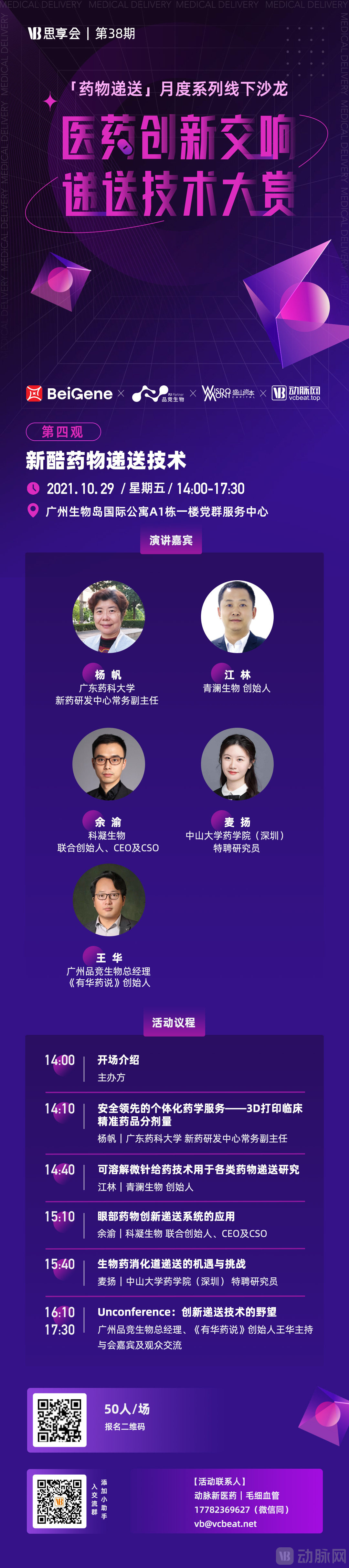
Recently, VCBeat/New Medicine, in collaboration with Shengshan Capital, BeiGene, and Pinjing Bio, launched the 38th session of the [VB Think Tank] offline salon series on “Drug Delivery.” Distinguished experts in attendance will discuss industry development and delve into core technologies surrounding various innovative drug delivery platforms. Scan the QR code below to register immediately.