

Overlooked but Promising: The Emerging Market of Evidence-Based Weight Management Targeting China's 200 Million Overweight Individuals
When it comes to weight loss, terms such as marketing, over-the-counter medications, beauty clinics, slimming teas, and internet-famous diets readily come to mind.
In the public consciousness, weight loss is often perceived as having little connection to medicine. However, as early as 1997, the World Health Organization (WHO) defined "obesity" as a chronic disease, ranking it among the world's four major medical and social issues alongside HIV/AIDS, drug addiction, and alcoholism.
A study published in The Lancet indicates that obesity may increase the risk of uterine cancer by 62%, gallbladder cancer by 31%, and kidney cancer by 25%.
Moreover, obesity is a major risk factor for hypertension, diabetes, fatty liver disease, osteoarticular disorders, and cardiovascular diseases.
Nowadays, the obese population is continuously expanding. According to data from the World Health Organization (WHO), the global obesity rate has increased approximately threefold since 1975. Data from Frost & Sullivan further indicates that China’s obese population exceeds 200 million, surpassing the United States to become the country with the largest number of obese individuals worldwide.
Paradoxically, public awareness of the severity of obesity is not proportional to the rapid growth in the obese population. Meanwhile, China’s obesity-related market remains in its early stages. According to the VCBeat Orange Database, there are only a few dozen domestic digital weight-loss therapy companies, most of which are still in their early development phases.

Meanwhile, domestic enterprise platforms are largely confined to areas such as body shaping, exercise, and dietary therapy. Their products primarily focus on disseminating weight-loss knowledge and facilitating self-management of weight loss. Key features span categories including weight-loss education, personalized plans, professional guidance, self-management tools, incentive mechanisms, community support, news and information, e-commerce, and consultation services. Few companies offer comprehensive weight-loss solutions backed by evidence-based medicine.
Health products such as weight-loss teas and pills often contain varying doses of laxatives in some tea formulations, creating the illusion of weight loss by depleting the body’s water and protein without addressing the core mechanisms of weight reduction. Some pharmaceutical products have been found to contain banned substances such as fenfluramine and amfepramone, lacking certification from relevant regulatory authorities.
In contrast, the overseas market for digital weight-loss therapies is more mature.

Most overseas enterprises have reached the mid-to-late stages of development, with more mature business models. Their services often integrate pharmaceuticals, customized solutions, and regular consultations, featuring extensive application of technology and comprehensive strategic layouts. Furthermore, their business operations are largely underpinned by medical evidence provided by relevant research scholars and endorsed by regulatory approvals such as those from the FDA.
So, for the domestic market, what lessons can be drawn from the development models of overseas digital therapeutics companies in weight loss?
VCBeat will analyze this topic in conjunction with Calibrate Health (hereinafter referred to as “Calibrate”), a remote weight management company that recently secured financing.
How Is Calibrate Changing the Weight Loss Model?
Calibrate’s official website homepage features the following slogan: “We are changing the way the world treats weight.”

Calibrate Clearly Holds a Different View on Weight Loss.
At Calibrate, body weight is viewed as a metric reflecting the status of the human metabolic system. Weight fluctuations are influenced by numerous factors, and traditional weight-loss approaches that rely on willpower—such as “eating less and exercising more”—are not sustainable for achieving long-term goals.
Guided by this understanding, Calibrate positions weight loss within the modern medical domains of health science and beyond. Its solutions are not only reviewed and approved by a clinical advisory board but also scientifically tailored to each user, leveraging data on their physiological characteristics, weight-loss goals, and lifestyle habits to create personalized plans.
Meanwhile, during the user's weight loss journey, Calibrate facilitates regular communication with physicians, coaches, and other professionals to enable timely adjustments to the user's weight loss plan.
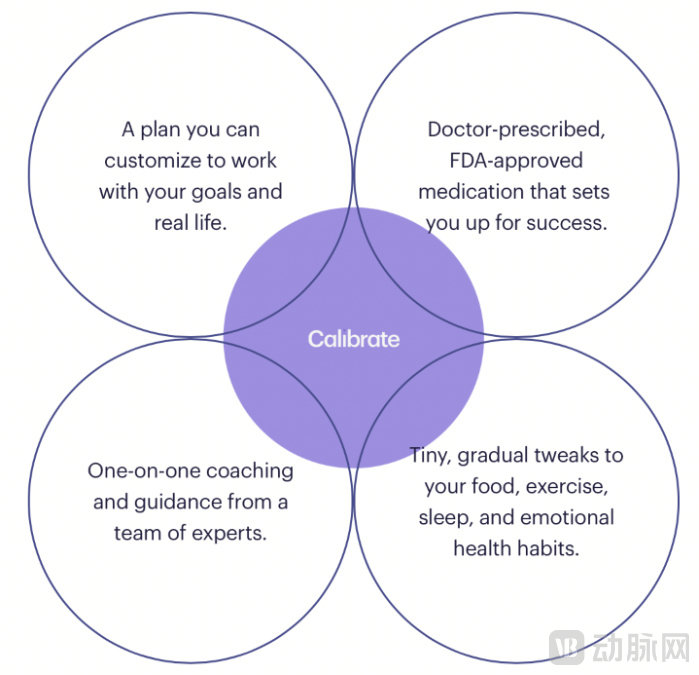
Calibrate’s current weight-loss program encompasses “metabolic system reset,” “FDA-approved pharmacotherapy,” “one-on-one coaching by an expert panel,” and “management of diet, exercise, sleep, and mental health.”
By reviewing the overall business operations of Calibrate, it is evident that its solutions are not limited to dietary control and exercise-based body shaping. Instead, they assess patients’ physical conditions through multiple dimensions, providing comprehensive weight management support across diet, exercise, sleep, mental health, medication, and coaching.
Evidently, Calibrate’s solution encompasses a wide range of weight management methods grounded in research and clinical data.
In an interview, Dr. Fatima Cody Stanford, a Calibrate advisor, explained her reasons for joining the company: “What Calibrate is doing differs from what we see across the broader medical community—it treats obesity as a disease, not a lifestyle choice.”
In essence, Calibrate adopts a more scientific approach to user weight management. Centered on the concept of “metabolic system reset,” it helps users understand their own metabolic health and, supplemented by medication, guides them to make gradual improvements across multiple dimensions—including diet, sleep, and psychological well-being—ultimately achieving sustainable weight adjustment.
Calibrate does not blindly encourage users to adhere to dietary and fitness regimens that are difficult to sustain, which significantly enhances user adherence.
Narrowing the Eligible Population for Precise Weight Loss
However, joining Calibrate’s weight-loss program is no “easy feat.” It has established two thresholds that narrow the eligible population.
First, Calibrate establishes an initial eligibility criterion for users, defining the scope of access. To enroll in this program, individuals must meet the criteria set by the company: they must be between 18 and 64 years of age and have a body mass index (BMI) of 30 or higher. Additionally, the company conducts an assessment and evaluation of each user’s health status to determine their eligibility for participation in the program.
Meanwhile, its services are not available nationwide but are limited to regions such as Arkansas, California, Connecticut, and Washington.
Secondly, membership requires payment of a fee. Calibrate offers two paid plans. One is an annual service plan, under which users pay a monthly membership fee of $129, or make a one-time payment of $1,550 to access all Calibrate services. The other is a one-time metabolic health assessment, priced at $249 per session, which includes a virtual consultation with a physician, an evaluation of current health status, and an overview of a one-year metabolic system calibration plan. In addition to these fees, users may also need to cover costs such as prescription medications.
Only after completing the above two steps can users officially begin Calibrate's weight loss program.
Users will first consult with a Calibrate physician and an accountability coach. Based on the user’s individual circumstances, the physician and coach will “reset” the user’s metabolic system through evidence-based protocols, helping to develop a personalized plan grounded in the four pillars of metabolic health: diet, sleep, exercise, and emotional well-being. They will also prescribe safe, FDA-approved medications with proven efficacy, managing the user’s weight from the perspectives of overall health and long-term sustainability.
It is worth mentioning that Calibrate’s plan is fully digital.
Specifically, all consultation and coaching sessions provided are conducted via video calls. Users can contact Calibrate’s medical team and member experience team through dedicated channels within the app to continuously refine their personalized plans. The value of this approach has become particularly evident amid the impact of the pandemic.
Scientific Curriculum Planning
Calibrate also demonstrates a scientific approach to curriculum planning, primarily dividing user courses into four stages:
First is the learning phase. During the first three months, users will acquire foundational knowledge related to metabolic health and fundamentally adjust their lifestyle habits. Meanwhile, users will meet with their coach every other week to set goals.
Second is the practice phase. This phase will last three to six months, during which users will continue to implement the habits they have previously developed and meet with their coaching team to calibrate their plans, thereby helping them achieve their weight loss goals.
Then comes the improvement phase. Users will not only continue to implement their weight loss plan along this path, but also select courses that better suit their individual needs. In the later stages, they will further refine their habits through ongoing communication with relevant experts.
Finally, the maintenance phase. The focus of this phase shifts to ensuring that these new habits and lifestyle changes are sustained long-term. The curriculum remains similar, consisting of biweekly coaching sessions and assigned coursework.
At its core, all of Calibrate’s curriculum and related planning are designed to educate users on understanding their metabolic health from a scientific perspective. Based on this understanding, users gradually adjust four key metabolic health habits—diet, sleep, exercise, and emotional well-being—to achieve weight loss goals, rather than being asked to adhere to unsustainable or unhealthy diet or fitness regimens.
According to the member report released by Calibrate, its users currently lose an average of approximately 14% of their body weight per year, far exceeding the company’s targeted weight loss goal of 10%.
Although Calibrate also regarded its services as expensive and its entry barrier as high, believing that this would render it less competitive against relatively popular and universal weight-loss service providers such as Noom.
However, Calibrate firmly believes that the additional services it offers at a premium price—such as one-on-one consultations and access to prescription medications—are not only valuable for individuals striving to adhere to their weight-loss plans and achieve long-term results, but will also help foster a healthier cycle in society. Furthermore, this program will differentiate Calibrate from other companies.
A team composed of medical, food, and sleep experts
Calibrate’s expertise in technology and weight loss is inseparable from the professional backgrounds of its corporate team. Judging by its team composition, the company appears to remain committed to an “evidence-based” approach in weight management. So, what exactly does Calibrate’s team look like?
Its founder, Isabelle Kenyon, a graduate of the University of Pennsylvania, founded Calibrate after learning that her mother’s weight had negatively impacted her health.

After setting out to found Calibrate, Kenyon gradually built his team. The team can be broadly divided into three parts: a cohort of coaches and physicians holding M.D. degrees; an expert advisory board comprising food specialists, as well as experts in sleep and emotional management; and a clinical advisory committee composed of senior U.S. metabolic health experts and researchers.
Among them, the coaching and medical team includes internist Dr. Kerri Masutto, and internist and endocrinologist Dr. Sona Shah. The expert advisory board includes nutrition coach Adam Rosante, Stephanie Middleberg, bestselling author of The Big Book of Organic Baby Food, and Emily Fletcher, founder of Ziva Meditation, among others.
Calibrate’s advisors include Dr. Donna Ryan, President of the World Obesity Federation; Dr. Fatima Cody Stanford, an obesity medicine physician-scientist and educator at Massachusetts General Hospital and Harvard Medical School; and Dr. Dariush Mozaffarian, a cardiologist and professor of medicine at Tufts University School of Medicine.
Why Was Calibrate Able to Secure Funding So Quickly?
Judging from its financing situation, Calibrate’s “firm belief” may well be justified.
To date, the company, founded in 2020, has secured three rounds of financing within just one year.

Calibrate’s curriculum design and business model are helping it achieve further growth.
Kenyon, Founder and CEO of Calibrate, stated: “Calibrate’s business is growing alongside consumers’ increasing attention to their potential health risks. Meanwhile, telemedicine is on the rise, driven by factors such as the pandemic. Calibrate’s digital platform caters to both of these market demands, which has attracted a large number of new users and investors.”
Moreover, according to relevant statistics, the United States spends over $300 billion annually on weight-related issues, with consumers allocating approximately $290 billion each year to weight-loss foods, meal plans, and weight-management programs. For investors at Forerunner Ventures, this may represent a promising arena for innovation and investment.
But Kirsten Green, an investor at Forerunner Ventures, has also candidly stated, “Calibrate’s true strength lies in its ability to strike a balance among science-backed medical solutions, lifestyle improvements, and remote education.”
Today, the company has further expanded consumer access to approved medications such as Wegovy. Meanwhile, its proprietary integrated vertical pharmacy will make these drugs more accessible to its users.
It is worth pondering: Why has Calibrate achieved success and secured funding so rapidly? Are there any lessons to be learned from its experience?
An analysis of its business model reveals that Calibrate is primarily grounded in scientific research. On one hand, its programs are based on clinical studies, and its curriculum is developed by a team of medical experts drawing on years of scientific research. Overall, its solutions offer greater safety and efficacy.
On the other hand, rather than relying on advertising and other marketing models as its primary promotional strategy, the company has established entry barriers to target a precise demographic, addressing weight loss through medical solutions and attracting users based on demonstrated efficacy. Backed by robust medical evidence, the company’s future development prospects are poised to be significantly broader.
Second, Calibrate offers a long-term, sustainable weight-loss solution. This not only helps patients with obesity address the root causes of their condition but also creates a more differentiated competitive advantage for the company. Its weight-management program combines physician-prescribed, FDA-approved medications with one-on-one coaching based on lifestyle interventions, delivering both comprehensive scope and scientific rigor.
Third, the company provides patients with a positive experience while enhancing patient adherence. Throughout the one-year program, Calibrate remains committed to delivering one-on-one services. During this period, physicians not only monitor patients’ progress toward their goals but also provide emotional support and motivation to help them improve habits related to diet, sleep, exercise, and emotional well-being, thereby enabling sustained, long-term weight loss and achieving positive health outcomes.
Fourth, Calibrate has catered to market demand by capitalizing on the growing public concern over potential health risks and the rising influence of remote health platforms in the post-pandemic era. Meanwhile, it fills a gap in the current market, where there are relatively few weight-loss solutions focused on medical protocols and pharmacotherapy.
How to Explore the Weight Loss Market?
Through the practice of Calibrate, we can draw the following insights:
Currently, China has become the country with the largest obese population globally. While domestic demand for weight-loss solutions continues to grow, there remains a certain degree of market gap.
On one hand, most market entrants focus on “light” weight management, offering weight-loss solutions that lack clinical trial evidence and demonstrate insufficient safety and efficacy. There remains significant room for improvement in addressing actual medical needs and delivering substantive outcomes.
On the other hand, corporate development models and solutions are becoming increasingly homogeneous, with few truly effective options available. Development approaches that lack differentiation and are relatively “asset-light” may lead to insufficient momentum for future growth, inevitably subjecting companies to a new round of industry consolidation.
From the perspective of market product diversity, China currently has numerous enterprises targeting the weight-loss market, including those engaged in the development of health-monitoring hardware, drug R&D, social apps for weight loss, exercise-based weight-loss platforms, personalized dietary health services, and medical devices for metabolic diseases. However, most of these ventures are still in their early stages, and their products lack competitiveness.
In contrast, Calibrate’s business model integrates telemedicine, pharmacotherapy, exercise-based weight loss, and personalized nutrition, making it more competitive and enabling the company to deliver more comprehensive and effective services to its users. In the future, integrated approaches may become a key trend in weight management.
Today, the domestic market has also seen the emergence of AI-driven drug developers such as Yiyao Technology, which leverage artificial intelligence platforms to screen compounds for the treatment of obesity, hyperuricemia, and non-alcoholic steatohepatitis (NASH); as well as medical device developers such as Tangji Medical, which focus on novel therapies for metabolic diseases including obesity, diabetes, and fatty liver disease. This demonstrates the rise of innovative enterprises that base their weight-loss interventions on evidence-based medicine.
Although the domestic weight-loss market is still in its early stages, it is undeniable that weight loss remains a valuable sector.