

Enchi Completes Digital Healthcare Service Loop for Autism with Launch of AI-Powered Early Screening and Diagnostic System
This article is reposted from 36Kr – by Dun Yuting
Children with autism (autism spectrum disorder), known as “children from the stars,” are like stars twinkling alone in the dark night sky. Due to their condition, they lack basic life and social skills, and may even face exclusion and discrimination because of their unusual behaviors.
Multiple studies have demonstrated that early intervention yields significant improvements in behavioral, cognitive, and emotional development among children with autism spectrum disorder (ASD). More specifically, the golden window for intervention is between the ages of 1 and 6; missing this critical period may impose a lifelong burden on both the child and their family.
However, China has not yet established a relatively comprehensive early screening system, and the number of child psychiatrists remains below 500, far failing to meet societal needs. To address this, Beijing Anding Hospital affiliated with Capital Medical University, the Institute for Barrier-Free Development at Tsinghua University, and Beijing Ingcare Technology Co., Ltd. (Enqi) have jointly developed an AI-based digital diagnostic and therapeutic system—the “Autism Spectrum Disorder Screening and Auxiliary Diagnosis System.”
It is reported that this system leverages AI-based detection and comparison technologies for facial features and human body behaviors in images, audio, and video. Aligned with the five early warning behavioral characteristics of autism outlined in the Expert Consensus on Early Identification, Screening, and Early Intervention for Children with Autism Spectrum Disorder issued by the Chinese Medical Association—namely, “limited or absent eye contact,” “limited or absent response,” “limited or absent pointing,” “limited or absent speech,” and “inappropriate behaviors”—the system performs localization, attribute recognition, and comparative analysis of these behaviors to generate an early risk screening report. This assists medical professionals in conducting rapid and precise screening and diagnosis of autism spectrum disorder (ASD) in children, reduces early screening costs, supports the full-process management of “early detection, early diagnosis, and early intervention” for ASD, and effectively enhances the outcomes of rehabilitation interventions.
According to Wang Wei, founder of Enqi, the system has initiated large-scale, multi-center clinical trials; additionally, it is planned to be applied in the large-scale epidemiological survey on autism led by Beijing Anding Hospital.
The implementation of this early screening system also signifies that Enqi has completed a closed-loop digital medical service model for children with autism spectrum disorder (ASD): achieving digital management across the entire rehabilitation process, from screening and diagnosis to ability assessment, rehabilitative intervention, and subsequent inclusive education.
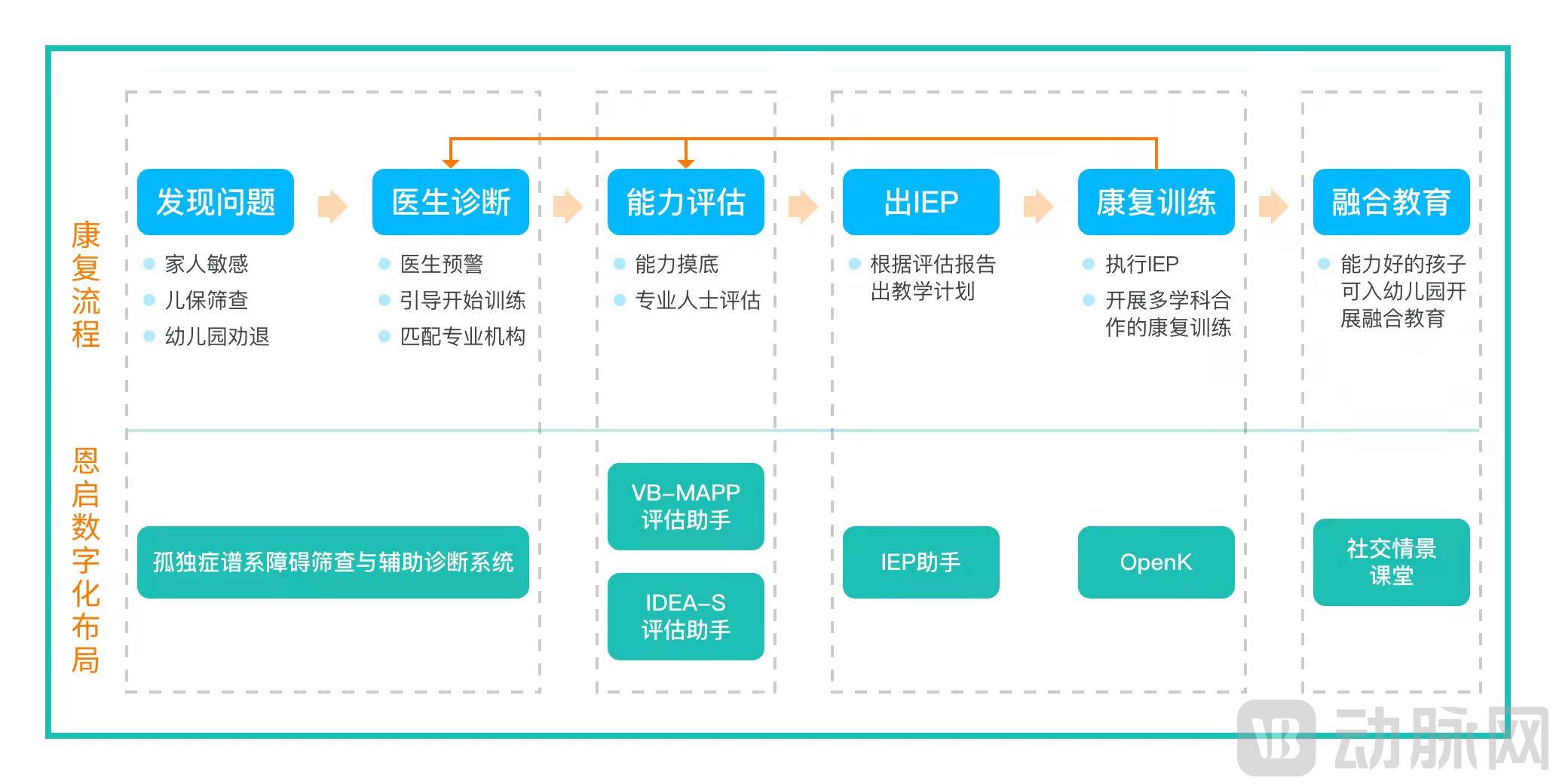
Enqi Rehabilitation Full Process (Image provided by the company)
Unlike other companies in the market that focus on autism rehabilitation services, Enqi has leveraged internet, big data, and artificial intelligence technologies as its core from inception to expand related business operations and elevate the overall professional standards of the autism rehabilitation industry. It helps primary healthcare institutions reduce the time spent on autism screening and diagnosis while improving screening accuracy. Additionally, it enhances the operational efficiency of existing autism rehabilitation institutions.
Specifically, since its establishment, Enqi has primarily focused on therapist training and the development of intelligent rehabilitation system products. Based on this focus, it has developed three major business segments: therapist training, offline rehabilitation centers, and technology-enabled services. In addition to the recently launched autism screening and assisted diagnosis system, Enqi has deeply integrated teaching, product development, and research based on its professional IDEA rehabilitation framework. It has successively launched a range of products, including the online education platform Enqi Cloud Classroom, the VB-MAPP Assessment Assistant evaluation tool, the Openk intelligent rehabilitation management platform, the therapist training talent development system, and the IDEA textbook and teaching aid system.
EnQi has remained committed to advancing the comprehensive enhancement of professional capabilities in the autism rehabilitation sector for children by leveraging technological tools such as the internet, big data, and artificial intelligence, thereby driving the industry’s digital transformation on the foundation of specialization, standardization, and scalability.
Unlike other companies in the industry that operate chain businesses, Enqi’s offline IDEA Rehabilitation Centers primarily serve three key functions: first, as delivery centers for high-quality rehabilitation services; second, as empirical centers for curriculum research and development and software systems; and third, as resource centers for teacher training and technical empowerment.
Embarking on the path of innovation in the autism industry is driven not only by market demand but also by Wang Wei’s personal experiences and accumulated expertise. Ten years ago, while working at the Institute of Interactive Media at the Academy of Arts & Design, Tsinghua University, Wang Wei accidentally discovered that the multimedia interactive games created by his team were highly popular among children with autism. At that time, he recognized the insufficient supply of high-quality resources in China’s autism sector, such as skilled rehabilitation therapists. The entire rehabilitation market was plagued by chaos, lacking a clear understanding of etiology, mature treatment modalities, and a rigorous regulatory framework, leading to instances where desperate families sought medical help indiscriminately.
Consequently, he began to explore how technological solutions could assist this population. Against this backdrop, Enqi was officially established in 2014 after being incubated by Tsinghua University’s X-lab, with the aim of driving the digital transformation of the autism rehabilitation industry and significantly enhancing the professional standards of autism care across the sector on a large scale and with high efficiency. The company subsequently completed multiple rounds of financing between 2017 and 2021.

Estimates indicate that the number of children aged 0–14 with autism spectrum disorder (ASD) in China exceeds 3 million, including over 800,000 children under the age of 7. Based on an average annual rehabilitation cost of RMB 80,000 per patient, the market size for early screening and rehabilitation services is approximately RMB 60 billion per year.
Industry veterans predict that, with the “Autism Spectrum Disorder Screening and Assistive Diagnosis System” serving as the starting point for digital diagnosis in the sector, the entire rehabilitation process for children with autism will inevitably be under comprehensive digital management within five years. The rehabilitation process will achieve a progressive leap from informatization and intelligence to full digitization, and digital healthcare will become the mainstream approach for autism rehabilitation.
"Given the current state of diagnosis and treatment for autism spectrum disorder (ASD) and the associated clinical needs, this field is highly suitable for the research and application of digital health. Taking the aforementioned diagnostic system as an example, during its development, we found that digital therapeutics are far more than just rating scales. They require the integration of multiple technological approaches, multidisciplinary collaboration, training on large-scale, rigorous datasets, and the accumulation of extensive case studies from frontline rehabilitation practice for analysis. Data models must be continuously refined or even reconstructed, and long-term follow-up, guidance, and comparative analysis by numerous medical experts are essential."
Viewed against the broader industry landscape, digital health is currently held to very high expectations. However, it remains a relatively new concept across all subsectors, particularly in the field of autism rehabilitation. The sector is still characterized by low-level replication and a prevailing reliance on empiricism, indicating that there is still a long way to go.
Building on its accumulated experience, Enqi has also established a core database of teachers and a database of child development assessments for China’s autism rehabilitation industry, laying the foundation for the development of related products.
According to data provided by the team, Enqi’s online education platform has trained more than 77,000 frontline teachers across China, accounting for over 60% of all teachers in the industry, and has served tens of millions of parents. Its assessment product, the “VB-MAPP Assessment Assistant,” is used by more than 1,300 rehabilitation centers, hospitals, and research institutions nationwide, generating over 41,000 scientific assessment reports and yielding 7.5 million valid rehabilitation data entries.
However, this is only the beginning for millions of children with autism; Enqi still has much to accomplish in the future.