

Entering the Deep Waters of Digital Healthcare: How Ping An Health's Family Doctor Membership Model is Pioneering a New Direction

Ping An Healthcare
One-stop Solution Provider for Health Management
The public is no stranger to membership-based services.
In the traditional service industry,Membership-based services are often employed by enterprises to retain and expand a base of loyal customers or those with high consumption demands, leveraging their influence to attract broader segments of potential customers.
In the healthcare services sector, many medical institutions have also made similar attempts.
Since the 1990s, certain medical institutions, such as Nanfang Hospital of Southern Medical University in Guangzhou and the Third Affiliated Hospital of West China University of Medical Sciences, have pioneered the exploration of membership-based healthcare service models. By providing members with specialized, differentiated, and patient-centered medical and health services, these institutions aim to enhance satisfaction and loyalty among users (including patients and a subset of healthy individuals), uncover potential clientele, expand their institutional influence, and increase revenue.
HoweverMembership-based medical services led by healthcare institutions often face numerous challenges, such as difficulties in health monitoring and implementation of interventions, inefficient service workflows, inadequate medical equipment, and a lack of expertise in user operations.
As a cohort of internet healthcare companies has grown, enterprises represented by Ping An Healthcare, JD Health, and WeDoctor have successively launched membership-based medical service products.Compared with the “offline” membership-based medical service products promoted by healthcare institutions, can this type of membership product, which integrates online and offline medical services, better meet user needs while addressing current market pain points? Can such products bring new possibilities to the healthcare services industry?
To address these questions, we may find answers in Ping An Healthcare’s “Family Doctor Membership” product, which was presented to users at the 2021 Ping An Healthcare Investor Open Day and offers services such as “one family doctor, five specialized professional services, and one member health record.”
Is the sluggish promotion of “membership-based medical services” by traditional healthcare institutions due to limited market capacity and low user demand?
First, from the perspective of the overall growth potential in the healthcare sector—Data from the seventh national population census shows that China’s total population reached 1.41178 billion. Among them, the population aged 60 and above was 264.02 million, accounting for 18.70% of the total population. The large population base, coupled with the advent of an aging society, signifies a massive demand for medical consumption.Today, with rising per capita income and evolving health consumption awareness, people are placing significant emphasis on disease prevention alongside treatment, demonstrating a willingness to invest in maintaining their health, which has fueled robust demand in the health consumer market.
From the perspective of overall scale, China's total expenditure in the healthcare and health sectors was RMB 9 trillion in 2020 and is highly likely to rise to RMB 15 trillion by 2025.Taking 2020 as an example, the share of healthcare expenditure in GDP exceeded 10% in countries such as Japan and the United Kingdom, while China’s stood at only 7.1%, compared with 17.7% in the United States. Compared with developed nations, China’s healthcare expenditure as a percentage of GDP remains relatively low, indicating significant potential for further growth.
Secondly, from the perspective of the payer's demand—The presence of payers willing to pay is often the key factor in building a business model. Payers with willingness to pay in the healthcare market can be simply divided into the consumer side (C-end) and the business side (B-end).
In the consumer market, according to the 2020 China Health and Health Statistical Yearbook, the annual number of clinical visits reached as high as 8.7 billion in 2019. Among the patient population, there are currently over 400 million individuals with chronic disease management needs and 40 million patients with critical illnesses.Patients often find that their needs remain unmet despite expending considerable effort, time, and money during the process of seeking medical care.
For instance, users have not only the need for disease treatment but also the need to maintain health. However, current hospitals primarily provide disease treatment interventions rather than preventive care. When users visit hospitals for consultations, they face the “hassle” of lacking professional guidance and do not know how to access high-quality physician resources. The medical consultation process is often cumbersome, requiring patients to shuttle back and forth among various institutions, which is highly “time-consuming.” During diagnosis and treatment, pharmaceutical and medical expenses may be unreasonable, resulting in “financial burden” without achieving a cure.Users have clear expectations: to save time, reduce worry, and minimize effort during the process of seeking medical care and consultations.
In the B2B market, corporate demands generally fall into two categories: one is to facilitate business expansion by offering concessions to clients and maintaining customer stickiness through selected value-added services; the other is to improve the health status and satisfaction of employees within B2B enterprises.
National policies are actively encouraging commercial insurance providers to enhance health management services. In 2019, the China Banking and Insurance Regulatory Commission (CBIRC) revised the “Administrative Measures for Health Insurance,” raising the cap on health management service costs from 12% of gross premiums under the previous version to 20% of net premiums. This adjustment signals that the health insurance market is poised for significant growth, with its scale expected to expand from RMB 800 billion in 2020 to RMB 2 trillion by 2025. Enterprises in the B2B financial and insurance sectors are increasingly likely to offer health management services to boost customer satisfaction and drive sales of related insurance products.
In China, there are currently 310 million corporate employees, with total compensation reaching RMB 23 trillion. Funds equivalent to 5% of employee compensation for supplementary medical insurance, 14% for employee welfare expenses, or 2% for labor union fees can be allocated to cover healthcare services. Companies are also motivated to offer employee benefit plans to support health management. Unlike in the past, corporate demands have evolved beyond merely providing annual health check-ups to encompassing a broader spectrum of healthcare services. By enhancing service quality in both pre- and post-examination phases, companies aim to improve employee well-being.
The presence of a market, growth potential, and clear demand from parties willing to pay has prompted numerous participants in the medical industry to enter the field. This trend is also closely tied to the return on investment (ROI) in the healthcare sector—among the global shareholder ROI across all industries from 2010 to 2020,The healthcare industry ranks second, trailing only the technology sector, with a return on investment (ROI) as high as 11%.
However, why is it difficult to see membership-based medical service products stand out in the market? This is related to many contradictions existing in the current market, and the supply capacity on the supply side is obviously a major limiting factor.
First, there is an inherent imbalance between the demand for and supply of medical resources.Deficiencies in the supply of medical resources are mainly reflected in two aspects: first, a shortage of medical personnel, with a current gap of over 15 million healthcare workers and more than 1 million general practitioners. Second, there is a severe imbalance in consultation volumes. In 2019, the total number of clinical visits reached 8.7 billion, of which 3.842 billion took place in hospitals. Among the total of 34,354 hospitals, 2,749 tertiary hospitals handled approximately 2.057 billion consultations.
This also indirectly explains why membership-based medical service products developed by hospitals often face greater obstacles. Without changing the internal institutional framework, such membership services, typically offered as “special-needs” care, frequently encounter staffing shortages within the hospitals themselves. Moreover, the “paid membership” model adopted by public hospitals often draws public criticism.
Secondly, medical resources are not being utilized effectively.While tertiary hospitals are overcrowded, some primary hospitals are deserted. Primary hospitals (accounting for over 50% of the total number of hospitals) have an average bed occupancy rate of less than 50%. Due to a shortage of patients, grassroots doctors gain experience at a slower pace, hindering the effective improvement of primary healthcare standards.
Furthermore, the discontinuity and lack of integration in services make it difficult for users to obtain a comprehensive service experience.The chain affiliation rate for the top ten suppliers in each category is currently below 10%. This also means that patients often experience fragmented services.
Finally, patient experience and perception are also evident., for high-net-worth individuals, existing routine medical services fail to adequately meet their needs, creating an urgent demand for high-quality professional services.
andPain points on the supply side have also spurred a series of new demands:
From the perspective of user needs, users need to obtain continuous services through an exclusive “private doctor,” enabling them to quickly locate the appropriate physician and access professional medical care.
From the Perspective of Government NeedsTo ensure that minor illnesses are treated at the primary care level and to fully leverage tertiary hospitals’ role in managing complex and refractory cases, it is essential to further implement the tiered diagnosis and treatment system. To better execute this system, the value of general practitioners and family doctors within community service networks must be further realized. Meanwhile, with the advent of an aging society, increased medical resources are needed to strengthen health interventions for the elderly population.
From the Perspective of Contemporary Needs, epidemic prevention and control efforts have driven the full utilization of telemedicine technologies; during this period, internet-based medical consultations increased by 17-fold year-on-year. The expansion of technologies such as AI-powered image interpretation will help overcome current constraints in healthcare resource availability.
From the perspective of the overall healthcare environment, general practitioners in developed countries address 90% of diagnostic and treatment needs. Drawing on international experience, we also need more general practitioners and family doctors to provide primary care services.
Guided by the aforementioned demands, Ping An Healthcare’s “Family Doctor Membership” product is poised for launch.
“We aim to connect payers and providers through our ‘Family Doctor Membership’ product. We no longer define family doctor services as merely lightweight consultations; rather, we position them as true navigators for users, helping to bridge online and offline services and resolve the disconnects between these two channels. Starting with the family doctor and ending with the family doctor—this is how we define our Family Doctor Membership.”At the 2021 Ping An Healthcare Investor Open Day, Fang Weihao, Chairman of the Board and Chief Executive Officer of Ping An Healthcare and Technology Company Limited, made the following remarks.
Addressing the current pain points in the healthcare services industry and the needs of payers,During the Strategic Deepening 2.0 phase, Ping An Healthcare launched its “Family Doctor Membership” product. While accelerating the onboarding of payers, it integrated supply-side medical service resources and refined its O2O closed-loop services, thereby connecting all stakeholders through the Family Doctor Membership product.
As of the end of September 2021, Ping An Healthcare had connected with over 4,000 medical institutions, more than 1,800 health organizations, 1,700 contracted physical examination centers, 800+ laboratory and diagnostic centers, 189,000 partner pharmacies, and 46,500 external experts, thereby establishing a comprehensive online and offline healthcare service ecosystem.
The family doctor membership model is centered on “1 family doctor + 5 professional services + 1 member health record.” It matches users with resources across five key scenarios—health management, sub-health management, disease management, chronic disease management, and elderly care management—based on their needs. This approach helps create a comprehensive member profile for each user that covers their entire lifecycle, coordinating and arranging healthcare services that span both online and offline settings.
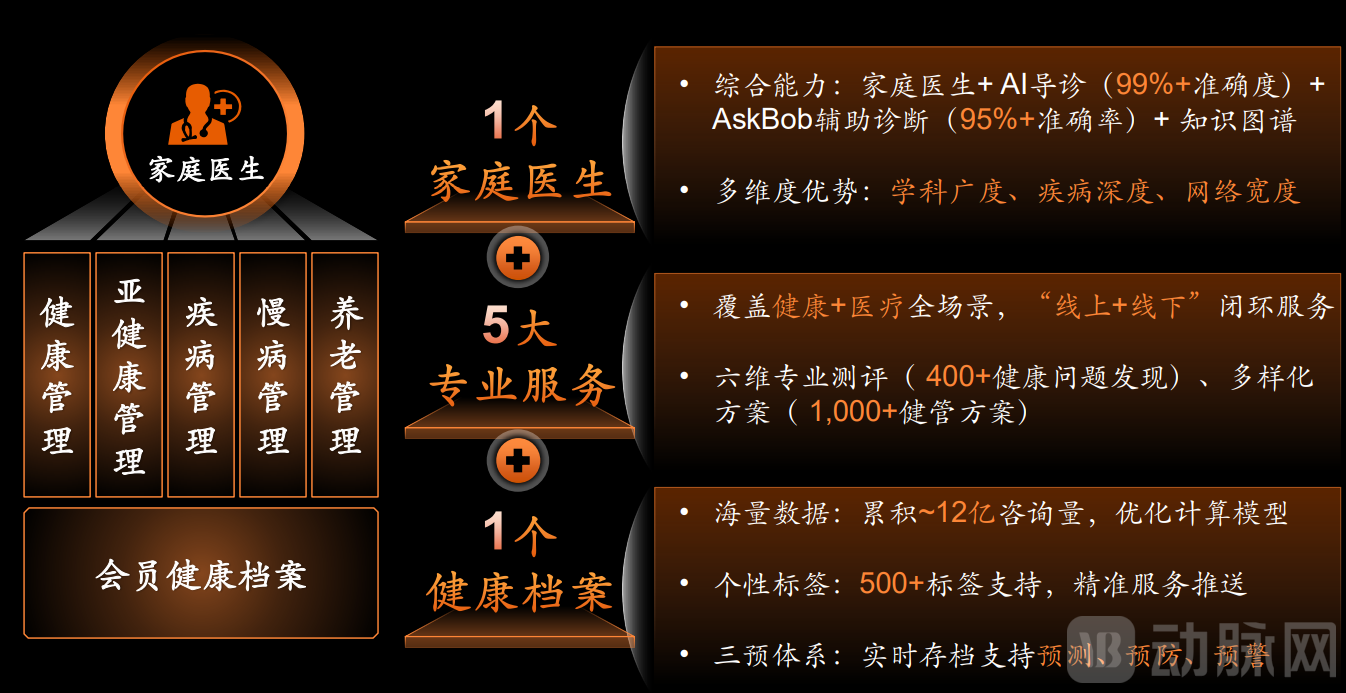
Source: Ping An Healthcare 2021 Investor Open Day PPT
Great products are forged through continuous refinement. Ping An Healthcare’s “Family Doctor Membership” product is closely linked to the company’s strategic Phase 1 initiative of building an internet healthcare model.
During the Strategy 1.0 phase (2014–H1 2020), Ping An Healthcare focused primarily on building scenarios and driving traffic.This period was more akin to a pioneering phase focused on “quantity.”During this phase, Ping An Healthcare accumulated resources on both the user and physician fronts. On the product side, it completed its initial exploration by offering services including online consultations and pharmaceutical products. In terms of medical services, the focus remained primarily on online offerings during this period.
Upon entering the Strategic Deepening 2.0 phase, Ping An Healthcare has placed greater emphasis on enhancing "quality."While focusing on user experience, Ping An Healthcare is exploring diversified channels for customer acquisition with lower costs and has launched a family doctor membership product. By connecting payers and providers, it delivers medical services that are “worry-free, time-saving, and cost-effective” to patients—By providing member-exclusive family doctors, personalized case management, and professional services, we help users achieve “peace of mind”; through 24/7 remote consultations, offline medical navigation and accompaniment, and home-visit services, we help users “save time”; and by offering professional guidance on medical expense control, health management, and account management, we help users “save money.”
Ping An Healthcare has always regarded B2C as a key strategy for attracting high-quality users, increasing the number of paying users, and boosting ARPU (Average Revenue Per User).In this regard, addressing the needs of B-side enterprises, Ping An Healthcare leverages its “Family Doctor Membership” product to help insurance companies, banks, and other businesses provide their customers with more “personalized and caring services,” thereby enhancing customer stickiness and improving renewal conversion rates.
Take insurance as an example,The integration of Ping An Healthcare’s medical service products can broaden the scope of medical services covered by insurance products and enhance overall service richness. The interconnection between medical provider networks and insurance technology platforms can streamline the claims process, while the proactive health management enabled by the inclusion of medical services can accumulate more user data for health tracking and rational premium control.
such as“Ping An Life Insurance Zhenxiang RUN”—The launch of this deeply integrated health and medical benefits product within insurance policies provides policyholders with a comprehensive suite of health and medical service benefits, including daily health management, inpatient care services, and specialized critical illness services, as well as weight management, sleep management, and other distinctive offerings.This product achieved a 97% customer service satisfaction rate and an overall repurchase rate of 74%, with its ARPU being 3–4 times that of the consumer-facing (C-end) segment.
It is not difficult to see that,“The Family Doctor Membership” Product Launch Signals a Shift in Ping An Healthcare’s Profit Model, transitioning from the traditional fee-for-service and commission-based models (tied to pharmaceuticals or products) to a membership-based model, while expanding revenue streams through members’ purchases of value-added services or products.
The launch of Ping An Healthcare’s “Family Doctor Membership” product has provided users with professional guidance, linked high-quality medical resources, empowered the government with specialized capabilities, and offered differentiated supplementary services to meet the needs of diverse population segments. However, as a pioneering product venturing into the deep waters of internet healthcare while striving to enhance societal medical efficiency, Ping An Healthcare has focused its efforts on“Family Doctor Membership” Products Connecting Providers and PayersCan it lead Ping An Healthcare toward its mid-term revenue targets? Can it become the key to “breaking the deadlock” in the current revenue challenges of medical services? Let us wait and see.