

Strictest-Ever Internet Healthcare Regulations Unveiled, Industry Braces for Major Transformation
On October 26, the Medical Administration and Hospital Management Bureau of the National Health Commission released the “Detailed Rules for the Supervision of Internet-Based Diagnosis and Treatment (Draft for Comments)” (hereinafter referred to as the “Detailed Rules”). This marks the first set of detailed implementation rules issued by the National Health Commission specifically targeting internet-based diagnosis and treatment since the introduction in 2018 of three major documents, including the “Administrative Measures for Internet-Based Diagnosis and Treatment (Trial).”
The Detailed Rules not only set forth meticulous requirements for institutions, personnel, services, and quality and safety related to internet-based diagnosis and treatment, but also firmly prohibit practices that have emerged in the industry, such as AI-generated prescriptions, dispensing medications before issuing prescriptions, and pharmaceutical kickbacks. Overall, the emphasis on “regulation” is fully reflected. Although the document is still in the public consultation phase and has not yet taken effect, its publication on the official website of the Bureau of Medical Administration and Hospital Supervision under the National Health Commission has sparked diverse discussions within the industry.
Since the outbreak of the pandemic in 2020, internet healthcare has entered a new phase of rapid growth. What impact will the issuance and future implementation of the Detailed Rules have on the industry? Does it entail only “regulation,” as the literal wording suggests? Under the new regulations, where is the internet healthcare sector headed? VCBeat offers an interpretation based on interviews with multiple stakeholders, including policy makers, heads of public internet hospitals, and internet healthcare companies.
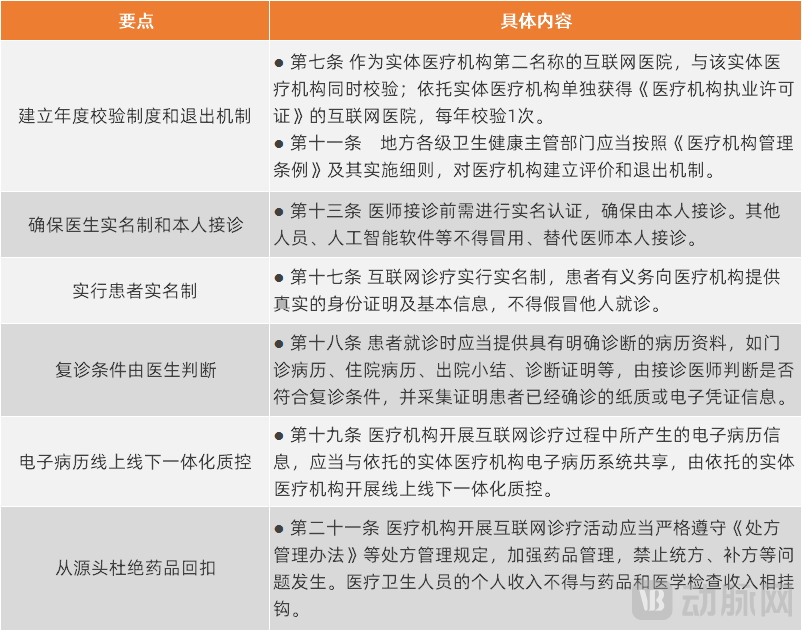
“Key Provisions of the Detailed Rules for the Supervision of Internet-based Diagnosis and Treatment (Draft for Comments) That Have Drawn Widespread Attention from the Industry.” Source: Official Website of the Bureau of Medical Administration and Hospital Management, National Health Commission; compiled and charted by VCBeat.
It is understood that prior to the public consultation on the “Detailed Rules,” internal feedback was solicited from local health commissions, medical institutions, and internet healthcare enterprises. Regions such as Hainan, Ningxia, and Sichuan had previously issued regulatory measures related to online diagnosis and treatment.
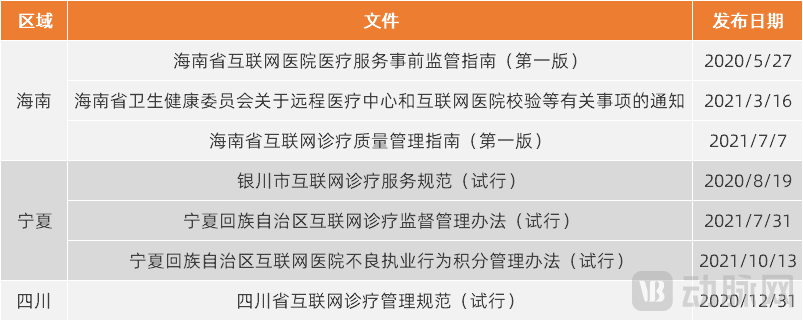
Local Management Regulations. Source: Official websites of local Health Commissions; compiled and charted by VCBeat.
In terms of content, many regulatory measures from various regions are reflected in the Detailed Rules. For instance, the Detailed Rules define the boundaries for the use of artificial intelligence (AI) and prohibit pharmaceutical kickbacks. Both the Yinchuan Internet Diagnosis and Treatment Service Standards (Trial), issued in 2020, and the Sichuan Province Internet Diagnosis and Treatment Management Standards (Trial) stipulate that AI and other technologies must not be used to completely replace physicians in conducting consultations, writing medical records, prescribing medications, or performing other diagnostic and therapeutic activities. Furthermore, internet hospitals are prohibited from linking physicians’ income to the monetary value of prescribed drugs, inducing prescription behaviors through drug profits, or providing physicians with disguised kickbacks in the form of points, events, or other incentives.
In addition to existing regulations on artificial intelligence and pharmaceutical kickbacks, Hainan Province, in its Notice on Matters Concerning the Verification of Telemedicine Centers and Internet Hospitals, also requires independently established internet hospitals to undergo annual verification and to establish an exit mechanism based on the verification results, a provision that is also reflected in the current Detailed Rules. Furthermore, the Hainan Province Guidelines for Quality Management of Internet Diagnosis and Treatment (First Edition) adhere to the principle of “consistency between online and offline services,” providing detailed stipulations on the quality of internet-based diagnosis and treatment, physician conduct, pharmaceutical care quality, and electronic medical record quality.
Hainan, Ningxia, Sichuan, and other regions were among the earliest to explore internet-based healthcare and have a relatively large number of internet hospitals, particularly those established by enterprises. Local regulatory implementation rules in these areas have already taken effect, and many internet healthcare companies have established their presence there. Therefore, the relevant provisions in the Implementation Rules are already familiar to many internet healthcare enterprises.
Liao Jieyuan, Chairman of WeDoctor Group, believes that the Detailed Rules send a clear signal: internet-based diagnosis and treatment services must achieve maximum “homogeneity” with those provided by physical medical institutions. Wang Hang, Founder and CEO of Haodf Online, holds that the Detailed Rules set forth numerous requirements for improving service quality, aiming to promote greater standardization and safety in the internet healthcare industry and to realize high-quality development.
“From a macro perspective, internet healthcare has developed rapidly in recent years, with industry participants making numerous explorations to improve the efficiency and accessibility of medical services.” A relevant official from JD Health stated that the Detailed Rules provide internet healthcare enterprises with more policy guidance as they explore business models and serve users.
Wang Shirui, Founder and CEO of WeDoctor, stated that the Detailed Rules will serve as another programmatic document guiding industry development. The Rules specify regulatory requirements for medical institutions, personnel, and services providing internet-based diagnosis and treatment. Additionally, they introduce key new mandates, including clear documentation for follow-up consultations, enhanced data transmission integration with provincial-level regulatory platforms, and mandatory annual inspections. The implementation of these Detailed Rules will provide practitioners and institutions with a clear regulatory basis, further promoting the standardized development of the industry.
Hainan Province also participated in providing feedback during the formulation of the Detailed Rules. “The Detailed Rules focus primarily on medical quality and safety,” stated an official from the Medical Administration and Hospital Management Department who was involved in the feedback process. Based on Hainan’s practical experience, investors or hospital administrators of internet hospitals established by social capital generally lack medical management expertise. Therefore, the Detailed Rules, building upon the framework of the 2018 Administrative Measures for Internet Hospitals (Trial), have set forth detailed requirements for the daily management of medical institutions.
Undoubtedly, the “Detailed Rules” set a clear regulatory tone, particularly with regard to practices previously observed in the industry. Earlier media reports indicated that certain internet healthcare platforms engaged in such practices as AI-generated instant prescriptions, fraudulent AI-based prescription reviews, and issuing prescriptions retroactively after medication purchases, with even emerging signs of online kickbacks for pharmaceutical products.
The Detailed Rules explicitly stipulate that physicians must undergo real-name authentication before patient consultations to ensure that they personally conduct the consultations. Other personnel, artificial intelligence software, or similar entities are prohibited from impersonating or substituting for physicians in providing medical consultations. Pharmaceutical management shall be strengthened to prohibit practices such as the aggregated collection of prescription data (“tongfang”) and the retrospective addition of prescriptions (“bufang”). Medical institutions and healthcare professionals are forbidden from referring patients in violation of regulations or designating specific locations for the purchase of drugs and medical consumables.
“Industry malpractices, such as non-medical personnel or AI impersonating doctors to conduct consultations and linking physicians’ income to drug sales, hinder and tarnish the healthy development of the sector. The introduction of detailed implementation rules serves to protect companies that operate in compliance,” said a representative from JD Health.
Indeed, there are no trivial matters when it comes to medical safety; any non-compliant practice could lead to irreversible consequences, or even deliver a devastating blow to the industry.
Wang Hang stated that prohibiting the use of artificial intelligence and other technologies to replace physicians in conducting consultations, and banning the practice of selling medications before issuing prescriptions, demonstrates a genuine commitment to patient safety and the quality of diagnosis and treatment. Decisions regarding medication should be made by physicians, rather than having patients select drugs first with physicians or even AI subsequently backdating prescriptions. The relevant provisions in the Detailed Rules represent a clear stance against irregular practices and serve as a “timely rain” for the industry. “These regulatory measures have hit the brakes before various irregularities could further escalate, harm the entire industry, and jeopardize the interests of more doctors and patients. By explicitly stipulating that physicians’ income must not be linked to drug revenue, these rules can curb the current trend of online kickbacks for pharmaceuticals and safeguard the achievements of years of healthcare system reform.”
“In fact, the prohibition of kickbacks for pharmaceuticals was already clearly stipulated in the ‘Nine Prohibitions’ on Strengthening the Conduct of the Healthcare Industry, issued in 2013,” said Hu Wei, Chief Medical Officer of Weimai. With the rise of internet-based medical consultations, certain irregularities have emerged in online diagnosis and treatment. Judging from these recent measures, the state is moving to further standardize practices, emphasizing that online services must adhere to the same baseline standards as offline services.
Furthermore, the Detailed Rules stipulate that internet-based diagnosis and treatment shall be subject to integrated online-offline quality control conducted by the affiliated physical medical institutions; electronic prescriptions, prescription audit records, and prescription review records must be traceable. The regulation of the entire diagnosis and treatment process imposes higher requirements on medical institutions.
Following the formal implementation of the detailed rules, practices that distort internet-based diagnosis and treatment into a tool for selling prescription drugs—such as using AI software for prescription issuance—will be effectively curbed. This will help steer internet-based diagnosis and treatment back to its proper positioning as “serious medical services,” while the stringent requirements will also raise the entry barriers for relevant stakeholders.
The highly anticipated “follow-up visit” is also newly defined in the Detailed Rules: Patients are required to provide medical records with a clear diagnosis, such as outpatient records, inpatient records, discharge summaries, and diagnostic certificates. The attending physician shall determine whether the patient meets the criteria for a follow-up visit and collect paper or electronic documentation confirming the prior diagnosis.
Previously, multiple provinces had also provided varying descriptions regarding the determination of follow-up visits. The National Health Commission only offered a framework-level statement in the “Administrative Measures for Internet Hospitals (Trial),” while local health commissions proposed more specific practices in their corresponding administrative measures and implementation rules. Hainan Province stipulated six conditions for follow-up visits, meeting any one of which would suffice. Jiangsu, Anhui, and Tianjin also introduced refinements to varying degrees.
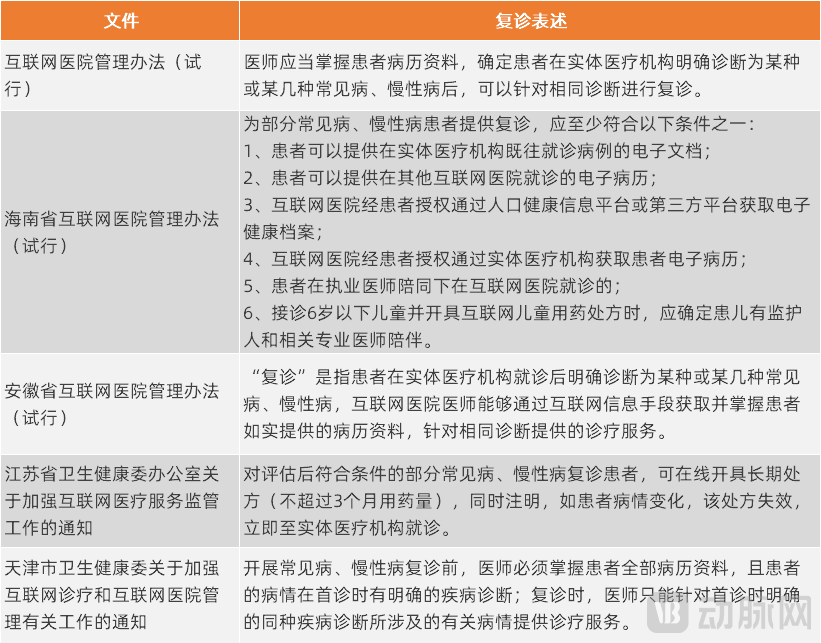
Definitions of Follow-up Visits in Previous Policies from the National Health Commission and Local Authorities; Source: Official Websites of Local Health Commissions, Compiled and Charted by VCBeat
The Detailed Rules do not impose restrictions on follow-up visits; instead, they define a broader scope, namely, that physicians shall determine whether patients meet the criteria for follow-up consultations. If other provisions of the Detailed Rules emphasize stricter regulatory oversight, the approach to follow-up visits reflects a more lenient and open stance.
Gong Daxin is the Director of the Smart Hospital Management Department and Deputy Director of the Urology Department at the First Affiliated Hospital of China Medical University. As a physician who has practiced on third-party internet healthcare platforms for many years, as well as a builder and administrator of public internet hospitals, he holds multiple roles and possesses a profound understanding of online diagnosis and treatment.
“The Administrative Measures for Internet Hospitals (Trial)” does not provide a clear definition of follow-up visits, leading to varying regulations across different regions and hospitals. Gong Daxin cited examples where some institutions require patients to have prior offline consultation records at the same hospital before qualifying for online follow-up visits, while others stipulate that online follow-ups must occur within a specified timeframe after the initial offline visit to be considered valid. “These regulations have their unreasonable aspects. For instance, if a patient is diagnosed offline at Hospital A and seeks a follow-up consultation via the internet hospital of Hospital B, this should still fall under the scope of follow-up care provided the condition remains unchanged. In reality, however, Hospital B may refuse to provide online follow-up services. Another example is when the prescribed timeframe for online follow-up is one month, but the patient’s condition changes after just one week; in such cases, the patient would no longer be suitable for internet-based diagnosis and treatment.”
Therefore, Gong Daxin believes that in practice, physicians should flexibly determine the criteria for follow-up visits rather than adhering to fixed standards, and the new regulations fully respect physicians’ decision-making authority. It is worth noting that channels for physicians to obtain patient information include not only text-and-image exchanges and video consultations but also telephone communications, which should likewise be recognized as a valid means of acquiring patient data.
“The medical industry is highly specialized and rapidly innovating, making simplistic one-size-fits-all approaches unfeasible. To ensure standardized development in the healthcare sector, regulatory authorities must establish clear baselines and principles, while professional bodies within the industry must exercise self-discipline and self-governance through mechanisms such as expert consensus statements, clinical guidelines, and standards issued by various specialty committees of the Chinese Medical Association,” said Wang Hang. He noted that internet-based diagnosis and treatment follow a similar logic: policies merely define red lines and fundamental principles, leaving physicians to make specific clinical judgments based on the actual conditions of patients’ diseases and in accordance with professional guidelines and consensus statements. Therefore, this provision aligns closely with the real-world realities of the industry.
Furthermore, a relevant executive from JD Health believes that although internet-based diagnosis and treatment are currently limited to follow-up consultations, the development and broader adoption of technologies such as 5G, AI, big data, and cloud computing will enable internet healthcare to accomplish much more in the future. “Within the existing policy framework, even without conducting initial consultations, internet healthcare can still deliver greater value. The diagnosis and treatment phase is only one part of the comprehensive, end-to-end healthcare ecosystem. Internet healthcare can play a significant role in pre-consultation and post-consultation stages, and even further along the continuum, including prevention, rehabilitation, chronic disease management, and overall health management.”
In fact, the cycle of identifying and resolving problems has always been the norm in industry development. The value of regulation also lies in problem-solving, rather than in "regulation" itself.
A medical administration official who had previously provided feedback stated that the Detailed Rules impose “strict constraints” on some privately operated internet hospitals. However, in the long run, those privately operated internet hospitals that operate in compliance with regulations and fully ensure medical safety and quality can play a significant role in the tiered diagnosis and treatment system by providing follow-up consultations and related services for common and chronic diseases, while large tertiary Grade A hospitals focus more on complex and critical cases as well as surgical treatments.
Liao Jieyuan believes that the Detailed Rules have strengthened the establishment of China’s internet-based medical consultation system, fully taking into account the unique characteristics of online consultations and the management principles of physical medical institutions, thereby acting as a “winnowing process” for the entire internet-based medical consultation industry. Furthermore, the Detailed Rules signify that internet-based medical consultations will become more standardized and regulated, facilitating payers’ evaluation of service outcomes and enabling broader and timelier inclusion of such services within payment coverage.
“After the introduction of three documents in 2018, including the Administrative Measures for Internet-based Diagnosis and Treatment (Trial), internet-based diagnosis and treatment services underwent a round of regulation.” In Hu Wei’s view, the Detailed Rules undoubtedly represent a new round of regulation for internet-based diagnosis and treatment. The industry may undergo a reshuffle, with non-compliant players facing risks of rectification or shutdown, while companies that persist in conducting business in compliance will benefit from this development.
Seizing the opportunity presented by the release of the Detailed Rules, industry experts have also voiced their expectations. Gong Daxin stated that while the new regulations require online and offline electronic medical record (EMR) systems to share data and mandate healthcare institutions to open data interfaces to regulatory platforms—thereby facilitating internal data sharing within institutions and enabling the formation of regional data platforms—they fall short of achieving data sharing among different healthcare institutions. As a result, patients are still required to personally maintain extensive medical records when seeking care across multiple facilities. “We hope that policies will promote data sharing among healthcare institutions from a higher strategic level.”
These “Detailed Rules” represent the first nationwide regulatory framework for the internet healthcare industry, but they will not be the last. As key participants, stakeholders must strictly uphold the baseline requirements for medical safety and quality, enhance their healthcare service capabilities, and pursue innovation on this foundation. This is the only path to sustainable operations and robust growth.