

LianBio Goes Public on Nasdaq Within Two Years of Inception: Is the 'Buy-and-License' Strategy Winning Investor Confidence?
LianBio
Innovative Drug Developer
Recently, LianBio (NASDAQ: LIAN) officially listed on the U.S. Nasdaq Stock Market. The IPO was priced at $15 to $17 per share, with an offering size of 20.3125 million American Depositary Shares (ADS). Based on the upper end of the pricing range, LianBio’s IPO proceeds could reach $350 million.
According to the prospectus, LianBio was incorporated in the Cayman Islands on July 17, 2019. In addition to the initial financing provided by the incubator fund Perceptive Advisors at its inception, the company announced in October 2020 that it had completed a $310 million crossover round, which was listed among Fierce Biotech’s “Top 10 Biotech Financings of 2020.”
The Series C+ financing round was co-led by RA Capital, Venrock, and China Merchants Capital (CMC Capital). Other biopharmaceutical investors participating in this round included funds under BlackRock, Casdin Capital, Farallon, Logos Capital, Perceptive Advisors, Pfizer, Sphera Healthcare, funds under T. Rowe Price Associates, Inc., Tybourne Capital Management, Vida Ventures, Viking Global Investors, and Wellington Management.
Within its first year, LianBio garnered strong confidence from major industry institutions; by its second year, the company rapidly went public on the Nasdaq. Let us delve into the secrets behind this achievement.
Let’s begin with the origins of LianBio. Incubated by the U.S. biopharmaceutical investment firm Perceptive Advisors, LianBio is headquartered in Princeton, New Jersey, and operates in both China and the United States.
LianBio is a global, science-driven biopharmaceutical company that primarily partners with renowned biopharmaceutical companies worldwide to introduce advanced therapies and innovative drugs into China and other major Asian markets. In other words, LianBio’s core business model is based on a “License-in” strategy.
Regarding the incubator Perceptive Advisors, it was founded in 1999 and is a well-established investment firm with over 20 years of focus on the life sciences sector, managing more than $7 billion in assets.
Perceptive Advisors typically partners with small and mid-sized companies, providing capital solutions ranging from $10 million to $200 million per investment. It offers tailored private credit financing to public and private healthcare companies across all stages and subsectors, including biopharmaceuticals, medical devices, diagnostics, life sciences research, and digital health technologies.
In addition to receiving support from professional incubators that helped the startup LianBio quickly establish its footing, the company’s scientific team is also composed of abundant talent.
In May this year, LianBio welcomed its second “head” (CEO), Dr. Wang Yizhe. Dr. Wang previously served as the Global Head of Oncology R&D at Eli Lilly and Company and as the Global Platform Leader for Anti-COVID Therapies at Lilly Research Laboratories.
In addition, Dr. Wang Yizhe previously served as Senior Vice President of Eli Lilly China and Head of the Biopharmaceutical and Oncology Business Unit. He was also a member of the Eli Lilly China Management Committee, the Global Biotherapeutics Leadership Team, and the Global Oncology Leadership Team. In his previous roles, Dr. Wang led a team of over 1,000 employees, achieved double-digit sales growth, and launched multiple new products.
Prior to joining Eli Lilly, Dr. Wang Yizhe spent 15 years at GSK, where he held roles related to product and commercial strategy in countries including the United States and the United Kingdom, and was responsible for GSK China’s pharmaceutical respiratory business. Earlier in his career, Dr. Wang served as a researcher at Bristol-Myers Squibb.
In addition, this August, LianBio welcomed a “new leader,” Qian Jiang, as its General Manager for China. Qian Jiang previously worked at Eli Lilly, where he served as Vice President of Eli Lilly China and Head of the Oncology Business Unit, managing a China oncology team of more than 700 employees.
Previously, Qian Jiang also worked at Novartis, where he served as Executive Director and Head of Solid Tumors for the Novartis Oncology Division. He also held positions at Pfizer, including Head of Business Liaison, Head of Global Clinical Development and Medical Affairs, and Head of China Oncology Business, bringing with him many years of industry experience.
LianBio’s ability to attract such a wealth of talent speaks volumes about its strength.
Under the leadership of a team of seasoned scientists, LianBio’s rapid growth is well justified. Its successful listing on the Nasdaq capital market also signals an easing of the impasse that had persisted for four months during which Chinese companies were paused from pursuing overseas listings.
In addition to being backed by prominent investment institutions and supported by a team of seasoned scientists, LianBio boasts another key strength: its primary strategy of establishing strategic collaborations with global biopharmaceutical companies through license-in agreements, thereby providing high-quality therapeutic drugs and scientific treatments to patients in China and other major countries and regions across Asia.
LianBio’s ability to achieve rapid growth in a short period and successfully list on the NASDAQ clearly demonstrates that it is far more than a company with mere superficial appeal.
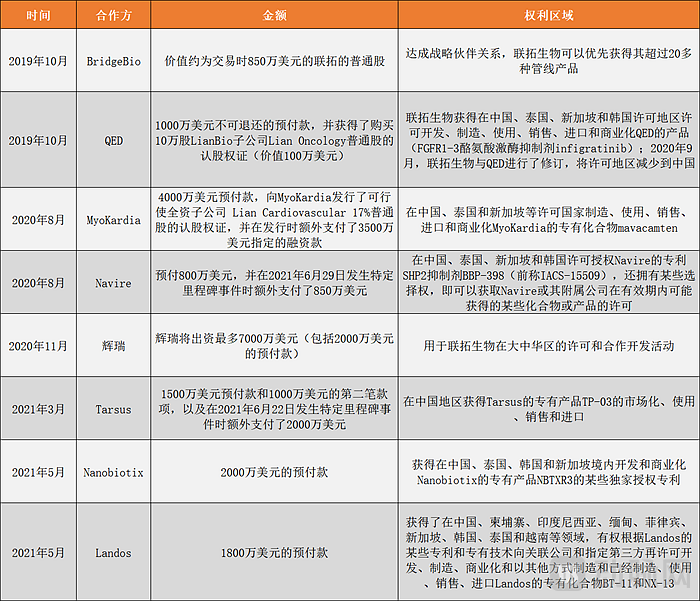
LianBio’s License-In Portfolio as of the Prospectus Update, Compiled from Prospectus Data
From a product perspectiveLianBio boasts a diversified late-stage clinical validation pipeline and a highly innovative portfolio of early- to mid-stage candidates, delivering multifaceted value to the company and its partners. The company is currently developing nine candidate products across five therapeutic areas: cardiovascular diseases, oncology, ophthalmology, inflammatory diseases, and respiratory conditions, with the majority already in late-stage clinical validation.
From a strategic deployment perspective, LianBio selects and licenses promising assets for development in target markets (namely, the vast Chinese market and other Asian markets) by leveraging region-specific development, regulatory, and commercial insights. Furthermore, within less than three years since its incorporation, LianBio has licensed nine pipeline assets across five therapeutic areas, laying a solid foundation for platform development.
From the perspective of operational models, LianBio leverages an asset-centric cross-border collaboration model to provide partners with access to regulatory and development expertise within the company’s licensed territories, thereby maximizing the value potential of LianBio’s assets in authorized regions and globally.
In addition, the company boasts a seasoned global management team and institutional investors with deep industry expertise.
It is evident that the license-in model enables companies to rapidly enter the market, significantly enrich their product pipelines, and secure full intellectual property rights.
In addition, the enterprise itself must have sufficient capital, purchasing power, and a certain level of independent R&D capability to complete clinical trials and bring the introduced products to market. At the stage when the product is approved for listing, the enterprise must also possess academic promotion and sales capabilities in the relevant field, turning potential new drugs into blockbuster products.
A combination of factors has contributed to LianBio’s successful IPO.
According to the prospectus, LianBio secured nine projects across five therapeutic areas within three years of its incorporation, with three of these projects poised to enter Phase III clinical trials. Meanwhile, LianBio also obtained licensed projects from Bristol-Myers Squibb, BridgeBio, and Pfizer.
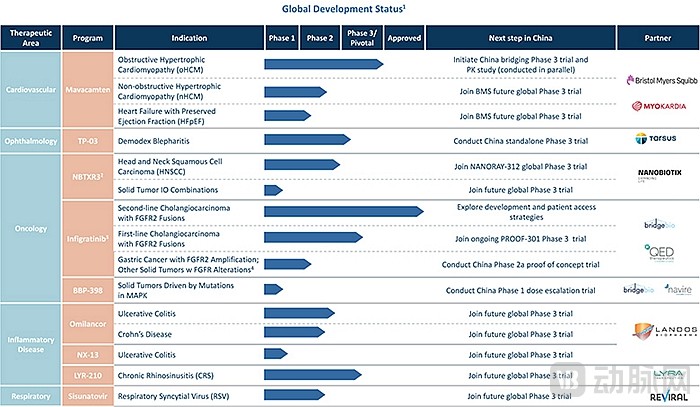
Project Pipeline, Source: Prospectus
1. Collaborate with BMS on a cardiovascular disease project, with Phase III clinical trials expected to commence early next year
Hypertrophic Cardiomyopathy (HCM) is a hereditary cardiomyopathy primarily caused by genetic mutations that lead to excessive myocardial contraction and abnormal thickening.
Patients with hypertrophic cardiomyopathy (HCM) are at increased risk of arrhythmias, tachypnea, chest pain, heart failure, and sudden cardiac death. The most common arrhythmia is atrial fibrillation, which occurs in 22% to 32% of patients with HCM. HCM is the leading cause of sudden cardiac death in young people and athletes under the age of 35.
Currently, there are no approved therapies for HCM in China. LianBio is developing and commercializing the mavacamten program in China and other Asian markets through a collaboration with MyoKardia (now a subsidiary of BMS). Mavacamten is an oral small-molecule allosteric modulator of cardiac myosin indicated for the treatment of HCM.
According to the prospectus, LianBio plans to concurrently conduct Phase 3 clinical trials and pharmacokinetic (PK) clinical trials of mavacamten in China to evaluate the safety, efficacy, and pharmacokinetics in Chinese subjects, as well as the consistency with the corresponding data demonstrated in global trials.
In August 2021, LianBio received approval from the NMPA to initiate Phase III clinical and PK trials. The formal launch of the trials is expected in the first quarter of 2022.
2. Partner with Tarsus to address ophthalmic diseases that currently lack approved therapies
Blepharitis (DB) is a condition characterized by ocular inflammation, irritation, redness, and disorders of the eyelid margins. If left untreated, severe progression of symptoms can lead to blurred vision, loss of eyelashes, corneal damage, and even blindness. Demodex mites are the most common ectoparasites in humans and are a frequent underlying cause of DB.
In 2020, there were approximately 43 million patients with diabetic foot in China. However, there is currently a lack of approved treatment options. Coupled with the large existing patient population, this underscores the substantial market potential for diabetic foot care in China.
Meibomian Gland Dysfunction (MGD) is a common ocular disorder. In patients with this condition, the meibomian glands fail to secrete sufficient lipids, or the secreted lipids are of poor quality. Consequently, MGD is one of the leading causes of dry eye disease. In the early stages of MGD, patients are typically asymptomatic; however, if left untreated, MGD can lead to exacerbated dry eye symptoms and eyelid inflammation. Symptoms include dryness, burning, itching, crusting or scaling, tearing, photophobia, erythema, and a foreign body sensation.
According to the prospectus, an estimated 50% of patients diagnosed with Demodex-driven MGD also suffer from DB. In 2020, there were an estimated 73 million patients with Demodex-driven MGD in China. Currently, there are no approved therapies for MGD in China.
Based on this, LianBio has partnered with Tarsus to develop and commercialize TP-03 (ophthalmic solution) in China. TP-03 is a novel topical ophthalmic formulation under investigation for the treatment of DB, with potential applications in treating MGD.
Tarsus has completed the first of two pivotal trials of TP-03 for the treatment of DB in the United States, namely Saturn-1. The second pivotal trial of TP-03 for DB, Saturn-2, is currently underway.
LianBio plans to further collect clinical data in China, which will be combined with the clinical data collected from the Saturn-1 and Saturn-2 trials. If these data are positive, LianBio will seek regulatory approval for DB in China. Additionally, LianBio also plans to develop TP-03 for the treatment of MGD.
3. Collaborate with Nanobiotix to develop radiosensitizers and immunotherapy
LianBio and Nanobiotix are collaborating on the development and commercialization of NBTXR3. NBTXR3 is a radioenhancer that is injected directly into malignant tumors prior to standard radiotherapy. Upon exposure to ionizing radiation, NBTXR3 has been shown to enhance the local efficacy of radiotherapy without causing additional side effects to surrounding healthy tissues.
NBTXR3 may also trigger an immune response against cancer, potentially enabling its use in combination with radiotherapy for the treatment of various solid tumors. Nanobiotix and its collaborators are currently conducting eight clinical trials to evaluate NBTXR3 as a potential therapeutic option for various cancers.
In March 2021, Nanobiotix presented preclinical data at the American Association for Cancer Research (AACR) Annual Meeting, demonstrating that combination therapy with radiotherapy-activated NBTXR3 and checkpoint inhibitors (anti-PD-1, anti-LAG3, anti-TIGIT) significantly promoted CD8+ T-cell proliferation, improved local and abscopal tumor control, and enhanced survival rates.
LianBio expects to initiate the Phase 3 clinical trial of NANORAY-312 in China in the second half of 2022, advancing the development of BTXR3 for the indication of head and neck squamous cell carcinoma (HNSCC) in the Chinese market. If approved, NBTXR3 will benefit up to 925,000 patients annually in China, including 25,000 patients with locally advanced head and neck cancer, more than 150,000 patients with other solid tumors (with or without additional chemotherapy), and over 750,000 patients receiving combination therapy with radiation and immunotherapy.
4. Simultaneous expansion into inflammatory diseases and respiratory conditions
In addition to the above three major pipeline projects,LianBio is also collaborating with Landos in the field of inflammatory diseases to develop and commercialize omilancor for inflammatory bowel disease (IBD) in China, Cambodia, Indonesia, Myanmar, the Philippines, Singapore, South Korea, Thailand, and Vietnam. IBD is a chronic autoimmune inflammatory condition, with an estimated 590,000 patients in China.
Landos has announced plans to initiate two Phase 3 clinical trials of omilancor. LianBio plans to join the omilancor development program by enrolling patients in China for Landos’ future global pivotal trials. LianBio believes that enrolling Chinese patients in these global pivotal trials may accelerate the global development program and support approval by Chinese regulatory authorities.
In addition, LianBio has partnered with ReViral to develop and commercialize the respiratory therapeutic Sisunatovir in China and Singapore., it is a highly efficient, selective, oral fusion inhibitor for the treatment of respiratory syncytial virus (RSV).
RSV is a respiratory pathogen that can cause severe and life-threatening lower respiratory tract infections (LRTIs) in high-risk populations, including infants, immunocompromised individuals, and the elderly, affecting approximately 64 million people globally and causing around 160,000 deaths each year.
ReViral has completed Phase 1 pharmacokinetic and safety trials in healthy adults and is currently conducting a Phase 2a RSV challenge trial in this population. LianBio plans to focus its initial development efforts on RSV infections in pediatric and elderly populations.
As LianBio currently has no products approved for market launch, it is likely to remain in a state of continuous losses for the foreseeable future. According to the prospectus, LianBio’s net losses for 2020 and the first half of 2021 were $140 million and $160 million, respectively.
Following this IPO, after deducting estimated underwriting discounts and commissions, LianBio’s net proceeds amounted to approximately $296.8 million. Of this, approximately $55 million will be used to further advance the clinical trials of three core assets: mavacamten, TP-0, and NBTXR3; approximately $100 million will be allocated to advancing other candidate products; approximately $35 million will support commercialization efforts; approximately $63 million will be used for in-licensing new projects; and the remaining funds will be used for corporate operations and other general corporate purposes.
This IPO will provide LianBio with sufficient funds to cover its operating expenses and capital expenditure requirements for at least the next 24 months. However, due to LianBio’s limited operating history, there remains significant uncertainty regarding the success of its future business operations and its long-term viability.
Let time be the ultimate validator. We look forward to LianBio’s evolution into a big pharma company with both in-house R&D capabilities and business development (BD) prowess.