

Axbio Secures Tens of Millions in USD Funding to Advance Fourth-Generation Gene Sequencing Platform

Axbio
Gene Sequencing and Diagnostic Equipment Developer
VCBeat has learned that Axbio, a fourth-generation gene sequencer company, announced the completion of a new round of financing amounting to tens of millions of US dollars. This round of financing was jointly invested by 5Y Capital (formerly Morningside Venture Capital), Kaitai Capital, Matrix Partners China, and Yuanhe Puhua. It is understood that the funds will be used for further research and development of the AXP series products, GMP factory construction, and commercialization.
Prior to this financing round, Axbio had received support from renowned biomedical venture capital firms and industrial investors, including Sinovest Capital, Lihexin Capital, and China Resources.Currently, the sequencer as a complete unit is capable of fully executing the sequencing workflow for the production of sequencers.GMPThe site for Phase I of the plant has been secured, and construction is underway. The Phase I facility is expected to become operational next year, positioning it for the formal commercialization of products.
Axbio’s AXP100 series is a true fourth-generation sequencer that simultaneously addresses the four core elements of sequencing instruments—cost, read length, accuracy, and speed—in a single device.
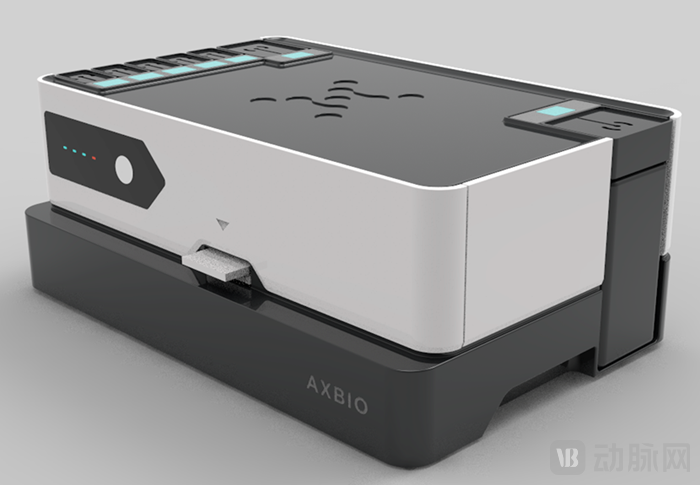
Axbio AXP100 Series Product Images. Images provided by Axbio
In principle, Axbio combines the advantages of both Pacific Biosciences (PacBio) and Oxford Nanopore Technologies (ONT) in third-generation sequencing. By leveraging nanopore sequencing chips based on mature semiconductor manufacturing processes and technologies, along with the benefits of circular consensus sequencing for self-correction, Axbio has achieved a sequencing platform that is low-cost, miniaturized, and capable of single-molecule, single-base, high-accuracy, long-read sequencing.
From the four key dimensions of sequencing—accuracy, read length, cost, and speed—Illumina’s second-generation sequencing (NGS), which holds a monopolistic position, primarily delivers high-precision, high-throughput, and low-cost sequencing for short fragments of approximately 150 base pairs. However, the short read lengths of NGS lead to challenges in sequence assembly and difficulty in identifying structural variants, among other issues. These limitations have spurred the emergence of PacBio and Oxford Nanopore Technologies (ONT) as representative third-generation sequencing companies. Although these two companies have addressed the read length issue, significant challenges have remained unresolved for over a decade: PacBio’s prohibitively high sequencing costs, and ONT’s reliance on extensive algorithmic inference and correction to achieve acceptable accuracy, coupled with its very low number of reads per flow cell.
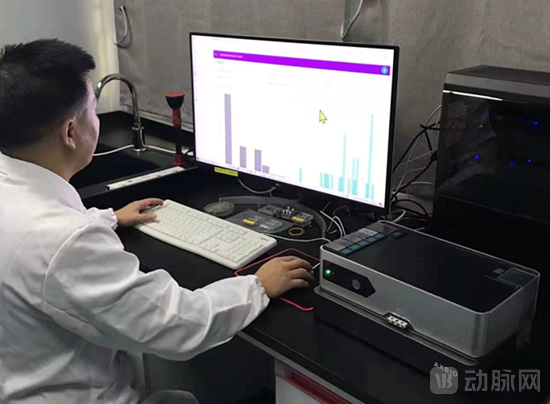
Researchers are using Axbio devices. Image provided by Axbio
Axbio was founded with the primary aim of addressing the aforementioned challenges. In addition to the inherent advantages of circular consensus sequencing and nanopore technology—such as single-molecule precision, long read lengths, and direct electrical signal detection—Axbio has ingeniously integrated mature semiconductor CMOS processes with cutting-edge biochemical detection techniques. Its proprietary ultra-high-throughput AC impedance signal detection chip significantly reduces sequencing costs compared to next-generation sequencing (NGS). The launch of this generation of sequencers will rapidly accelerate the adoption of sequencing from research markets to clinical-grade and even consumer-grade applications, thereby better serving life, health, and the broader life sciences sector.
Axbio’s core team comprises top-tier talent with extensive experience in scientific research, technology, and industry. Among them, Dr. Hui Tian, Founder of Axbio, holds dual bachelor’s degrees and a master’s degree from Tsinghua University, as well as a master’s and Ph.D. from Stanford University, and has been granted more than 50 U.S. patents. Prior to founding Axbio, Dr. Tian served as Vice President of the Gene Sequencing Division at Roche Group and held executive positions at several companies acquired by Apple and Sony.
Co-founder Dr. Igor holds both a Ph.D. and a Master’s degree from Saint Petersburg State University, has been granted over 50 U.S. patents, and has published more than fifty peer-reviewed academic papers. Previously, Dr. Igor led the R&D of quantum dot nanomaterial processes and the establishment of mass production lines at Invisage (a company acquired by Apple). The several companies he founded have either gone public on NASDAQ or been acquired by well-known multinational corporations. Other members of the R&D team hail from world-class institutions and laboratories, including Tsinghua University, Peking University, Stanford University, Yale University, the University of Chicago, Saint Petersburg State University, the Russian Academy of Sciences, and Bell Labs. Among the company’s full-time employees, over 25% hold doctoral degrees, and more than half possess master’s degrees or higher. These professionals come from renowned enterprises such as Roche, Intel, Life Technologies, BGI, and Rainbow, bringing extensive industry experience that lays a solid foundation for product R&D, design, and imminent commercialization.