

Agilis Robotics Files for IPO with World’s Smallest Flexible Surgical Robot Arm (2.3–2.5mm) Poised to Become China’s 'Da Vinci'

Agilis Robotics
Surgical Robot Developer
In 1999, the first da Vinci surgical robot was introduced. Common issues in traditional open surgery, such as poor precision, prolonged operative times, and the lack of a three-dimensional visual field, were addressed. However, factors such as the high acquisition cost of the equipment have limited the widespread adoption of surgical robots in many developing countries and less developed regions.
Approximately 20 years later, the first batch of patent protections for the da Vinci Surgical System began to expire successively, prompting numerous companies worldwide to enter the market. In addition to medical device giants such as Medtronic, Johnson & Johnson, and Stryker, domestic surgical robot startups have also seized this strategic opportunity, leveraging advantages in product innovation, diversity, and intelligence.
According to statistics from Zheshang Securities, the market size of surgical robots in China reached USD 425.3 million in 2020, with a compound annual growth rate (CAGR) of 44%, significantly higher than the global average. However, given the current state of the industry, the number of domestically approved companies remains limited. Notably, the da Vinci Surgical System is the only laparoscopic surgical robot that has received approval.
This signal indicates that, upon successful commercialization, the company will have the opportunity to rapidly capture the domestic market.
Recently, VCBeat learned about Agilis Robotics, a medical technology company incubated by the University of Hong Kong.The company has developed a surgical robot system for endoscopic procedures, which consists of three components: a flexible surgical robotic arm, a main console, and a control system. The flexible robotic arm has a minimum diameter of 2.3–2.5 mm.
Currently, the company has entered the cadaver testing phase based on research findings to validate and optimize its products. Next year, Agilis Robotics will proceed to animal trials, prepare to submit an application to the National Medical Products Administration (NMPA), and finalize the development of its second-generation product.
Cross-disciplinary Research Across Industries to Promote the Translation of Results
Agilis Robotics was founded after co-founder Xu Jiaming learned of Professor Guo Jiawei from the Department of Mechanical Engineering at the University of Hong Kong and his progress in developing a robotic system for endoscopic surgery of the digestive tract. Xu recognized that the surgical robot system was nearly complete, more compact than the da Vinci Surgical System, featured a simpler workflow, and had the potential to reduce healthcare costs and benefit the general public. Consequently, he partnered with Professor Guo to establish Agilis Robotics.
Professor Guo Jiawei, the company’s co-founder, has over a decade of experience in the research and development of surgical robots.Guo Jiawei graduated from the Department of Mechanical and Automation Engineering at The Chinese University of Hong Kong, where he participated in the research and development of China’s first Chinese calligraphy robot. He subsequently pursued his Ph.D. at the Hamlyn Centre for Robotic Surgery at Imperial College London, specializing in mechanical endoscope control. As a Croucher Fellow, he furthered his research on magnetic resonance imaging (MRI)-guided surgical robots at Harvard Medical School.
During his tenure at the University of Hong Kong, Dr. Kwok Ka-wai also developed multiple prototypes of magnetic resonance imaging (MRI)-guided surgical robots, including the world’s first MRI-navigated robot for bilateral stereotactic neurosurgery.
Years of accumulated expertise in surgical robotics have laid the foundation for its expansion into endoscopic surgical robots.
After years of research on surgical robots by the Agilis Robotics team, its products have now gradually matured,It is scheduled to enter the animal testing phase next year, with experiments expected to conclude in 2024, followed by the submission of an FDA application and market launch in 2025. Furthermore, its team is gradually expanding.
The founding team of Agilis Robotics comes from diverse industry sectors.
These include Mr. Guo Jiawei, Associate Professor in the Department of Mechanical Engineering at The University of Hong Kong, representing academia; Dr. Chan Ying-kuen, Deputy Director of the Jockey Club Minimally Invasive Surgical Centre at The Chinese University of Hong Kong, representing the medical community; Mr. Hui Ka-ming, a finance professional with extensive experience in quantitative investment; and Mr. Ho Tik-long, a research master’s student specializing in medical robotics within the Mechanical Engineering program at The University of Hong Kong.
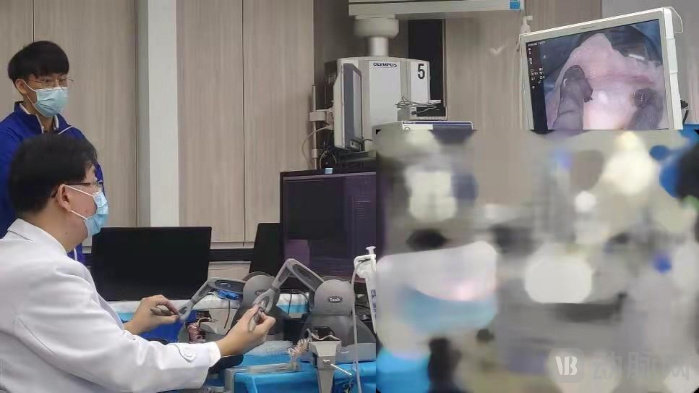
Dr. Ng Siu Man, Associate Dean of the Faculty of Medicine, The Chinese University of Hong Kong: Anorectal Disease Screening Test
Following the successful inaugural cadaveric test by Agilis Robotics, Professor Wu Zhaowen and Professor Wu Zhihui, each boasting over 25 years of clinical surgical experience, were engaged as advisors. Agilis Robotics aims to enhance product applicability and safety by addressing physicians’ needs, thereby enabling the resolution of a broader range of pathological conditions. This effort supports partner enterprises in translating scientific achievements into market-ready products, ultimately benefiting a larger patient population.
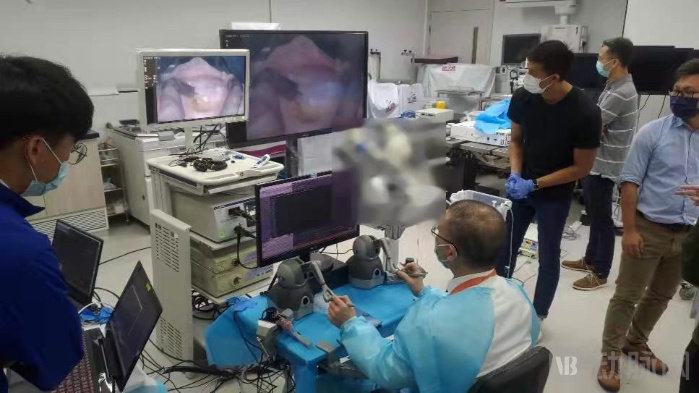
Dr. Wu Zhihui's Bladder Lesion Test
The product is maturing and is expected to enter the market in 2025.
In summary, the gastrointestinal endoscopic surgical robot system developed by Agilis Robotics has the following features and advantages:
1. Adopts a multi-segment flexible continuum structure, with structural optimization tailored to the confined operative environment of endoscopic submucosal dissection (ESD). The robotic arm can be inserted through the instrument channel of an endoscope, maintaining sufficient force for surgical maneuvers while achieving a minimal footprint (diameter < 2.8 mm);
2. The extension length of the micro-robotic arm is adjustable. Different surgical instruments can be attached for various procedural steps (such as tissue grasping and electrosurgical cutting), enabling dexterous manipulation in confined spaces; furthermore, its diameter and overall dimensions can be tailored to specific surgical types, thereby streamlining the design process.
3. The micro-robotic arm also features a detachable design similar to that of the da Vinci Surgical System; intended for single-use, it connects to the robotic drive unit via a detachable module, facilitating easy replacement and use;
4. Compared with traditional surgical robot systems, the micro-manipulator’s controller is compact in size and can be integrated with existing endoscopic systems without requiring changes to surgical workflow design. As a result, the upfront investment cost is significantly lower than that of traditional surgical robot systems. It is suitable for deployment in general hospitals and even endoscopy centers, thereby promoting the development of endoscopic surgery.
From a market perspective, flexible surgical robots used in endoscopic procedures present greater R&D challenges and require higher dexterity of the operating arms compared to the da Vinci Surgical System. Most companies are still in the R&D phase and remain far from industrialization. Agilis Robotics’ breakthrough can redefine mechanical miniaturization and minimally invasive surgery, effectively filling a gap in the market.
From a technical perspective, the robotic micro-arm developed by Agilis Robotics has undergone testing in cadaver trials, achieving a minimum tool diameter of 2.6 millimeters. Currently, the company is focusing on improving its manufacturing processes by leveraging computer simulations to further reduce the diameter of the micro-arm tools. This advancement aims to accommodate a wider variety of configured instruments, thereby enhancing adaptability for diverse surgical procedures.
In addition to the robotic arm tools required for endoscopic surgery, Agilis Robotics is developing a suite of artificial intelligence (AI)-assisted software solutions that integrate with augmented reality (AR) technology. These innovations are designed to help surgeons adapt more quickly to operating the robotic arms, thereby further enhancing surgical efficiency and safety.
Additionally, advancing the mass production of its products and reducing manufacturing costs are also key priorities for Agilis Robotics’ future development.
Effectively Fills the Gap in the Surgical Robot Market
Currently, in clinical practice, whether for surgeries involving the upper abdomen, lower abdomen, bladder, or urethra, endoscopes are used to manipulate patients’ lesion tissues in a relatively coarse and rigid manner. However, in most cases, rigid instrument arms are fundamentally unable to generate traction or counter-traction.
The advent of surgical robots can undoubtedly address this critical issue in tissue dissection by enabling operation with two robotic arms. This process is akin to allowing surgeons to perform open surgery with both hands, thereby providing better control over tissue stripping. It will also lower the entry barrier for technically demanding procedures requiring specialized expertise, such as Endoscopic Submucosal Dissection (ESD), enabling more physicians to perform surgeries using robotic systems and facilitating the transition from traditional major resections to minimally invasive procedures.
For patients, this will also minimize their recovery time, pain, and hospital stay.
Currently, Agilis Robotics is collaborating with the Prince of Wales Hospital, the affiliated teaching hospital of The Chinese University of Hong Kong, as well as relevant physicians, to conduct technological research and development aimed at expanding the application of surgical robots in anorectal, gastrointestinal, and urological procedures. As its R&D efforts advance, the company is poised to address unmet needs in the surgical robotics market.
Related Articles: