

Digital Transformation as a Strategic Breakthrough for Medical Device Companies Amidst Volume-Based Procurement, Market Penetration, and Rising Costs
“The barrier-breaking effect of technology is a key driver of major transformation. New technologies bypass existing regulations and established industrial pathways, boost production efficiency, reshape the upstream, midstream, and downstream segments of the industry chain, and alter the prevailing pattern of resource allocation, thereby opening up new possibilities in seemingly entrenched industries—a change that is utterly irreversible.”
As a vital industry impacting national welfare and people's livelihoods, healthcare is poised for disruptive innovation driven by digital technologies, which will reshape the entire healthcare ecosystem. In fact, digital technologies have already begun to restructure the landscape of the medical industry. Within the context of doctor-patient relationships, internet hospitals have proliferated rapidly. According to data from the National Health Commission, there were over 1,600 internet hospitals across China as of June 2021. Some pharmaceutical companies have taken the lead in digital transformation, implementing changes in empowering existing channels, expanding incremental channels, and integrating doctor-patient relationship management. Digital technologies will inevitably continue to permeate every link of the healthcare industry value chain.
As a crucial component of the healthcare ecosystem, medical devices must also align with this trend, proactively pursue innovation, and accelerate their digital transformation. “Digital transformation is not exclusive to pharmaceutical companies; the medical device industry also has substantial demand,” said Wang Xuezhu, Head of the Healthcare Sector at Udesk Technology.

Wang Xuezhu, Head of the Healthcare Industry at Udesk Technology
Emerging markets, represented by China, are the most promising medical device markets globally, with growth rates in recent years exceeding the world average. In terms of device consumption levels, China’s medical device market accounts for only about one-quarter of its overall healthcare market. This is significantly lower than the global average of over 40% and the approximately 50% seen in developed countries such as those in Europe, the United States, and Japan, indicating substantial room for growth in China’s medical device consumption.
Amid the vast, foreseeable growth potential in the medical device industry, domestic players face significant challenges, making technological innovation imperative to break new ground.
On the sales front, medical device companies must expend substantial human resources to maintain relationships with healthcare providers and patients, driving up labor costs. Meanwhile, the iteration of technologies and tools has expanded customers’ channels for information acquisition, sharply intensifying market sales pressure. Taking Yuwell Medical as an example, the company boasts a channel, terminal, and online team of over 700 employees, one global customer service center and eight regional service centers, and has established branded flagship stores on all major e-commerce platforms.
Meanwhile, the scale of volume-based procurement has continued to expand, leading to significant fluctuations in the selling prices of related products. MicroPort Medical disclosed in its 2020 annual report that revenue from cardiovascular interventional products decreased by 45.3% in 2020 compared with 2019 (in USD terms). Penetrating into county-level hospitals has become a common strategy for many medical device companies. According to relevant reports published by VCBeat, county-level hospitals serve a population of over 900 million, accounting for more than 90% of China’s total population, indicating enormous growth potential in the grassroots market. However, primary healthcare institutions are generally small in scale, widely dispersed, and located in remote areas, which has been the main reason why many pharmaceutical and medical device companies have struggled to effectively reach this segment using traditional marketing approaches.
On the service provider side, as medical devices are critical products, full lifecycle management is an inherent requirement. However, the product lines of medical devices are complex. Yuwell Medical offers more than 600 categories and nearly 10,000 product specifications, covering various aspects such as home medical devices, professional disinfection and infection control, hospital equipment, clinical consumables, emergency equipment, traditional Chinese medicine (TCM) instruments, surgical instruments, ophthalmic instruments, and eye health.
In R&D and manufacturing, a global network of multiple R&D and production centers enables medical companies to fully leverage regional advantages worldwide, enhancing R&D capabilities and production efficiency. However, challenges remain in knowledge sharing, interaction, and systematization.
Faced with the numerous challenges in the medical device industry, digitalization is a self-evident solution. However, this presents two choices.
Should the first choice be to transplant solutions from other industries into the healthcare sector, or to start from within the healthcare industry and identify solutions tailored to its specific characteristics?
The second option is whether to begin exploring digital solutions in highly consumer-oriented sectors such as medical aesthetics and dentistry, or to start with more clinically focused areas like the medical device industry.
Udesk Technology has chosen the latter path, delving deeper into the healthcare industry. Wang Xuezhu noted that the opportunities and challenges in the broader health sector stem from the medical products and solutions themselves. “If we can excel at complex tasks, we can certainly handle simpler ones with ease,” Wang explained, clarifying why the company prioritized serious medical care over consumer-oriented healthcare.
Udesk has currently launched an “Integrated Customer Lifecycle” solution, whereby enterprises can address all pain points across pre-sales, in-sales, and after-sales scenarios in their interactions with customers through a one-stop shop by procuring products and services solely from Udesk. This capability not only demands extensive industry service experience but also tests the vendor’s robust technological accumulation and team support.
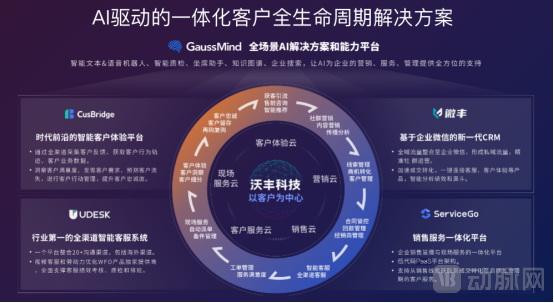
On the sales side,Help medical device companies rationally allocate internal resources, coordinate the operation of internal resources, and evaluate the value of internal marketing assets. Specific functions include customer acquisition and traffic generation, pre-sales consultation, communication analysis, content marketing, and community marketing.
On the server side,Help medical device companies unify sales and customer service departments, empower employees to meet customer needs, enhance customer experience, and support sustained business growth. Key features include distributor management, customer retention, and automated order assignment.
In the R&D and production sectors,Leveraging Udesk’s leading AI infrastructure, the “Yuanxin Engine,” and its closed-loop AI technology framework of “Product Applications + Knowledge Middle Platform + Modular Development Platform,” it provides functionalities such as enterprise search, KCS knowledge bases, and knowledge graphs.
Medical device companies share common needs, but also have personalized requirements. The product platform built by Udesk functions like LEGO bricks, allowing the company to construct scenarios tailored to customer needs whenever such demands arise.
“First, enhance the advantages of multi-channel services; second, strengthen AI capabilities; third, continuously address challenges in customer marketing, service, and after-sales systems.” This is how Wang Xuezhu summarized Udesk’s methodology for continuously consolidating its service capabilities and driving ongoing innovation.
Since its launch, Udesk’s integrated customer lifecycle management solution has delivered significant results. By adopting this solution, Yuwell Medical has consolidated, unified, and upgraded its existing customer service channels, leveraging Udesk’s integrated sales and service platform to support after-sales services across 30 secondary service centers nationwide and over 100 engineers. This initiative has not only strengthened Yuwell Medical’s reverse logistics system and enhanced on-site service scenarios, thereby achieving a closed-loop after-sales service process, but also improved customer satisfaction. Similarly, MicroPort Medical has adopted Udesk’s integrated solution to boost customer service efficiency and quality while reducing labor and management costs.