

Philips Showcases Five-Year Digital Transformation Achievements at Its Fourth CIIE Participation | 2021 CIIE

Philips Healthcare
Integrated service provider in healthcare, quality living, and lighting fields
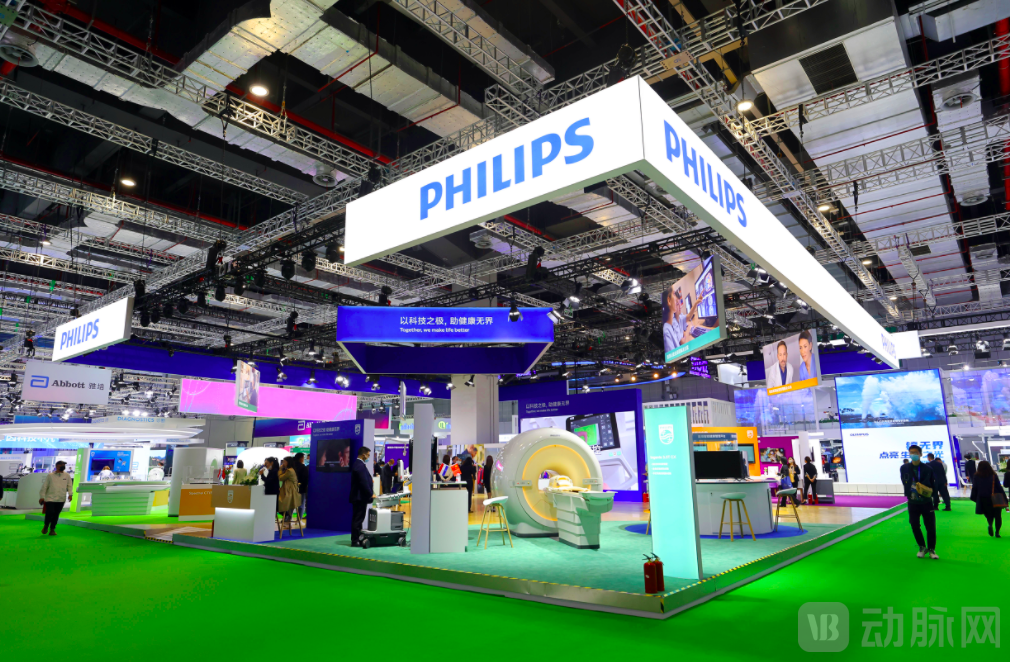
As top-tier pharmaceutical and medical device companies gathered at the China International Import Expo (CIIE), Philips, making its fourth appearance on this stage, stunned the audience with its largest and most comprehensive healthcare product portfolio, continuing its commitment to “Pushing the limits of technology to enable boundless health.”
With a 500-square-meter exhibition space, this tech giant is making a significant push into the big health sector, rolling out four major modules: “Healthy Living,” “Value-Based Healthcare,” “Smart Hospital Management,” and “County-Level Healthcare/Public Health Infrastructure.” It continues to focus on the “Full-Cycle Health Care” model, which covers healthy living, disease prevention, precision diagnosis, interventional therapy, and home care.
At this exhibition, we observed Philips showcasing its creativity through a new model. For instance, it launched “Zoom!”, a medical-grade, professional, and personalized teeth whitening solution, to enhance traditional single-function dental cleaning products; additionally, it strengthened its conventional CT and MR equipment offerings with comprehensive smart solutions for cardiac care and oncology care.
There are many more such examples, with the core being Philips’ innovation and redefinition of “digitalization.” It can be said that these three words are reshaping the way Philips operates.
Philips’ “digitalization” is not merely reflected in the smart enablement of its products, but represents a thoroughgoing digital transformation.
Back in 2016, Philips established four strategic transformation directions for itself: shifting from standalone products to integrated solutions; moving from addressing single-product demands to meeting clinical needs; transitioning from hardware to a combination of hardware, software, services, and smart devices; and fostering multi-party collaboration, mutual empowerment, win-win cooperation, and the construction of a digital ecosystem. These efforts aimed to focus on health technology and revolutionize the healthcare sector.
Over the past few years, Philips has prioritized software development and artificial intelligence as key strategic focuses, investing nearly €1.9 billion annually in research and development. More than 50% of its R&D personnel are dedicated to software development and related fields such as big data and AI.
This CIIE serves as a concentrated showcase of Philips’ five-year transformation achievements. On-site, VCBeat personally experienced Philips’ four major modules. Under the digital framework, Philips’ transformation is unfolding as expected.
In traditional industrial sectors, R&D personnel typically prioritize design, efficiency, and capabilities, but rarely consider user convenience from the end-user’s perspective.
In its transition from “industry” to “health technology,” Philips has undergone a significant shift in its approach to B2B customers. It has adopted a customer-centric, value-driven, and digitally powered strategy focused on integrated solutions, designing products based on customer needs.
In the clinical domain, Philips has developed solutions that integrate intelligent devices, systems, software, and services, addressing the pain points and needs of local customers. These solutions target key diseases such as cardiovascular and cerebrovascular disorders, cancer, and respiratory conditions, as well as critical departments including radiology and intensive care. After five years of dedicated development, Philips comprehensively showcased its “upgraded” integrated solutions for key clinical needs in healthcare systems at this China International Import Expo (CIIE).
Philips Smart Heart End-to-End Solution: Providing full-lifecycle care for cardiovascular patients, improving diagnostic and treatment efficiency, enhancing surgical confidence, and optimizing clinical experience.
Philips Smart Oncology End-to-End Solution: Covering the entire workflow from early screening, precise diagnosis, treatment selection, and treatment implementation to prognostic follow-up, this solution promotes intelligent and personalized precision oncology care, enhances clinical outcomes, healthcare provider satisfaction, and patient experience, while reducing healthcare costs.
Philips Smart Imaging End-to-End Solution: Innovative smart hardware systems seamlessly integrated with enterprise-level information systems to optimize workflows and enhance operational efficiency.
Philips Smart ICU Solution: Patient-Centric, Enabling Interconnectivity Between In-Hospital and Out-of-Hospital Settings, Empowering Healthcare Professionals to Derive Insights from Data, and Enhancing the Quality of Patient Care.
These four solutions share two commonalities: first, the integration of AI to digitize traditional diagnostic processes, thereby enhancing efficiency and reducing costs for hospitals; second, a shift from point-specific clinical enablement to holistic solutions that break down data and workflow barriers across various diagnosis and treatment stages, reshape clinical workflows, and provide patients with refined solutions to help them manage their health.
Of course, given the vastness of the healthcare sector, even Philips cannot cover every aspect of diagnosis and treatment—which is precisely why Philips has built an open ecosystem. Currently, Philips is collaborating with leading domestic AI enterprises such as Shenzhou Medical and Bosh Vision Medical to jointly usher in a new era of digital diagnosis and treatment.
The digital transformation of clinical care requires the support of digitized healthcare IT infrastructure. Against the backdrop of rapid development in hospital IT infrastructure in China, Philips has once again showcased its “Smart Healthcare Management” solution at its exhibition booth.
Unlike traditional healthcare IT companies, Philips has positioned its digital initiatives in the “back-office” realm—leaning toward backend management—to help hospitals make clearer decisions in managing facilities such as medical equipment and security systems.
Specifically, the “Smart Medical-Engineering Integrated Solution” enables intelligent lifecycle management of medical equipment; the “Smart Logistics Integrated Solution” monitors, dispatches, manages, analyzes, and visually displays hospital-wide operational status to support decision-making in hospital operations management; and the “Smart Safety Integrated Solution” provides real-time monitoring of fire safety, security, and risk conditions within the hospital, facilitating standardized management and prevention of risks and hazards through a central control duty and dispatch center.
Research reports from VCBeat indicate that although smart logistics has been incorporated into the smart hospital framework, there are few listed companies participating in this sector. The market is predominantly composed of regional small and medium-sized medical IT enterprises, and no company has yet developed intelligent products covering the entire spectrum of logistics operations. With Philips now increasing its investment in smart logistics, it may accelerate the transition of medical institutions from single-business digitalization to comprehensive hospital-wide digital management that includes smart logistics, thereby further enhancing operational efficiency in healthcare facilities.
With the completion of primary-level interoperability and electronic medical record (EMR) systems in tertiary hospitals, healthcare IT development has gradually entered the era of regional health informatics.
Regional Healthcare Informatics refers to the reliance on hospital information integration platforms, leveraging subsystems such as telemedicine, two-way referrals, and tiered diagnosis and treatment to facilitate effective information integration and sharing among medical institutions at all levels within a region. Its essence is to promote the decentralization of high-quality medical resources, enhance healthcare capabilities at the county and grassroots levels, achieve homogenization of medical resources, and serve as a key solution to the public’s difficulties in accessing affordable medical care.
Philips’ final module focuses on regional healthcare informatization and public health infrastructure development.
In recent years, Philips has deliberately provided flexible and highly adaptable solutions for the establishment of Chest Pain Centers, Stroke Centers, Oncology Centers, and Sleep Centers in county-level and primary healthcare institutions. It also helps primary hospitals obtain remote decision support, effectively alleviating their resource shortages in facilities, personnel, and information, thereby empowering them to improve the quality and efficiency of care.
In addition to the aforementioned achievements, Philips also showcased regional public emergency response solutions and home care solutions for chronic diseases such as cardiovascular, cerebrovascular, and respiratory conditions. By extending care from within hospitals to outside settings and enabling connectivity between in-hospital and out-of-hospital environments, Philips is continuously deepening its engagement in regional healthcare informatization and the public health system.
“Healthy Living” is the module that gives the entire booth its most “youthful” appearance. At the China International Import Expo, we got an early look at Philips’ launch in China of the world’s first integrated online-offline innovation platform—“Philips Healthy Living Lab”—which combines consumer experience with new retail.
“Philips Healthy Living Lab” was conceived in response to the needs of the new generation in the post-pandemic era. In a health and wellness consumer goods industry characterized by homogeneity, the Lab aims to innovatively create a business model that fosters community and embodies a human touch.
Guided by this approach, Philips strives to create an inspiring experiential space through its Lab, integrating offline physical healthy living experience centers with online healthy living content platforms. It also collaborates closely with like-minded partners in areas such as cross-category product development and digital marketing, thereby delivering a comprehensive, all-scenario healthy living experience for consumers.
At the CIIE’s condensed “Healthy Living Lab,” Philips showcased its full range of personal care products, covering multiple care scenarios including oral health, maternal and infant health, grooming and beauty, and respiratory health.
Taking the medical-grade, professional, and personalized teeth whitening solution “Zoom!” as an example, this system offers both in-office and at-home whitening options. At dental clinics partnered with Philips, patients can receive a medical-grade, professionally customized teeth whitening treatment using the “Zoom!” LED whitening lamp in combination with in-office whitening gel. The in-office procedure typically involves 3–4 sessions, each lasting only 15 minutes. For consumers who wish to reduce the frequency of clinic visits for whitening treatments, they may also undergo an examination and have custom-fitted trays made at the clinic, then use take-home whitening gel independently at home.
For the new generation, “convenient” healthcare solutions are highly appealing. By enabling consumers to manage follow-up dental care at home after their initial consultation, Philips can reach more customers who are unable to maintain consistent teeth whitening routines due to time constraints.
Despite achieving comprehensive coverage from B2B to B2C, from devices to clinical applications, and from hospitals to regional healthcare systems, Philips must still adapt its strategies to local conditions and effectively implement its “localization” strategy to translate this coverage into tangible value.
A review of the four modules showcased at the China International Import Expo (CIIE) clearly demonstrates Philips’ strong commitment to “localization.” Whether providing home-based medical-grade solutions tailored for the new generation of consumers, or delivering regional healthcare informatization and smart public health system solutions to advance tiered diagnosis and treatment, Philips has carefully considered the lifestyles of next-generation consumers and the current priorities of healthcare IT infrastructure. By designing solutions from the perspective of consumer “roles,” Philips closely adheres to its “customer-centric” philosophy.
Of course, localization is an ongoing journey with no endpoint. He Guowei, Member of the Philips Global Executive Committee and President of Greater China, stated, “Philips was among the first foreign-invested enterprises to enter the Chinese market. For over three decades, Philips has remained closely aligned with Chinese society, sharing its destiny and adapting to its development. By focusing on the needs of local customers and consumers, and leveraging the power of technological innovation, we are committed to improving people’s health and well-being.”
“We are committed to becoming a truly ‘localized’ global enterprise. We are increasing our investment in the Chinese market, accelerating localization efforts, and further establishing China as a key global hub for value creation, unwaveringly fulfilling our promise of ‘In China, For China.’”