

Digital Health Management Empowers Commercial Health Insurance: Addressing Industry Challenges through Tech-Driven Integration
Driven by factors such as consumption upgrading and favorable policies, commercial health insurance has ushered in a period of rapid development.
According to data from the China Banking and Insurance Regulatory Commission (CBIRC), health insurance premiums reached RMB 817.3 billion in 2020, with a compound annual growth rate (CAGR) of 28% from 2015 to 2020. In 2020, total health insurance claims amounted to RMB 292.1 billion, representing a year-on-year increase of 24%. This demonstrates the substantial potential of the health insurance market and its promising future prospects.
However, insurance companies continue to face numerous challenges in the operation of health insurance. Specifically,Currently, the health insurance industry as a whole faces challenges such as an unreasonable structure, an excessively high proportion of critical illness insurance, a low proportion of medical insurance, difficulty in product differentiation, difficulty in risk identification, difficulty in medical cooperation, and difficulty in proactive cost control.Furthermore, price wars driven by intense product competition have placed profit pressure on insurance companies; meanwhile, the difficulty in identifying high-risk customers has led to challenges in controlling customer risk and heightened claims payment pressures.
This lies in,Insurers primarily play the passive role of payers, settling claims after diseases occur.In terms of proactive management, domestic health insurance companies are not yet able to prioritize proactive health management for the insured to maintain their health status, thereby reducing claims risk.
In fact, as early as September 2020, the Notice on Regulating Health Management Services of Insurance Companies issued by the China Banking and Insurance Regulatory Commission (CBIRC) explicitly stated that insurance companies should establish health management service information systems to record and manage changes in customers’ health information and the provision of health management services. Information on health management services provided by insurance companies should be shared with customer data related to policy underwriting and claims settlement.
Therefore,, targeting this industry pain point, many companies both domestically and internationally have already begun to make strategic moves.For example, digital health management companies represented by Miao Health have been continuously strengthening the integration of health and insurance, and began early to explore the application of health management in insurance scenarios.
Recently, Zhao Hongwen, Senior Vice President of Miao Health, shared insights on the company’s exploration and practices in leveraging health management to empower the insurance sector during an industry event. This article distills his key points and reviews industry trends to examine how digital health management is driving insurance upgrades in the AIoT era.
The foundational logic of delivering quality health services lies in data and technological capabilities.
Zhao Hongwen stated that it took Miao Health seven years to complete the foundational infrastructure for health management technology. The underlying technologies consist of the Miao+ IoT Health Big Data Platform, the H-Health Risk Stratification Management Platform, and the M-AI Health Management Platform.
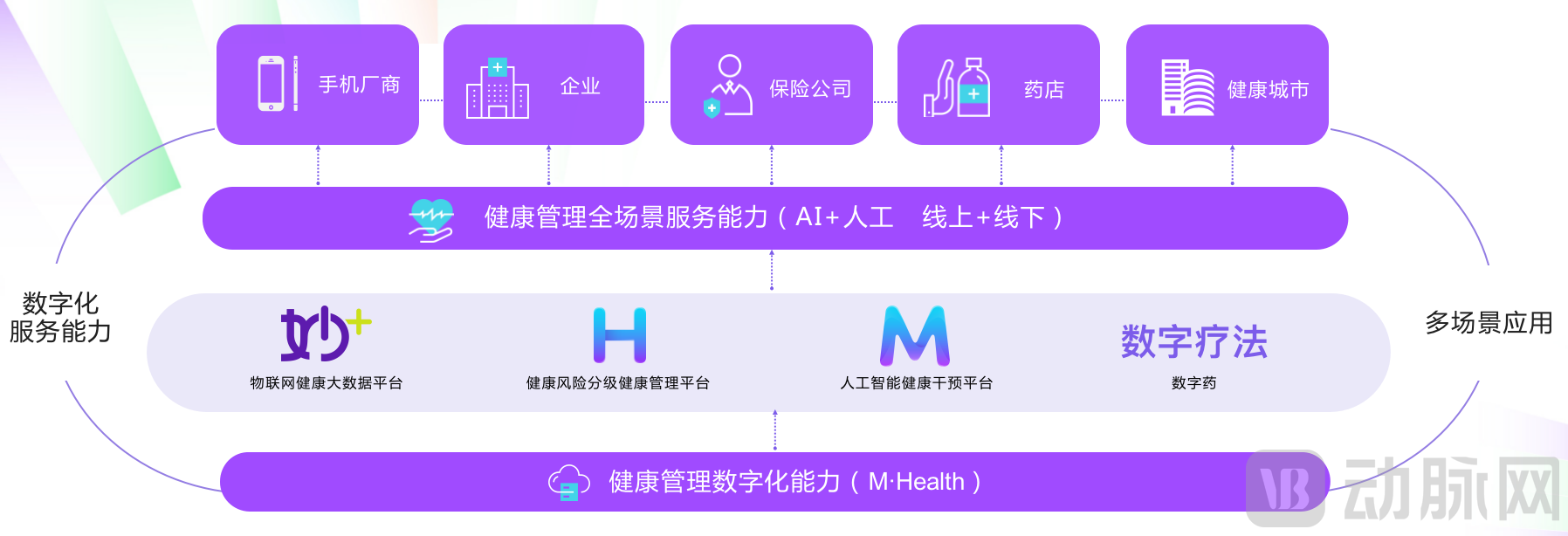
Among these, “Miao+” serves as an IoT-based big data platform for health, primarily focused on data collection. Currently, Miao+ is integrated with the vast majority of smart hardware devices available on the market, enabling the acquisition of user data after de-identification and with user consent. Notably, Miao Health has jointly established the “Big Data Platform for Health Management Information Exchange” with the National Center for Chronic and Noncommunicable Disease Control and Prevention of the Chinese Center for Disease Control and Prevention, and the Standards Institute of the China Academy of Information and Communications Technology.
Additionally, there are the H and M platforms, which constitute an AI-based platform for health management and chronic disease management. The H Platform utilizes AI models to conduct health assessments and generate a user Health Index (H-value). The M Platform intelligently distributes health tasks targeting modifiable health risk factors, records the Health Behavior Index (M-value), and achieves scientific and effective health interventions. The H and M indices are analogous to Sesame Credit scores in the healthcare sector, influencing the pricing and purchase of subsequent insurance products.
Miao Health is the first digital health company in China to propose quantifying user health with numerical values. The Healthy Behavior Index, or M-Score, reflects users’ adherence to health management. Targeting modifiable risk factors, it provides personalized health plans that include health tasks and goals tailored to different stages and cycles. Users can accumulate M-Scores by checking in and logging their completion of these tasks.
Currently, Miao Health has partnered with multiple smartphone manufacturers, including OPPO, vivo, Huawei HarmonyOS, Xiaomi, Samsung, and Lenovo, to provide them with embedded, low-level health management capabilities. Additionally, it has supplied digital health management platforms to nearly 900 enterprises, addressing the pain points of difficult employee health data acquisition and insufficient chronic disease management.
“In terms of commercial implementation, we integrate high-frequency health management with low-frequency health insurance. By providing ABC insurance solutions to insurers, insurance agents, and end users, we help insurance companies build their own health management platforms,” said Zhao Hongwen.
He stated,It is precisely based on the data and technological accumulation in the health technology sector over the years that a digital middle platform integrating insurance and health management has been built for commercial insurance, seamlessly interfacing with core insurance business systems.
By covering business dimensions such as innovative insurance product design, product marketing and health services, intelligent underwriting and claims processing, personalized health plans, offline health management stores, and precision medical service arrangements, we meet insurers’ needs for upgrading agent marketing, user engagement, and medical-health resources. This approach addresses key challenges in traffic acquisition, cost control, and risk management, thereby enabling precise operations in health insurance.
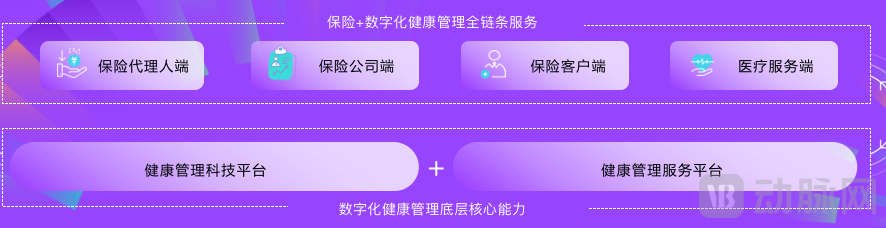
Specifically, for insurance agents, Miao Health provides specialized training and digital health consultant certification, along with business development tools such as all-in-one health monitoring kiosks and private health steward service cards. This empowers insurance agents across the entire value chain—from health resource allocation and customer value excavation to customer relationship maintenance and health management services—facilitating their transition from traditional insurance agents to high-productivity “Health Managers.”
For insurers, Miao Health builds insurtech platforms that enable digital management of agents, policyholders, and health benefit resource allocation through a visualized back-end dashboard. By dynamically displaying risk based on data and reallocating healthcare service resources, the platform enhances risk control capabilities and service efficiency, achieves cost containment for insurance, and promotes the integration of health insurance with health management services.
For end users, health data analysis enables end-to-end services across the pre-underwriting, in-policy, and post-claim stages. By integrating high-frequency lifestyle management with medical services such as clinical consultations, it assists insurers in providing daily health management to policyholders, encouraging healthy lifestyle habits, thereby reducing disease incidence and claim ratios. Previously, Miao Health launched interactive insurance policies that enabled dynamic cost control for insured users and reduced both in-hospital and out-of-hospital medical expenditures.
From the allocation of health resources to the excavation of customer value and the maintenance of customer relationships, Miao Health has successfully integrated the entire service chain linking health insurance with health management. Zhao Hongwen introduced that, to date, Miao Health has established collaborations with dozens of insurance companies through its “Insurance + Comprehensive Health Management Solution,” continuously providing insurtech capabilities, health management services, and operational expertise, while extensively implementing practices under the “Health Insurance + Health Management Services” model.
In 2019, Miao Health partnered with Pacific Insurance to establish offline health management centers in Hangzhou and Zhengzhou. These lifestyle medicine centers were designed to address the health management needs of insurance customers, providing users with comprehensive, full-lifecycle health management services. This initiative contributed to the creation of regional integrated health service complexes and helped improve the health status of local residents.
The accelerated rollout of offline stores is gradually expanding the service scope of traditional insurance through the "insurance + health management" model.The extension of commercial health insurance from mere underwriting to comprehensive “pre- and post-insurance” services has also provided new development insights for the insurance industry on how to engage in cross-sector collaboration and achieve data integration and interoperability.
Across the industry, national authorities and the healthcare sector are vigorously advocating for a shift from passive to proactive medical care under the concept of “preventive treatment of disease,” making prevention and rehabilitation key priorities alongside traditional clinical consultations. Amid mounting pressure on China’s basic medical insurance fund, the state is encouraging the development of commercial health insurance under the Healthy China strategy, while progressively increasing the emphasis placed on health management within health insurance offerings.The Administrative Measures for Health Insurance, which came into effect in December 2019, proposed lifting the proportional restrictions on health management services, uniformly raising the share of health management expenses in pricing from 10% for expenditure-type services and 2% for consultation-type services to 20%.
According to data estimated by Analysys, the market size of health management will exceed RMB 650 billion in 2021. As commercial insurance serves as the primary payer for health management services, the boom in the health insurance sector will bring more opportunities and innovative models to digital health management.