

Raynovo Medical Advances as an Imaging R&D Platform with Endoscopes and 3D Intraoral Scanners, Files for IPO
The fervor in the endoscopy sector can perhaps be gleaned from investment activities.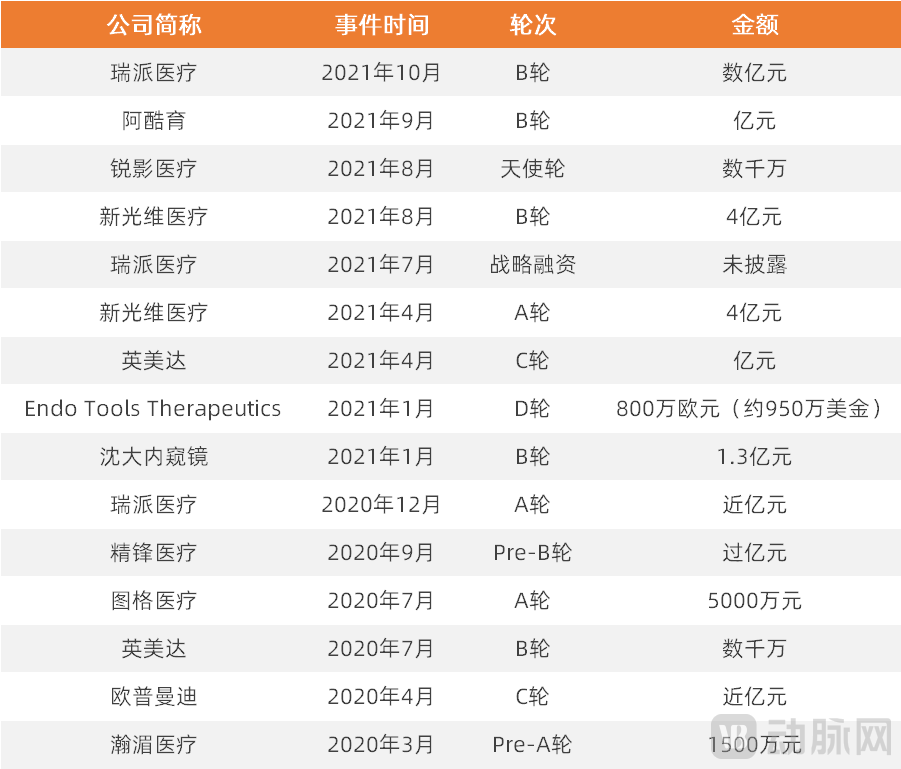
Selected Financing Events in the Endoscopy Sector, Compiled from Artery Orange and Public Data; Graphic by VCBeat
Large-scale financing deals, each reaching up to hundreds of millions of yuan, have frequently emerged in the endoscopy sector. Moreover, several companies have completed multiple rounds of funding within just two years.Among them, companies such as New Guangwei Medical have reached the stage of submitting their prospectus and awaiting listing.
The surge in the endoscopy sector is closely linked to current market demand. According to data from Frost & Sullivan,The global medical endoscope market is a vast and rapidly growing market.In 2020, the global medical endoscope market was valued at $20.3 billion and is projected to reach $39.6 billion by 2030. China’s medical endoscope market is growing at a relatively faster pace, with expectations of increasing from RMB 23.1 billion in 2020 to RMB 62.4 billion by 2030.
The vast market has prompted a large number of enterprises to bet on the endoscopy sector. With the outbreak of the COVID-19 pandemic, hospitals have placed greater emphasis on infection control, drawing close attention from investors to the development of single-use endoscopes and leading many companies to launch their own single-use endoscope products.
Established in March 2019,Realmage, completed a tens-of-millions-of-yuan angel financing round led by Jinding Capital in August this year.While launching its disposable endoscope, it has taken a path somewhat different from that of other companies.—Opting to explore upstream in the endoscopy sector, we develop our proprietary endoscope console modules starting from foundational algorithms and components, thereby expanding our own line of endoscopic products.
What led them to make this choice? We interviewed Chen Haihua, founder of Realmage.
Tackling the Hard Problems: Why Focus on Endoscope Host Modules?
“In endoscopic equipment, the component that best reflects technical proficiency is actually the endoscopic image processor.“This is also why imaging systems are so expensive. Since the R&D, production, and manufacturing of these systems involve many interdisciplinary fields, the technical barriers are high, making breakthroughs difficult to achieve; consequently, the value of such technological breakthroughs is relatively significant,” Chen Haihua pointed out to VCBeat.
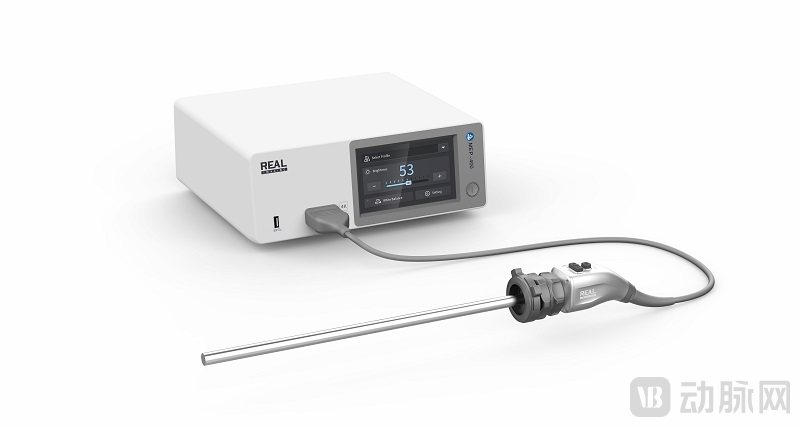
Realmage Medical Imaging Host Product, Renderings
Given this, how do domestic endoscope manufacturers typically approach image processing units?
“Currently, most domestic enterprises adopt mainboard modules produced by companies such as Panasonic or Ikegami, and then assemble and debug them to create image host units.“Chen Haihua stated that because the system is not from the original manufacturer, the functionality of the endoscope processor is often significantly limited—different manufacturers using the same mainboard module may ultimately produce different image outcomes due to variations in their respective optimization capabilities.”
The rationale for companies to adopt off-the-shelf motherboard modules in developing their own image processing units is evident: imported off-the-shelf motherboard modules benefit from a relatively mature supply chain, which helps companies reduce R&D investment in endoscopy image processors and enables them to more rapidly launch their proprietary endoscopic image processing units and配套 endoscopes by integrating the industrial chain.
A project leader at Jinding Capital once stated, “In recent years, minimally invasive surgeries have grown at a rate of 18%, and the endoscope console is a key factor directly affecting imaging quality in minimally invasive surgical visualization. Meanwhile,”Currently, 90% of endoscopy systems in China are controlled by a few major foreign brands, such as Germany’s STORZ and Japan’s Olympus, presenting significant opportunities for import substitution.”
In fact, changes have also begun to occur in recent years.
According to Chen Haihua, prior to 2018, it was rare to see companies in the industry developing proprietary image processing units. “Capabilities in industry insight, talent structure, and external financial support were all relatively weak, making the development of proprietary image processing units quite challenging. Now, there is a growing recognition of their value, and China has gradually built the talent base and industrial infrastructure necessary to allow endoscope manufacturers to explore this direction.”
Chen Haihua, who single-handedly founded another endoscopy company in 2015, also recognized the current challenges facing the industry during the process of product iteration—He believes that the market will not lack mediocre-quality endoscopic equipment; to create top-tier devices, one must start with the image processing unit, with the host module being the key component.It was also based on this that, building upon its accumulated experience and technical expertise in the early stages, Realmage Medical was established in 2019. From its inception, Realmage Medical set out to develop its own image processing host systems, starting with mainboard modules.
What Does Realmage Rely on to Break Through in the Host Module Market?
Why haven’t large tech companies explored this direction? Chen Haihua pointed out that major domestic players have indeed made attempts, but the resulting products from some manufacturers have been mediocre. Large corporations enjoy greater room for trial and error; however, their product pipelines may be abruptly terminated if performance falls short. In contrast, startups face a do-or-die situation with no other options. Realmage, driven by an unwavering commitment, continues to forge ahead in its exploration.
Confidence alone may be far from sufficient. In this field that requires the convergence and integration of multiple disciplines,Developing the endoscope host module itself requires a top-tier, cross-disciplinary team. As the host module involves hardware components such as chips and sensors, building it also demands the team’s ability to integrate resources across the industrial chain.
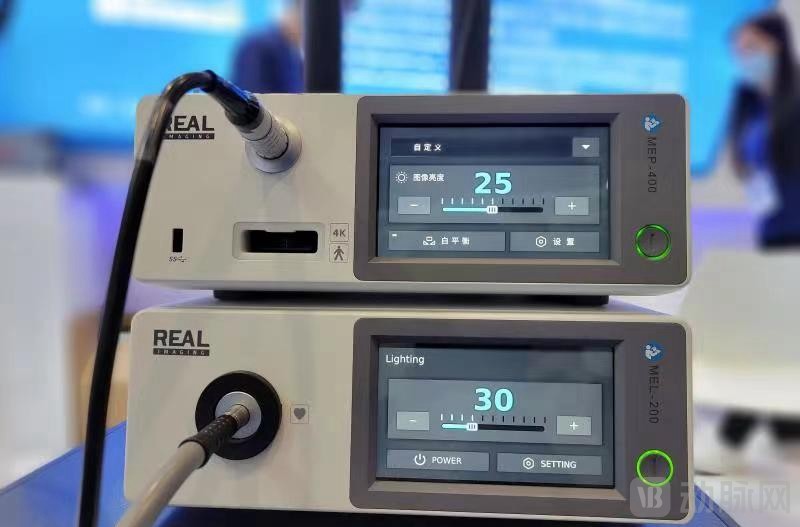
realmage Endoscope Main Unit: Actual Product Photos
realmage’s advantage lies in its seamless integration of both.
In terms of team composition, Realmage currently has a team of nearly 30 members, most of whom have prior work experience at major companies in related fields.
Chen Haihua, founder of Realmage Medical, holds a degree in Computer Science. As a serial entrepreneur, he launched his first venture in 2011, focusing on fields closely related to edge computing and machine vision.In 2015, he entered the endoscopy field and launched “Realmage” in 2019. Realmage did not emerge out of nowhere; it was built upon substantial prior experience and expertise in the endoscopy sector.
The CTO of Realmage holds a Ph.D. from Beihang University and completed a joint doctoral program at the University of Pennsylvania, with over 10 years of experience in the field of image processing research.He leads the image processing division at the National Key Laboratory of Assisted Reproductive Technology (ART), where he is primarily responsible for the research and development of algorithms for medical image segmentation, organ modeling, and disease quantification. He has also conducted deep learning research at a renowned laboratory in China and developed 2D and 3D endoscopic imaging algorithms at a leading industry enterprise, where he served as the project lead for 3D endoscopy, accumulating extensive project management experience.
Realmage’s Head of Hardware, who holds a Ph.D. from the Chinese Academy of Sciences and serves as a Senior Lecturer at the State Key Laboratory of Semiconductor Superlattices, previously led R&D for national key special projects involving industrial cameras, LiDAR, Time-of-Flight (ToF) cameras, and UAV-borne optoelectronic detection systems. Also responsible for circuit design and FPGA design of 2D/3D surgical vision products for well-known industry enterprises.
In terms of supply chain resource integration capabilities, endoscope processors need to address issues at the foundational level by securing technical support from FPGA chip manufacturers.Realmage has secured chip support from Xilinx, the global leader in FPGA chips. Additionally, Shenda Endoscopy Co., Ltd., a shareholder of Realmage, has provided other relevant support in the field of endoscopy., enabling Realmage to focus on research and development in the field of endoscopy console systems.
Ultimately, Realmage Medical selected Xilinx chips combined with the Weiyun Zhilian edge computing platform, along with image sensors from a major manufacturer, and developed a host module tailored to its specific needs by modifying the underlying system algorithms. Chen Haihua pointed out, “Compared with image hosts built using modules from Sony or Panasonic, the advantage of image hosts built using Realmage’s medical host modules lies in the “software and hardware platform + system integration.”, high integration leads to improved imaging quality of the image host.
R&D of Localization Imaging: Parallel Development of Endoscopy and 3D Intraoral Scanning Pipelines
For Chen Haihua, developing endoscopic image processing units is crucial. Realmage is currently striving to develop host systems that support 4K, 4K fluorescence, and 3D imaging.
“In scenarios involving an image host, the development of single-use endoscopes allows for autonomous control over imaging capabilities, thereby enabling superior image quality.” For Realmage, the creation of its single-use endoscope products appears to be a natural progression. The company is currently initiating the regulatory certification process for these products.
In addition,Realmage is also developing 3D intraoral scanning devices, currently exploring device miniaturization, with product launch and regulatory submission expected by year-end.
Why Expand from Endoscopic Products to 3D Intraoral Scanners?
Chen Haihua responded that this is related to his identity as a serial entrepreneur and his early strategic layout. In his view, endoscopic imaging is poised to evolve toward 3D imaging. “In the future, supporting surgical robots will require high-precision 3D images with real-world measurement data, rather than the simulated 3D image effects currently available.”
realmage began laying out its 3D imaging algorithms at an early stage.The company’s current focus on commercializing 3D intraoral scanning solutions stems from its earlier experience as an overseas contract manufacturer for 3D intraoral scanners, which has endowed it with certain resource advantages. Its imaging algorithms are also poised for deployment in other fields in the future.
Overall, realmage“"The endoscopy system can continue to develop products such as fluorescence and 3D imaging; disposable endoscopes can continuously expand into gastrointestinal endoscopes, bronchoscopes, and other products; 3D image processing technology can be applied in fields such as medical aesthetics and brain scanning, with strong technical extensibility.", with broad market prospects.
The product advantages of realmage are manifested in—
In terms of image hosting, Realmage has developed its products based on extensive clinical data, leveraging its own resources., rather than being a product developed solely in the laboratory. It aims to provide comprehensive support to clinicians, offering complete solutions that span from services to product design. This stands in contrast to many products currently on the market, which are not only expensive but also often lack even basic localization, with “most products having menus entirely in English.”
In the field of disposable endoscopes, Realmage has further enhanced the imaging quality of its ancillary products by developing dedicated image processors, while simultaneously reducing endoscope costs through optimized supply chain management., thereby changing the previous situation in which imported disposable endoscopes often cost tens of thousands of yuan.
In terms of 3D intraoral scanners, the current scanning accuracy has reached 10 micrometers.Chen Haihua stated that Realmage’s advantages in 3D intraoral scanning devices lie in its familiarity with overseas markets and its lower pricing compared to similar products.
Build a Reserve of Technical Talent and Actively Expand into Domestic and International Markets
In the endoscopy field, it is not easy for a product to stand out.
Chen Haihua, who has extensive entrepreneurial experience, pointed out in an interview that to secure a foothold in the current competitive landscape, “"First, we must diligently develop high-quality products and secure intellectual property certifications. Second, we should strengthen academic promotion to enhance awareness of the product among medical institutions and physicians."
“Enhancing the acceptance and awareness of products among the healthcare industry and physician community” is no less important than product development itself—only when physicians adopt the equipment for surgical procedures and engage in collaborative projects can they provide genuine product feedback based on hands-on experience, thereby helping companies develop products that meet clinical needs.
Chen Haihua is confident about obtaining product certification. He has already begun planning the product’s sales markets: “Our sales will not be limited to China. Leveraging our base in China, we will compete globally with today’s leading enterprises. We have full confidence in Realmage’s core products.”
This confidence stems from his familiarity with the market and his experience selling related medical devices and equipment in overseas markets. “The European and American markets are receptive to top-tier equipment made in China, and high-quality Chinese medical devices can indeed be exported to Europe and the United States.”While expanding into domestic and international markets, Realmage is also strengthening its talent pool and building a multidisciplinary team to support the future expansion of its product pipeline.