

ImpACT Therapeutics: Backed by Lilly Asia and Junshi Biosciences, Synthetic Lethality Emerges as the Next Frontier in Targeted Oncology
IMPACT Therapeutics
Targeted Anti-Cancer Innovative Drug Developer
VCBeat: “You have over 20 years of experience in drug R&D, technology transfer, licensing and business development, venture capital, entrepreneurship, and corporate financing. With such extensive experience and achievements, you could easily found your own company or continue to serve in a leadership role at a large enterprise. What motivated you to step away from your distinguished career and join a startup biotech company?”
Dr. Jun Bao, President and Chief Executive Officer of IMPACT Therapeutics: “In 2016, innovative drug development in China began to flourish. Encouraged by the favorable macro environment, I was eager to contribute to biomedical innovation domestically. At that time, I had a strong interest in synthetic lethality, believing it to be a promising field for future development.”
“At that time, IMPACT Therapeutics was a startup that had just initiated clinical trials for its PARP inhibitor. I aimed to build a synthetic lethality pipeline centered on PARP inhibitors, so,”My optimism about the field of synthetic lethality is the fundamental reason why I chose IMPACT Therapeutics.
“Secondly, when I chose to join IMPACT Therapeutics, the company had already begun building its own clinical team, which would significantly enhance the efficiency of later-stage drug development. I have accumulated years of experience in the business development (BD) field and maintain close ties with numerous fund institutions. Prior to my joining IMPACT Therapeutics, Lilly Asia Ventures and Decent Capital completed a new round of financing for the company, enabling me to focus more intently on corporate business development over the next one to two years.”
“With the right timing, favorable conditions, and strong team synergy, I plan to expand IMPACT Therapeutics’ synthetic lethality product pipeline through business development after joining. My goal is to lead this ‘small but specialized’ company in creating ‘small yet exquisite’ products. To me, it is worth a try.”
Why Is Synthetic Lethality So Compelling? What Has Drawn Support and Participation from Lilly Asia Ventures, Junshi Biosciences, and Numerous Industry Scientists? Let Us Begin with IMPACT Therapeutics, a company dedicated to developing proprietary targeted anti-cancer innovative drugs based on the synthetic lethality mechanism.
IMPACT Therapeutics was founded in Nanjing in 2009. With support from Lilly Asia Ventures and WuXi AppTec, the company accelerated its growth in 2014, relocating its headquarters to Shanghai. Focusing on the development of best-in-class targeted anticancer drugs, it rapidly advanced its first compound, a PARP inhibitor, into clinical trials, while simultaneously initiating R&D on other DDR-related targets.
After Dr. Bao Jun joined IMPACT Therapeutics in 2018, he established the company’s R&D direction—focusing on the development of targeted anti-cancer novel drugs in the field of synthetic lethality (SL).
Synthetic lethality refers to the phenomenon in which simultaneous inhibition of two non-lethal genes leads to cell death.Specifically, cancer cells harboring a mutation in gene A exhibit increased dependency on the pathway of its complementary gene B. Inhibition of gene B leads to the death of these cancer cells while sparing normal cells. Therefore, this complementary gene B can serve as a therapeutic target for the development of new drugs.
By leveraging the synthetic lethality mechanism, it is possible to indirectly target many tumor-specific mutations, including some commonly recognized “undruggable” oncogenes, thereby significantly expanding the repertoire of therapeutic targets for cancer treatment.
Furthermore, synthetic lethality holds the potential to overcome therapeutic resistance caused by new mutations commonly arising during conventional targeted therapy. Therapies targeting synthetic lethal interactions can also complement or synergize with treatments employing other mechanisms to exert anticancer effects. The application of synthetic lethality in drug development, which aims to selectively kill cancer cells harboring specific mutations (such as defects in DNA damage repair), has opened new avenues for targeted anticancer therapy.
Currently, IMPACT Therapeutics has built one of the most comprehensive DDR product portfolios among global biopharmaceutical companies, based on its independently developed products targeting the DNA damage response (DDR) pathway, and is gradually expanding into more novel synthetic lethality targets.
Cancer cells typically harbor defects in one or more DNA damage response (DDR) pathways. When such defects are present, cancer cells become highly dependent on other complementary DDR pathways. Consequently, further inhibition of these complementary pathways induces synthetic lethality, leading to the death of cancer cells.
Such a promising field naturally attracts significant interest from investment firms.
Since 2014, IMPACT Therapeutics has completed three rounds of financing, with investors including Eli Lilly Asia Venture Fund, Decheng Capital, and Hualing Capital, among other renowned institutions.
In addition, IMPACT Therapeutics entered into a strategic cooperation with Junshi Biosciences, establishing a joint venture in Shanghai, China, in 2020.The two parties will collaborate on clinical trials and commercialization preparations for IMP4297 (Senaparib) across multiple indications in China. Leveraging Junshi Biosciences’ established clinical and commercial resources, IMPACT Therapeutics will be able to maximize the clinical and commercial value of its drug candidates with greater efficiency.
In addition to external professional support, IMPACT Therapeutics also boasts a highly capable core team.
Dr. Jun Bao, CEOFormerly served as Senior Vice President and Chief Business Officer at Shengaoji Pharmaceuticals, Director of Global Business Development and Head of China Region at GlaxoSmithKline, and Director of Corporate Development and Financial Planning at Onyx. He is a Board Member of the Baihua Association and has over 20 years of experience in the industry.
In addition to Dr. Bao, the company’s other scientists also possess many years of R&D and management experience.
IMPACT TherapeuticsDr. Tian Ye, Executive Vice President and Chief Scientific Officer, previously served as Researcher, Associate Director, and Senior Scientist at Parke-Davis, Pfizer, and Transtech Pharma, respectively. Multiple new drug development projects he participated in have all entered Phase II clinical trials in the United States. He has over 25 years of extensive experience in new drug development and project management.
Dr. Cai Suixiong, Executive Vice President and Chief Technology Officer, formerly served as Senior Director at EpiCept, Maxim, and Cytovia. He participated in multiple new drug development collaboration projects, including NMDA and AMPA receptor antagonists at Parke-Davis, Crolibulin at BioChem Pharma, and Azixa at Myriad Genetics. He has over 25 years of extensive experience in drug design, new drug development, and project management.
Xie Zhiyi, M.D., Senior Vice President and Chief Medical Officer, formerly served as Chief Medical Officer at Aslan Pharmaceuticals and led multiple clinical trials; also worked as a Medical Advisor at Novartis Oncology and as a physician at Taipei Veterans General Hospital, with over 10 years of experience in medical oncology, hematology, and clinical trial management.
Furthermore, IMPACT Therapeutics boasts a Scientific Advisory Board composed of several international experts, including members of the U.S. National Academy of Sciences, the National Academy of Medicine, and the American Academy of Arts and Sciences. R&D personnel account for 70% of the company’s total workforce.
With support from various stakeholders, IMPACT Therapeutics has implemented a comprehensive multi-target layout strategy based on its independently developed DDR platform, following a “three-step” approach.
Step 1: “Establishment” – IMPACT Therapeutics’ first R&D project, IMP4297 (Senaparib), was built upon PARP, a mature and clinically validated target, thereby reducing the risks associated with new drug development.
Step 1: “Dominate” – Establish a comprehensive, multi-target portfolio in the DNA Damage Response (DDR) field, covering scientifically validated hot targets such as Wee1, ATR, and ATM. The unique design of our compounds ensures higher selectivity, enabling our products to target a broader range of tumor types and creating more opportunities for internal combination therapies.
Step 3: “Expand” – Gradually expand to more novel synthetic lethality targets, further enriching the product pipeline.
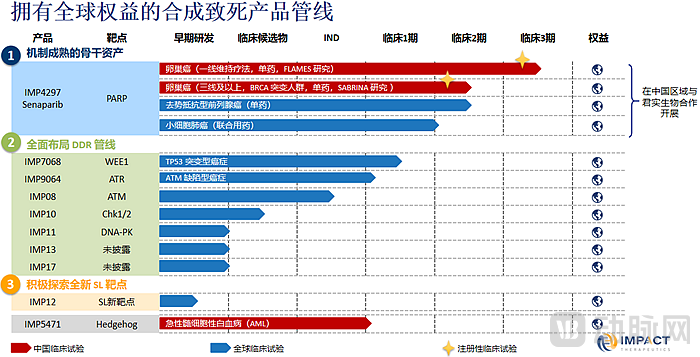
In line with the aforementioned development strategies, IMPACT Therapeutics has publicly disclosed multiple products in its pipeline. These candidates target PARP, Wee1, ATR, ATM, Chk1/2, DNA-PK, Hedgehog, and undisclosed targets, with indications including ovarian cancer (first-line maintenance therapy, monotherapy), ovarian cancer (third-line and beyond, BRCA-mutated population, monotherapy), castration-resistant prostate cancer (monotherapy), and small cell lung cancer (combination therapy).
From the perspective of project layout, IMPACT Therapeutics boasts an extensive DDR product portfolio and is one of the few biotechnology companies that simultaneously possess PARP inhibitors and other DDR-targeting agents, a pipeline that greatly facilitates internal combination therapy development. With PARP inhibitors as its core assets, IMPACT Therapeutics has initiated multiple studies on combination therapies.
From the project results,, multiple investigational products from IMPACT Therapeutics have demonstrated higher selectivity and lower toxicity, laying the foundation for combination therapies to achieve better efficacy and for exploring additional indications.
In addition to the project's target layout greatly facilitating combination therapy with internal products, IMPACT Therapeutics has another distinctive feature: Unique Design of Compounds from the Source. Unlike many me-too or me-better drugs that typically choose to modify existing compounds, IMPACT Therapeutics opts to invest more effort in designing compounds from the ground up during the early stages. This unique approach to compound design results in higher activity and selectivity, ensuring that the company’s products can target a broader range of tumor types. Although this process may take more time, sharpening the axe will not delay the woodcutting.
Currently, IMPACT Therapeutics’ core project, IMP4297 (Senaparib), has multiple clinical trials underway globally, with smooth progress.Based on the disclosed data, senaparib, featuring a novel chemical structure, demonstrates 15–20 times greater inhibitory potency and 8.5-fold higher selectivity against BRCA (breast cancer gene)-mutated tumor cell lines compared to olaparib.
Senaparib demonstrates a wider therapeutic window and superior tolerability and safety profile, showing potential for long-term treatment (such as maintenance therapy) and combination therapy. Interim analyses of related clinical studies are expected to be conducted next year.
In addition to the anticipated major breakthroughs with PARP inhibitors in the near future, IMPACT Therapeutics’ Wee1 inhibitor has also entered Phase I clinical trials, with Phase II results expected in two years. Regarding the ATR target, IMP9064, both as monotherapy and in combination with the PARP inhibitor Senaparib, has recently received approval in the United States to initiate Phase I/II clinical trials.
It is evident that, in terms of clinical advancement, IMPACT Therapeutics has consistently maintained a development pace of advancing one new product into clinical trials each year.
Regarding the company’s development vision, Dr. Bao Jun stated, “In the near term, IMPACT Therapeutics will remain primarily focused on advancing clinical progress. From a long-term perspective, we will simultaneously pursue additional financing and team expansion, with the goal of achieving an initial public offering (IPO) in the capital markets within two years. In terms of product development, we anticipate that one or more products may receive regulatory approval for market launch within the next three years. At that stage, IMPACT Therapeutics will not limit itself to drug R&D but will also gradually establish infrastructure and teams for sales and manufacturing. Ultimately, we aspire to become a ‘small yet specialized’ biopharmaceutical company with comprehensive capabilities spanning from early-stage R&D to commercial sales.”