

He Yuan Bio Passes STAR Market IPO Review, Offering Integrated CRO Solutions for Gene Therapy Research and Continuously Expanding Its Ecosystem
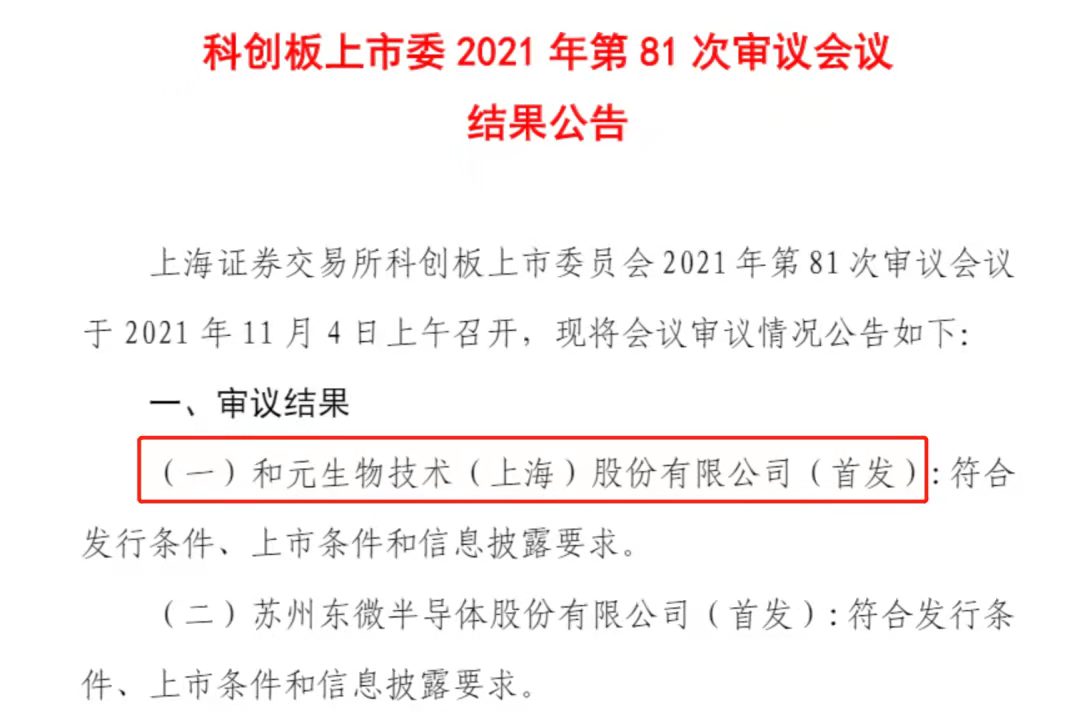
On November 4, the Listing Committee of the STAR Market released its review results, approving Obio Technology’s initial public offering.
Obio Technology, established in 2013, is one of the earliest CDMOs in China to specialize in gene and cell therapy. With robust technical capabilities, it integrates three core strategic areas: basic research services, R&D of gene therapy drugs, and industrial-scale manufacturing of clinical-grade recombinant viruses. The company is dedicated to providing comprehensive CRO solutions for gene therapy research to domestic academic institutions, medical facilities, and pharmaceutical enterprises.
Since the outbreak of the pandemic in 2020, Obio Technology has garnered significant attention, successfully completing multiple rounds of financing and attracting renowned investment institutions such as Loyal Valley Capital, Jinpu Investment, and Tencent. As early as July 2019, Yifeng Capital participated in Obio Technology’s early-stage financing; in July 2020, Yifeng Capital led the company’s Series C financing round with an additional investment.
Gene therapy has long been a key sector of focus for Yifeng Capital. In early 2019, after extensive internal discussions, Yifeng concluded that gene therapy represented a strategic avenue for China’s healthcare industry to achieve leapfrog development, and consequently shifted its investment focus to the midstream segment of the industry. Following a comprehensive search of CDMO companies, Yifeng ultimately selected Obio Technology.
Zhu Pai, Managing Partner at Yifeng Capital and Director of Obio Technology, pointed out that different viral vectors can be utilized for various gene therapies. Although Obio Technology is a relatively young company, it is the only platform in China covering all six major types of viral vectors, including plasmids, lentiviruses, recombinant adeno-associated viruses (rAAV), and oncolytic viruses. This diverse portfolio of viral vector types enables Obio to collaborate with research institutions and enterprises developing gene therapies across different disease areas. Obio has established a one-stop CDMO platform, which has been validated through the end-to-end development of several products, from sequence design to clinical sample preparation. Furthermore, Obio is currently the only company in China dedicated exclusively to CDMO services without developing its own gene therapy products. With the sole mission of helping clients produce viral vectors, Obio operates as a pure-play CDMO platform and possesses significant competitiveness in the international market.
What Are Viral Vectors? They Address the Transportation Challenge of Delivering Genetic Tools into Human Cells. Researchers commonly use viral vectors to introduce exogenous genetic material into cells, enabling genetic manipulation at both in vivo and in vitro levels to modulate gene expression for physiological and pathological research, gene therapy, and other applications.
According to an analysis by Jain PharmaBiotech, the global market size for gene and cell therapies is projected to exceed $25 billion by 2027, with multiple institutions forecasting a compound annual growth rate (CAGR) of over 33%. At the core of the gene and cell therapy industry lies the manufacturing technology for clinical-grade viral vectors. Currently, the shortage of viral vectors has become a bottleneck for the entire industry.
To overcome the “chokepoint” technologies constraining the development of gene therapy, Obio Technology has independently developed two core technology clusters: gene therapy vector development technologies, and gene therapy vector manufacturing process and quality control technologies. Leveraging its proprietary large-scale, highly flexible GMP production system, the company is capable of customized development of various gene therapies from the foundational level of vector technology through to large-scale manufacturing processes, delivering samples for international multi-center clinical trials, thereby demonstrating robust technical capabilities.
Currently, Obio Technology has emerged as a leader in its niche sector within China. On one hand, it attracts advanced global gene therapy achievements and provides them with clinical-grade viral vector industrialization and manufacturing services. On the other hand, it assists domestic enterprises in filing Investigational New Drug (IND) applications abroad for their gene therapies, thereby propelling China’s innovative gene therapy outcomes onto the global stage.