

Airdoc, China's First AI Medical Imaging IPO, Led by Programmer Founder Zhang Dalei, Lists on HKEX

Airdoc
Retinal Imaging Artificial Intelligence Field Product Developer
On November 5, 2021, the race to become the first publicly listed medical imaging AI company finally came to an end.
As the winner of this race, Airdoc listed on the Hong Kong Stock Exchange. The issue price was HK$75.1, with an opening price of HK$67.6. As of press time, the real-time market capitalization of Airdoc (02251.HK) stood at HK$7.188 billion.

Six years ago, Zhang Dalei, a programmer who ventured into medical AI after his family member was misdiagnosed, gave little thought to capital. In an interview, he stated that amid the uneven distribution of medical resources, he “wanted to provide better treatment opportunities for patients who might never have the chance to consult top-tier doctors in their lifetime.” Although he had experience at a medical school, Zhang did not pursue a career in medicine; instead, he sought to recreate a “doctor.”
This vision has given rise to a publicly listed company now valued at RMB 5.8 billion. In 2020, the year Airdoc obtained its Class III medical device certification, the company, which focuses on AI-driven ophthalmology research and development, reported revenues of nearly RMB 50 million, representing a year-on-year increase of 56.74%. In the first half of 2021, revenue growth was even more pronounced, surpassing the full-year total for the previous year.
Judging solely by product diversity, there is not significant differentiation among various medical AI products. What did Airdoc do right to stand out from hundreds of medical imaging AI companies?
Diabetic retinopathy, the niche selected by Airdoc, was a hot sector at the time. The large patient population, ease of acquiring fundus images, and relative simplicity of model development enabled medical AI companies to readily build foundational models and create artificial intelligence-assisted software that appeared reasonably competent.
However, excessively low entry barriers have intensified competition in the early stages of medical AI. Whether for fundus imaging or pulmonary nodule detection, while some companies have built specialized algorithm teams to tackle challenges in deep learning, others have merely tweaked open-source computer vision algorithms to create “white-labeled” AI solutions.
An investor who has reviewed numerous AI projects described the frenzy of that year as “chaotic”: “The pitch decks for various projects looked largely similar, making it difficult to immediately discern whether genuine technology was being employed. At that time, many entrepreneurs without a medical background set overly ambitious goals and went all-in on such an ahead-of-its-time concept, which mostly proved unsustainable in later execution.”
Airdoc, under the helm of Zhang Dalei, has taken a steadier path. He began programming in middle school and, after graduating from university, joined Microsoft, where he worked on the product teams for Remote Desktop Connection and Excel, eventually rising to become the product lead for both projects.
Subsequently, Zhang Dalei held management positions at PPTV and Sina. It was during his tenure at PPTV that he pioneered the use of artificial intelligence for video content moderation, leveraging computer vision to identify sensitive user-uploaded videos containing violence, pornography, and other prohibited material.
The convergence of multiple identities endowed Zhang Dalei with a clear understanding of the development of computer vision at the outset of his entrepreneurial journey. As an investor in Airdoc’s first two rounds of financing, Jiuhe Venture Capital closely witnessed its early growth. When recalling Airdoc in those days, Wang Xiao’s first thought was of Zhang Dalei himself.
A leader’s ability to steer the development of an AI company is crucial. Wang Xiao told VCBeat, “Although fundus photographs can be used to detect a variety of diseases, Airdoc made strategic trade-offs in its early stages by focusing initially on diabetic retinopathy before gradually expanding to multiple conditions, taking into account factors such as the size of the patient population for each disease and the availability of annotated reference datasets. This approach aligned perfectly with our recommendations.”
Therefore, after securing angel-round financing, Zhang Dalei led his team to accomplish three key initiatives: first, refining their diabetic retinopathy AI into a diagnostic-grade product; second, pivoting Airdoc’s product line from medical devices toward the broader health and wellness sector; and third, establishing a proprietary database to build a core data moat in the AI field.
In August 2020, Airdoc’s auxiliary diagnostic software for diabetic retinopathy based on fundus images received Class III medical device approval from the National Medical Products Administration (NMPA), thereby enabling its widespread adoption in healthcare institutions. In terms of database development, Airdoc has established one of the world’s largest retinal imaging databases through research collaborations, comprising approximately 3.7 million real-world user retinal images and corresponding multimodal data, all cross-annotated by hundreds of medical experts. Regarding expansion into the broader health industry, Airdoc’s health risk assessment solution can screen for 55 types of diseases and lesions, including retinal abnormalities, cardiovascular anomalies, and anemia, thereby allowing the company to tap into the vast cardiovascular market.
With the three major barriers established, Airdoc has entered its harvest phase. Commercialization will be the core focus of the next stage.
On multiple public occasions, Zhang Dalei has pragmatically emphasized the importance of accurately assessing market demand—namely, the genuine needs and scenarios of doctors and patients. As stated in Airdoc’s prospectus:
First, fields that have been included in medical guidelines and expert consensus statements across various countries, but where the number of proficient physicians remains low due to high learning barriers; meanwhile, the vast patient population and stark physician-to-patient ratio have led to severe supply-demand imbalances.
Second, validation can be achieved through randomized, double-blind, controlled clinical trials in domains where algorithms can perform no worse than excellent human physicians, and which are reproducible, verifiable, and quantifiable.
Third, domains that can create value and provide services to each user in real-world practical usage scenarios.
The underlying message is that for AI to succeed, three conditions must be met: there must be a rigid demand, the technology must be feasible to implement, and it must deliver incremental value. As for whether medical AI should remain within hospitals, Zhang Dalei did not address this issue.
Looking back at Airdoc’s fundraising journey, over the course of seven funding rounds spanning six years, the AI company has gradually attracted prominent shareholders such as Fosun International, Ping An Group, and Sogou. Bolstered by the resources provided by its investors,Airdoc’s product strategy was the first to integrate comprehensive health management into its system, carving out a path distinctly different from that of other artificial intelligence enterprises.
Currently, Airdoc’s AI portfolio is divided into three major segments: ophthalmic AI, ophthalmic examination devices, and health risk assessment. Products across all three segments have obtained regulatory approval and entered the commercialization phase. At this stage, Airdoc’s user base includes not only large hospitals and physical examination centers, but alsoHealthcare Institutions (Medical and Health Scenarios), as well as insurance companies, optometry centers, and pharmacies# General Health Scenariosintegrated into the system. The broader health scenario is particularly significant, meaning that Airdoc has taken the lead in entering a new market with a scale exceeding that of the in-hospital market.
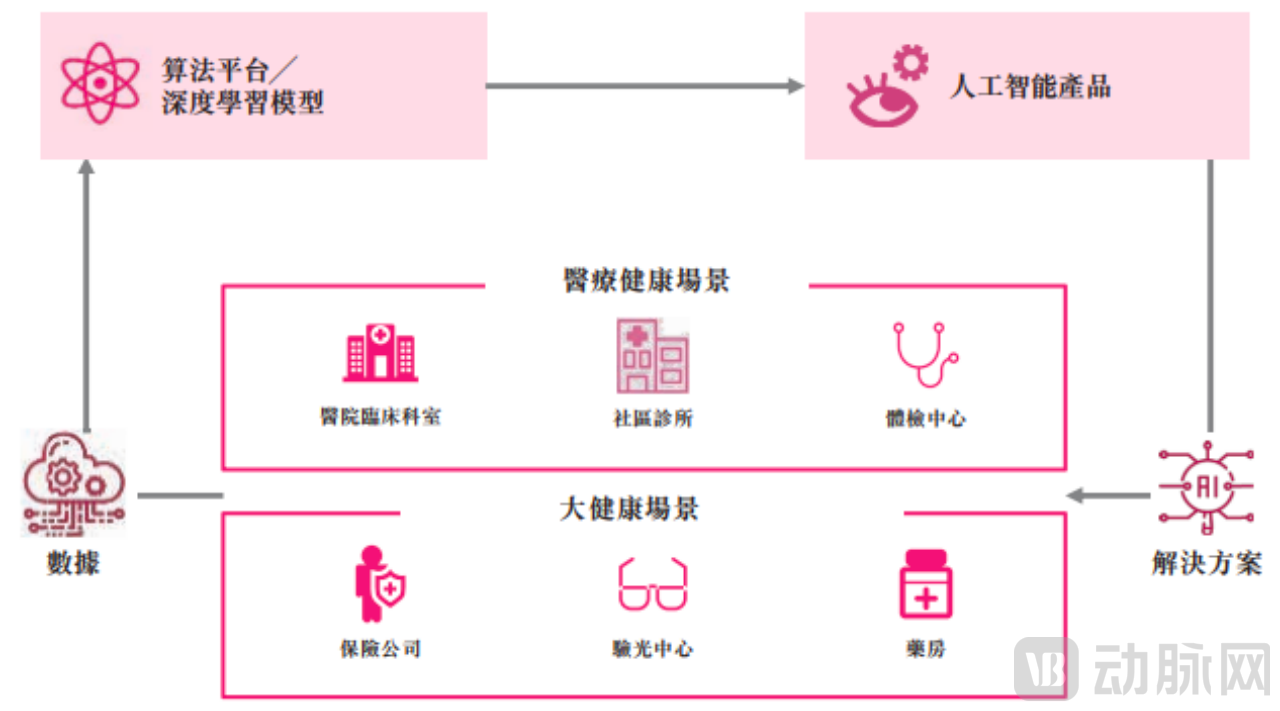
Among the three major segments, Airdoc’s collaboration with insurance companies has advanced most rapidly. In 2020, revenue from “insurance companies” in the general health scenario accounted for nearly 30% of Airdoc’s total income, second only to that from “medical examination centers” in the healthcare services scenario. As stated in its prospectus:
We partner with leading commercial insurers, including Ping An Insurance, China Pacific Insurance, China Life Insurance, Taiping Life Insurance, and New China Life Insurance, to assist them in comprehensively, accurately, and efficiently assessing the health status of insurance applicants and insured individuals. As the incidence of chronic diseases rises, there is a growing demand among insurers to identify risk factors for chronic conditions, thereby gaining a deeper understanding of customers’ health profiles, providing health management recommendations, offering personalized insurance products, and ensuring adequate coverage.
According to Frost & Sullivan’s research data, the compound annual growth rate (CAGR) of the broader health and wellness sector since 2021 (90.7%) is expected to exceed that of the medical device market (76.7%). As the slogan “One retinal scan for early disease detection” gains wider public acceptance, Airdoc may position the health and wellness sector as another new core area of strategic focus.
However, while the AI production line architecture only determines the ceiling of the market that AI companies can enter, to mine gold beneath this ceiling, AI companies must find effective business models.
Airdoc and Starry Vision Group entered into a partnership in July 2018. As the parent company of Baodao Optical, Starry Vision Group needed to identify new growth initiatives for its increasingly competitive brick-and-mortar stores.
At that time, Wang Zhimin, the Chairman, stated at the Geek Park conference: “The essence of the eyewear industry is optometric medical services, providing consumers with optometric care.”
Optometry addresses preliminary eye examinations, initial diagnosis and treatment of eye diseases, management of complex refractive errors and binocular visual function issues, as well as rehabilitation training for strabismus and amblyopia. In contrast, the majority of ophthalmologists primarily focus on the detailed diagnosis and treatment of ocular diseases. From this perspective, optometry and ophthalmology are strongly interconnected, with the optometry industry serving as both the entry point and the ultimate destination within the field of ophthalmology.
In other words,Star Vision aims to expand the professional capabilities of its stores, positioning them as entry points for health management.—Airdoc can provide product and technical support for this entry point.
Following the collaboration, Baodao Optical leveraged Airdoc’s AI to launch a new service that provides users with comprehensive health risk assessments and eyewear recommendations, helping to prevent vision impairment caused by underlying health risk factors.
Airdoc has successfully implemented a per-case payment model for its AI-powered fundus imaging services, pioneering a new B2C commercial paradigm in the broader health and wellness sector—a milestone that remains significant to this day.
The traditional bidding and tendering model in medical IT makes it difficult for AI companies to sell their products to healthcare institutions. However, Airdoc’s per-visit fee model (a service-based model) can unlock the true commercial value of AI. This is particularly significant following the release of the Pilot Program for Deepening the Reform of Medical Service Pricing by eight national ministries and commissions this September, which has been widely regarded as a major positive development for the medical AI sector. This is especially true for AI applications such as fractional flow reserve (FFR), which are attempting to establish pricing standards and transition from a medical device sales model to a medical service fee model.
According to Airdoc’s prospectus, its health risk assessment solutions have been deployed by insurance company branches across 28 provinces, covering more than 950 optometry centers and over one million individuals.
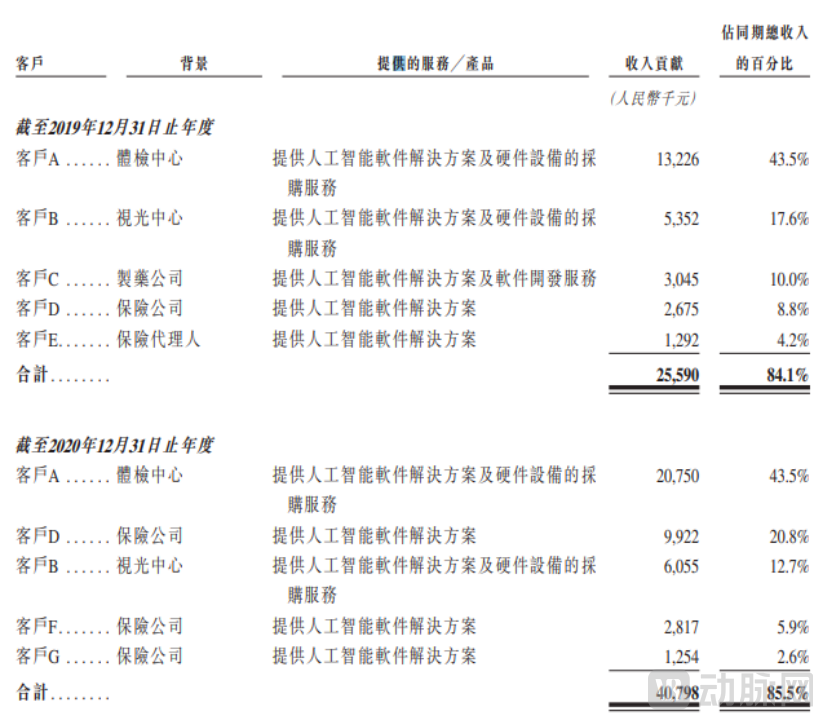
In 2019, Airdoc’s top five customers were health examination centers, optometry centers, pharmaceutical companies, insurance companies, and insurance agents. In 2020, the top five customers were health examination centers, insurance companies, optometry centers, insurance companies, and insurance companies.
In 2020, four clients (B, C, D, and E) in Airdoc’s general health scenarios collectively accounted for 42% of its operating revenue, just a narrow margin behind the top-ranked client, Physical Examination Center A, which contributed 43.5%.
Airdoc’s endeavors can be seen as an inspiration for AI companies in medical imaging. Next, can AI products transition from project-based sales to service-based sales? How can they expand from medical scenarios into the broader health and wellness sector? These may become two questions that all AI companies in medical imaging must answer.
In summary, Airdoc’s current achievements can be attributed to three key factors. First, it chose the right market niche—avoiding the overly ambitious and complex oncology space pursued by Watson, as well as the crowded and highly competitive pulmonary nodule segment. Second, by entering the healthcare and broader health industries, it accurately identified the needs of physical examination centers, insurance companies, and optometry institutions. Finally, it successfully realized the “insurer-pays” and “pay-per-case” models, which had been widely anticipated but not yet fully implemented in the AI sector.
Moving forward, Airdoc still has numerous strategic options for expansion. For instance, it maintains deep collaborations with leading hospitals across China, including the Zhongshan Ophthalmic Center of Sun Yat-sen University, Beijing Tongren Hospital affiliated with Capital Medical University, and the First Medical Center of the Chinese PLA General Hospital. Following the approval of its Class III medical device certification by the National Medical Products Administration (NMPA), Airdoc has begun to expand the commercial application of its products in healthcare institutions, acceleratingTertiary Hospitalscommercialization in such scenarios. It is foreseeable that the accumulation of hospital-side resources will gradually enter a harvest phase after obtaining Class III medical device certification.
Now listed on the secondary market, Airdoc enjoys greater financial resources, which will undoubtedly accelerate its market expansion and enable it to secure more clients. The healthcare industry has never developed at the pace dictated by capital. Regardless of the stage artificial intelligence reaches, companies must remain true to their original commitment to serving patients.