

Shanwaishan, a Leading Blood Purification Company Backed by Hillhouse and OrbiMed, Files for Sci-Tech Innovation Board IPO

SWS MEDICAL
Blood Purification Equipment R&D and Manufacturer
VCBeat (WeChat ID: vcbeat) has learned that on November 4, the STAR Market listing application of Chongqing Shanwaishan Science&Technology Co.,Ltd. (hereinafter referred to as “SWS MEDICAL”), a leader in blood purification, was accepted, with a planned fund raise of RMB 1.247 billion.
As a full-industry-chain company integrating blood purification equipment, consumables, intelligent management systems, and a chain of hemodialysis centers, SWS MEDICAL has been deeply engaged in the field of blood purification for 20 years.
The prospectus reveals that SWS MEDICAL’s blood purification equipment has achieved cumulative installations of over 10,000 units both domestically and internationally, with terminal installations in more than 1,000 hospitals across China. Its primary customers include major medical institutions at home and abroad, such as several renowned domestic Grade A tertiary hospitals, including the Chinese PLA General Hospital (301 Hospital), Nanjing General Hospital of the Nanjing Military Command, the Second Xiangya Hospital, and Xinqiao Hospital of the Army Medical University. The products are exported to 62 countries and regions, including Indonesia, the Philippines, and South Africa.
It is worth mentioning that in August 2021, SWS MEDICAL was certified by the China Association of Medical Device Industry as the “leading domestic manufacturer of high-end blood purification equipment” and ranked first in market share for domestically produced blood purification equipment.
In terms of revenue, SWS MEDICAL recorded revenues of RMB 114 million, RMB 142 million, RMB 254 million, and RMB 132 million from 2018 to the first half of 2021, respectively, demonstrating a steady growth trend. Regarding gross profit margin, SWS MEDICAL reported figures of 33.29%, 28.95%, 41.87%, and 39.22% during the reporting periods, maintaining a relatively high level.
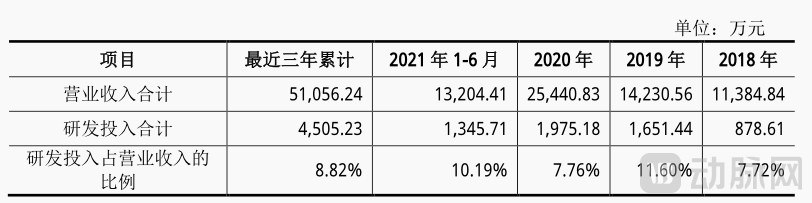
SWS MEDICAL’s Revenue Performance, Image Source: Prospectus
Next, VCBeat will analyze SWS MEDICAL based on its prospectus, examining its development history, product portfolio, and market potential.
Since its establishment in 2001, SWS MEDICAL has been dedicated to the research and development of key technologies for blood purification equipment and hemodialysis machines., conducting in-depth research and technological innovation across the entire system, control software, core algorithms, equipment components, and specialized sensors, thereby establishing a comprehensive technical solution for continuous blood purification equipment and hemodialysis machines.
Specifically, SWS MEDICAL has established a comprehensive layout across the entire industry chain, encompassing blood purification equipment, blood purification consumables, and chain hemodialysis centers. Furthermore, the company has built several technological innovation platforms, including a National Enterprise Technology Center, a National Postdoctoral Research Station, and a National-Local Joint Engineering Research Center.
Furthermore, SWS MEDICAL leverages its informational advantages across all stages of blood purification, studies advanced technologies both domestically and internationally, and continuously improves its products and technologies to provide safe, stable, and convenient blood purification solutions for patients with kidney disease.
Looking back on the 20-year development of SWS MEDICAL, it has been both a process of continuous innovation in products and services, and a journey of constant self-breakthrough for the enterprise.In 2014, SWS MEDICAL established its first independent hemodialysis center (pilot), actively laying out autonomous community-based dialysis medical services and exploring a chain hemodialysis service model. As of the date of the prospectus, SWS MEDICAL has established and stably operated 10 hemodialysis centers.
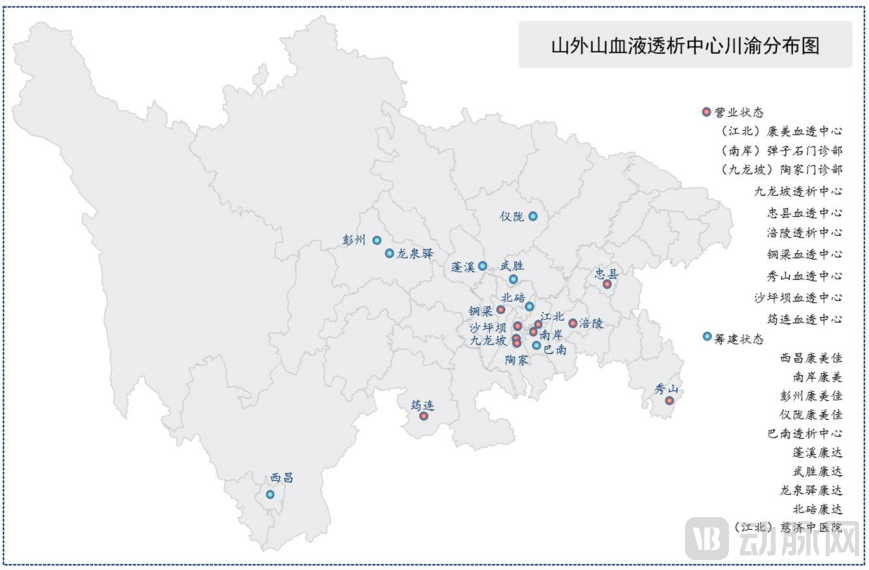 Image source: Prospectus
In terms of products, in 2015, SWS MEDICAL launched the SWS-6000 series of online hemodiafiltration machines. This series represents a new type of digital medical device that organically integrates hemodialysis and hemofiltration, addressing the shortcomings of domestically produced equipment in China with regard to functions such as online hemodiafiltration (HDFon-line).
At the end of 2019, a new product line—the SWS-5000 series of continuous blood purification devices—was launched. It features 14 treatment modes, including Continuous Renal Replacement Therapy (CRRT), Double Filtration Plasmapheresis (DFPP), and Molecular Adsorbent Recirculating System (MARS) therapy (whereas similar imported devices offer no more than 11 modes). The system can be used to treat various conditions, such as acute and chronic renal failure, liver failure, multiple organ failure, sepsis, severe pancreatitis, crush syndrome, rheumatic diseases, immune-mediated disorders, and neurological diseases.
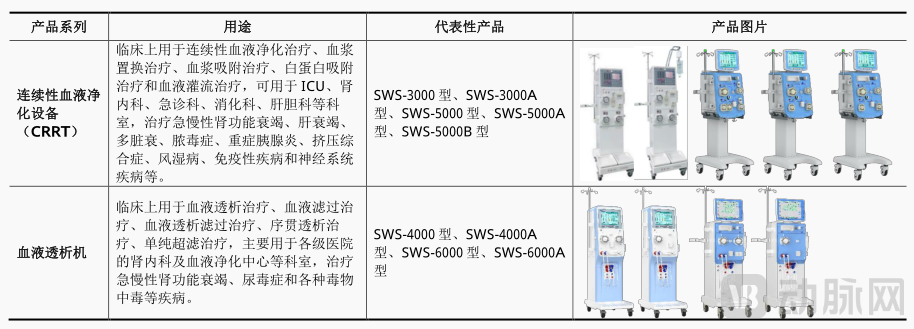 SWS MEDICAL’s Blood Purification Equipment (Partial) Image Source: Prospectus
With its superior product quality and technical advantages, as well as its deep cultivation in the field of blood purification, SWS MEDICAL has also gained widespread recognition from society and the industry.In February 2020, SWS MEDICAL was recognized by the China Association of Medical Device Industry as a “leading domestic manufacturer of blood purification equipment,” and its SWS-3000 and SWS-5000 series products were included in the list of “emergency medical devices for the treatment of critically ill patients with novel coronavirus infection.” In March 2020, SWS MEDICAL was designated by the Ministry of Industry and Information Technology as a “key national enterprise for the production of epidemic prevention and control supplies.”
Additionally,Through continuous independent innovation, SWS MEDICAL has also gradually attracted the attention of top-tier capital.: Hillhouse Capital, Xiangjiang Industrial Guidance Fund, Xiangjiang Liyuan Investment, and Huagai Capital have all placed bets on SWS MEDICAL.
Globally, hemodialysis has remained and will continue to be the primary treatment modality for patients with chronic kidney disease.
According to forecasts and statistics disclosed in Fresenius’ annual report, the global dialysis market size has steadily increased from €66.8 billion in 2015 to €82.0 billion in 2020, with an average annual growth rate of approximately 4%. By 2021, the dialysis market is expected to continue growing, reaching approximately €83.0–85.0 billion. Among this, the market for dialysis services (including pharmaceuticals) accounts for more than 80% of the total, while the market for dialysis products, primarily dialysis machines, represents a relatively smaller share.The global hemodialysis market is expected to maintain steady growth in the coming years, with its size projected to approach €100 billion by 2025.
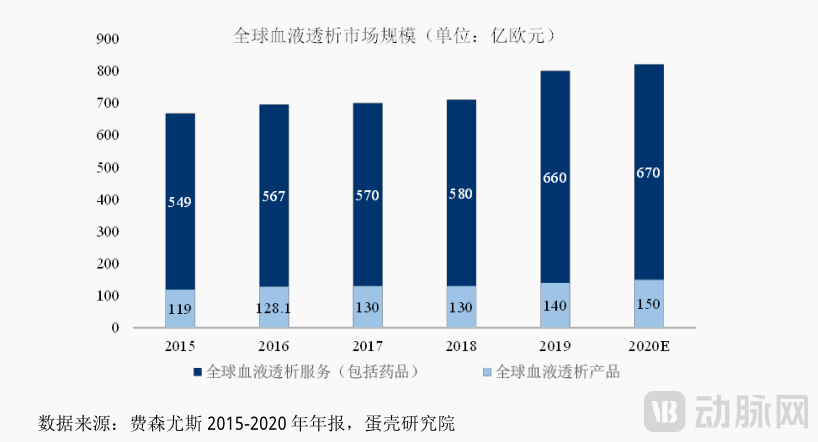 Image source: Prospectus
An important industry background to note is that the blood purification market is predominantly concentrated in developed countries and regions, such as the United States, Japan, and Europe, which collectively account for over 70% of the market. In Europe, hemodialysis services are primarily provided by public institutions, whereas in the United States and Japan, private operators dominate. Currently, the major global companies providing hemodialysis services include Fresenius Medical Care, DaVita, and Baxter.
In contrast, China's blood purification market started relatively late, and its technical level still lags behind that of foreign countries. However, with the continuous growth in the number of patients with kidney disease and the increasing reimbursement rate for hemodialysis costs under medical insurance,The market size of blood purification in China will grow rapidly.
How Significant Is the Opportunity? Taking the hemodialysis services market as an example, according to the latest statistical data from VCBeat Research Institute, the market size of hemodialysis services has maintained double-digit growth for consecutive years. It is estimated that the total market size of hemodialysis services reached approximately RMB 54.8 billion in 2020. In the future, with further improvements in healthcare policies—such as expanded health insurance coverage, increased reimbursement ratios for critical illness insurance, and the implementation of tiered diagnosis and treatment—as well as the innovative development and clinical application of new technologies and dialysis models, the multi-level and personalized needs of patients with end-stage renal disease will inevitably be met. Consequently, the market size of the hemodialysis services industry will continue to grow, reaching nearly RMB 70 billion by 2025.
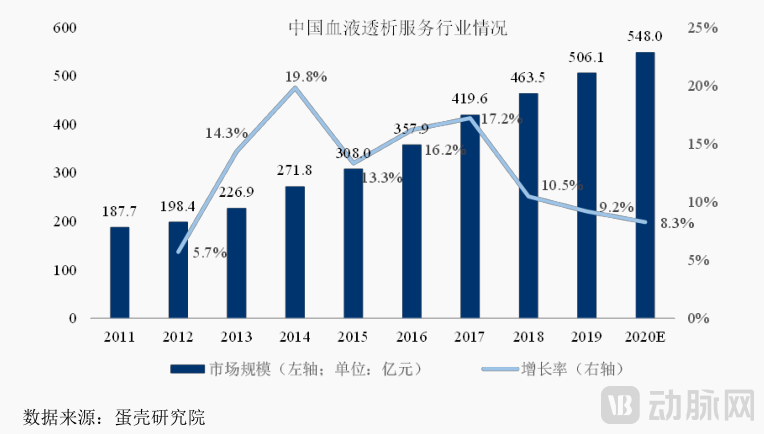 Image source: Prospectus
Looking at the upstream sector, in 2020, the market sizes for dialysis machines, dialyzers, other consumables (such as powder/liquid concentrates and tubing), and pharmaceuticals were approximately RMB 3.8 billion, RMB 6.6 billion, RMB 5.3 billion, and RMB 6.4 billion, respectively. As the market size of hemodialysis centers expands, demand for dialysis equipment and consumables will continue to rise. It is projected that by 2025, the combined market size of the upstream industry chain—including dialysis equipment, pharmaceuticals, and consumables—will approach RMB 30 billion.
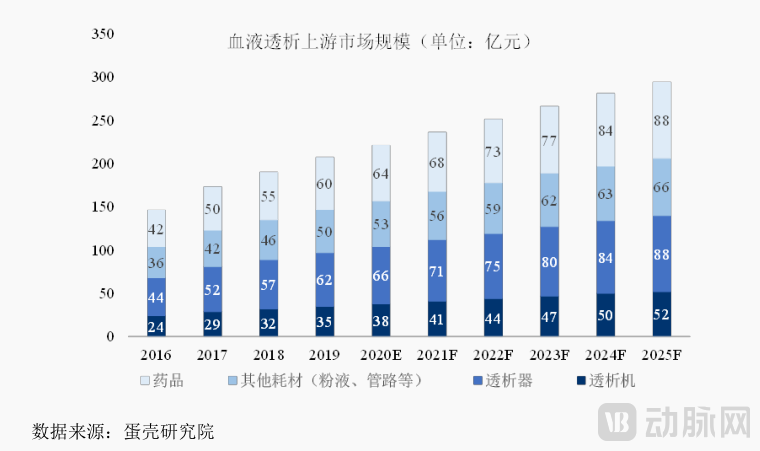 Image source: Prospectus
Of course, as the blood purification equipment sector is a technology- and talent-intensive high-tech industry characterized by significant R&D challenges, long development cycles, high entry barriers, and stringent regulation, it requires substantial investment in R&D personnel and funding. This imposes extremely high demands on companies’ financial resources, technological capabilities, and talent pool, resulting in limited participation by domestic enterprises in the market.Currently, the market share of hemodialysis machines in China still mainly relies on imported products.
According to statistics from VCBeat Research Institute, Fresenius topped the list of domestic hemodialysis machine sales in 2020 with a 30% market share. The five major foreign manufacturers—Fresenius, B. Braun, Nikkiso, Baxter, and Nipro—collectively accounted for approximately 80%-90% of China’s hemodialysis market. Currently, the market for hemodialysis machines in China is highly concentrated, with import brands dominating the majority of the market share, while domestically produced independent brands hold only about 10%-20%.
Against this backdrop,We believe that with the public listings of outstanding domestic enterprises represented by SWS MEDICAL, coupled with continuous technological advancements, the pace of import substitution in the blood purification market will further accelerate.