▲May 14-15Shanghai BiopharmaceuticalsInnovators SummitScan to Register
Disclaimer: Due to limited expertise, errors are inevitable, and some information may not be the most up-to-date. Comments pointing out any inaccuracies are welcome. This article is solely for the introduction of drugs related to healthcare.Non-therapeutic program recommendations (if applicable); This article does not constitute any investment advice.。
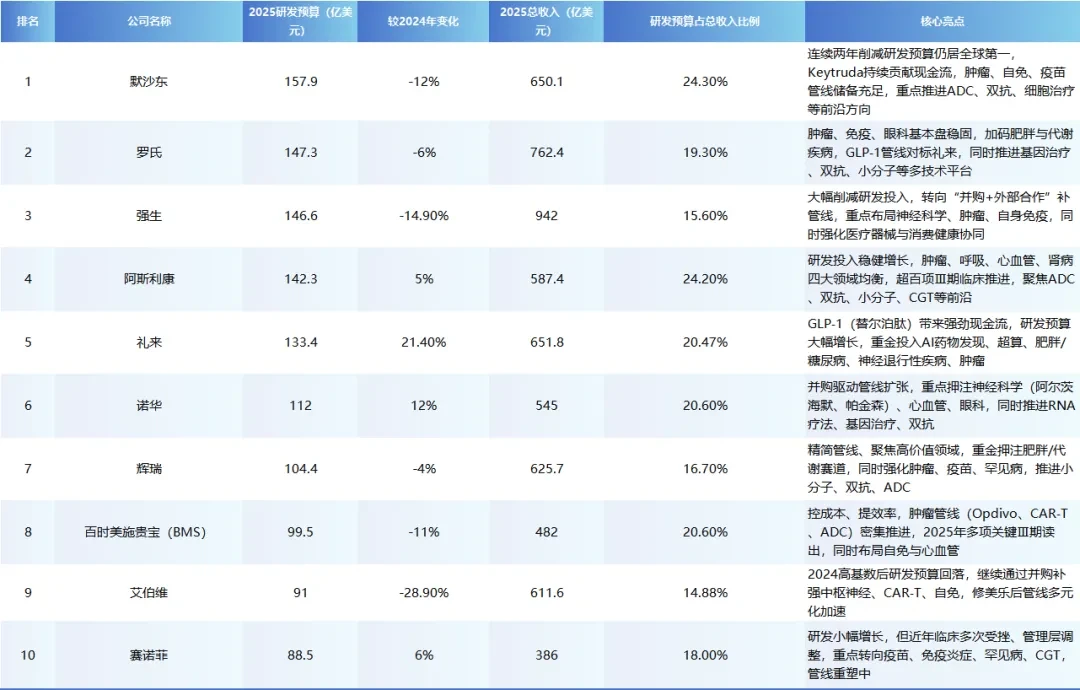
The wind direction of capital has changed. By 2025, the total R&D investment of the world's top ten pharmaceutical giants will drop to$121.8 billion, a contraction compared to 20245.39%——This is the first overall decline in recent years. Under the multiple pressures of policy uncertainty, rising capital costs, and the approaching patent cliff, the giants are collectively adjusting their course.
First, let's look at the rankings:
Seven companies cut expenditures, while only three increased investment against the trend.Merck & Co.In$15.79 billionRemained at the top of the rankings, but with a 12% budget reduction;RocheUp one place to second, R&D investment$14.73 billion;Johnson & JohnsonEli Lilly stood out as the most dazzling underdog, with a 21.4% increase in R&D spending and a leap of two places in the rankings during this "capital winter," while others saw a significant 14.9% cut in R&D expenditure, dropping from perennial second to third place.
Political changes have directly impacted the innovation ecosystem of the U.S. biopharmaceutical industry, such as cuts in NIH funding, ambiguous FDA approval expectations, and sudden tariff policies. The dramatic shifts in the external environment have forced pharmaceutical companies to reassess the "risk-return" ratio of every dollar invested in R&D.
This is not simply "belt-tightening," but a systematic reshaping of pipeline priorities. Johnson & Johnson has exited multiple infectious disease and vaccine projects to focus on oncology, immunology, and neuroscience; AbbVie’s R&D budget dropped sharply by 29%, but after adjustments, it actually increased by approximately $1 billion; Bristol-Myers Squibb has concentrated resources on high-potential areas by terminating inefficient projects.
The proportion of R&D budget to revenue has generally declined, but the quality of investment is improving — the industry is shifting from "scale expansion" to "efficiency first."
Merck: Rational Contraction with a Tight Exterior and Relaxed Interior
R&D Budget: $15.79 billion, a year-on-year decrease of 12%Total Revenue in 2025: $65.01 BillionR&D as a percentage of revenue: 24.3%Although Merck remains firmly at the top, its budget has declined for the second consecutive year. The strategic shift is clear — tightening externally while loosening internally. In 2024, four deals exceeding $500 million each pushed the budget higher, while in 2025, the largest expenditure will be $300 million allocated for the technology transfer of MK-2010, a PD-1×VEGF bispecific antibody.However, internal R&D continues to intensify. Merck Research Laboratories (MRL) spending reached $10.8 billion, increasing by $700 million year-over-year, marking more than a decade of continuous growth. This team of 24,700 members carries a dual mission: sustaining the success of Keytruda and preparing for its patent expiration in 2028.Phase III Data for Enlicitide Decanoate, an Oral PCSK9 Inhibitor, Expected in 2025. Looking Ahead to 2026, More Key Data Will Be Released. CEO Robert Davis Predicts That by the Mid-2030s, the Company Will Face a $70 Billion Annual Commercial Opportunity.Roche: A Dual-Track Balance of Preservation and PressureR&D Budget: $14.73 billion, a year-on-year decrease of 6%Total Revenue in 2025: $76.24 BillionR&D as a percentage of revenue: 19.3%Roche slightly cuts R&D investment, but its ranking rises from third to second, backed by a precise strategy of selective support and pressure.Tumors remain the core focus. The key priority is advancing the KRAS inhibitor divarasib, with plans to submit a marketing application for non-small cell lung cancer by 2026. The Phase III data for the oral estrogen receptor degrader giredestrant is impressive — reducing the risk of recurrence or death by 30%, and a submission for second-line breast cancer indication has already been made.Doubling Down on Obesity Strategy by 2025, Aiming for Top Three Globally. Core Weapon: GLP-1/GIP Dual Receptor Agonist CT-388, Phase II Weight Loss Data Comparable to Eli Lilly's Zepbound.However, adjustment means trade-offs. The restructuring of gene therapy subsidiary Spark Therapeutics and the reconfiguration of cancer data company Flatiron's resources have offset the growth of investment in specific areas.Johnson & Johnson: Radical Transformation Through M&A AlternativesR&D Budget: $14.66 billion, a year-on-year decrease of 14.9%Total Revenue in 2025: $94.2 BillionR&D as a percentage of revenue: 15.6%Johnson & Johnson's transformation is the most radical — a full shift from internal R&D to external mergers and acquisitions. The R&D budget decreased by nearly 15%, while investment in the M&A market reached $17.6 billion.Johnson & Johnson to Acquire Central Nervous System Specialist Intra-Cellular Therapies for $14.6 Billion in Early 2025, Followed by $3 Billion Acquisition of Halda Therapeutics in November. The Latter’s Cell Death Platform Expected to Build on the Success of Johnson & Johnson’s Prostate Cancer Drug Erleada.Behind this "merger and acquisition alternative" are continuous setbacks in the internal pipeline. However, external acquisitions have effectively hedged the risks. There are still highlights in the pipeline: icotrokinra, a psoriasis drug developed in collaboration with Protagonist, outperformed BMS's Sotyktu in Phase III trials; early data from the next-generation dual-target CAR-T therapy achieved a 100% response rate.AstraZeneca: Deep Ties in the Chinese MarketR&D Budget: $14.23 billion, a 5% increase year-over-yearTotal Revenue in 2025: $58.74 BillionR&D as a percentage of revenue: 24.2%AstraZeneca Maintains Positive R&D Growth, Strategic Core Lies in Deeply Binding with the Chinese Market.The company commits to investing 15 billion US dollars in China over the next five years, while reaching an 825 million US dollar rare disease collaboration with JCR Pharmaceuticals. This "deep integration" strategy enhances adaptability in the Chinese market.Despite setbacks on the 2025 R&D journey, the company emphasized positive data from pre-specified subgroups. CEO Pascal Soriot remained resolute: "We have over 100 Phase III studies underway, and these transformative technologies hold the potential to alter patient treatment outcomes."Lilly: The Capital Feast of the Obesity Drug WaveR&D Budget: $13.34 billion, a year-on-year increase of 21.4%Total Revenue in 2025: $65.18 BillionR&D as a percentage of revenue: 20.47%Eli Lilly Shines as the Brightest Star in 2025 — Achieving a Stunning Comeback with GLP-1 Blockbuster Tirzepatide. In Q3 2025, the drug's sales surpassed Merck's Keytruda, making the company the first pharmaceutical enterprise to break the $1 trillion market value."We plan to transform the revenue from weight-loss drugs into the 'cornerstone' of a global innovation ecosystem," revealed a senior executive at Eli Lilly. This ambition has been demonstrated through a series of strategic moves: collaborating with NVIDIA to launch LillyPod, the pharmaceutical industry's largest supercomputer; and expanding the global incubator network, Lilly Gateway Labs.Simultaneously expanding into gene therapy by acquiring Adverum, which is facing cash flow challenges, for approximately $74 million.
The core mission is to advance the oral GLP-1 drug orforglipron, with an anticipated market launch in 2026. Evaluate Pharma has ranked it as the second most anticipated new drug launch for 2026.Novartis: Merger and Acquisition-Driven Transformation LeapR&D Budget: $11.2 Billion, Up 12% Year-over-YearTotal Revenue in 2025: $54.5 BillionR&D as a percentage of revenue: 20.6%Novartis Ranks Up Three Places to Sixth, Growth Mainly Driven by M&A-Driven R&D Investment.Following the $2.9 billion acquisition of MorphoSys in 2024, Novartis made a whopping $12 billion acquisition of Avidity Biosciences, a late-stage muscular dystrophy company, in 2025. CEO Vas Narasimhan explained that the acquisitions aim to position Novartis as "a leader in the neuromuscular disease field."The company maintains its focus on the brain and heart while adjusting its pipeline and divesting certain inefficient assets.Pfizer: Strategic Adjustments in the Post-Pandemic EraR&D Budget: $10.44 billion, a year-on-year decrease of 4%Total Revenue in 2025: $62.57 BillionR&D as a percentage of revenue: 16.7%Pfizer Reflects Strategic Adjustments in the Post-Pandemic Era. After the peak income of COVID-19 vaccines, the company recalibrated its R&D focus.The largest move in 2025 is the $10 billion acquisition of Metsera. At the end of the year, it also obtained the authorization for a GLP-1 candidate drug from a subsidiary of Fosun Pharma, with a total transaction value of up to $1.9 billion.However, the pipeline encountered setbacks. The development of inclacumab was terminated after multiple trial failures. In February 2025, the gene therapy pipeline was cleared, but subsequently re-entered the field by acquiring a candidate drug from Beam Therapeutics.CEO Albert Bourla's Shift in Stance Amid Policy Fluctuations Draws Attention: From Being Seen as Close to the Trump Administration to Publicly Criticizing Anti-Vaccine Positions.Bristol-Myers Squibb: Rational Return to Cost Reduction and Efficiency ImprovementR&D Budget: $9.95 billion, a year-on-year decrease of 11%Total Revenue in 2025: $48.2 BillionR&D as a percentage of revenue: 20.6%BMS Tightens Expenses, Cuts R&D Budget by 11%. This cut is not simply "cost-saving" but a rational reallocation of resources.The company achieved cost reduction and efficiency enhancement by optimizing its structure and cutting inefficient assets. Preclinical spending decreased from an average of over 1.5 billion USD annually in the past three years to 1.3 billion USD, while impairment expenses significantly dropped from 980 million USD to 385 million USD.CEO Christopher Boerner Drives Plan to Save $1.5 Billion in 20 Months. Fewer Late-Stage Data for New Drugs in 2025, but Multiple Myeloma Drug Iberdomide Achieves Success Through Mid-Term Adjustments.AbbVie: The Painful Transformation of Pipeline SlimmingR&D Budget: $9.1 billion, a year-on-year decrease of 28.9%Total Revenue in 2025: $61.16 BillionR&D as a percentage of revenue: 14.88%AbbVie saw the largest decrease, with its R&D budget falling by 28.9%, driven by a strategic shift to streamline its pipeline.Driven by the $8.7 billion acquisition of Cerevel in 2024, R&D investment surged by 66%. However, the failure of two Phase II trials for Cerevel's schizophrenia drug emraclidine resulted in a $3.5 billion loss.The company remains committed to its acquisition-driven strategy. In 2025, it acquired the depression drug Bretisilocin for $1.2 billion and purchased Capstan Therapeutics, an in vivo CAR-T company, for $2.1 billion.However, it is also scaling back internal R&D. The long-term collaboration with Calico Labs has been terminated, resulting in the departure of approximately 100 employees from the collaborative team.Sanofi: Focused Challenges in ImmunologyR&D Budget: $8.85 BillionTotal Revenue in 2025: $38.6 BillionR&D as a percentage of revenue: 18%Sanofi Focuses on Immunology but Faces Challenges on the R&D Road in 2025.Core product Dupixent annual sales exceed 13 billion euros. However, the company has encountered a series of clinical setbacks, including the failure of the anti-OX40 ligand antibody in Phase II asthma trials and the oral TNF inhibitor not meeting goals in mid-stage research.CEO Paul Hudson once emphasized the progress of the transformation, but high expectations brought pressure. As time passed, the pressure to find revenue replacements for Dupixent increased. In February 2025, the board removed Hudson and appointed Belén Garijo as his successor, with one of the core tasks being to enhance R&D productivity.Chinese pharmaceutical companies absent from Top 10, but with a steep growth curve
In the Top 10 global R&D budgets for 2025, Chinese pharmaceutical companies are still absent. The lowest threshold, represented by the tenth-ranked Sanofi, has an R&D budget of $8.85 billion, while Hengrui Medicine, which currently has the highest R&D investment in China, is expected to spend approximately $1.2 billion on R&D in 2025, showing a still significant gap.
But this does not mean the silence of China's innovative drugs. On the contrary, in the past five years, the R&D investment of Chinese pharmaceutical companies has achieved an average annual growth rate of 17.3%, far exceeding the global average. Local innovative companies such as BeiGene, Innovent Biologics, and Junshi Biosciences have increased their R&D intensity to the range of 30%-40%.
In cutting-edge fields such as PD-1/PD-L1 inhibitors, ADC drugs, and CAR-T therapies, the number of clinical pipelines of Chinese pharmaceutical companies has risen to the second largest globally. By 2025, the total number of new drugs under research in China will exceed 5,000, accounting for 15% of the global share, up from 5% five years ago.
"We are transitioning from 'imitation and innovation' to 'original innovation,'" said a research and development head of a leading pharmaceutical company in China. "Although it is difficult to match the overall investment scale of multinational giants in the short term, we already have the capability for breakthroughs in specific technological pathways and disease areas."
In my view, the reduction in the "R&D budget" for 2025 is not a sign of industry decline but rather a profound strategic recalibration. Companies that can maintain their commitment to R&D during this contraction, focus on technological trends, and build innovative ecosystems through openness will gain a competitive edge in the next industrial cycle.
Source:https://www.fiercebiotech.com/
Copyright Statement: This article is reproduced fromThe Era of Biologics, Media or individuals who do not wish to be reprinted can contact us, and we will delete it immediately.