

Beyond Digitalization: Yaoyanshe Strengthens Forward-Looking Medical Strategy with T4S Service Upgrade
In recent years, driven by a series of favorable policies for the biopharmaceutical industry, China’s investment in pharmaceutical innovation and R&D has continued to increase, leading to sustained growth in the clinical CRO (contract research organization) sector, which serves as critical “infrastructure.” Meanwhile, national laws and regulations have imposed new requirements on the industry’s standardization and professionalism.
In the new era of value-based medicine, Yaoyanshe recently announced the appointment of Ms. Zhang Yun as Chief Operating Officer (COO).In this role, Yun Zhang will lead the strategic upgrade of Yaoyanshe’s T4S services, deepening the clinical research service closed loop characterized by “medical strategy first, expertise in study design, SaaS technology application, and innovative service concepts,” thereby strengthening Yaoyanshe’s value proposition in both medical strategy formulation and deliverable outcomes within clinical research.
Ms. Zhang Yun has 10 years of experience in preventive medicine and as a clinician, along with over 20 years of experience in multinational pharmaceutical companies and domestic innovative drug enterprises, specializing in clinical research, medical affairs, and regulatory registration.
As a leading figure in the medical field, Ms. Zhang Yun has worked at renowned domestic and international pharmaceutical companies such as MSD, Sanofi, GSK, Takeda Pharmaceutical, and Hengrui Medicine, holding senior executive positions including Head of Medical for Greater China, Vice President of Asia Pacific, and Deputy General Manager.
She led her team in building a comprehensive post-marketing clinical research system, advancing more than 200 clinical studies and establishing the group as an outstanding professional medical affairs team within the industry. Multiple research initiatives spearheaded by her team were accepted and recommended by national authoritative academic institutions and presented at international conferences.
Meanwhile, she also serves as a Standing Committee Member of the Biological Products Branch of the Chinese Preventive Medicine Association, a Standing Committee Member of the Professional Committee on Real-World Studies of Drugs and Medical Devices, a Standing Committee Member of the Professional Committee on Clinical Research Management in Oncology of the China Anti-Cancer Association, and a member of the Chinese Medical Affairs Expert Group. She participated in the compilation of *Medicine-Driven* and *Smart Medicine*, and served as a chief reviewing editor for *Clinical Standards for Post-Marketing*.
Seizing this opportunity, VCBeat interviewed Ms. Zhang Yun, COO of Yaoyanshe, to gain deeper insights into its innovative model, the specifics of this strategic upgrade, and its future plans.
The following is a transcript of part of the interview:
VCBeat: We understand that your previous professional experience was primarily in pharmaceutical companies. What prompted you to join YaoYanShe?
Zhang Yun:I believe that pharmaceutical companies/sponsors and CROs share a mutually supportive and collaborative partnership, with both parties dedicated to serving patients and investigators. Having worked in the pharmaceutical industry for over 20 years, I have always regarded clinical CROs as valuable partners. My decision to join a CRO was driven by the desire to adopt a new perspective, gain a more comprehensive understanding of the challenges encountered in the execution of clinical studies, and better address diverse, complex, and personalized research needs.
I chose Drug Research Society because I recognized its emphasis on technological innovation and long-term planning, as well as its strong alignment with the company’s mission and vision. Drug Research Society’s corporate vision is “to be the most compassionate and trustworthy technology platform in the pharmaceutical R&D ecosystem, with patients at the center.” This resonates deeply with me and reflects the aspirations we all share as clinical research professionals.
VCBeat: As a seasoned medical affairs professional, how do you view the current state of the clinical CRO industry?
Zhang Yun:In recent years, with the rapid development of China’s innovative drug industry, the clinical CRO sector has experienced explosive growth and rapid expansion. However, it still faces challenges such as a shortage of experienced professionals and inconsistent quality in clinical research.
As laws and regulations continue to improve, the development of Contract Research Organizations (CROs) has gradually entered a stage of specialization and standardization. In particular, the frequent introduction of laws and regulations in recent years, such as the Consistency Evaluation for Generic Drugs, the new Good Clinical Practice (GCP) guidelines, the “Guiding Principles for Clinical Development of Anticancer Drugs with a Focus on Clinical Value,” the “Guiding Principles for Real-World Evidence,” and the “Guidance on Investigator-Initiated Trials (IITs),” has provided direction and requirements for the clinical research industry, which is characterized by high professionalism, high complexity, and the need for long-term management.
This presents both opportunities and challenges for the clinical research industry. To enhance the efficiency of clinical research, standardization, normalization, systematization, and digitalization are inevitable.
VCBeat: What opportunities and pain points has Yaoyanshe identified?
Zhang Yun:The successful development of innovative drugs requires substantial, scientifically rigorous clinical evidence. This necessitates collaboration with large-scale clinical research organizations, particularly innovative contract research organizations (CROs).
The clinical research operational phase is the most time-consuming and costly, wherein workforce efficiency management, data management, and statistical analysis play a decisive role in the generation of research evidence and the successful market approval of drugs.As a service-oriented industry heavily reliant on human resources, challenges such as the shortage and high cost of professional talent, inadequate business system processes, and low efficiency all impact the quality of clinical research.
Clinical research is a highly rigorous process. How to ensure that the digitalization of clinical research meets the requirements of "standardization, normalization, proceduralization, precision, and unification," and gains recognition from laws, regulations, and industry experts, requires continuous practice, repeated validation, and iterative upgrades.
VCBeat: How has Drug Research Society addressed these industry pain points? What are the advantages of its business model?
Zhang Yun:The innovative model of Drug Research Society was born to address these challenges, with our advantages centered around three core pillars: “data-driven, talent innovation, and technology empowerment.”
First, after six years of in-depth development and accumulation, Yaoyanshe enjoys a first-mover advantage in data aggregation. By consolidating publicly available information, platform-shared data, and primary service data derived from projects, it continuously enriches and forms“Digital Clinical Research Map”, as an information reference, to achieve "precision navigation" for clinical trials.
Thanks to the guided execution checklist, our center’s startup efficiency significantly outperforms peers, with a 33% improvement; by leveraging digital tools to support clinical research decision-making, we have increased our center survey and screening efficiency by 80%.
This “Digital Clinical Research Map” can help foster industry-wide collaboration, eliminate information asymmetry, reduce communication costs, time costs, and operational risks, establish service standards, and deliver greater value in clinical research.
In terms of technology empowerment, it is usTransforming experience into knowledge through digital technology, and optimizing workforce efficiency via a structured knowledge system.. While individual capabilities are inherently limited, leveraging digital tools to deconstruct each execution step into standardized and regulated sub-processes can help mitigate the impact of variability in personnel competence on trial quality and efficiency, thereby laying a solid foundation for more flexible hybrid workforce models.
Meanwhile, digital tools and platform systems synchronize information among service providers, researchers, and patients, enabling real-time, standardized management of personnel and projects. This significantly enhances the accuracy and operational efficiency of clinical trial data, thereby optimizing data analysis quality, empowering project management and execution, improving efficiency, and achieving risk early warning.
In terms of talent supply, we have established a proprietary industry talent innovation network that covers 95% of practitioners across more than 210 cities in China. This network extends to third- and fourth-tier cities, encompassing the majority of county-level medical institutions, thereby fully enabling large-scale, localized clinical research and medical services.
Real users active on our practitioner tools provide continuous feedback through real-world data, enabling us to maintain the most comprehensive talent profiles in the industry and achieve precise capability matching for clinical research project execution. Meanwhile, we have established a robust system for talent assessment, incentives, and certification, effectively ensuring project delivery capabilities.
VCBeat: What is the current T4S strategic plan being implemented by Yaoyanshe? Could you elaborate on it in detail? What triggered this strategic upgrade?
Zhang Yun:One of the key initiatives in Pharmabook’s 2021 strategic upgrade was the launch of its comprehensive T4S service system, which covers the entire clinical development lifecycle. In this model, “T” stands for “Total,” representing an integrated layout, while “4S” denotes the four core components provided by Pharmabook: Strategy consulting, Solution design, a multi-terminal interconnected digital System, and full-scenario integrated Service delivery for clinical studies. This framework spans clinical research strategy, protocol design, project execution, and result delivery, providing comprehensive empowerment for clinical research.
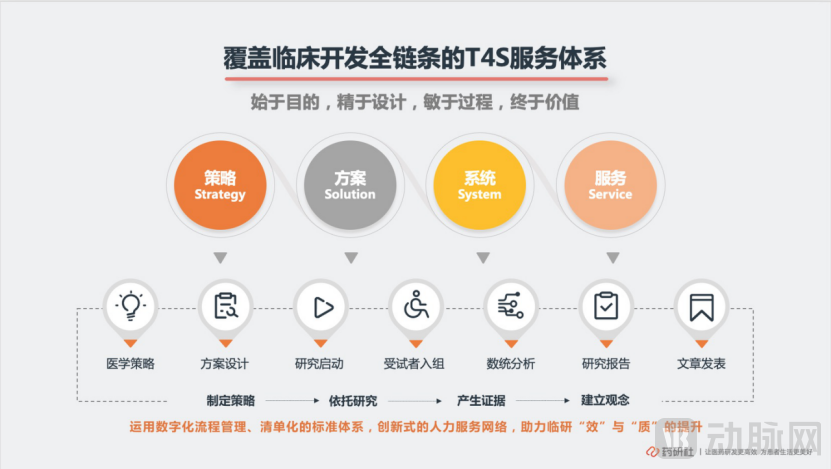
Yaoyanshe T4S Service System
These four modules can be applied independently or integrated seamlessly, offering a customizable, building-block-style combination. The T4S service system is defined by four key words:“Purpose-driven, design-focused, process-agile, value-delivered.”
Through its business accumulation in recent years, Drug Research Society has established unique advantages in the digitalization and standardization of clinical services. The strategic upgrade not only meets market demands but also further expands its areas of competitive advantage.
Currently, many emerging biotech and biopharma companies lack experience in medical strategy and clinical trial design, creating an urgent need for support from medical experts and strategic consulting services. The value that Yaoyanshe aims to deliver“Making drug development more efficient” means that cost and talent supply will no longer be barriers to new drug development.。
VCBeat: Compared with other digital CROs, what do you think are the differences of Pharmaron?
Zhang Yun:My understanding is that Yaoyanshe is not merely a digital CRO, but rather a digital CRO combined with a technological innovation platform. Distinct from traditional CROs that focus on execution-oriented clinical operations, Yaoyanshe features an innovative service philosophy known as T4S, a proprietary talent network model, and the “Clinical Research Digital Map,” which empowers industry decision-making in clinical research.
While upholding innovation, we also prioritize empathy by supporting frontline professionals. For instance, we provide the “Yaoyanshe APP,” a free efficiency tool for practitioners, and have created the public-welfare space “Huaka.” Our goal is not merely to become an outstanding CRO company, but to care for and empower the ecosystem, delivering interactions that are both valuable and compassionate to all stakeholders in the clinical research landscape.
VCBeat: What do you think the future development path of CROs will look like?
Zhang Yun:I believe that, under increasingly stringent policies and regulations, the future of China’s CRO industry will further strengthen its patient-centric, clinical value-oriented approach.。Aligned with the trends across the entire pharmaceutical R&D industry chain, the future development of China’s CRO sector will inevitably be characterized by digitalization, standardization, global interconnectedness, information sharing, and personalized talent development.
VCBeat: What are Yaoyanshe's future development plans?
Zhang Yun:Looking ahead to the future of Yaoyanshe, with technological iterations, data accumulation, and growing project experience, we will gradually refine and mature our product offerings and business strategies. This will enable us to deliver end-to-end clinical research services with greater capability and efficiency. In terms of organizational planning, we have recently recruited several highly experienced medical professionals, ensuring that our team is well-prepared. We are very confident in enhancing Yaoyanshe’s medical strategy, clinical research delivery capabilities, and overall value proposition.
In the future, Drug R&D Society will not only leverage digitalization to address operational efficiency issues and better serve the “three stakeholders and two ends”—namely patients, researchers, practitioners, pharmaceutical companies or sponsors, and hospital institutions—but also provide comprehensive strategic support and delivery capabilities covering the entire drug lifecycle. This will create a closed-loop service system for clinical research. We aim to deliver multi-party win-win value to all participants in clinical research and truly become the most trusted partner for everyone.
About Drug Research Society
Founded in 2015, it is China’s leading innovative digital service platform for clinical research. The company completed its Series D financing round in 2020 and has garnered recognition from top-tier investors, including Yuanjing Capital, Matrix Partners China, Yansheng Capital, Zhongding Capital, Sequoia Capital, and GGV Capital.
Drug Research Society’s business scope covers CRO services such as clinical monitoring, project management, regulatory affairs, biostatistics, pharmacovigilance, and medical affairs; SMO services including central site management, patient recruitment and management; clinical research talent dispatch services; and intelligent information reporting. The company currently employs over 800 staff, with offices in Shanghai, Beijing, Jiangsu, Guangzhou, Xi’an, and Wuhan, and its clinical operations team covers 210 cities across China. The various scientific research topics and study projects in which the company participates span multiple disease areas, including oncology, cardiovascular, endocrinology, respiratory, central nervous system, ophthalmology, and pediatrics, as well as vaccines, medical devices, and diagnostic reagents.