

Escope Tech Completes Hundreds of Millions RMB Series A+ Financing to Advance Computational Medicine in Cardio-Cerebrovascular Imaging

ESCOPE
AI Developer for Cardio-Cerebrovascular Disease Diagnosis and Treatment Technologies
In China, medical imaging accounts for over 80% of all clinical data. By providing visual representations of internal organs and tissues, it serves as the cornerstone of clinical diagnosis, disease treatment, and health management. In recent years, with the rapid development of technologies such as artificial intelligence, machine vision, and simulation science, AI- and simulation-based medical imaging analysis systems have been able to provide comprehensive support for image interpretation. These systems significantly enhance the efficiency and accuracy of clinical diagnosis, treatment, and management, substantially improve patients’ diagnostic and therapeutic experiences and outcomes, and help avoid unnecessary surgeries and medical expenses.
According to industry forecasts disclosed in the IPO prospectus of an AI medical imaging company, China’s AI medical imaging solutions market (including diagnosis, treatment, and health management) will grow from less than RMB 1 billion in 2020 toRMB 44.2 billion in 2025, with a compound annual growth rate (CAGR) of 135.9%, and is projected to further increase to RMB 155.4 billion by 2030, representing a CAGR of 28.6% from 2025 to 2030.
In this exponentially growing market, AI-assisted diagnosis and treatment of cardiovascular and cerebrovascular diseases using medical imaging constitute the largest and most dynamic segment. This sector has attracted numerous medical imaging technology service providers, including ESCOPE, RayHeart Medical, Keya Medical, and Heart Century Medical.
Among them, ESCOPE has been deeply engaged in the field of computational medicine for heart and brain diseases for many years. The company builds a multi-dimensional medical imaging analysis system based on CT, MRI, DSA, and other medical images, with four core modules: high-precision simulation technology, graphic image processing technology, data mining technology, and deep network learning technology. Its aim is to establish the world’s most professional imaging and data analysis platform for cardiovascular and cerebrovascular diseases.
ESCOPE was founded in 2017 by professors, engineers, and entrepreneurs returning from the United States and Europe. Leveraging a standardized evidence-based medicine system and computational medicine paradigms, and harnessing foundational technologies such as artificial intelligence, medical imaging, machine vision, simulation science, and data mining, the company has achieved a comprehensive upgrade in clinical diagnosis from morphological to functional imaging indicators. It is reported that ESCOPE’s products are positioned atCoronary (Coronary Artery Analysis), Cardiac (Cardiac Function Assessment), Cranial (Intracranial Artery Analysis), Cerebral (Cerebral Function Assessment), and Peripheral (Systemic Artery Analysis): Five Major Domains, providing end-to-end solutions for cardiovascular and cerebrovascular diseases, covering screening, diagnosis, preoperative planning, intraoperative navigation, and postoperative follow-up.
Recently, ESCOPE announced the completion of its A+ round financing, amounting to hundreds of millions of yuan. The investors participating in this round were all well-known institutional and industrial investors.including Dazhen Capital, Rongquan Venture Capital, Tasly Capital, and the investment fund under Shanda Group. The proceeds from this financing round will be used to accelerate the company’s parallel R&D of multiple products, clinical trials in China and the United States, and commercialization efforts.Zhang Chao, Founder of ESCOPEstated that these renowned investors’ investment in the company and their long-term, multi-faceted support not only serve as an endorsement and recognition of the company’s competitive strength and development prospects, but will also introduce abundant industry resources and professional talent to the company, helping it enhance and refine its corporate governance standards and fueling rapid business growth.
From Invasive to Non-Invasive FFR: ESCOPE Pioneers the “Heart-Vessel Integrated” Detection Model
According to data from the "Report on Cardiovascular Health and Diseases in China 2020," the number of cardiovascular disease patients in China has currently reached 330 million, with the prevalence rate continuing to rise. Among these, coronary heart disease (CHD) is a highly prevalent condition within cardiovascular diseases, with the number of patients exceeding 11.39 million. For many years, CHD has been the leading cause of death both globally and in China. In 2019, the number of deaths due to CHD reached 9 million globally and 1.75 million in China.
With the continuous increase in the number of patients with coronary heart disease (CHD), greater emphasis is being placed on the precise diagnosis and treatment of CHD. In clinical practice,Fractional Flow Reserve (FFR)-Based Diagnostic Pathway for Coronary Artery Disease Has Become Expert Consensus and Guideline RecommendationFractional Flow Reserve (FFR) refers to the ratio of the maximum blood flow achievable in a vessel with a stenotic lesion to the maximum blood flow achievable in the same vessel under normal conditions. It assists physicians in assessing the severity of coronary artery stenosis and determining whether it is likely to induce myocardial ischemia.
In the past, clinical measurement of fractional flow reserve (FFR) required invasive intervention using pressure guidewires. This approach was associated with drawbacks such as invasiveness, procedural complexity, high cost, and elevated risk, leading to low patient compliance and limited clinical adoption. In contrast, non-invasive CT-derived FFR (CT-FFR) primarily leverages technologies such as artificial intelligence and computational fluid dynamics, using algorithms to replace pressure guidewire-based measurements. Due to its advantages—including non-invasiveness, precision, cost-effectiveness, and ease of operation—CT-FFR holds promise for replacing traditional invasive FFR and achieving widespread application in the clinical diagnosis and health screening of coronary artery disease.
Zhang Chao, Founder of ESCOPE“It is stated that, considering future alternatives, invasive FFR, as the gold standard for the functional diagnosis of coronary stenosis, holds its own value in certain specific application scenarios and will not be completely replaced by CT-FFR. However, with the enhanced non-invasiveness and safety of CT-FFR, it will play a more significant role in scenarios such as initial screening for patients with moderate coronary artery disease. The inclusion of CT-FFR technology as a Class IIa recommendation in the latest guidelines released by the American Heart Association in October 2021 further corroborates this fact.”
CT-FFR is a typical representative of computational medicine.The concept of computational medicine, first proposed in 2005, emphasizes leveraging technologies such as artificial intelligence, medical imaging, machine vision, simulation science, and data mining to meet the standards required for practical clinical applications. This aligns precisely with the positioning of Escope, a company that, based on the frameworks of computational medicine and evidence-based medicine, focuses on cardiovascular and cerebrovascular clinical applications and is committed to providing a suite of imaging-assisted diagnostic and therapeutic solutions designed to address clinical needs.
ESCOPE's CT-FFR ProductPulseShadow®It is a coronary artery physiological function assessment software that primarily integrates coronary CTA anatomy with FFR functional evaluation. Based solely on resting CTA data, without the need for special scanning protocols or additional medications, it simulates coronary blood flow and pressure using computational fluid dynamics (CFD). Through complex image processing and computational procedures, it enables the acquisition of FFR values at any point along the coronary arterial tree.
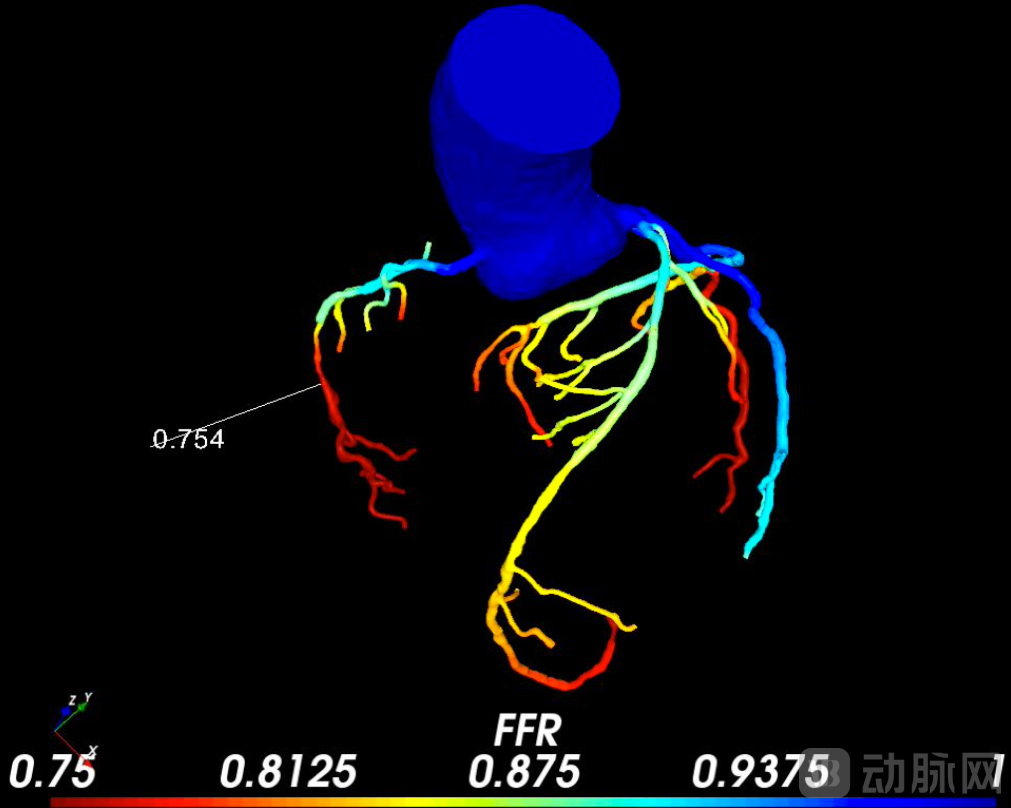
ESCOPE Maiying®Inspection Examples
Currently, ESCOPE"Maaying has been completed."®Product Clinical Trials; Expected to Obtain NMPA Class III Medical Device Registration Certificate in Mid-2022. Meanwhile, ESCOPE alsoVBInsight has been launched.®Product FDA Certification and U.S. Clinical Trial Process。
Unlike its competitors, ESCOPE has not rested on its laurels with a standalone coronary CT-FFR product but has achieved significant breakthroughs in the depth of its product portfolio. Building upon CT-FFR technology, ESCOPEPioneered the “Heart-Vessel Integration” Detection Model, achieving integrated functional assessment from the heart to the coronary arteries.
Clinically, FFR values serve solely as an indicator for assessing the adequacy of coronary blood supply and cannot evaluate the functional status of downstream myocardium or cardiac chambers. Therefore, when diagnosing structural heart diseases such as valvular heart disease and cardiomyopathy, FFR should not be used as the sole diagnostic criterion. Physicians typically require additional clinical parameters—including myocardial strain, chamber hemodynamics, transvalvular pressure gradients, and ejection fraction—to facilitate a precise assessment.
In 2019, American and European clinicians proposed that the future direction of CT-FFR testing is “integrated heart-vessel assessment.”—By performing a single CT scan, all parameters related to blood flow from the cardiac chambers to the coronary arteries are analyzed. When conducting FFR analysis on patients’ CT angiography images, precise modeling and analysis of the myocardium and heart valves are simultaneously performed, providing a comprehensive set of cardiopulmonary parameters. This is ESCOPE’s pioneering “integrated cardio-vascular” imaging diagnosis, which better aligns with clinicians’ needs and offers more precise and comprehensive guidance for clinical diagnosis and treatment.
ESCOPE's Second Flagship ProductCardiac SilhouetteIt is a software solution that provides comprehensive evaluation of cardiac function. Based on CT angiography images, XinYing enables precise modeling and data mining of the ventricles and valves. By leveraging image processing and simulation technologies, it accurately assesses clinical parameters such as myocardial strain, chamber hemodynamics, transvalvular pressure gradients, and ejection fraction in patients with valvular heart disease, thereby assisting physicians in making functional diagnoses of valve pathology. Furthermore, XinYing utilizes simulation technology to perform preoperative planning for the positioning and deployment depth of prosthetic valves, providing surgical strategy guidance for clinical procedures including TAVR (Transcatheter Aortic Valve Replacement), TMVI (Transcatheter Mitral Valve Implantation), and LAAO (Left Atrial Appendage Occlusion), thus further reducing the risk of postoperative adverse events.
Cardiac Silhouette and Vascular Silhouette®This synergy perfectly meets clinicians’ needs for cardiac CT examinations, enabling direct acquisition of a comprehensive set of hemodynamic parameters—from the ventricles to the aorta—through a single CT scan. This eliminates the need for additional image acquisition procedures, significantly reducing the diagnostic and therapeutic burden on clinicians. Meanwhile, patients can undergo a complete cardiac functional assessment and evaluation with just one cardiac CT scan, greatly enhancing their medical experience and examination outcomes.
Top Industry Experts from the US and Europe Join Forces to Break Through Major Technical Bottlenecks
Zhang Chao, founder of ESCOPE, earned his Ph.D. through a joint program between the School of Medicine and the Department of Mechanical Engineering at Johns Hopkins University, studying under world-renowned fluid dynamics scientist Dr. Rajat Mittal. He was deeply involved in the Hopkins Heart digital heart project, accumulating extensive technical expertise in simulation algorithms and computational functional analysis. Founded in Shenzhen in 2017, ESCOPE’s core R&D team and technical advisors are graduates or former affiliates of top-tier institutions such as Johns Hopkins University, bringing years of experience from projects like the digital heart initiative.
During the Hopkins Heart project, Dr. Zhang Chao conducted in-depth research on high-performance simulation algorithms under the guidance of his mentor, accumulating more than ten algorithm combinations, includingHow to Make Traditional Simulation Algorithms More Adaptable to Modern Computing ArchitecturesDr. Zhang Chao stated that this topic has long been a core research focus for U.S. institutions engaged in simulation and computational R&D, yet it presents numerous challenges.
Fortunately, after Dr. Zhang Chao returned to China to establish ESCOPE, the company’s simulation computation technology achieved a qualitative leap through the joint efforts of the team. The company not onlySuccessfully applied simulation algorithms to the new architecture of modern GPUs, ensuring maximum algorithmic performance and increasing computational efficiency by nearly 10,000-fold.。
Currently, ESCOPE’s computational efficiency in fluid dynamics simulations within the field of incompressible biofluid calculationsAchieved a computational efficiency of 1 second per time step for grids exceeding ten million cells, enabling a single simulation to be completed within a maximum of 20 seconds without relying on supercomputing resources. This computational efficiency surpasses that of HeartFlow, the international benchmark company for imaging-based FFR, by a factor of 10,000.Ranked among the top international levels.

ESCOPE’s CT-FFR Product “Maiying”®” Working Principle
Escope®First, the patient's coronary CTA images undergo segmentation and quantitative analysis. Then, a 3D blood flow model is established through precise computational fluid dynamics calculations to simulate the state of maximal hyperemia in the vessels, thereby calculating blood flow and pressure to obtain CT-FFR values. From angiography®As can be seen from the working principle, the key points in the development of CT-FFR, in addition toFluid Dynamics Simulation Calculation, another technical point lies inMedical Image Processing。
Professor Wang Chunliang, Chief Scientist at ESCOPE, is a senior expert with 15 years of experience in medical image processing. Dr. Wang is an Associate Professor at the Royal Institute of Technology in Sweden and began researching AI-assisted imaging diagnosis as early as 2006.
As domestic image-based FFR companies have all introduced artificial intelligence technology to address the challenge of image segmentation accuracy, Professor Wang Chunliang proposed:The biggest challenge in introducing artificial intelligence to process CTA images lies in how to achieve automation while ensuring image accuracy.To address this technical challenge, Professor Wang Chunliang has devoted years to intensive research. He has not only developed patented technologies but also published over 100 high-quality papers in leading international medical journals and won multiple awards at international medical competitions, demonstrating his globally recognized technical expertise.
Currently, the deep learning solutions offered by most medical imaging AI companies adopt an end-to-end learning paradigm, in which the entire learning process is delegated to deep learning models that directly learn the mapping from raw data to desired outputs. In contrast, the AI algorithms developed by ESCOPE draw inspiration from human learning pathways: they first focus on healthy, normal anatomical structures, then identify abnormal structures, and finally integrate information from both aspects to make automated judgments. This approach ensures that a high-precision convolutional neural network architecture can be built using only a small number of high-quality cases, thereby significantly reducing reliance on large volumes of raw medical data.
As a result, even if some abnormalities appear in the scan images, such as diffuse calcification or motion artifacts, ESCOPE's products can still accurately perform vessel segmentation. Clinical data shows that,Pulse Shadow®The sensitivity and specificity of FFR measurements reached 95% and 93%, respectively. The accuracy in calculating the FFR gray zone (i.e., FFR values between 0.75 and 0.80), which is the critical range where physicians most require diagnostic assistance, was significantly higher than that of similar domestic and international products., which can effectively meet the clinical diagnostic needs of coronary heart disease.
Data Remains Within the Hospital, Enabling End-to-End Fully Automated Local Deployment
Traditional CT-FFR measurement involves substantial computational workload and imposes high demands on computer hardware. It requires hospitals to upload CT data to the cloud for processing by enterprise servers, with the final report then returned to clinical departments. The entire process typically takes several hours or even days.
ESCOPE’s proprietary automated image processing technology and ultra-efficient, high-precision hemodynamic simulation technology have achieved breakthrough improvements in computational efficiency and accuracy while reducing computing power requirements, enabling fully automated processing of CT images.Automatic measurement of coronary FFR values completed within 3 minutes, enabling angiographic visualization.®Product'sOn-premises deployment to ensure data remains within the hospital.。
Therefore, ESCOPE has achieved true end-to-end full automation in product implementation, from image input to the output of structured reports, enabling complete offline and localized processing. This ensures real-time and efficient case detection even under high-volume testing conditions within hospitals. Meanwhile, the local deployment model also guarantees the security and compliance of medical data collection and usage, aligning with the growing emphasis on data security by both the state and the public.
From Heart to Brain: Building a World-Leading Cardio-Cerebral Computational Medicine Platform
Unlike the horizontal expansion strategies pursued by many medtech companies, ESCOPE focuses on deepening its technological expertise in the cerebrovascular and cardiovascular domains. The company has established a comprehensive presence in areas such as coronary arteries, intracranial vessels, and cardiac imaging, while also building robust technical and product portfolios in imaging modalities including perfusion and electrophysiology.
For example,SilhouetteIt is a medical software that performs morphological and functional analysis of coronary vessels relying solely on DSA images. During invasive coronary angiography, Jianying can accurately reconstruct the three-dimensional structure of the coronary vascular tree based on the acquired DSA images and precisely localize lesions, thereby enabling quantitative coronary angiography (QCA) and various functional analyses of the diseased vessels. This guides interventionalists in making intraoperative decisions regarding stent implantation and determining the precise placement location. Meanwhile,SilhouetteIt is also a non-invasive, intraoperative multi-parameter navigation and analysis system for coronary arteries and the microcirculation. It successfully overcomes the computational challenges of motion compensation caused by cardiac movement. The functional indices analyzed include a comprehensive set of clinical gold standards, such as FFR, IMR, and CFR, enabling an integrated assessment of coronary hemodynamics and microcirculatory function. Currently, this product has received funding and awards from the Beijing Municipal Science and Technology Project, with support amounting to millions of RMB.
ESCOPE’s other core pipeline is focused on intracranial functional diagnostics, based on which it has developed software for assessing cerebrovascular physiological function.Cranial Shadow®, selected“13th Five-Year” National Key R&D Program — “Research on Digital Diagnostic and Assessment Technologies for Cerebral Blood Flow Reserve Function and Their Applications”Project; it is not only aimed atDiagnosis of Intracranial Arteries, also targetingIntracranial Multimodal Image Fusion。Skull Shadow®Precise modeling and data mining using brain MRI scans, combined with simulation technology to reconstruct three-dimensional anatomical information of blood vessels in real time, enable physicians to non-invasively and rapidly extract the 3D intracranial vascular tree structure and calculate cerebral fractional flow reserve (FFR) values. This approach facilitates functional assessment of intracranial vascular lesions in patients, and its potential clinical value has been recognized by the Neurointerventional Committee of the Chinese Medical Doctor Association.
Currently,ESCOPE has initiated clinical trials of its Silhouette product with multiple hospitals in China, and will collaborate with top-tier neurological centers such as Xuanwu Hospital for cranial imaging.®The Center for Product Commercialization。
Furthermore, through close collaboration with numerous physicians, ESCOPE has developed multiple integrated hardware-software solutions for systemic vasculature in response to their requests, achieving “on-demand customization” to effectively address urgent clinical needs.
The Future: Escope’s Globalization Strategy
Dr. Zhang Chao also told VCBeat that overseas expansion is a strategic priority for ESCOPE. As a provider of domestically produced medical image analysis solutions, the prerequisite for its products to establish a foothold in China and expand globally is to build technological advantages and barriers abroad through continuous innovation.
“The overseas commercialization of products is most easily constrained by patent risks. If one merely imitates existing ‘me-too’ products from abroad, it is difficult to break into the international market. However, since the initial project inception, ESCOPE has consistently adhered to a strategy of independent innovation, developing ‘me-better,’ ‘best-in-class,’ and even ‘first-in-class’ products, thereby laying a solid foundation for our global expansion,” said Dr. Zhang Chao.
Therefore, EscopePatent layout for overseas markets was established in the early stages of the company's founding., collaborating with specialized U.S. law firms to mitigate patent risks across its various product and technology lines, while simultaneously establishing its own patent-based technological barriers to safeguard international expansion and enable forward-looking strategic planning.
In overseas markets, the company"We are working closely with the Department of Cardiology at Stanford University School of Medicine, Johns Hopkins University, and other medical institutions, while introducing renowned overseas medical experts to jointly conduct global multicenter clinical trials for our company's products.", strengthen the clinical evidence base for our products, elevate the hierarchy of the evidence chain, and lay a solid foundation for obtaining certifications from overseas regulatory authorities and promoting global commercialization.
Looking to the future, ESCOPE firmly believes that, leveraging its profound technological expertise, diverse product portfolio, and deep industry insights, it can successfully introduce China’s computational medicine products to the international market, thereby contributing to establishing China’s leading position in the global field of computational medicine.