

SoSo Medical Files for IPO: Building China's Leading Third-Party Clinical Support Platform Covering 4,800 Hospitals
In September this year, the national centralized volume-based procurement for artificial joints opened its bids. This procurement round resulted in an average price reduction of 82% for artificial joints, lowering prices from around RMB 30,000 to approximately RMB 5,000–7,000. In addition to focusing on the prices of the consumables themselves, this procurement also fully accounted for accompanying clinical services, requiring participating companies to specify the prices for such services.
Incorporating ancillary services into the rules for centralized procurement reflects the continuous improvement of centralized procurement policies for high-value medical consumables. Because orthopedic joint surgeries are relatively complex and require numerous instruments, physicians have a significant reliance on clinical ancillary services such as intraoperative technical support.
However, following the price reduction of consumables, the original profit margins have been squeezed, which may dampen manufacturers’ enthusiasm for providing accompanying services as they seek to control costs. The current volume-based procurement program requires companies to itemize fees for accompanying services in their bids precisely to ensure the stable use of the products.
The “National Centralized Volume-Based Procurement Document for Artificial Joints” indicates that the settlement prices for selected product systems between medical institutions and winning enterprises are categorized into two types: “including ancillary services” and “excluding ancillary services.”
1. If a medical institution selects the option “including ancillary services,” it shall settle payments with the enterprise and charge patients based on the winning bid price for “including ancillary services.”2. If a medical institution selects the option “excluding ancillary services,” it shall settle payments with the enterprise based on the winning bid price for “excluding ancillary services” and shall not require the winning bidder to provide ancillary services; the medical institution shall bear the responsibility for providing ancillary services itself and charge patients based on the winning bid price for “including ancillary services.”
Ancillary services generally include intraoperative support, logistics and distribution, and warehouse management. Among these, intraoperative support is a critical service component. Support personnel are typically provided by manufacturers or distributors; they serve clinical settings on a long-term basis, guiding physicians in the proper use of medical products to ensure accurate application.
However, under the volume-based procurement (VBP) policy, if companies can no longer afford their previous sales and support staff, they may outsource intraoperative technical support to third-party providers; alternatively, hospitals may assume this responsibility themselves, but they must also evaluate the cost of providing such ancillary services. This creates a niche for third-party service providers to survive and operate.
Sousou Medical is committed to building a third-party technical service platform for medical devices. Currently, it has launched the "Sousou On-Site Support" app, with services covering pre- and post-operative care as well as intraoperative on-site support.Guo Yidong, General Manager of Sousou Medical, stated that centralized procurement is actually beneficial for service platforms.
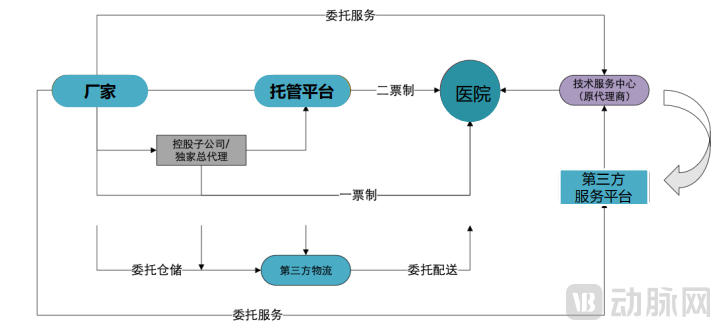
With the continued advancement and refinement of national policies such as the “Two-Invoice System,” centralized procurement, and tax regulations, third-party medical device technical services have encountered new opportunities. As indicated in the National Healthcare Security Administration’s “Guiding Opinions on Conducting Centralized Volume-Based Procurement and Use of High-Value Medical Consumables Organized at the National Level”:Selected products shall be delivered by distribution enterprises commissioned at the discretion of the selected manufacturers, or by the selected manufacturers themselves. Accompanying services shall be provided either directly by the selected manufacturers or by third parties entrusted by them, with all related costs borne by the selected manufacturers.
Sousou Medical stated that, for intraoperative support services,On the one hand,, under the centralized procurement policy, improving the efficiency of intraoperative support and reducing service costs is an inevitable path; therefore, platforms have emerged across various segments to enable scaled operations.On the other hand,, Under the Golden Tax Phase III system, providing service fees supported by a legitimate chain of evidence is essential, and utilizing third-party platforms is the preferred approach.
Source: Sousou Medical
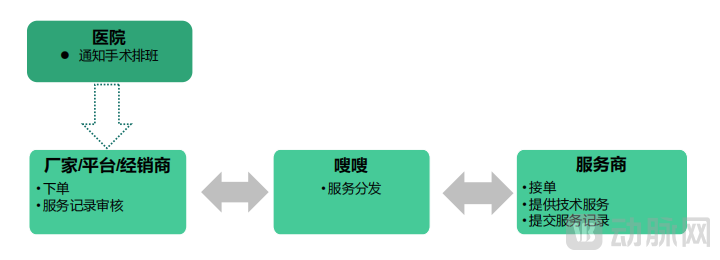
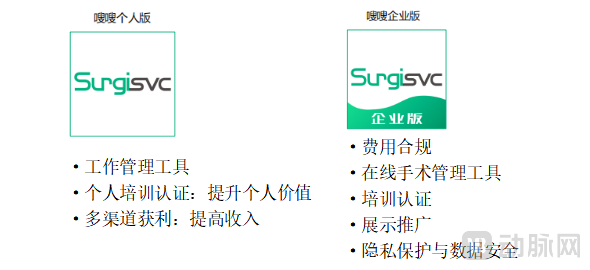
SouSou Healthcare, by integrating"Sharing Economy"A philosophy that provides a one-stop solution for medical device manufacturers, distributors, sales representatives, and surgical support personnel, featuring precise matching of technical service resources and compliant service fees.Specifically, the “Sousou Gentai” application aggregates the resources of technical service personnel to fulfill the on-site support demands of medical device manufacturers and efficiently allocate these tasks to the platform’s certified technicians.
Source: Sousou Medical
Sousou Medical has been fully committed to building its surgical support service program since late 2018. After three years,Currently covering 4,800 hospitals across China, with 564 manufacturer brands, users in all 31 provinces, and a cumulative total of 900,000 surgical orders served.
Sousou Medical’s current technical services are primarily focused on orthopedic surgery, with growing demand for its intraoperative support services.Studies have shown that, according to incomplete statistics, the number of artificial hip and knee joint replacement surgeries in China exceeded 900,000 in 2019, with an annual growth rate of nearly 20%. As population aging intensifies, the high-risk population for orthopedic diseases will become even larger. For orthopedic surgical support services, the demand will increase accordingly with the rising volume of orthopedic surgeries.
Overall, frontline clinical services remain highly essential, but their delivery models will evolve under the influence of policies and other factors.It is reported that surgical support specialists are generally recruited by medical device distributors or manufacturers. After completing specialized training on instruments, they provide technical support related to medical devices and assist physicians in performing surgeries.
In 2016, when Sousou Medical was being established, the concept of the “sharing economy” was extremely popular.The company’s founding team envisioned establishing a platform-based enterprise in the field of medical and device technical services to facilitate resource sharing.
Meanwhile, Guo Yidong stated that surgical demands in hospitals cannot be accurately predicted—there might be three surgeries one day and five the next, which could lead to a shortage of technical service personnel. To address this need, “Sousou Gentai” was launched.
When discussing the business model, Guo Yidong said: Sousou Medical is the "Uber" of the healthcare industry.Medical device manufacturers with needs can issue order instructions like passengers, and on-site technicians on the platform accept orders based on their actual availability. However, while Didi has national industry access standards, our industry has not yet established such standards.
In response, SouSou Medical ultimately aims to build a professional third-party technology service platform, with the company focusing on professional development in two key areas.First, manufacturers provide technical service personnel with training on medical devices; second, hospitals conduct training for technical service personnel on basic surgical and medical knowledge. In the second half of this year, Sousou Medical has conducted nearly 20 offline training sessions.
This process not only resolves the issue of matching online and offline resources among manufacturers, distributors, surgeons, and surgical support staff during surgical procedures, but also effectively reduces labor management costs, fully integrates surgical technical service resources, and enhances the market competitiveness and service efficiency of surgical support personnel.
Source: Sousou Medical
Furthermore, as a subsidiary of Medray Group, Sousou Medical leverages the group’s third-party logistics service system to precisely and efficiently address the “last-mile” service needs for medical device products, truly enabling one-click ordering that completes both the delivery of surgical products and intraoperative technical support services.
Sousou Medical is a subsidiary incubated by Medray Group. In 2019, Yin Jiangang, Chairman of Medray Group, joined the first cohort’s “Rocket Class” of the Star Future Entrepreneurship Camp. Mr. Yin stated that Fosun is a large-scale company driven by the dual engines of “industry + investment” in the healthcare sector. During the one-year program at the Entrepreneurship Camp, he gained significant insights through exchanges with instructors, alumni, and heads of various industrial divisions. Consequently, in 2020, Mr. Yin recommended Guo Yidong, General Manager of Sousou Medical, to join the second cohort of the Entrepreneurship Camp.
Currently, Sousou Medical is in the business expansion phase. Guo Yidong stated,In the short termRegionally, the focus will be on tier-2 and tier-3 cities where technical services are relatively scarce. In terms of service offerings, in addition to existing surgical technical services, clinical trial technical services and post-sales equipment maintenance and repair services will be introduced.
From a longer-term perspective, as a professional technical service platform, in addition to meeting the demands for medical technical services, it is essential to establish industry standards on the platform, facilitate the training of technical personnel, and assist manufacturers in the precise promotion of their distinctive products.
Fosun · Star Future Entrepreneurship Camp
Fosun·Star Future Startup Camp is an incubation and investment platform focused on the broader health sector, established by Star Future Capital under Fosun Group in collaboration with Fosun Pharma. Adopting a “community + incubation + investment” model, it explores cutting-edge innovation, focuses on entrepreneurial talent, and secures early-stage investments in future unicorns.
In 2021, Fosun Star Future Entrepreneurship Camp launched its third cohort, targeting entrepreneurs in the healthcare sector and aspiring innovators. It invited top-tier global mentors and introduced six core incubation modules, offering entrepreneurship courses grounded in China’s medical industry background and practical experience.