

Saama Technologies Files for IPO After Powering Pfizer's COVID-19 Vaccine Development and Securing $430M Funding

Saama
Clinical Data Analysis Service Provider

The Carlyle Group
Diversified Investment Institutions

McKesson Ventures
Venture Capital Firm

Population Health Partners
Venture Capital and Private Equity Firms

Intermountain Ventures
Intermountain Healthcare’s Venture Capital Arm

Northpond Ventures
Venture Capital Firms

Merck GHI Fund
Healthcare Venture Capital Firm

Amgen Ventures
A venture capital firm based in California
In 2020, when Pfizer sought to bring its COVID-19 vaccine to market as quickly as possible, it turned to Saama Technologies (“Saama”).
Saama is an AI-driven clinical cloud platform designed to streamline clinical trials by using machine learning and high-performance algorithms to screen tens of millions of patient data points daily.
According to Forbes, the use of Saama’s AI programs shortened Pfizer’s research timeline by approximately one month. In the early stages of the COVID-19 pandemic, racing against time was tantamount to racing against death, underscoring Saama’s indispensable role. This collaboration undoubtedly marked a milestone for Saama: it not only catapulted the company into the spotlight and etched its name into the annals of humanity’s fight against the pandemic, but also, thanks to its robust operational capabilities, secured $430 million in strategic growth investment in October 2021.
The investment was led by Carlyle, a globally leading investment firm, and followed by investors including Amgen Ventures, Intermountain Ventures, Merck Global Health Innovation Fund, McKesson Ventures, Northpond Ventures, and Population Health Partners.
According to Saama, the funds will be used to accelerate the development of Saama’s AI-driven data management and analytics capabilities, with the aim of redefining the drug development paradigm.
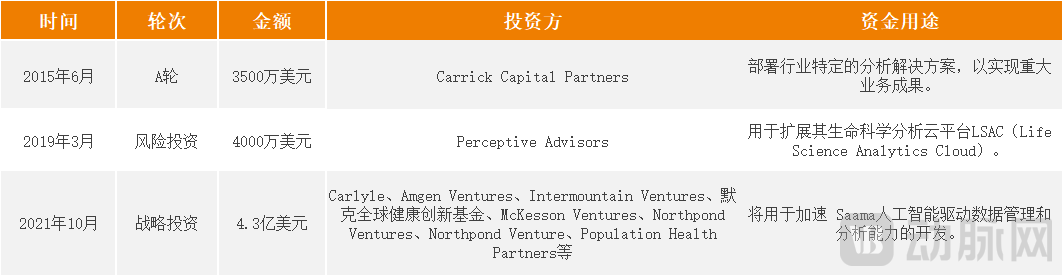
Data source: Saama official website; graphic by VCBeat
Capital is smart; it always flows in the direction that represents the future. How has Saama managed to pull ahead in the highly “cutthroat” red ocean of medical AI?
Saama was founded in 1997. Over the past two decades, Saama has operated in the broader field of data analytics, with its services spanning security, business, and other sectors, but exclusively excluding healthcare.
It was not until the mid-2010s that, by chance, I transitioned into the healthcare sector, focusing on clinical analysis. During this period, I collaborated with multiple companies, including Elligo Health Research, Oracle, and Gilead.
No step taken in entrepreneurship is ever wasted; every move counts. It was precisely this solid foundation, built through steady progress and mastery of diverse competencies, that enabled Saama to seize opportunities, swiftly pivot its strategic focus, and achieve renowned success in a single decisive effort.
In 2020, Pfizer partnered with Saama to jointly develop and deploy an AI-powered solution designed to streamline the management of clinical trial data.
Although Saama had no prior experience in vaccine-related collaborations, it quickly provided a solution, leveraging its mature algorithms and Pfizer’s comprehensive data inputs. These algorithms enabled the completion of data processing within a single day—a task that typically takes several weeks—significantly enhancing research efficiency.
“It saved us a full month,” said Demetris Zambas, Head of Data Monitoring and Management at Pfizer. “It has indeed had a significant impact on the first-pass quality of our clinical data, as well as on the speed at which we move forward and make decisions.”

Founder and CEO Suresh Katta
While it is unclear whether Saama’s founder felt a tinge of melancholy alongside his joy upon securing $430 million in financing, this day certainly came after an excessively long wait for Suresh Katta, who has led Saama since its founding in 1997.
Suresh graduated from the University of Louisiana at Lafayette, a renowned public university in the United States, with a Master’s degree in Computer Engineering. His passion for mathematics led him to embark on an entrepreneurial journey.
Prior to founding Saama, he had two successful entrepreneurial experiences. The first was as a co-founder of GVI, the developer of the application XTeleScreen, which was later sold to Netscape Communications. The second was as a co-founder of Multisoft, a provider of high-end graphics products for the Indian marketing market.
This tech-savvy professional is not only highly competent in his field but also exudes considerable personal charm—Suresh was named an Elite Entrepreneur of 2018 by PM360 and recognized as one of the 100 Most Inspiring Leaders by PharmaVOICE. He frequently contributes to industry publications and delivers speeches at industry conferences.
Testing new drugs is a slow, expensive, and labor-intensive process.
As is well known, clinical trials are conducted in multiple phases, with costs escalating throughout the process. Phase III trials require larger patient populations and are significantly more expensive and complex than Phase I trials. Despite substantial investments of time and money, only one in ten new drugs that enter Phase I clinical trials ultimately receives FDA approval for market launch. Saama’s Life Sciences Analytics Cloud (LSAC) effectively addresses these pain points.
Flagship Product LSAC: AI Safeguards the Entire Clinical Trial Process
LSAC is an AI-powered platform that covers all phases of clinical trials, providing a unified approach to clinical trial data management and analysis.
The platform comprehensively collects, integrates, manages, and coordinates the processing of clinical trial and patient data from internal and external sources to provide effective recommendations.
LSAC’s deep learning methods significantly shorten the timeline of clinical projects from clinical protocol development to the determination of New Drug Application (NDA) submission, enabling the interruption of planning, design, and implementation of clinical trials at various stages of clinical development. This helps pharmaceutical companies complete new drug approval applications faster and more efficiently, thereby reducing costs.
Moreover, LSAC’s pre-trained AI-embedded intelligent applications can learn complex patterns from clinical data and provide predictive insights to accelerate the clinical research process across multiple domains and therapeutic areas.
It is worth noting that this October, Saama upgraded LSAC and launched version 4.1. LSAC 4.1 improves the GPP and topic progression dashboards within Clinical Insights, redesigns and enhances six Operations Insights dashboards, and introduces new intent and query response capabilities in DaLIA.
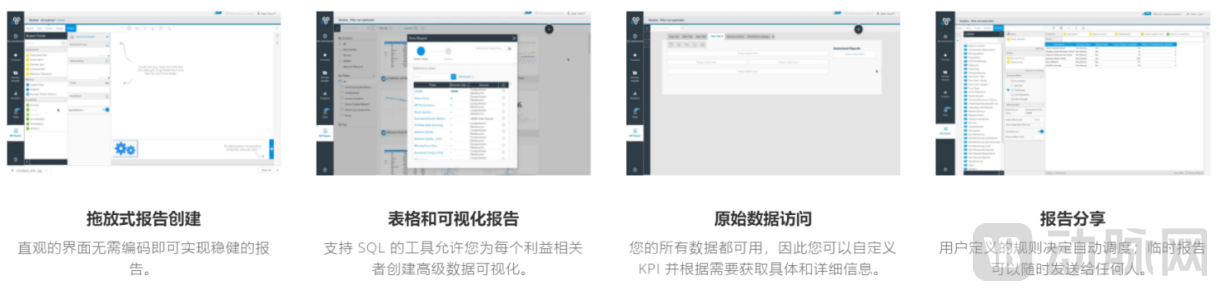
Image source: Saama official website
Currently, Saama’s Intelligent Life Sciences Analytics Cloud (LSAC) is being used by more than 50 pharmaceutical and biotechnology companies in over 1,500 studies.
Risk Assessment Classification Tool (RACT): Effective Prediction, Proactive Preparedness
Risks permeate every aspect of clinical trials, making their identification and management both urgent and critical. Characterized by uncertainty, potential harm, objectivity, and contingency, risks can have immeasurable impacts on enterprises and patients once they materialize.
LSAC RACT can effectively predict risks in clinical trials, helping companies plan ahead.
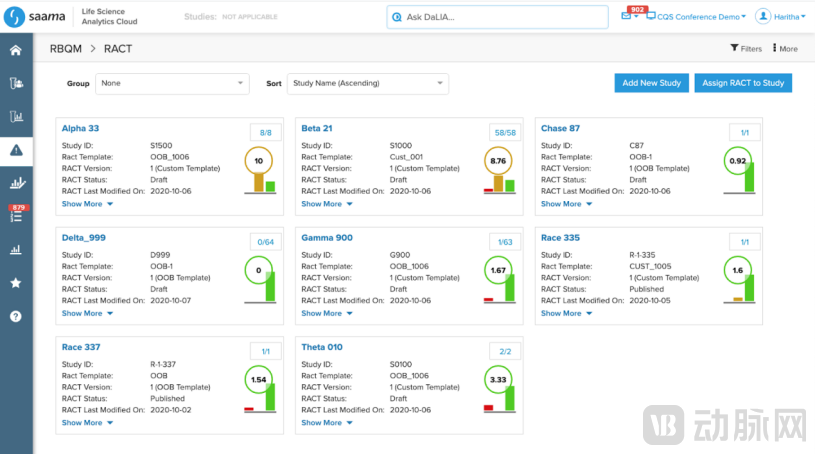
Example of the RACT Template. Image source: Saama official website
RACT classifies risks based on user-provided data, calculates the probability and impact of each risk, identifies risk mitigation plans, and highlights the overall risk associated with the study.
RACT has the following five characteristics:
(1) Customization support. Users can create custom RACT templates in the LSAC RACT console based on their actual needs.
(2) Broad applicability across stages. This function can be used to evaluate both existing studies and those still in the planning phase.
(3) Automatically calculate risks and provide corresponding solutions. RACT categorizes risks, calculates the probability and impact of each risk, provides risk mitigation plans, and presents an overview of the overall risks that may arise in the study.
(4) Efficient and Convenient Risk Assessment. Use risk scorecards to quickly view study-level risk scores and understand performance in key risk areas and the progress of mitigation plans.
(5) Continuous system optimization and updates. Over time, Saama will optimize and modify the RACT templates to support evolving research needs.
Overall, users can customize LSAC RACT based on their specific needs and actual progress, thereby more effectively reducing and mitigating risks in clinical trials.
Two Pricing Models
According to Saama’s official introduction, there are currently two main purchasing options: pay-as-you-go and prepaid models.
If you choose pay-as-you-go, customers do not need to prepay; they simply select the services they wish to use and receive monthly billing statements from Saama, much like receiving an electricity bill.
Prepaid ModelThe prepaid model is designed for customers who have already experienced the Saama intelligent application. This model offers greater cost savings compared to pay-as-you-go pricing. Customers are required to prepay a fixed amount for services and will receive a monthly statement to track usage and monitor remaining capacity. Saama will not incur additional charges until the customer requires extra services.
Prior to the client’s purchase and use of Saama’s services, Saama will work with the client in advance to estimate demand, enabling the client to have a clear understanding of the total cost throughout the entire project lifecycle.
In the drug development process, the long R&D cycle, low success rate, and high R&D costs of new drugs are obstacles that many pharmaceutical companies find difficult to overcome.
AI technologies, represented by deep learning, can accelerate pharmaceutical R&D and improve the success rate of drug development by leveraging their powerful capabilities in relationship discovery and computation. This has led to a growing demand among pharmaceutical companies for AI assistance in new drug development. VCBeat has selected three representative companies.
XtalPi,A pharmaceutical R&D technology company driven by computational innovation. Founded on the campus of the Massachusetts Institute of Technology (MIT), its core team comprises top talents from academia, the IT and internet sectors, and the pharmaceutical industry. To date, XtalPi has successfully provided drug discovery and development services to more than 70 pioneering pharmaceutical companies across the United States, Europe, China, and Japan. In terms of financing, the company announced in September 2020 that it had completed a $318.8 million Series C funding round. (Related recommendations:【Exclusive】XtalPi Participates in PhoreMost’s $46 Million Series B Financing, Building an Intelligent Drug R&D Closed Loop from Target Discovery to Preclinical Development)
Fermion Tech, founded in August 2018 by Dr. Deng Daiguo, who holds a Ph.D. in Computer Science from Sun Yat-sen University. The company is dedicated to building an AI-assisted drug discovery platform for small-molecule chemical drugs. By forging deep collaborations with CROs and originator pharmaceutical companies, it leverages AI technologies to enhance the efficiency and success rate of preclinical R&D for new small-molecule drugs. In terms of financing, the company completed its Series A funding round in May 2020, raising a cumulative amount exceeding RMB 100 million. (Related Recommendations[Exclusive] Fermion-Enabled AI Drug R&D Platform FermiNet Standardizes PCC Delivery; Team Completes Series A Financing, Cumulative Funding Exceeds 100 Million)
SuiKun Intelligence,Registered at the Jiangsu Life Science and Technology Innovation Park in Qixia District, Nanjing, the company boasts biological and chemical laboratories. It is a new-type technology platform enterprise that closely integrates artificial intelligence with innovative biopharmaceutical R&D. Currently, it has offices and laboratories in Beijing, Shanghai, and Nanjing. In terms of financing, Suikun Intelligence announced in September 2021 that it had completed an Series A financing round exceeding RMB 100 million. (Related recommendations:“Born from the Turing AI Institute, How Does Suikun Intelligence Help Break the Pharmaceutical Industry’s ‘Eroom’s Law’?”)