

ZhaoYang Health Files for IPO, Aiming to Become China's Mental Health Service Benchmark Inspired by Cerebral
For a long time, the mental health industry seemed to occupy a “marginal” position, receiving little attention from the general public.
However, this year, the state has introduced multiple policies. First, the Guangdong Provincial Healthcare Security Administration, in conjunction with the Provincial Department of Human Resources and Social Security, issued the “Guangdong Province Basic Medical Insurance, Work-Related Injury Insurance, and Maternity Insurance Diagnosis and Treatment Project Catalog (2021)” and the “Guangdong Province Basic Medical Insurance, Work-Related Injury Insurance, and Maternity Insurance Medical Consumables Catalog (2021),” which stipulate the inclusion of “psychotherapy” within the scope of reimbursement by basic medical insurance funds.
Furthermore, the Ministry of Education recently responded to the Chinese People’s Political Consultative Conference’s “Proposal on Further Implementing Prevention and Control Measures for Adolescent Depression,” explicitly incorporating depression screening into student health examinations, establishing mental health records for students, assessing their psychological well-being, and providing focused attention to those with abnormal assessment results. The announcement immediately sparked widespread public discussion on mental health.
In fact,Although public awareness of mental health remains somewhat limited, policy initiatives in recent years have consistently worked to bring this sector into the public spotlight.Since 2015, China has seen a continuous stream of policies on mental health services, with the national approach to mental health evolving from macro-level emphasis and guidance to the concrete development and standardization of mental health service systems and platforms.
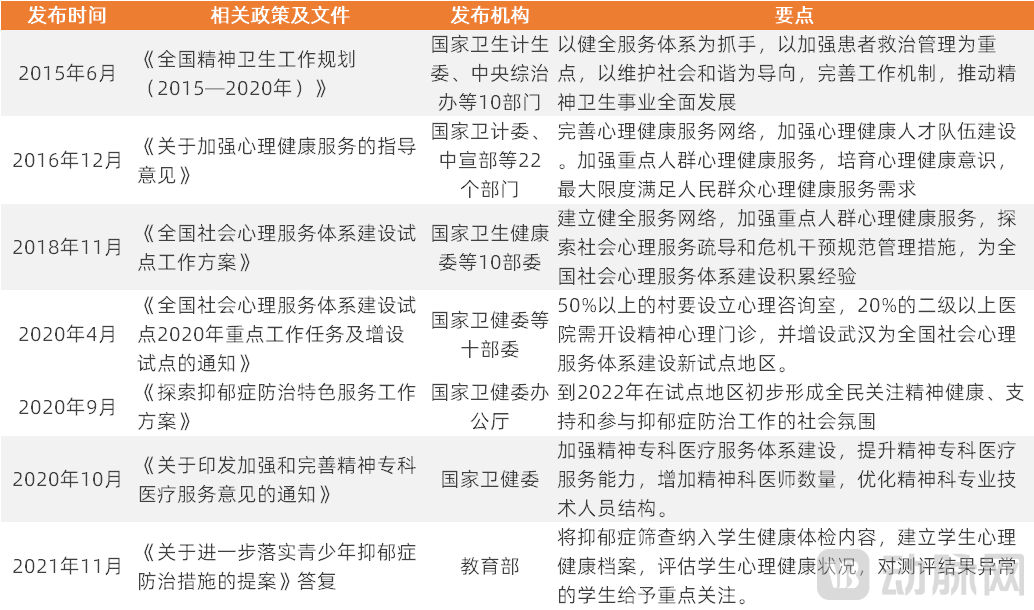
Driven by policy support, the mental health sector in China continues to gain momentum.
From a market perspective, an increasing number of companies are targeting this sector and launching innovative solutions—such as specialized internet-based diagnosis and treatment platforms, psychological counseling platforms, and communication communities—to address industry pain points. These include vertical internet specialty smart management platforms like XQ Health (Zhao Yang Health), which pioneered the exploration of “Internet + Mental and Psychological Disease Diagnosis and Treatment,” as well as brands focusing on the broader mental wellness space, such as KnowYourself and FLOW Meditation.
From the perspective of public demand, with economic development, consumption upgrades, and growing awareness of mental and psychological disorders, an increasing number of people are beginning to pay attention to their own mental health status.
Driven by strong policy support and growing market demand, the mental health sector in China is emerging as a key area of opportunity.In a sector where no unicorns have yet emerged in China, how should companies operating in this space choose their development path when faced with opportunities??
A Market Worth Hundreds of Billions, with Pain Points Urgently Needing Resolution
Although the industry as a whole is showing positive development trends, the domestic mental health sector still faces multiple pain points at the current stage.
First, there is a shortage of medical resources, with an uneven geographical distribution of high-quality medical resources, making it difficult for patients to access care.. According to publicly available information, the overall prevalence of mental and psychological disorders in China is currently 17.5%, affecting 250 million individuals. However, there is a significant shortage of psychiatrists, with fewer than two psychiatrists per 100,000 people, a figure that falls far short of international standards. Furthermore, high-quality medical resources are primarily concentrated in first-tier cities and leading hospitals. Most county-level hospitals in China lack specialized departments for mental and psychological health, resulting in high costs for patients who need to seek diagnosis and treatment in other regions.
Moreover, public awareness of mental and psychological disorders remains inadequate at this stage, and patients experience significant stigma. Consequently, the rate of clinical consultation for mental and psychological disorders in China, as well as patient awareness, is far lower than that in developed countries. Taking depression as an example, the study “Epidemiology of the Prevalence of Depressive Disorders and Utilization of Mental Health Services in China,” published in The Lancet Psychiatry this September, shows that even among patients visiting specialized mental health institutions, only 9.2% receive adequate treatment.
Second, patient management is difficultMental and psychological disorders are characterized by two prominent features: a prolonged disease course and the need for continuous disease management services. However, most psychiatrists primarily rely on traditional follow-up methods to monitor and manage patients’ disease progression. This approach is not only inefficient but also prone to issues such as inadequate follow-up control and low patient medication adherence, which in turn contributes to persistently high relapse rates for mental disorders.
Third, psychiatrists, psychotherapists, and psychological counselors operate in silos, lacking coordination.. Most patients require not only clinical interventions to stabilize their condition during treatment, but also appropriate psychotherapy and psychological counseling; however, China currently lacks mature models for integrated care and referral mechanisms in the field of mental health.
It is precisely driven by pain points across multiple stakeholders that the industry’s call for more valuable innovative solutions has grown increasingly strong.
From specialized diagnostic and treatment tools to a comprehensive ecosystem service platform,
XQ Health Aims to Set a New Benchmark for Service Models in the Mental Health Industry
Amid market development, an increasing number of entrepreneurs and investors are betting on this sector, with technologies such as the internet, big data, and artificial intelligence being applied in this field. However, for patients and practitioners, what matters more is whether products and services closely meet their needs.
In other words, in this field that is still in a stage of exploratory development, the prerequisite for enterprises to gain a firm foothold and grow is to meet genuine diagnostic and treatment needs and address actual medical pain points.
Among the companies we focus on, Zhaoyang Health, founded in 2015, is one of the fewCapable of simultaneously addressing challenges such as patients’ difficulty in accessing care, physicians’ difficulty in conducting post-consultation follow-ups, and the lack of collaboration between psychiatrists and psychological counselors.as one of the enterprises, it not only possesses "Zhaoyang Doctor," an auxiliary diagnosis and treatment platform for mental and psychological disorders that connects doctors and patients, but also has established its own physical psychiatric outpatient clinics and pharmacies, covering all aspects of disease management needs including patient screening, diagnosis and treatment, prescription, psychotherapy, and relapse prevention.
In terms of service, XQ Health closely aligns with user needs; in business operations, it has also delivered impressive performance.
As of now, the Zhaoyang Doctor platform under Zhaoyang Health has gathered over 10,000 professional psychiatrists and psychological counselors. The participating psychiatrists are primarily from top-ranked public specialized hospitals across China, with a participation rate of chief physicians reaching as high as 75%. The platform covers tertiary hospitals in more than 30 core provinces and municipalities, having provided millions of diagnostic, treatment, and consultation services to hundreds of thousands of patients. With a patient satisfaction rate of up to 99.4%, it stands out as an industry leader.
Meanwhile, due to its outstanding business performance, Zhaoyang Health has attracted investment from prominent firms such as Matrix Partners China, Qianji Capital, and Bencao Capital, with cumulative financing exceeding RMB 200 million.
Specifically, how has Zhaoyang Health designed its products to address industry pain points? And why has it achieved such remarkable results? In light of Zhaoyang Health’s business layout, the primary reasons can be summarized as follows.
Establish a Professional Diagnosis and Treatment Service System to Promote Service Efficiency
First, to address the challenges physicians face in patient management and the difficulties patients encounter in accessing medical care, XQ Health, at its inception,With “Internet + Mental Health” as its core product model, the Zhaoyang Doctor platform has been prominently launched, enabling patients to engage in one-on-one consultations with specialist physicians from hospitals through the platform., thereby providing a safer, more private, time-saving, and efficient approach to medical care, addressing patients’ stigma and the high costs associated with seeking treatment across regions, while significantly enhancing service convenience.
For physicians, joining the Zhaoyang Doctor Platform is equivalent to establishing a personal online clinic., the platform optimizes treatment workflows, creates exclusive virtual consulting rooms for physicians, and provides AI-powered pre-consultation questionnaires and post-consultation follow-up systems, thereby enabling effective digital patient management for physicians to enhance diagnostic efficiency and quality.
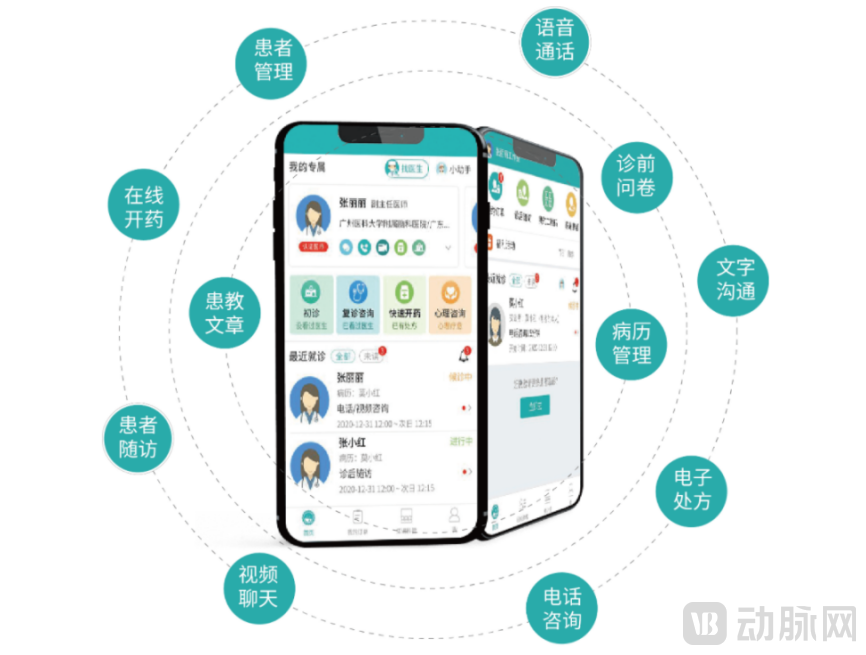
Moreover, the model of online consultation enables high-quality physician resources to extend to second- and third-tier cities, thereby alleviating the imbalance and uneven distribution of medical resources to some extent and improving service accessibility.
Digitalized, Refined Operational Service System: Precisely Identify Needs, Empower Users, and Create Value
XQ Health has established a digital marketing system and a professional customer service team, integrating industry resources to empower physicians and jointly serve patients through a new business model that precisely addresses user needs and efficiently delivers solutions.
For physicians, the Zhaoyang Doctor Platform empowers them by leveraging digital technologies such as an AI-powered pre-consultation system, an electronic medical record (EMR) system, and a chronic disease management system., making physicians' work more efficient and creating greater value.
For users, the Zhaoyang Doctor platform has established self-operated offline medical institutions and built a pharmaceutical supply chain upon identifying high-frequency medication needs, thereby providing patients with a closed-loop healthcare service platform integrating diagnosis, treatment, and medication.. Furthermore, the platform can regularly push popular science knowledge about different diseases to users based on their disease profiles, with each precise delivery aimed at facilitating better user recovery.
Provide Multi-Level, Comprehensive Services to Build a Benchmark Ecosystem for Mental Health Management with a Closed-Loop System
At the current stage, due to varying user needs, corresponding mental health services differ in type. If categorized along a severity spectrum of severe, moderate, and mild, these services can be divided into psychiatric and psychological diagnosis and treatment services, psychological counseling services, and more generalized mental health services (including mental health education, emotional support, mindfulness meditation, etc.). From this classification, a multi-tiered mental health service system can be derived in a top-down manner.
However, at present, there are still issues such as low connectivity efficiency and insufficient effective coordination across different levels. For instance, there is a lack of joint diagnosis and treatment and referral mechanisms between medical institutions and non-medical institutions. In this regard,XQ Health has integrated its existing service framework with multidisciplinary team (MDT) combined therapies to create a distinctive “Psychiatrist + Psychotherapist” joint diagnosis and treatment model., can collaborate with psychiatrists, psychological counselors, and professional supervision teams to develop optimal treatment plans for patients, thereby enhancing the overall quality of care.
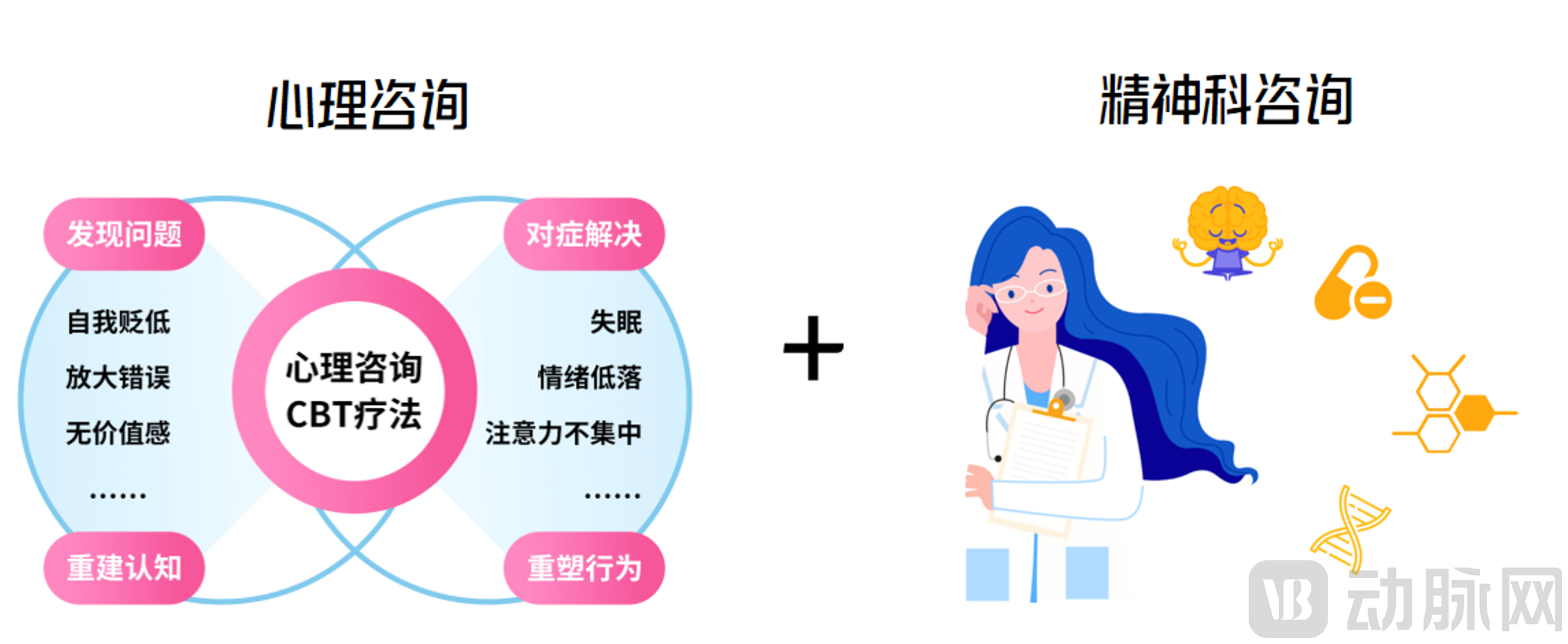
Meanwhile, XQ Health is gradually transitioning from its previous diagnosis and treatment services to comprehensive mental health services., and actively explore digital diagnostic and therapeutic models, including services such as mindfulness and meditation, to meet users’ multi-level needs across the spectrum of “prevention–diagnosis/treatment–rehabilitation–consolidation,” ranging from mild to severe conditions, from online to offline settings, and from pharmacological interventions to psychotherapy, thereby creating a comprehensive, multi-tiered closed-loop ecosystem for mental health management.
The formation of an ecological closed loop not only brings significant benefits to practitioners and users, but also has clear positive implications for the development of the entire industry. Moreover, XQ Health’s unique service philosophy offers valuable reference points for other players in the sector.
Benchmarking Against Unicorn Cerebral: How Much Potential Does the Zhaoyang Model Hold?
At this stage, mental health is receiving unprecedented attention from both capital investors and patients/consumers. However, in terms of industry development, China’s mental health sector remains immature, with the demand side, payment mechanisms, and supply chain all still in their early stages.
The resulting question is: How significant is the market potential for platforms like Zhaoyang Health, which provide comprehensive online-to-offline and in-hospital to out-of-hospital diagnostic and treatment services covering mental and psychological health management?
To address this question, we focus on the United States, where the mental health market is more mature, and analyze the development of companies with business models similar to that of XQ Health.
From a business structure perspective, Cerebral, founded in 2020, bears striking similarities to XQ Health. Both companies center on patient needs to build a closed-loop pharmaceutical ecosystem, collaborative care models, and one-stop services, winning user favor through the efficiency, convenience, and accessibility of their offerings.

Since its inception, Cerebral has prioritized enhancing the convenience and accessibility of mental health services. Its integrated model, combining online psychiatric care with offline medication delivery, not only enables users to access mental health support more quickly and conveniently but also connects fragmented physician resources with patients, ensuring the rational allocation of medical resources.
In strengthening collaboration between psychiatrists and psychological counselors, both Cerebral and Zhaoyang Health have adopted a collaborative care model. This ensures effective and close coordination among psychiatrists, psychotherapists, and care consultants within the patient care team, thereby better addressing patients’ service needs at various stages. During treatment, Cerebral also conducts regular visits and timely communications to monitor users’ mental health status, establishing a full-cycle service model.
In terms of business scale, Cerebral’s services have rapidly expanded to cover all 50 U.S. states and the District of Columbia, with approximately 100,000 registered users.
The rapid expansion of the market has also attracted capital attention. In June this year, Cerebral announced that it had completed a $127 million Series B financing round, with its valuation reaching $1.23 billion. Within just over a year since its founding, Cerebral achieved a hundredfold increase in valuation and swiftly emerged as a unicorn company in the U.S. mental health sector.Cerebral’s success signifies market recognition of the one-stop service model and, to some extent, reflects the future growth potential of XQ Health.。
Moreover, in terms of market size, the domestic market offers ample room to support corporate growth.
According to IBISWorld data, the U.S. mental health market was valued at approximately $45 billion in 2021. Driven by digital health IPOs, SPAC transactions, and M&A activities, the United States now has nearly ten mental health unicorn companies. Although China’s mental health market is slightly smaller than that of the U.S., its overall scale remains substantial. The market has maintained a high growth rate in recent years, indicating significant untapped potential. Companies with high-quality service models are undoubtedly poised to stand out in the future.
"Patient-Centered, True to Our Original Mission"
Of course, having high-quality products and services only indicates that a company meets the entry requirements for large-scale development in the future. To truly stand out, continuous innovation and resource accumulation are also needed, which are also advantages possessed by XQ Health.
An examination of Zhaoyang Health’s business evolution since its inception—from its initial focus on vertical internet-based diagnosis and treatment platforms for psychiatric and psychological disorders, along with digital patient management technologies, to its current multidisciplinary team (MDT) collaborative care model and ecosystem development—demonstrates the company’s continuous exploration and innovation throughout its growth journey.
During its service expansion, Zhaoyang Health has consistently remained committed to professional clinical care as the core focus of its business development, while strategically planning business upgrades in response to market demands. This approach is clearly underpinned by founder Lin Zhaoyu’s firsthand experience and deep understanding of the mental health industry.
Holding the dual identity of both a physician and a patient, Lin Zhaoyu has gained profound insights into the inefficiencies of traditional diagnosis and treatment models within the healthcare industry, as well as the challenges patients face in accessing high-quality medical resources.
It is precisely for this reason that Zhaoyang Health is able to address the industry’s actual pain points, providing comprehensive disease management that covers every stage of patient care, including screening, diagnosis and treatment, medication, psychological counseling, and relapse prevention.
A solid business model and the accumulation of professional resources have continuously drawn attention to Zhaoyang Health from the capital market. To date, Zhaoyang Health has successfully completed five rounds of financing, including a Series B round exceeding RMB 100 million this year—a remarkably substantial amount within China’s mental health sector.
Looking ahead,XQ Health will continue to uphold its corporate goal and positioning of building a high-standard, high-quality, and trustworthy one-stop mental health management platform., and continue to focus on user needs to build a full-chain, full-lifecycle service system that benefits a broader population.
Final Thoughts
Empowered by modern technology, the mental health industry is continuously unlocking its potential. Leading companies such as Cerebral and XQ Health are delivering more valuable services to the sector through ongoing technological innovation and business model upgrades.
It is crucial not to overlook the fact that opportunities are accompanied by significant challenges, particularly as China’s mental health industry remains in an exploratory stage of development. Amidst the tide of market growth, mental health services will progressively optimize toward greater accessibility, inclusivity, and scalability—a trend that represents both the direction of industry evolution and a strategic opportunity for enterprises.
As more players enter this high-potential sector, we look forward to seeing the value of mental health services continuously unlocked and applied through collective participation and efforts, ushering in a new chapter for the industry’s development.