

What Novogene Got Right: Doubling Market Cap Within Months of IPO

Novogene
Gene Technology Products and Services Provider
Ever since China joined the Human Genome Project as the sixth participating country, genetic technology has been destined to spur a series of transformative changes here.
The first clinical product, non-invasive prenatal testing (NIPT), has become the choice of over one million pregnant women worldwide each year since its launch in 2011. Cancer early screening products developed based on genetic technology are now flourishing, reshaping people's health management behaviors. Meanwhile, multi-omics analysis at the single-cell level has become a key research direction for many top scientists globally. The possibilities brought by genetic technology have sparked great enthusiasm among many.
Amidst the fervent wave of biotech startups, Li Ruiqiang has been somewhat slow to warm up; Novogene, the company he founded, has consistently projected an image of steady and prudent operations.
In April 2021, Novogene rang the bell for its listing on the STAR Market of the Shanghai Stock Exchange, becoming the first publicly traded company in the genetic research services sector. Over the past six months, despite the turbulence in the secondary market, Novogene’s market capitalization has nearly doubled.
Founded in 2011, Novogene initiated shareholding reform and prepared for its public listing in 2016, ultimately completing its IPO in 2021. Over its ten-year history, half of that time was dedicated to listing preparations. From bioinformatics services to genomic research solutions, the name Novogene is widely recognized by most who have ever stepped into university laboratories. The underlying logic behind its IPO lies in the fact that Li Ruiqiang, a leading technical expert, has always pursued an ultimate technological ideal. By integrating the roles of entrepreneur and scientist, he chose first to build a sufficiently strong company, thereby driving genomic technology to reshape numerous human practices.
For a long time, the question most frequently posed to Novogene by secondary market investors has been which overseas star company it benchmarks against. The context behind this question is that high-throughput sequencing has been in commercial application for less than 20 years, and the pioneers internationally have largely been engaged in exploratory efforts to test the waters. Therefore, Novogene represents a self-consistent entity within the gene technology sector, having built and validated its own business logic.
“The genomics industry is a lifelong endeavor that can never be fully completed.” Li Ruiqiang once described the sector in which Novogene operates.
For him, the deeper he delved into this industry, the more he realized how limited his existing knowledge of genetics truly was. For instance, it was long believed that genetic differences among individuals of the same species were minimal. This perception was only disproven when gene technology advanced to provide information beyond simple sequences and basic mutations. Because early gene sequencing technologies could capture only raw base-pair data, failing to observe dynamic epigenetic modifications or provide critical insights related to the onset and progression of individual diseases, gene technology failed to fully realize its clinical value for a considerable period.
The potential of genetic technology is limitless. Imagine if single-cell atlases could be mapped for every tissue and organ, enabling the real-time visualization of the human body’s trillions of cells at the single-cell level. In such a fully digitalized representation of the human body, any clues related to physiological mechanisms and disease progression would become exceptionally clear.
Today, scientists can perform single-cell analysis on thousands of cells simultaneously—a technological leap that was unimaginable a decade ago, when Novogene could only manually assay dozens of single cells at a time. However, for the vast array of application scenarios, the accessibility of genetic information remains far from sufficient.
Often, when describing his vision for the genomics industry, Li Ruiqiang presents an illustration of a “genomics industry tree.” The canopy bears “fruits” such as tumor diagnosis, treatment, and early screening; biopharmaceuticals; and infectious disease management. The roots extend deep into the ground, drawing sustained momentum for scientific research along two veins: biotechnology and computational technology. Those familiar with Novogene will note that the company does not focus on any single application scenario. Instead, it likens itself to this genomics industry tree—deepening its expertise in biotechnology and computational technology to support scientific research, and developing a broad range of innovative genomics applications grounded in rigorous scientific evidence.
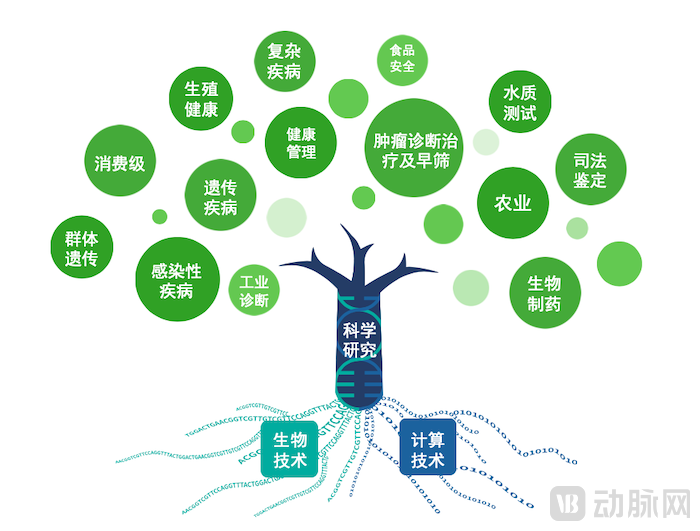
Novogene's Genomics Industry Tree
From NIPT and companion diagnostics to early cancer screening, gene technology has spawned innovative applications across multiple clinical niches, yet all must adhere to the objective laws governing the translation of gene technology from research to clinical practice. In other words, the cross-disciplinary integration of biotechnology and computational technology is continuously deepening, thereby providing more comprehensive and accurate information for scientific research. Only when technological breakthroughs accumulate to a certain level will it be possible to develop innovative products that support the application of gene technology in broad scenarios such as agricultural breeding, biological evolution, early diagnosis and screening of diseases, and drug development.
Novogene’s strategy is to align with this trend by starting with research services and building the infrastructure for the genomics industry.
In fact, scientific research remains the primary application scenario for gene sequencing. According to Illumina’s 2020 annual report, approximately 57% of the revenue generated by this global gene sequencing giant came from the scientific research sector, exceeding the combined total from oncology, reproductive health, and genetic applications. Gene technology needs to evolve from scientific research and ultimately feed back into it. In line with Li Ruiqiang’s vision, Novogene aims to ultimately safeguard life and health through gene technology.
Many users first became familiar with Novogene by sending samples to its laboratory.
As the utility of high-throughput sequencing technology in scientific research and product development gains increasing recognition, its adoption in research studies continues to rise. This trend has elevated the role of specialized third-party service providers with end-to-end capabilities—including library preparation and sequencing, bioinformatics analysis, gene databases, and cloud platforms—making them more critical than ever before. Consequently, the gene sequencing industry is witnessing a growing trend toward data platformization.
In practice, Novogene primarily provides data generation and analysis services to universities, research institutions, biotechnology companies, and pharmaceutical enterprises. It is important to note that raw data generated by gene sequencing instruments do not provide intuitive information; genomic variation information can only be obtained after multiple steps, including genome alignment and data filtering, thereby offering references for life science research as well as disease diagnosis and treatment. In this process, the efficiency and stability of gene data production, along with the speed and accuracy of massive data analysis, determine the end-value delivered by gene sequencing.
Unlike gene testing companies that focus on consumer-facing applications and often rely on single products to increase market penetration, Novogene primarily adopts a made-to-order production model, undertaking production tasks in the form of orders or projects. Currently, Novogene offers two delivery formats: “data generation” services and “data generation + bioinformatics analysis” services. The former provides customers with raw, unanalyzed data only, while the latter delivers end-to-end services including sample testing, nucleic acid extraction, library preparation, sequencing, and data analysis, ultimately delivering analyzed results. Novogene’s focused comprehensive genomic sequencing solutions fall into this latter category. According to its latest third-quarter report, Novogene achieved a cumulative operating revenue of RMB 1.276 billion in the first three quarters of 2021, representing a year-on-year increase of 33.71%, demonstrating the strong growth potential of this business model.
At the outset of the venture and prior to its shareholding reform, Li Ruiqiang’s founding vision was to establish a bioinformatics company. Consequently, Novogene’s bioinformatics analysis capabilities are unparalleled both domestically and internationally: equipped with high-throughput, high-performance computing platforms and data centers that process up to 100 TB of data daily, Novogene provides solutions to many challenging genomic data analysis problems. It was not until the shareholding reform was launched in 2016 that the term “bioinformatics” was removed from the company’s name.
However, Li Ruiqiang recognized early on that bioinformatics analysis is merely the second step in the overall workflow. If the preceding sequencing stage fails to generate high-quality data, there are very limited corrective measures available during bioinformatics analysis. To ensure controllable project quality, Novogene expanded its services to include library preparation and sequencing.
Over the past decade of providing sequencing services, Novogene has found that it must continuously expand its sequencing scale.
In early 2014, Illumina launched the HiSeq X Ten, a factory-scale sequencing system. Comprising ten HiSeq X ultra-high-throughput sequencers, the system was priced at $10 million but delivered tenfold the data output efficiency of mainstream equipment at the time, enabling the highest sequencing throughput and the lowest sequencing costs. Driven by the unique technical acumen typical of engineers, Li Ruiqiang immediately approved the procurement. This decision endowed Novogene with an ultra-high-throughput capacity for whole-genome sequencing of 40,000 individuals annually, establishing it as the largest sequencing center in the Asia-Pacific region.
More importantly, the convenience of having a centralized hub for sequencing samples enabled Novogene’s technical team to rapidly develop a deeper understanding of various instruments and technologies, thereby establishing a lean operational and management system for sequencing experiments. In this process, Novogene, as a professional sequencing service provider, gradually built its competitive moat by optimizing sample processing, library preparation, and data interpretation, thereby enhancing the quality of gene sequencing services and broadening their applications. Meanwhile, with improvements in management efficiency and technical capabilities, Novogene further enhanced the stability of data quality and shortened turnaround times—factors that are critical to researchers.
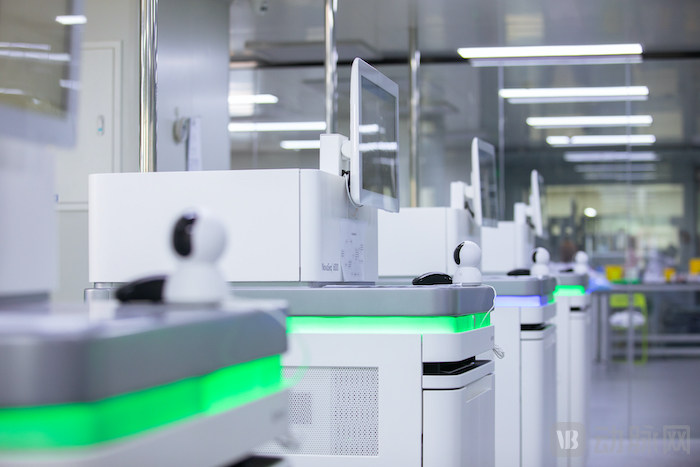
Novogene Experimental Center
At Novogene, bioinformaticians are the group with the most influence.
For years, the most defining characteristic of Novogene has been its technological imprint. Li Ruiqiang first gained recognition as a highly skilled expert in bioinformatics analysis. In his early career, he foresaw the future of gene technology through lines of software code, led and participated in multiple bioinformatics software development projects, and concurrently served as an Honorary Associate Professor in the Department of Computer Science at the University of Hong Kong. Today, Li Ruiqiang has assembled a team of nearly 200 experienced bioinformatics analysts. In China’s technology sector, where the supply-demand imbalance for bioinformatics analysts is becoming increasingly severe, this undoubtedly represents a formidable technical community.
In 2016, Novogene established its first overseas laboratory in the United States. Since then, Novogene has successively set up operations in Singapore, the United Kingdom, the Netherlands, Japan, and Thailand, building a global service network covering approximately 70 countries and regions across six continents through localized laboratories as key nodes. The continuous expansion of its business footprint is directly reflected in its financial data; in recent years, the proportion of Novogene’s overseas business has been steadily increasing. According to the interim report for 2021, revenue from this segment accounted for more than one-third of the total.
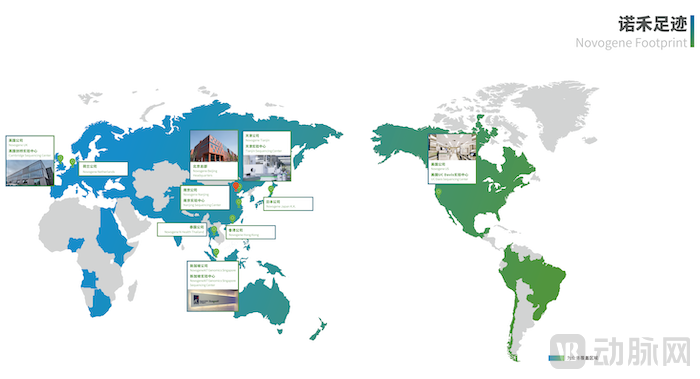
Novogene's Global Business Footprint
Unlike most biotech enterprises, it is extremely challenging for genomics technology companies to adopt a “In China, for Global” strategy. In the United States and Europe, the primary destinations for international expansion, life sciences research and development started earlier, and research institutions initially adopted the model of building their own in-house sequencing laboratories. Under this model, researchers can independently handle small-batch sequencing tasks within their own institutional laboratories. Consequently, domestic genomics technology companies have rarely considered pursuing global expansion.
Nevertheless, Li Ruiqiang remains committed to expanding overseas. In his view, engaging with and serving the most cutting-edge customer base is the only way to keep the team’s technical capabilities at the forefront globally. Scientific research is more advanced in the United States and Europe, where many frontier technologies were initiated earlier; this disparity is particularly evident in the fields of life sciences and biomedicine. “Although the current scale of China’s scientific research market is three times that of its neighbor Japan, it was only one-third during 2007–2008,” Li Ruiqiang once told the media. “Even now, China’s share of the global scientific research market has just exceeded 10%, indicating significant potential for gene technology companies to expand internationally.”
Thus, after scaling up its domestic gene sequencing services business, Li Ruiqiang led his team in transplanting this relatively mature operational and product framework to the United States and Europe. The overseas expansion proceeded more smoothly than anticipated; leveraging the reputation Novogene had previously built within the genomics community, the company gradually established connections with leading scientists and quickly secured its first angel orders.
After several rounds of collaboration, Novogene discovered that even when addressing the most cutting-edge global scientific research demands, its standardized, large-scale sequencing and analytical capabilities could deliver significant advantages in stability and efficiency. However, in the initial period, the spillover demand for gene sequencing services from overseas research institutions was limited. It was only several years later that Novogene’s overseas business truly demonstrated robust vitality.
Around 2018, as the scale and depth of life sciences research expanded significantly, global genomics application scenarios continued to increase. The sporadic demand for third-party sequencing services from overseas research institutions evolved into a sustained demand for high-efficiency, high-quality, and short-turnaround scientific sequencing. By 2020, 99% of the top 100 global academic research institutions had become customers of Novogene.
At present, there are few centralized sequencing laboratories abroad equipped with high-throughput sequencing instruments and technologies. As one of the few specialized sequencing service providers worldwide, Novogene has successfully capitalized on the benefits of technological iterations. Meanwhile, the rapidly expanding global gene technology market has provided Novogene with a broader platform for growth.
In 2018, driven by the overarching trend of intelligent transformation across various industries, Novogene also began to explore intelligence. At that time, there was no mature understanding across the entire industry regarding whether gene sequencing could be made intelligent or how such intelligence should be implemented.
Two years later, the Falcon Flexible Intelligent Delivery System was officially launched. This globally leading intelligent system reduces the workload associated with generating genomic sequencing data and achieves full-process automation.
Specifically, this system integrates 66 precision instruments to achieve fully automated workflows spanning sample extraction, detection, library preparation, library quality control, library pooling, and bioinformatics analysis. Leveraging intelligent solutions provided by the system’s automated task planning, it enables co-line parallel production of four standardized product types—WGS, WES, RNA-seq, and library preparation and sequencing products—with capacity for future expansion to include additional product categories. Compared with manual collaboration or single-step semi-automated production lines, this system reduces labor input by 70% and shortens the average product delivery cycle by 60%.
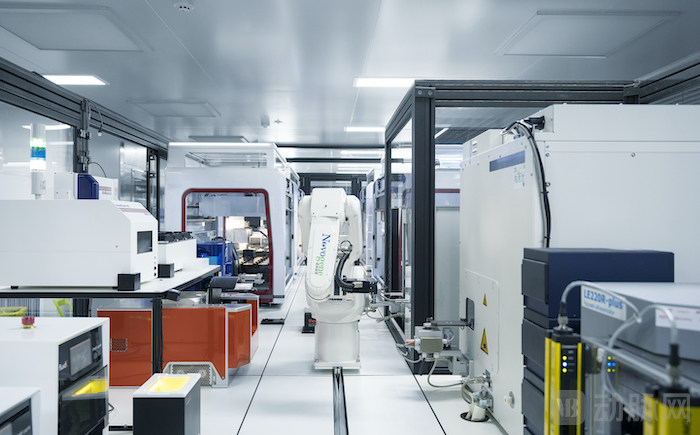
Falcon: A Flexible Intelligent Delivery System in the NGS Field
Furthermore, leveraging efficient data transmission and machine recognition, Novogene achieves precise control, real-time monitoring, and dynamic optimization of each production unit. By employing automated machine-based discrimination and analysis to minimize human intervention, it maximizes the assurance of contamination-free testing processes and data accuracy.
Li Ruiqiang remains equally resolute in building and extending intelligent capabilities. In his view, leveraging gene sequencing to explore life sciences requires support from massive amounts of data. This process not only demands that upstream technology companies achieve technological breakthroughs to further reduce sequencing costs, but also that application-layer developers like Novogene vigorously expand the scope of gene sequencing applications, enhance their capacity to process diverse sample types, and develop corresponding software algorithms to create relatively comprehensive solutions. For him and Novogene, there is still a long road ahead with many tasks to accomplish.
Looking back, Novogene did make attempts to expand into clinical services over the past decade. In 2018, amid the booming development of China’s tumor NGS industry, Novogene’s gene mutation detection kit became one of the first tumor NGS companion diagnostic kits in China to obtain Class III medical device registration certification.
This marks the first time Novogene has successfully completed a full closed loop from scientific research to product commercialization, relying entirely on internal capabilities to bring an innovative genomic technology product into deep clinical application scenarios, thereby validating the growth logic of the genomics industry ecosystem. This timely launched product not only complements Novogene’s existing expertise in library preparation, sequencing, and bioinformatics analysis, but also builds complex competencies in product registration, sales management, and medical promotion, paving a smoother path for the future clinical translation of more scientific research achievements.
Future practices in genetic technology may well validate Li Ruiqiang’s assessment. Though the road is long, sincerity of purpose ensures arrival; every new technology, from research to application and from accumulation to creation, is the result of a group’s patient and steadfast pursuit.