

Pharma-InsurTech Collaboration Drives the Rise of 'Care-Payment-Ecosystem' in China: A Case Study of ZhongAn and Boehringer Ingelheim’s Stroke Management Initiative
“Digital Marketing” by Pharmaceutical Companies: A Buzzword of the Past Two Years
On one hand, the pharmaceutical industry faces multiple policy reforms, including volume-based procurement, the two-invoice system, and stringent crackdowns on kickback-driven sales. On the other, biotech firms are compelled to increase R&D expenditures amid a “baby boom” in the sector. Under the dual pressure of rising costs and constrained revenues, pharmaceutical companies are forced to seek new revenue growth drivers by embarking on a “digital” transformation of their marketing strategies.
This transformation often begins with the digitization of internal business processes, optimizing customer acquisition channels for pharmaceutical sales representatives through methods such as digital user profiling and the establishment of patient communities. After laying a solid foundation for cost control, the wave of digitization gradually extends to the exploration of innovative payment models, seeking new sources of revenue support.
In the latter half of pharmaceutical companies’ transformation, a representative approach is to partner with insurance providers to build a closed-loop “medical-pharmaceutical-insurance” ecosystem within specific scenarios, thereby identifying precise payers among insured individuals.
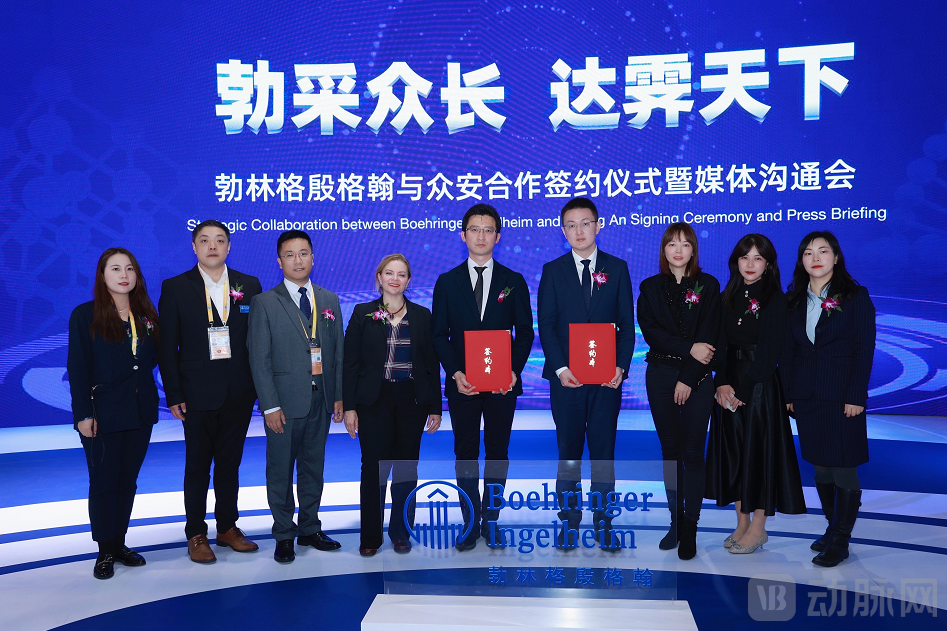
At the recently concluded Fourth China International Import Expo, multinational pharmaceutical company Boehringer Ingelheim partnered with ZhongAn Online, China’s first internet insurance company. This time, both parties will focus their attention on stroke patients.
As the leading cause of disability and death in China, stroke sees approximately 3.5 million new cases annually. Post-stroke, patients may experience sequelae affecting sensory, motor, cognitive, language, emotional, and psychological functions. Approximately 70%–80% of these patients require care due to varying degrees of disability, imposing a substantial burden on patients, families, and society.
Rehabilitation therapy is a crucial pathway for patients to return to their normal lives, and the earlier it is initiated, the better the outcomes. However, data show that only 11.5% of stroke patients in China receive rehabilitation treatment within the first week, while 42.4% do not receive any rehabilitation therapy at all after their stroke.
The cornerstone of the collaboration between Boehringer Ingelheim and ZhongAn is to provide patients with full-lifecycle stroke care services.
As the name suggests, full-lifecycle stroke care services refer to a model in which, starting from the patient’s diagnosis of stroke, both collaborating parties intervene through online and offline means in the processes of treatment, follow-up, and rehabilitation, proactively assisting patients in managing their stroke.
In terms of functional division, ZhongAn leverages its patient benefits platform, “Oak Health,” within its health ecosystem to provide patient education, enhance patients’ understanding of rehabilitation, and improve treatment adherence. Meanwhile, Boehringer Ingelheim has launched an innovative “Comprehensive Stroke Solution,” covering seven key modules: prevention, disease education, screening, emergency care, diagnosis, treatment, and rehabilitation. Specifically, Jida Rehabilitation, a subsidiary of Boehringer Ingelheim, offers free rehabilitation trials to customers of ZhongAn Insurance’s “Zunxiang Yisheng” product and users of the patient benefits platform, providing timely feedback on rehabilitation progress.
To deliver more personalized diagnosis and treatment plans, ZhongAn Insurance’s pharmaceutical business, operating within its broader health ecosystem, conducted an analysis of stroke patients under its management. For individuals at high risk of stroke, ZhongAn proactively engages them with ongoing health education to lower barriers to medication decision-making. It also provides professional and convenient services such as online medical consultations and interpretation of health checkup reports, thereby promoting standardized diagnosis, treatment, and medication adherence, and ultimately reducing the incidence of severe stroke cases.
During the collaboration between ZhongAn and Boehringer Ingelheim, the roles of both parties have evolved.
For Boehringer Ingelheim, its role is evolving from a mere manufacturer of stroke treatment medications to a provider of comprehensive stroke solutions. By integrating the entire stroke care continuum, Boehringer Ingelheim has enhanced user stickiness across multiple stages, including prevention, treatment, and rehabilitation.
For ZhongAn, emphasizing quality control in the rehabilitation process necessitates its direct involvement in the rehabilitation journey of stroke patients. By transitioning from a risk bearer to a risk controller, ZhongAn assists pharmaceutical companies in managing patient communities such as the “Atrial Fibrillation-Stroke Care Home,” ensures patient adherence to stroke medications and rehabilitation therapies, and thereby facilitates rapid patient recovery while simultaneously controlling insurance costs.
Patients are undoubtedly the biggest beneficiaries. On one hand, medical insurance products that were previously difficult to bring to market due to cost-control constraints can now enter the non-hospital-based insurance market through precise risk management, thereby working in synergy with basic medical insurance to better safeguard patients’ interests. On the other hand, the returns offered by health insurance can attract more participants into the “healthcare–pharmaceuticals–insurance” ecosystem, enabling patients to benefit from a more diverse range of health services.
Within the healthcare system, insurers and pharmaceutical companies are also exerting mutual influence.
First, through pharmaceutical-insurance collaboration, the insurance and pharmaceutical industry chains are deeply integrated and cooperate to create more health insurance products that benefit patients and individuals with pre-existing conditions, thereby expanding the reach of commercial insurance.
Second, the inclusion of advanced pharmaceuticals and medical devices in commercial insurance formularies will likely enable them to serve a broader patient population. In this process, pharmacies and hospitals will also pay greater attention to these formulary-listed medications.
Meanwhile, for health insurance itself, incorporating specialty drugs and mid-to-high-end medical devices—often excluded from basic medical insurance coverage—into the insurance framework can extend healthcare and pharmaceutical benefits to a broader population, thereby fully realizing the social value of health insurance.
In summary, the integration of insurance and pharmaceuticals will unleash tremendous potential. As an increasingly important payer within the “three-medical-linkage” framework and a strong advocate for patient communities, commercial insurance is bound to attract more pharmaceutical companies into this closed-loop ecosystem.
From the perspective of the conditions covered by ZhongAn’s existing medical insurance products, stroke is merely one among many. To provide lifecycle health management services similar to those in the stroke care domain to a broader patient population, ZhongAn needs to further expand its network of partners in the healthcare and pharmaceutical sectors by establishing collaborations with more medical and pharmaceutical enterprises.
Ma Jie, Head of ZhongAn’s Health Ecosystem Pharmaceutical Business, stated in an interview with VCBeat: “Our collaboration with Boehringer Ingelheim represents a critical step in ZhongAn’s effort to build a closed-loop ecosystem integrating healthcare, pharmaceuticals, and insurance. As the ZhongAn health ecosystem continues to expand, we will engage with more pharmaceutical companies to understand their needs and explore new opportunities for mutual benefit. Meanwhile, we aim to provide personalized medical services to more patients, assist them in managing their health, and ultimately contribute to the improvement of a multi-tiered healthcare security system.”
This system has already gained market and policy recognition and support. Under the influence of multiple factors, the health insurance market is advancing rapidly with the tide. Data shows that in 2020, health insurance premiums reached 817.3 billion yuan, with a compound annual growth rate of 28% over five years. At this growth rate, the 2025 health insurance premium target proposed by the China Banking and Insurance Regulatory Commission in conjunction with 13 ministries is within reach.
ZhongAn may capture a significant share of the RMB 2 trillion target.