

Amid the Brain-Computer Interface Hype, Why Did Zhenxin Capital Back Core Medical, Surui Robotics, and Maiwei?

Core Medical
Artificial Heart Series Product Developer

SHURUI
Surgical Robot R&D and Manufacturer

In 2025, brain-computer interface became one of the most watched tracks in the primary market financing for medical devices, with the Neuralink effect attracting significant capital. In the same year, national healthcare expenditure entered a downward cycle, and the centralized procurement policy continued to impact the commercial space of device companies. In this environment, Zenith Capital completed three major investments: a second round of nearly 300 million yuan in Core Medical, a second round of close to 500 million yuan in SHURUI surgical robot, and a new investment in Shenzhen Maiwei Technology, which specializes in nanosecond PFA and interventional focused ultrasound.
On one side is the contraction of the macro environment, and on the other side is the implementation of specific investments.MedTF Interviews Taihao Zhang, Vice President of Investment at ZhenXinGu Capital, listen to his judgment.
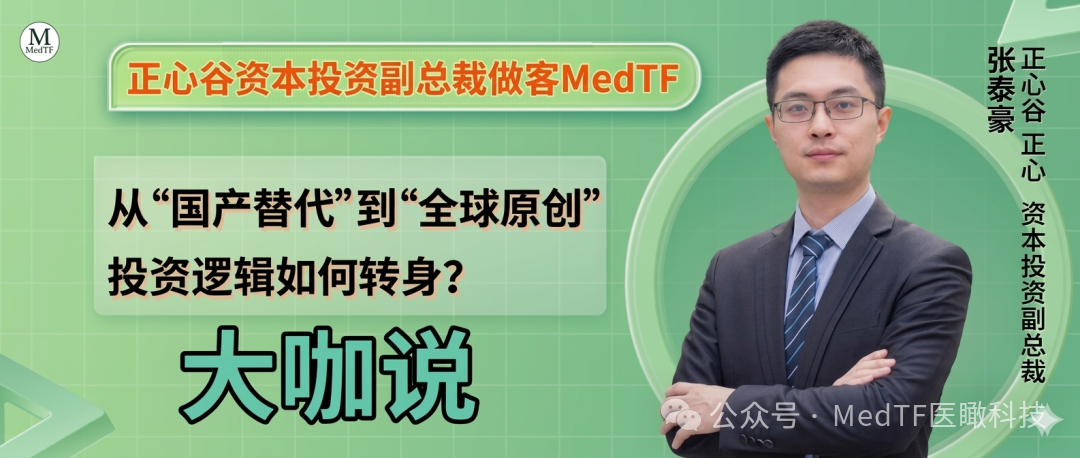
Guest Profile
Zhang Taihao · Vice President of Investment, FountainVest Partners
Focused on growth-stage investments in the medical technology sector, with a strategic emphasis on medical device companies possessing globally original technological barriers. During his time at ZhenXinGu, he invested in multiple projects including Core Medical, SHURUI Surgical Robot, and Shenzhen Maiwei Technology, covering fields such as artificial hearts, surgical robots, and next-generation pulsed field ablation (PFA). He has long-term tracking and systematic judgment of the medical device sector, with particular attention to differentiated technical routes, clinical value validation, and the establishment of patent barriers.
MedTF: In 2025, what track in the medical device field will attract the most capital attention?
Zhang Taihao: It must be brain-computer interface. There is a phenomenon in the primary market - many people pay attention to what Musk does and invests in. As his final innovative project, Neuralink has dramatically increased the attention on this track. Therefore, among the medical device tracks in 2025, brain-computer interface will have the highest financing热度.
? Although brain-computer interface financing is hot, Zhenxin Valley has not made a move yet — judging that the maturity is not enough, they do not act rashly.
But so far, Zhenxin Valley has not made a move. The reason is simple: our maturity requirements for evaluating this track are relatively high – we hope to see about a 60% success rate before making investment arrangements.
The brain-computer interface track is now a mixed bag. Many companies that are not actually brain-computer interface firms—such as those specializing in electromyography control or open-loop neuromodulation—also consider themselves as part of the brain-computer interface sector, but they do not technically qualify. We don't focus on technical jargon; instead, we care more about whether it represents the best clinical solution.
? Brain-computer interfaces should not be defined by technology, but by application — are you treating depression, epilepsy, or Parkinson's disease?
The core of everyone's attention is invasive brain-computer interfaces. From the current perspective, the challenge in this field lies not in engineering, but in the understanding of biology. The human brain is a highly complex organ that constantly reshapes itself, and there is no consensus yet on whether the existing electrode implantation solutions are the optimal choice. The stability period of current models lasts only about one to two weeks, after which the effectiveness significantly decreases. The main reasons include, but are not limited to, neural drift, micro-inflammatory scarring, and even real-time emotional fluctuations.
? Products with a stability period of only one or two weeks are display items in the laboratory and cannot be promoted as clinical products.
This track is indeed very attractive, and Integrity also pays close attention. But when to make a move and which direction to invest in are still in the discussion stage, with no clear conclusion yet.
MedTF: What investment layouts did Jolly Presence make in the medical technology track in 2025?
Zhang Taihao:Over the past year, we have focused on making strategic layouts in three directions.
The first and second rounds of leading investment have been completed.Core Medical, amounting to nearly 300 million yuan. Second, it led the investment again inSHURUI Surgical Robot, close to 500 million yuan. Third, it made its first investment in next-generation nanosecond PFA technology-basedShenzhen Maiwei Technology。
Zhengxin Valley is positioned as a growth-oriented investment institution, not a strictly defined VC. Our strategy focuses on investing in the next generation of great enterprises — unlike most institutions in China that focus on domestic alternatives or Fast Follow micro-innovations, we prefer to seek out original technologies with global potential.
? No investment in minor innovations, only in next-generation technologies — the selection criterion of Integrity Hill is something never seen globally.
Core Medical can create the world's smallest fully magnetically levitated artificial heart. The core lies in its special axial magnetic levitation technology and unique algorithms developed by its founder, Dr. Yu Shunzhou. Dr. Yu graduated from Harbin Institute of Technology and has a strong background in aerospace and electromechanical engineering.
SHURUI Surgical RobotThe investment logic is that we judge there will be a trend in the future for surgical robots to evolve from multi-port to single-port technology — single-port is more patient-friendly with less trauma. SHURUI's core technology is based on a patented nickel-titanium alloy continuum mechanism, which has formed differentiation in both clinical outcomes and application areas.
? From Multi-Port to Single-Port: The Evolution of Surgical Robot Technology Will Determine Who Leads in the Next Cycle.
Maiwei TechnologyThe differentiation is embodied in two points. First, its nanosecond pulse differs from the microsecond PFA commonly referred to in the market, representing a different technical approach. Second, its RDN solution is based on focused ultrasound, which also differs from the Recor solution currently widely understood in the industry. In terms of treatment depth and nerve damage effects, current clinical results have already demonstrated differentiation. The founder, Bo Tan, graduated from the PLA University of Science and Technology and has a military industry background.
MedTF: How do you assess the medical device capital market in 2026?
Zhang Taihao: I think the medical device track has not yet reached a clear bottom.
The judgment should be based on two points. First, the country's expenditure in the medical field is currently in a downturn. Medical device companies generally generate revenue, so they are the first to feel the pressure from the paying end. Unlike innovative drugs, which mainly face payment pressure from the National Healthcare Security Administration, medical devices have two ends: the consumables end faces pressure from healthcare security expenditures, while the equipment end faces the reality of a significant reduction in fiscal spending.
Secondly, at the policy level, the "innovation recognition" in the medical device sector is relatively stricter. Some Fast Follow drugs and modifications based on the same target are still considered innovative drugs, thus enjoying corresponding payment policies; however, in the device sector, products based on micro-innovations or Fast Follow are generally not recognized as true innovations at either the national or clinical level, offering no benefits on the payment side. This is the structural issue presenting the biggest challenge to investors in the device sector. Indiscriminate price bargaining has led to a rare historical regression in China's medical device industry, with the country losing four spots among the top 100 global medical device technology companies by 2025, further widening the industrial gap.
? The pressure on the payment side has just begun, and it is not yet at the absolute bottom — even more than innovative drugs, there is a need to embrace truly original technology.
In this situation, the medical device field can only embrace more original and even breakthrough technologies more actively than the innovative drug team. This is the investment logic driven by current realities.
MedTF: What would you like to say to the readers of MedTF?
Zhang Taihao:In two directions.
For the industry and entrepreneurs: It is still necessary to plan for the future and lay out the next generation of leading technologies, rather than simply copying overseas technologies. The importance of this cannot be overstated.
To friends in the investment community: It is necessary to change the entrenched perception of the past, namely the "logic of domestic substitution." The current logic of domestic substitution is similar to when everyone invested in generic drugs 15 years ago during the innovative drug boom — that era has passed. What we need to face now are the next-generation medical technology companies, requiring medical device technologies that can benchmark against global capital markets and possess global competitiveness.
? Medical devices have longer product life cycles, creating more opportunities for companies with single-product values exceeding tens of billions of US dollars.
We hope that China will see a group of medical technology products representing the country's technological strength entering the mainstream developed markets in Europe and America—this is the true proof to global investors and markets that China’s technical capabilities are well-founded. We also call on the Chinese government to strengthen the protection of intellectual property rights, enhance the supervision of clinical data authenticity, reinforce randomized double-blind clinical trial designs, and focus on competition based on long-term data-driven economic evaluations. Excessive numbers of approvals causing internal friction will not lead to healthy industry development.
If this article is valuable to you, give it a `, allowing more device professionals to see.`
?Click to view more exciting content
The content of this article is sourced from the MedTF "Expert Talk" column interview · The guest's opinions are personal judgments and do not constitute investment advice.