

Realheart Files for IPO: Swedish Total Artificial Heart Aims to Transform End-Stage Heart Failure Treatment

Scandinavian Real Heart
Artificial Heart Developer
He will no longer have a pulse.
The silver-haired man before us, with sparse hair, wearing glasses with thin temples and large lenses, and possessing blue eyes, was still joking and laughing with those around him. Yet, if you were to encircle his wrist with your hand, you would feel only the warmth radiating from his skin, without detecting any pulse beneath the thin layer of skin on the inner aspect of his wrist.
This is not a supernatural incident, but a real event that occurred under the sun.
This sharp-eyed, pulseless octogenarian is Dick Cheney, the 46th Vice President of the United States.
However, what we will discuss today is not this elderly man’s illustrious and eventful past, but rather the reason he has no pulse—the mechanical heart in his chest that tirelessly pumps blood day and night.
The heart is the engine of our body. This organ, roughly the size of a human fist, beats 60–100 times per minute, amounting to approximately 100,000 beats per day. Each heartbeat pumps about 70 mL of blood (less than one-fifth of a standard canned cola) throughout the body.
Such a tirelessly working organ is prone to excessive strain, leading to failure.
Heart failure is referred to as the “cancer of heart diseases.” According to Scandinavian Real Heart’s 2020 Annual Report, there are 64 million patients with congestive heart failure worldwide, and this number continues to rise steadily. It is estimated that half of all newly diagnosed patients will die within five years of diagnosis.
Organ transplantation is the optimal treatment, yet only 7,000 donor hearts are available for transplant globally each year. The stark disparity between supply and demand leaves patients with little hope but to lament their plight.
Furthermore, frequent hospitalizations for patients are not only time-consuming, labor-intensive, and costly, but also result in substantial social healthcare expenditures and other societal costs. According to the 2020 Annual Report by Realheart, the United States is projected to incur $70 billion in such costs by 2030.
Thus, artificial hearts have become the most viable option for improving heart failure.
Artificial hearts, elegant yet complex, are among the most sophisticated medical devices. Due to the significant technical challenges involved in their development, they are often referred to as “the jewel in the crown of medical devices.” It is no exaggeration to say that a country’s capability in developing artificial hearts reflects, to a certain extent, its level of advanced medical device technology.
Artificial hearts have now become one of the standardized treatments for heart failure recommended by international guidelines. They assist or replace the pumping function of the natural heart by delivering blood into the human circulatory system via a mechanical pump.
Most patients with heart failure present with left ventricular dysfunction; therefore, many can effectively bridge the waiting period for heart transplantation or achieve long-term survival with an artificial heart by receiving left ventricular assist device (LVAD) therapy alone. In some cases, cardiac function may fully recover after a period of mechanical circulatory support, allowing for the explantation of the artificial heart.
High technical barriers, cutting-edge patent inventions, substantial R&D investments, and the considerable challenges in conducting clinical trials have not only served as a moat for existing players but also represent pressing industry hurdles to overcome. Coupled with ethical and moral challenges, these factors have kept the development of the artificial heart industry cautious.
Currently, artificial heart products are primarily concentrated in industrialized nations and regions such as North America, Australia, Europe, and Japan. Most products remain in the research and development or clinical trial stages, with only a few offerings from leading companies having been launched in markets across Europe and the United States.
A global overview of the artificial heart market reveals that it is primarily dominated by two giants: Medtronic and Abbott. However, on June 3 this year, Medtronic announced the global discontinuation of sales for its HeartWare Ventricular Assist Device (HVAD). Medtronic’s withdrawal from the market signifies the loss of years of dedicated effort, effectively ceding the artificial heart market to Abbott.
Although Abbott appears to hold a dominant position, the only artificial heart device currently approved by the FDA is SynCardia’s TAH-t. The seemingly entrenched market landscape is not the final outcome; global competition in the artificial heart market has only just begun.
Due to the previous article“Medtronic’s $1.1 Billion Acquisition Flops, Yet Domestic Capital Remains Heavily Invested: Where Is the Path for Artificial Hearts?”As detailed introductions have already been provided, they will not be reiterated here.
In short, the eagerness of foreign companies, the narrowing technological gap between China and the United States, and the determination of domestic enterprises to catch up and surpass their competitors inspire boundless imagination for the future of artificial hearts.
Sweden’s innovative prowess has not only brought the world advanced medical technologies such as heart-lung machines, cardiac pacemakers, and dialysis machines, but also another Swedish patent—Real Heart, a total artificial heart that helps patients with heart failure survive.
Scandinavian Real Heart is a Swedish medical technology company listed on the Swedish Spotlight Stock Market in 2014.
In 1999, Dr. Azad Najar began drafting sketches for a fully biomimetic artificial heart, laying the foundation for the company. In 2007, Azad co-founded Scandinavian Real Heart with two partners.
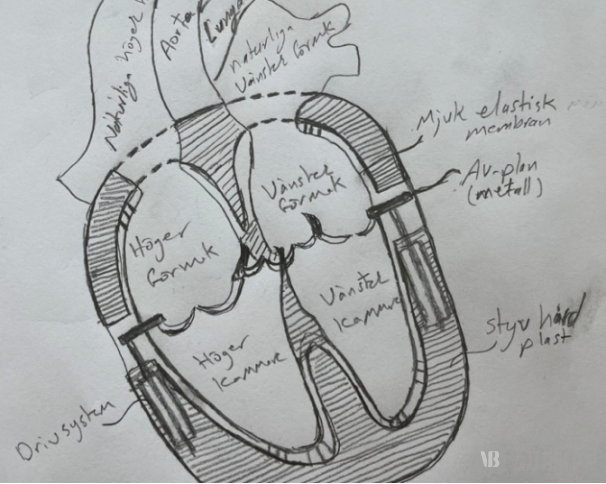
Manuscript by Dr. Azad Najar, image source: Realheart 2020 Annual Report
Scandinavian Real Heart has only one goal: to provide a long-term alternative to the natural heart. Therefore, it is developing an artificial heart that mimics the function of the natural heart, known as the total artificial heart (TAH)—the Realheart TAH.
(I) Product Introduction
According to the official Realheart website, the Realheart TAH is the first total artificial heart (TAH) designed to completely replace a diseased natural heart, offering the potential for a long-term solution for patients diagnosed with end-stage heart failure.
This device mimics the function and form of a natural heart, enabling blood circulation through the atria and ventricles via its unique atrioventricular design.
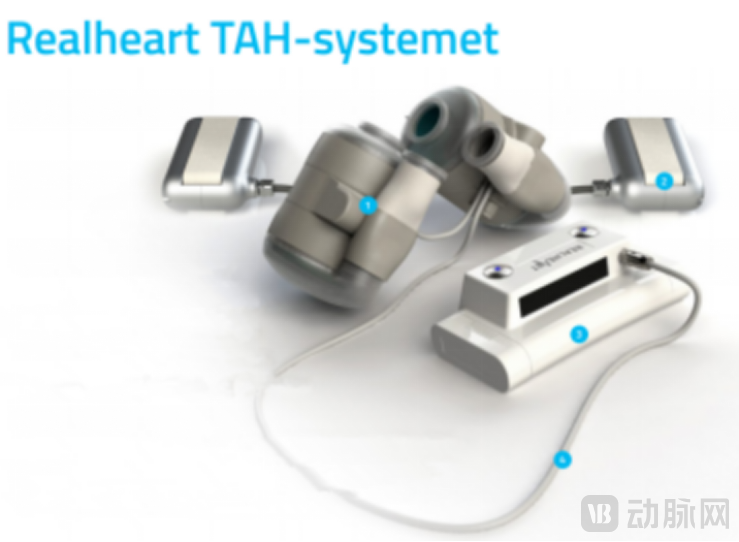
Image source: Realheart 2020 Annual Report
The product consists of four components: two identical heart pumps, an intelligent control unit, two batteries, and a drivetrain. The implantable components are made from biocompatible materials to ensure optimal compatibility with the body.
1. Customizable Pump
Each of the two pumps consists of one atrium, one chamber, and two mechanical valves. They pump blood in exactly the same manner as the human heart. The design aims to reduce complications associated with artificial hearts, such as stroke, hemorrhage, and anemia.
Since the Realheart system consists of two independent pumps, it can be customized according to the size and appearance of the patient’s chest. The pumps are equipped with pressure sensors that transmit information about the patient’s activity level to the intelligent control unit.
2. Battery
The system comprises two batteries mounted on the same belt as the control unit, providing a maximum battery life of up to 12 hours. Additionally, the control unit is equipped with an emergency backup battery to prevent fatal outcomes in the event that a patient accidentally disconnects both battery cables simultaneously.
3. Intelligent Control Unit
The intelligent control unit serves as the brain of the system, independently regulating blood flow from both pumps to maintain proper balance between systemic and pulmonary circulation. The intelligent control system receives data from pressure sensors and adjusts the volume of blood pumped according to the patient’s activity level.
The intelligent control unit is mounted on the belt together with two batteries, and can also be carried in a bag. The total weight of the intelligent control unit and the battery belt is 2.5 kg.
4. Drive System
The drive system that connects the pump to the smart control unit is made of soft, flexible materials to provide a comfortable wearing experience for the user. Realheart’s drive system minimizes the risk of infection, a common complication associated with cardiac pump therapy.
In addition to the Realheart TAH,Realheart also offers products such as sternal prostheses, PulsePump (pulsatile flow for cardiopulmonary bypass machines), and RealVAD (pulsatile left ventricular assist device).。
(II) Design Principles
The Realheart TAH simulates the working state of a natural human heart, allowing atrial pressure to automatically adjust blood flow and maintaining left-right balance as seen in a natural heart by pumping different stroke volumes from the right and left ventricles. This design aims to minimize the risks of stroke, bleeding, and anemia, which are the most common complications associated with artificial hearts.
Furthermore, the Realheart TAH mimics natural blood flow to minimize blood damage and blood-related side effects commonly associated with existing artificial hearts. To this end, the design has undergone rigorous testing using multiple methods, including computer simulations, benchtop testing, and animal studies.
Realheart TAH Features:
• Provides physiological blood flow, pressure, and oxygenation
• Simulates natural blood flow using two atria and two ventricles
• Automatically adjusts blood flow based on atrial pressure
• It can pump different volumes of blood from the left and right ventricles to maintain bilateral balance, just as in a natural heart.
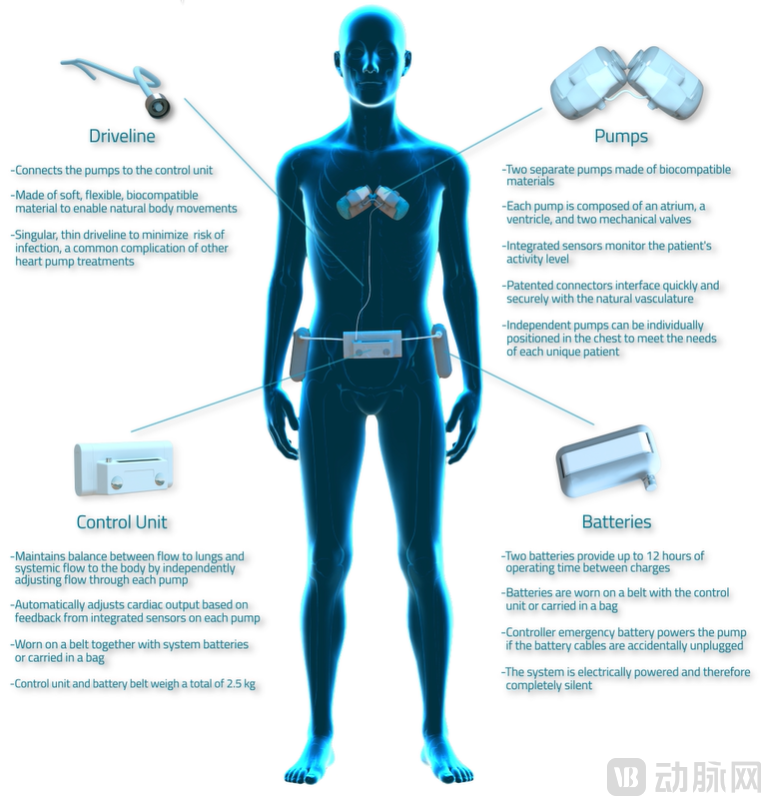
Product Illustrations Displayed on the Official Realheart Website
The system design of the Realheart TAH incorporates medical procedural considerations to make surgical implantation as simple as possible. The artificial heart is sold together with other necessary equipment, including the controller, battery belt, batteries, charger, and cables.
Meanwhile, Realheart will also provide hospital nursing staff with equipment, equipment services, healthcare professional training, and 24/7 support.
Over the years, Realheart has continuously refined and tested its technology, achieving significant progress in product development. Currently, blood circulation, pump function, pressure, and pulse generation have been validated in ethically approved animal studies.
It is worth noting that infection and hematologic adverse effects are two persistent challenges associated with the clinical application of artificial hearts. During treatment involving artificial heart implantation, infections may occur at the percutaneous exit site of the driveline.
Realheart minimizes the potential risk of infection by employing a slim drive system made from biocompatible materials.
Regarding blood-related side effects, two characteristics of existing continuous-flow pumps—high shear stress and non-pulsatile flow—are considered risk factors for many hematologic complications. High shear stress can also damage blood cells themselves, leading to further complications. The Realheart TAH states that its current design is capable of reducing shear stress to some extent.
(3) Patent Protection
Realheart is highly diligent in safeguarding its patents. It holds patents in the United States, the United Kingdom, Sweden, Germany, China, India, Australia, and other countries to protect the latest version of the Realheart TAH.
In addition to the aforementioned patent protections, Realheart has also filed patent applications for future products: Realheart VAD, Realheart PulsePump, and Realheart Sternalprotes.
As the world's most populous country, China is witnessing a continuous rise in the number of patients with end-stage heart disease, driven by population aging and growth.
According to the “Report on Cardiovascular Health and Diseases in China 2019,” the prevalence of cardiovascular disease in China continues to rise, with an estimated 8.9 million patients suffering from heart failure in 2019.
However, the research and development (R&D) of artificial heart technology in China remains in its early stages, lagging significantly behind that of Europe, the United States, and Japan. In the face of a large population of patients with heart disease and the favorable policy environment for domestic substitution, the R&D of artificial hearts is gaining momentum, with broad prospects for the future.
Whether for short-term adjunctive therapy to restore cardiac function, bridging therapy prior to heart transplantation, or long-term cardiac replacement with an artificial heart, each niche segment demands “a width of one centimeter and a depth of ten thousand meters.”
On the other hand, domestic artificial hearts also face significant challenges.
The rapid development and substantial commercialization of artificial hearts in the United States are driven not only by a robust reimbursement system but also by effective market education. In contrast, while cancer patients in China may spend hundreds of thousands of yuan to extend their lives, heart failure patients are less likely to do so. Furthermore, with no institutions investing in market education, individual companies cannot bear the high costs of promotion on their own.
VCBeat has provided a brief overview of “China Heart,”If you are also deeply engaged in the field of artificial hearts but have not been covered by VCBeat, or if you need capital support, you are welcome to add the author’s WeChat at the end of the article to inject “heart” energy into the world.
Yongrenxin,Established in June 2014 as a joint venture between Chongqing Lilong Technology Industry (Group) Co., Ltd. and Japan’s HI-LEX Corporation, the company specializes in manufacturing world-class advanced medical devices. It is primarily engaged in the research and development, production, and sales of products such as implantable left ventricular assist systems, artificial blood vessels, and artificial catheters. It is currently the only enterprise in China approved for market launch to develop and manufacture implantable left ventricular assist systems.(Recommended reading: “[Exclusive] Vivo Capital Completes Initial Multi-Million Dollar Controlling Acquisition and Strategic Restructuring of Eternal Heart Artificial Heart”)
Tongxin Medical,Founded in 2008 by a team of overseas technology experts who returned to China, the company is headquartered in Suzhou, China, with its wholly-owned subsidiary, CH Biomedical USA, Inc., located in Los Angeles, United States. CH Biomedical focuses on the research and development of internationally leading ventricular assist devices (artificial hearts), promoting the global commercialization and sales of artificial hearts to benefit a vast number of patients with end-stage heart failure. In terms of financing, CH Biomedical has recently completed a Series D funding round amounting to hundreds of millions of RMB. This round was led by Sequoia China, with participation from ClearPool Capital, Lingdao Capital, and Suzhou Longmen Venture Capital, among others. Existing shareholders, including Baiyang Pharmaceutical Group and Houxin Health Investment, continued to support the company.(Recommended reading: “[Exclusive] Tongxin Medical Completes D-round Financing Worth Hundreds of Millions of RMB, Led by Sequoia China”)
Core Medical,Established in 2016, the company is a high-tech enterprise dedicated to the research and development of active implantable medical devices. It aims to develop, manufacture, and promote next-generation high-end active implantable medical devices to improve human health and well-being. In terms of financing, Core Medical secured nearly RMB 100 million in Series A funding in October 2020, led by Lianxin Capital, with participation from Puhua Capital and Yifeng Capital.(Recommended reading: “[Exclusive] Core Medical Secures Nearly RMB 100 Million in Investment, Shenzhen’s “Chinese Heart” Technology Achieves Another Breakthrough”)
Xinqing Medical,Founded in May 2017, MedHeart Medical started its journey in the field of heart failure and is committed to building a multi-organ failure life support platform. In terms of financing, MedHeart Medical completed its Series C funding round of nearly RMB 500 million this October, led by Sequoia China, with participation from CDH VGC (“CDH Innovation and Growth Fund”) and Qianji Capital. Previous institutional shareholders include Guoqian Venture Capital, Northern Light Venture Capital, Mifang Capital, Taiyu Investment, Huatai Health Care Fund, and Suzhou New District Venture Capital, among others.(Recommended reading: “[Exclusive] Heart Failure Sector: XinQing Medical Closes Nearly RMB 500 Million in Series C Financing, with Sequoia, CDH, and Qianqi Jointly Betting on a Multi-Organ Critical Care Life Support Platform”)
Aerospace Taixin,Established in 2016 and affiliated with China Aerospace Science and Technology Corporation, Aerospace Taixin has developed the HeartCon magnetically and hydraulically levitated artificial heart, leveraging over five decades of expertise in aerospace servo technology. In 2018, it entered the innovative medical device approval pathway.
At this stage, the biggest problem faced by patients with artificial heart implants, apart from potential complications, is the issue of charging the device in daily life. To charge it, patients need to have a “charging cable” extending from their body to connect to external equipment that provides power to the mechanical heart.
We boldly envision that future artificial hearts will be more compact, safer, easier to charge, and cause no surgical trauma to the human body...
Or could it function like wireless fast charging, where patients simply lie on a “charging bed” to receive inductive charging while resting...
Although artificial hearts are crafted from cold metal, emitting a stark, mechanical chill, they represent the pinnacle of life sciences that humanity can ascend to, embodying our most advanced wisdom and crystallizing our profound love and aspiration for life.
Bathed in fervent passion, the artificial heart will imbue us with the courage to confront death and a profound reverence for life.
It will continue to pump, warm and steady. The metallic flower blooming in the heart is technology’s silent hymn to life.
References:
1. Scandinavian Real Heart Official Website
2. cision<Realheart prepares listing on Nasdaq First North Growth Market break>
3. ROSEMARY BLACK<Former vice president Dick Cheney now has no pulse; Heart pump like artificial heart>
4. VCBeat, “Tongxin Medical: How Far Does Artificial Heart Technology Still Need to Go to Replace Heart Transplantation?”
5. Siyu Medical Devices “Roundup | Five Leading Overseas Artificial Heart Companies”
6. Yang Xue, “Medtronic’s $1.1 Billion Acquisition Fiasco: Domestic Capital Still Heavily Bets on Artificial Hearts—Where Is the Path Forward?”