

Alibaba Health Discloses Key Progress in Financial Report: A New Breakthrough in Internet Healthcare

AliHealth
Medical and Health Services Network Service Provider
On November 24, AliHealth (00241.HK) released its interim results announcement for the 2022 fiscal year. The data showed that in the six months ended September 30, 2021, AliHealth generated revenue of RMB 9.4 billion, a year-on-year increase of 30.7%; gross profit reached RMB 1.9 billion, with all business segments continuing to maintain steady growth.
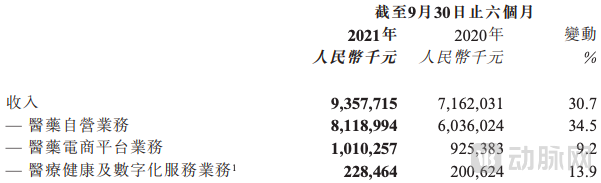
AliHealth Revenue Structure
During the reporting period, AliHealth’s self-operated pharmaceutical business generated revenue of RMB 8.1 billion, representing a year-on-year increase of 34.5%. Notably, drug sales from self-operated pharmacies operated under the “AliHealth” brand accounted for 64% of this revenue, while prescription drug business revenue surged by 127.3%. Leveraging refined operations in the prescription drug sector, the number of chronic disease users reached 5 million, a year-on-year increase of 170%, with continuous improvements in average medication duration and user repurchase rates. As of September 30, 2021, the annual active consumers of its online self-operated stores reached 90 million.
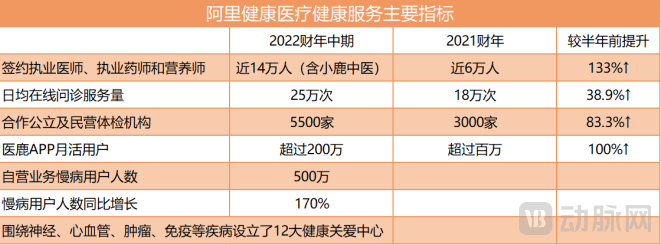
Notably, AliHealth has disclosed data related to chronic disease patients for the first time.。The “Chronic Disease Welfare Program” under AliHealth’s direct-sales business provides users with a suite of services, including discounted high-quality medications, dedicated physicians, medication follow-ups, and patient education. The number of chronic disease patients served has reached 5 million, representing a year-on-year increase of 170%. Furthermore, through platforms such as Tmall Medical Health, the Yilu App, and Xiaolu Traditional Chinese Medicine, AliHealth continues to deliver diverse services to a broader population of chronic disease patients.
While consolidating its reach in both B2B and B2C businesses, AliHealth has continued to increase its investment in digital healthcare. During the reporting period, AliHealth successively entered into partnerships with a number of companies, including ZhongAn Insurance, Huirui Gene, Roche, Haisco Pharmaceutical, and AstraZeneca, further enhancing its closed-loop capabilities in “healthcare + pharmaceuticals + insurance.”
Behind this strategic layout, we can see AliHealth making significant strides in both the e-commerce ecosystem and healthcare services. A deeper examination of its logic—partnering with Xiaolu TCM, making strategic investments in LinkDoc, collaborating with ZhongAn Insurance, and engaging with top 100 pharmaceutical companies—reveals that an “Internet + Chronic Disease Management” business line has been quietly established.
AliHealth’s connection with “Internet+ Chronic Disease Management” can be traced back to 2014, the year the company was established. In the first two or three years, AliHealth sought to combine Alibaba Group’s e-commerce sales strengths with the traditional pharmaceutical sector, creating a new experience for online medication purchases.
At that time, the chronic disease management market in China had already become sufficiently attractive. On one hand, the country boasted the world’s largest population of chronic disease patients, with annual spending on chronic disease management exceeding RMB 1 trillion. On the other hand, the “Healthy China 2030” Planning Outline called for a continuous reduction in premature mortality from major chronic diseases and strengthened screening and early detection of such conditions. As the concept of “Internet + Chronic Disease Management” began to gain traction, many companies started to strategically position themselves in this sector.
The reality is that chronic diseases affect a large population, involve prolonged disease courses and complex etiologies, incur high cumulative treatment costs, and require frequent patient-provider communication. The conventional offline healthcare system struggles to accommodate the massive demand for disease management, making the internet an efficient solution for chronic disease management.
The key to breaking the deadlock emerged in 2020. The sudden outbreak of the pandemic drove a massive shift of medical services online. As healthcare-seeking habits evolved and information exchange improved, physicians were able to leverage the internet to obtain more comprehensive patient data and manage disease progression. Meanwhile, patients increasingly turned to online platforms for consultations, diagnoses, follow-up visits, and medication purchases.
This shift signifies that “Internet + Chronic Disease Management” is no longer characterized by a “light online, heavy offline” approach, but rather by a deep integration of online and offline services. The online component serves as a tool for patient education, adherence monitoring, and communication between healthcare providers and patients, thereby facilitating the implementation of offline chronic disease management protocols.
In the new environment, the pain points of “Internet + Chronic Disease Management” have begun to shift. Factors such as uneven distribution of medical resources across different scenarios, poor accessibility to high-quality pharmaceutical and healthcare services, and inefficient flow of medical information have become major obstacles, urgently necessitating improved accessibility of chronic disease management services.
Faced with the current state of internet-based chronic disease management, AliHealth is clearly well-prepared. Looking back at its strategic moves over the past two years, it appears to be seeking answers to every challenge confronting the “Internet + Chronic Disease Management” model.
The imbalance of medical resources across different scenarios is a key factor constraining the development of “Internet + Chronic Disease Management.” Patients in first- and second-tier cities have relatively easy access to tertiary hospitals, whereas rural patients in fourth- and fifth-tier cities may need to spend considerable time and effort just to reach secondary-level county hospitals.
The challenge lies in the fact that chronic disease management is a long-term, meticulously governed endeavor requiring sustained patient follow-up and education. While patients in remote cities can travel to major metropolitan areas for diagnosis at tertiary hospitals, it is often impractical for them to repeatedly cross city boundaries for follow-up visits. In such scenarios, the value of internet-enabled out-of-hospital chronic disease management becomes evident.
The “Internet Physician Insights Report” released by the AliHealth Research Institute in 2021 shows that 52% of the patients seeking consultations from doctors at Grade A tertiary hospitals in first- and second-tier cities on the Yilu platform come from regions below the fourth tier. In other words, the Yilu platform can, to a certain extent, address the imbalance in medical resources for chronic disease management.
In this process, the AliHealth platform serves as a bridge connecting doctors and patients while enhancing the efficiency of medical resource allocation: physicians from tertiary hospitals in first- and second-tier cities conduct “cloud consultations” and provide follow-up care services through internet hospitals, enabling patients with chronic diseases in remote areas to manage their conditions without leaving home—thus resolving the “last mile” challenge in chronic disease management. The internet connects doctors and patients, transcending temporal and spatial barriers, facilitating the flow of high-quality medical resources, continuously expanding physicians’ service reach, and allowing an increasing number of patients in grassroots regions to access advanced medical care via online platforms.
In practice, both physicians and patients have increasingly embraced this model. Data show that the total number of licensed physicians, licensed pharmacists, and dietitians contracted with AliHealth to provide online health consultation services has reached nearly 140,000, an increase of over 80,000 from the end of the previous fiscal year; the average daily volume of online consultations has exceeded 250,000.
During the reporting period, AliHealth established 12 Health Care Centers focused on neurological, cardiovascular, oncological, and immunological diseases, providing affordable and high-quality services. The number of users with chronic diseases increased by 170% year-on-year, enabling patients to access a range of chronic disease management services, including discounted high-quality medications, medication follow-ups, patient education, and dedicated physicians.
AliHealth stated that the company will continue to increase its investment in primary healthcare services, providing users with comprehensive, one-stop solutions for health-related issues. Building on the upgrade of its medical and health service platform, AliHealth aims to develop more innovative business models.
In the landscape of chronic disease management, Traditional Chinese Medicine (TCM) holds a significant position. AliHealth is also continuously strengthening its efforts in the TCM sector.
Compared with Western medicine, Traditional Chinese Medicine (TCM) often involves a longer diagnostic and treatment process, fostering closer doctor-patient relationships. Furthermore, TCM’s emphasis on “preventive treatment of disease” yields more pronounced advantages in preventive healthcare and the management of chronic conditions, resulting in higher frequency of clinical visits.
The imbalance in medical resources also exists within the traditional Chinese medicine (TCM) system. High-quality TCM resources are concentrated in top-tier tertiary hospitals in first-tier cities, making renowned TCM practitioners a “scarce resource.” For patients who seek consultations with multiple esteemed specialists, the pain points are particularly pronounced: the course of treatment is prolonged, requiring repeated follow-up visits and prescription adjustments, while patients in remote areas face additional challenges such as inconvenient transportation. The internet can unlock greater value for TCM and deliver an improved healthcare experience for patients.
In August 2021, AliHealth announced its integration with Xiaolu TCM, expanding its strategic footprint into the internet-based traditional Chinese medicine (TCM) sector, with the aim of facilitating the flow of high-quality TCM and Western medical resources to grassroots levels.
Xiaolu TCM is a full-process traditional Chinese medicine (TCM) diagnosis and treatment service platform that integrates physician and patient management, remote consultations, and home delivery of medications. It has onboarded over 66,000 physicians and served nearly 8 million patients.
By injecting these resources into AliHealth, the integration of the Yilu App and Xiaolu Chinese Medicine—forming a “Dual Lu” synergy—enables the company to take the lead in delivering internet-based healthcare services that combine traditional Chinese medicine (TCM) and Western medicine, and even create more innovative business models. Statistical data show that over half of the patients seeking physician services on AliHealth’s Xiaolu Chinese Medicine platform are from tier-three cities and below.
Currently, the platform’s capabilities continue to expand. In addition to enabling TCM practitioners in major cities to provide online follow-up consultations, the Xiaolu Platform leverages its smart pharmacy system to deliver decocted traditional Chinese medicine directly to patients’ homes, ensuring that residents in remote areas can access high-quality TCM services comparable to those available in major cities.
Innovation in healthcare service models is not the only driver behind “Internet+ Chronic Disease Management.” In fact, AliHealth has previously made substantial investments in digital technologies to empower chronic disease management through smart healthcare.
In November 2020, with technical support from AliHealth and Xinniu Medical, Tiantai County People's Hospital launched China’s first county-level “Cloud-based Medical Consortium.” Previously, primary care physicians encountering complex cases beyond their capacity had to temporarily set them aside, waiting until they could travel to the county seat to consult with senior specialists. Now, by simply accessing the “Mobile Consultation Room,” they can initiate remote consultations with experts at the county hospital.
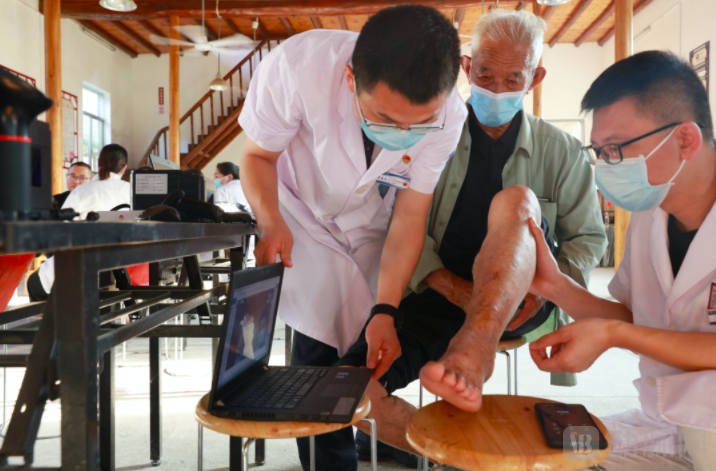
Via the “Cloud-Based Medical Consortium,” primary care physicians are connecting with specialists from tertiary hospitals to conduct a remote video consultation for a patient with varicose veins.
Taking hypertension as an example, physicians tailor chronic disease management plans for patients and assign health-related tasks, such as medication reminders. These tasks include regularly uploading blood pressure measurements and reading popular science education articles. Patients can earn Health Coins by completing these tasks, which can be redeemed for rewards such as medical supplies and daily necessities.
For chronic disease management, the significance of the “Cloud-Based Medical Consortium” lies in the integration and reallocation of limited medical resources. Since its launch nearly a year ago, Tiantai’s “Cloud-Based Medical Consortium” has covered 120 medical institutions across the county, increased the county-level consultation rate by 5.3%, significantly expanded the coverage of family doctor contracts, and improved the control compliance rate for chronic diseases such as hypertension and diabetes by 20.2%.
Co-building a full disease-cycle service platform for cancer patients in China with Zero Kr Technology represents another facet of AliHealth’s strategic layout in “Internet + Chronic Disease Management.” For special chronic conditions such as cancer, both parties will actively explore innovative online service models for oncology-specific pharmaceuticals and establish an integrated online-offline oncology care ecosystem, thereby providing cancer patients with high-quality medical and health services that cover the entire disease continuum, from clinical care to medication.
By leveraging technological innovation to enhance disease treatment and service standards, AliHealth completed a series of ecosystem partnerships in the first half of the fiscal year, including collaborations with LinkDoc, Lading Medical, Genetron Health, and InnoCare Pharma. Among these, AliHealth’s medical technology ecosystem now covers the three major tumor detection modalities: imaging diagnostics, pathological testing, and genetic testing.
From this perspective, by offering full-cycle disease management services spanning screening, testing, and post-diagnosis care, AliHealth is poised to deliver more precise, convenient, and comprehensive services to cancer patients, thereby creating greater user value.
According to the latest financial report, the pharmaceutical e-commerce business remains the core of AliHealth’s ecosystem and a key pillar in its “Internet + Chronic Disease Management” strategy.
Reviewing AliHealth’s 2021 strategic layout, the e-commerce business segment had two key focuses. The first was to secure the primary entry point into the out-of-hospital market for new drugs and expand medication options; the second was to leverage its pharmaceutical care service advantages to provide comprehensive disease journey management for patients.
In October 2021, AliHealth launched the “New Drug First-Release Support Program.” Over the past two years, numerous new drugs from well-known pharmaceutical companies have chosen to make their debut on AliHealth Pharmacy, including Roche’s innovative anti-influenza drug baloxavir marboxil tablets; AstraZeneca’s lung cancer treatments gefitinib and osimertinib; Baiyang Pharmaceutical’s new formulation of metformin nidate; Takeda Pharmaceutical’s novel-mechanism acid suppressant vonoprazan fumarate tablets; and GSK’s fluticasone furoate/umeclidinium/vilanterol inhalation powder for the maintenance treatment of chronic obstructive pulmonary disease (COPD).
Under the new plan, while addressing patients’ challenges in accessing novel and specialty drugs—such as unavailability, difficulty in purchase, and improper usage—AliHealth will upgrade its previous one-off collaborations with top 100 pharmaceutical companies into structured projects. This initiative provides end-to-end support to pharmaceutical partners, covering the entire process from “submission and listing” to “delivery to patients,” thereby ensuring timely patient access to high-quality medications and enabling new drugs to reach those in need more efficiently.
Meanwhile, collaboration with ecosystem partners such as ZhongAn Insurance has enabled AliHealth to close the loop across its “medical care + pharmaceuticals + insurance” ecosystem. As an initial initiative targeting hepatitis B, AliHealth partnered with multiple stakeholders to launch a million-yuan medical coverage service. This one-stop solution addresses comprehensive health management needs for patients, including diagnostic tests, early screening, multidisciplinary consultations, medication procurement, and insurance coverage, thereby ensuring that hepatitis B patients and their families truly benefit from easier access to medications, cost-effective treatment, and robust financial protection.
With the involvement of pharmaceutical companies and insurance institutions, solutions have been found for both the lack of service providers in chronic disease management and the generally insufficient Duration of Therapy (DoT) for drugs in China. On the AliHealth platform, there are also modules supporting medication safety, long-term medication services (providing guidance and patient education for chronic disease patients during long-term treatment), and 24/7 pharmacist services. Under this new model, “Internet + Chronic Disease Management” has ultimately overcome the challenges of lacking service channels and poor patient adherence.
Reviewing AliHealth’s comprehensive ecosystem for chronic disease management, AliHealth has successively established direct connections with physicians, patients, pharmaceutical companies, medical device manufacturers, insurers, and health technology enterprises. In the process of building this “Internet + Chronic Disease Management” service system, AliHealth serves as an ecosystem builder, connector, and participant.
The advantage of such a strategic layout lies in AliHealth’s ability to address the challenges previously faced by “Internet + Chronic Disease Management,” by identifying service providers, channel partners, and service platforms, thereby enabling the “Internet + Chronic Disease Management” model to become operational. However, new questions have emerged: Can every link in the ecosystem fulfill its intended role? And can the service model for chronic disease management achieve innovation?
In this vast market, key competitive factors include platform operational capabilities, the breadth of partnerships with pharmaceutical companies and drug offerings, and the comprehensiveness of integrated “medical care, pharmaceuticals, and insurance” services. AliHealth has clearly entered the arena well-prepared; its financial reports reveal significant enhancements in digital technology capabilities, supply chain and service capacities, and the ability to extend medical resources to grassroots levels.
From the pharmaceutical e-commerce of the 1.0 era, to internet healthcare in the 2.0 era, and now to digital healthcare in the 3.0 era, AliHealth has correctly capitalized on every major trend. As it faces another transformation, can AliHealth, with its comprehensive ecosystem for chronic disease management, once again seize the first-mover advantage?